
When it comes to B2B customer support, choosing the right platform can make or break your operations. Many businesses use IT Service Management (ITSM) tools like ServiceNow for customer support, but these platforms are primarily built for internal IT processes – not external client relationships. Supportbench, on the other hand, is designed specifically for B2B support, offering tools that prioritize customer relationships, long-term case tracking, and multi-stakeholder collaboration.
Key Takeaways:
- ServiceNow: Ideal for internal IT operations with features like incident management, change control, and asset tracking. However, it can be costly, complex, and slow to implement for customer support teams.
- Supportbench: Tailored for B2B customer support with features like AI-driven case summaries, dynamic SLAs, and a Customer 360 view. It’s easier to set up, more affordable, and focuses on customer relationships.
Quick Comparison:
| Feature | Supportbench | ServiceNow |
|---|---|---|
| Primary Use | B2B Customer Support | Internal IT Management |
| AI Tools | Built-in (case summaries, sentiment) | Requires third-party plugins |
| Setup Time | Days to weeks | Weeks to months |
| Pricing | $32/agent/month (all features) | $100+/user/month (scales with add-ons) |
| Flexibility | Customer-centric workflows | ITIL-compliant, rigid processes |
If your team focuses on managing customer relationships, tracking contracts, and handling long-term cases, Supportbench offers a more practical and cost-effective solution. For internal IT operations, ServiceNow remains a strong choice. Ultimately, the decision depends on whether your needs align more with IT management or customer support.
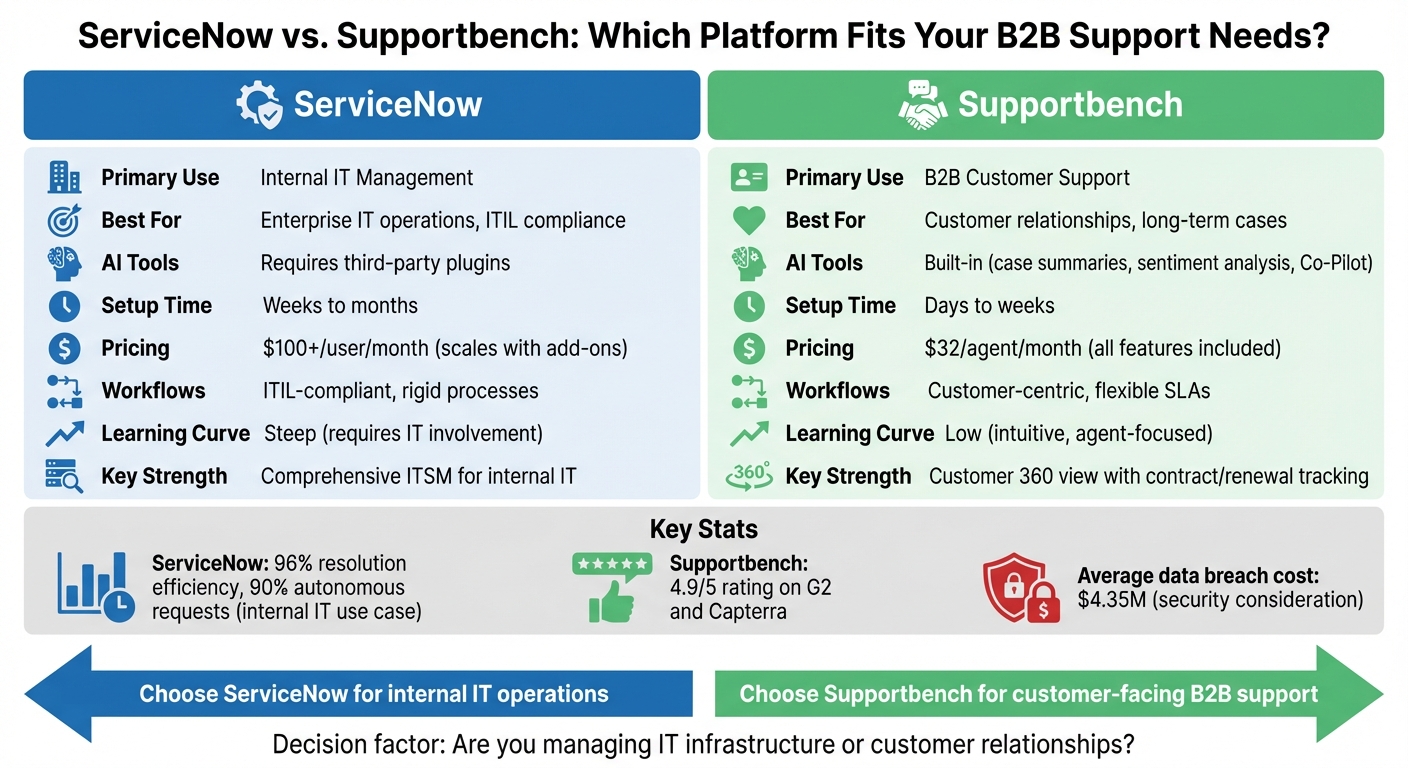
ServiceNow vs Supportbench Feature Comparison for B2B Support
What ServiceNow Does for ITSM
ServiceNow is designed to streamline tasks like employee requests and infrastructure changes, all while adhering to ITIL (Information Technology Infrastructure Library) workflows. Its main user base includes IT professionals, DevOps teams, and enterprise service desks, rather than customer-facing support teams.
At its core, ServiceNow acts as a centralized hub for internal IT workflows, managing everything from service interruptions to system updates. This centralized structure is the backbone of its ITSM capabilities, which are detailed below.
ServiceNow’s Core Features
The platform’s features are deeply rooted in ITSM principles. Incident management focuses on tracking and resolving service disruptions, helping to minimize downtime and keep employees productive. Change management ensures updates and deployments follow standardized procedures to reduce risks. Problem management works to identify and address the root causes of recurring issues, aiming to prevent future incidents and reduce the ticket load.
ServiceNow also offers IT Operations Management (ITOM), which enhances visibility into IT infrastructure, prevents outages, and supports proactive digital operations. A Configuration Management Database (CMDB) is included to monitor IT assets and configurations throughout their lifecycle. Recently, ServiceNow introduced AI Agents and Now Assist, which integrate GenAI to provide 24/7 self-service options and autonomous triage capabilities.
In February 2026, ServiceNow highlighted its internal "Now on Now" initiative. This AI-powered system supported over 33,000 employees and contractors, managing 950+ business applications across 34,000 devices. The results were impressive: 96% resolution efficiency, 90% of requests handled autonomously, and 85% of IT agents redeployed to higher-level roles like L2/L3 support.
While these features excel in internal IT management, they sometimes fall short in customer-facing scenarios.
ServiceNow’s Strengths and Weaknesses for Customer Support
ServiceNow shines in enterprise IT automation, offering robust workflows that comply with ITIL standards – essential for regulated industries. However, these same strengths can become limitations when applied to customer support.
For one, the platform’s complex configuration often requires dedicated IT or DevOps teams for setup and ongoing maintenance. This complexity can slow down customer support teams that need to act quickly and flexibly, rather than follow rigid IT processes.
The pricing model also presents challenges. ServiceNow uses an enterprise pricing structure that scales with user growth, often requiring direct negotiations with sales. For fast-growing B2B support teams, this can result in rising costs without the flexibility needed to adapt to customer-focused operations. Furthermore, the platform’s design, while excellent for compliance and internal IT, can feel restrictive for businesses that require highly customized or agile customer support solutions.
Perhaps the most significant limitation is ServiceNow’s internal IT focus. It lacks built-in tools for managing customer relationships, multi-stakeholder coordination, and long-term case tracking – all critical for B2B support teams. As a result, while ServiceNow excels in internal IT processes, it struggles to meet the demands of customer relationship management or handle complex, multi-party support scenarios effectively.
sbb-itb-e60d259
What Supportbench Does for B2B Customer Support
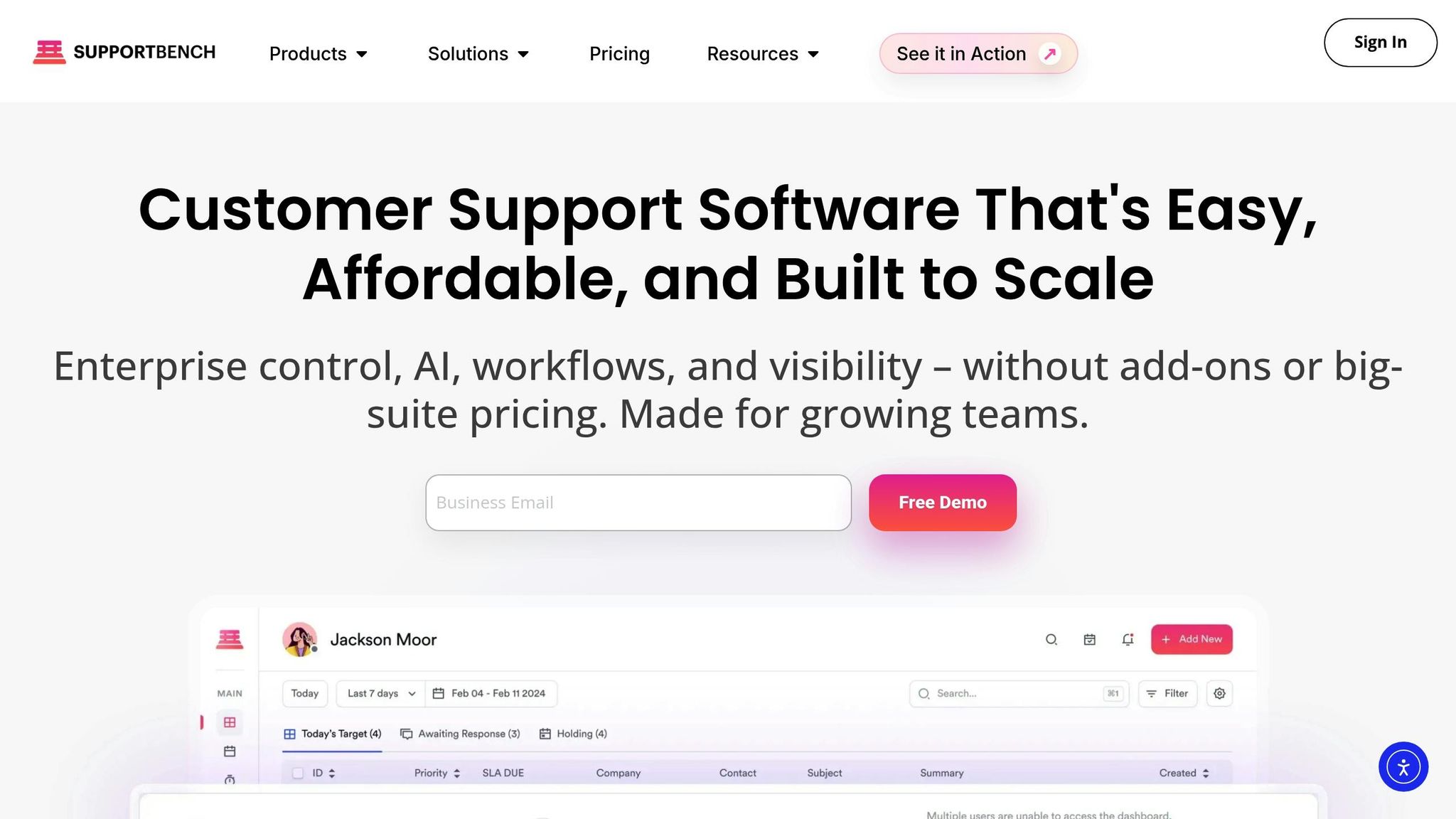
Supportbench is purpose-built for external B2B support, focusing on high-touch accounts, long-term cases, and renewal-driven relationships that demand a deep understanding of customer needs.
"Supportbench unifies conversations from email, chat, phone, and social channels into one intuitive workspace."
– Eric Klimuk, Founder and CTO of Supportbench
The platform emphasizes relationship management over ticket volume, offering a Customer 360 view that consolidates contracts, licensing, product usage, and interaction history. This comprehensive perspective helps support teams not only address customer inquiries but also understand the broader business impact behind them. With this as its foundation, Supportbench delivers features designed specifically for the complexities of B2B operations.
Supportbench’s Core Features
Supportbench’s design principles shape its standout features, making it an ideal tool for B2B support.
The platform includes dynamic SLAs that adjust automatically based on renewal dates, risk indicators, and customer value, ensuring top-tier accounts receive the attention they deserve. Agents benefit from AI-driven case summaries, which distill complex, multi-stakeholder discussions into concise overviews, allowing them to quickly grasp the status of long-running cases. The integrated AI Co-Pilot suggests replies based on historical cases and even generates knowledge base articles from resolved issues. Predictive metrics like CSAT and Customer Effort Score are calculated before surveys are completed, using sentiment and emotion analysis to flag at-risk accounts early.
Supportbench also integrates seamlessly with Salesforce, pulling in key data like licensing details, contracts, and customer health scores directly into the support interface. The platform’s email editor simplifies formatting and image handling, while escalation management ensures visibility across multiple levels of an issue.
How Supportbench Handles Complex B2B Operations
Supportbench is built for support operations teams, not IT departments, offering a fast implementation process and earning a 4.9/5 rating on G2 and Capterra.
"Everything you need is included – no surprise bills, no feature gating, no ‘contact sales for pricing.’ What you see is what you get, and you get everything."
– Supportbench
Pricing starts at $32 per agent per month (billed annually), covering all core AI tools, ticket management, and analytics. The Enterprise plan, priced at $100 per agent per month, adds advanced features like single sign-on, sandbox environments, and white-labeling. This straightforward, all-inclusive pricing avoids the hidden costs and feature restrictions often found in traditional ITSM platforms.
For industries like manufacturing, logistics, managed service providers, or supply chain operations, Supportbench delivers multi-stakeholder visibility, ensuring tailored access for complex engagements. The platform excels at managing long-running cases – sometimes spanning months – through AI-powered summaries and workflows that prioritize relationships over ticket counts. This streamlined approach addresses the pain points of traditional ITSM systems, offering better cost-efficiency and responsiveness for B2B teams managing intricate accounts.
ServiceNow vs. Supportbench: Direct Comparison
This comparison brings into focus the operational trade-offs between ServiceNow’s comprehensive ITSM framework and Supportbench’s tailored B2B customer support solution. Each platform serves distinct purposes, making their differences in features, cost, and flexibility critical for businesses to consider.
Feature, Cost, and AI Comparison Table
The table below highlights the key differences between ServiceNow and Supportbench, emphasizing their primary use cases, AI capabilities, and overall usability. While ServiceNow prioritizes IT Service Management (ITSM) for internal operations, Supportbench is designed specifically for external B2B customer support.
| Feature | Supportbench | ServiceNow |
|---|---|---|
| Primary Use Case | External B2B Customer Support | Internal IT Service Management |
| AI Capabilities | Built-in AI (Co-Pilot, sentiment analysis, ticket summaries, knowledge base creation) | Often requires third-party plugins |
| Setup Time | Quick deployment (days to weeks) | Lengthy setup (weeks to months) |
| B2B Context | Comprehensive (contracts, licensing, Customer 360 view) | Limited (focused on IT assets and incidents) |
| Workflows | Flexible, customer-centric SLAs and escalations | Rigid, ITIL-compliant processes |
| Pricing | $32 per agent/month (billed annually) | Costs rise significantly with team size and add-ons |
| Knowledge Base | Included with AI-generated article capabilities | Often requires additional modules or integrations |
| Learning Curve | Low; intuitive and agent-focused | Steep; usually requires IT department involvement |
"ServiceNow’s reliance on third-party plugins for AI limits its automation potential. Alternatives should feature robust, native AI capabilities for automating tasks like ticket routing, escalation, and knowledge management."
– Nooshin Alibhai, Founder and CEO of Supportbench
ServiceNow’s higher pricing and dependency on external plugins for AI add to its complexity, making it less accessible for teams seeking efficiency and cost control. In contrast, Supportbench offers simplicity and affordability while delivering advanced features.
ITSM Complexity vs. Support Efficiency
ServiceNow’s ITIL-focused design caters to internal IT management, excelling at incident tracking, change control, and asset management. However, these rigid structures can create significant overhead for B2B customer support teams. The platform often demands extensive configuration, reliance on IT resources, and ongoing maintenance, which can slow down operations.
Supportbench, on the other hand, is built for the dynamic needs of B2B support. It simplifies workflows with adjustable SLAs based on customer renewal dates or risk levels, AI-powered case summaries for long-standing issues, and a Customer 360 view that consolidates critical data like contracts and licensing. Its no-code interface allows support teams to manage the system themselves, eliminating the need to wait for IT involvement.
"Supportbench redefines service management for businesses tired of the limitations and high costs of traditional ITSM platforms like ServiceNow. It provides a highly customizable, scalable platform powered by AI automation to streamline operations and reduce complexity."
– Supportbench
Supportbench’s streamlined setup process allows teams to go live in just a few days, compared to the weeks or months required for ServiceNow implementations. Its user-friendly design and effectiveness are reflected in a 4.9/5 rating on platforms like G2 and Capterra, making it a strong choice for businesses focused on operational efficiency and ease of use.
When ITSM Platforms Are Too Much for Customer Support
Not every customer support team requires the full weight of an ITSM (IT Service Management) framework. Platforms like ServiceNow are primarily tailored for internal IT departments managing infrastructure, compliance, and change control – not for teams dedicated to building and maintaining external customer relationships. When these systems are shoehorned into customer support roles, they often become a source of inefficiency and unnecessary expense.
The signs of a mismatch are clear: spiraling costs, rigid workflows, and a reliance on IT just to make simple adjustments. These platforms are designed for structured IT processes, but customer support – especially in B2B settings – demands flexibility. If your team constantly needs IT to tweak a field or adjust an SLA, the system is likely creating more problems than it solves.
How to Decide If You Need ITSM for B2B Support
The right choice depends on your team’s day-to-day responsibilities. If your primary tasks revolve around internal incidents, IT asset management, and ITIL-compliant change processes, an ITSM platform might fit. But for most B2B customer support teams, the focus is entirely different. They need tools that provide a 360-degree view of customers, including contract details, licensing information, and renewal dates – not IT asset inventories. They also require flexibility in SLA management, allowing adjustments based on customer risk, and AI tools that summarize cases or analyze sentiment, rather than backend-focused configurations.
Ask yourself: Does your team spend more time managing customer relationships or internal IT processes? If customer relationships dominate, an ITSM platform is likely overkill. Purpose-built B2B support tools offer faster deployment – sometimes in just days – and allow teams to make workflow changes without requiring IT approval. These platforms also come equipped with built-in AI to streamline operations, eliminating the technical bottlenecks that ITSM systems often create.
Cost is another factor. ITSM platforms like ServiceNow can become prohibitively expensive as your team grows, with advanced features such as AI and SLA management locked behind higher-tier pricing. By comparison, Supportbench provides transparent pricing at $32 per agent per month (billed annually), including AI capabilities from the start.
"ServiceNow’s complex setup and steep learning curve can be resource-draining." – Nooshin Alibhai, Founder and CEO, Supportbench
If ITSM feels like an unnecessary burden, it’s worth considering the additional risks that such platforms can introduce to your support operations.
Risks of Using ITSM for Customer Support
The challenges of using an ITSM platform don’t stop at the initial setup. These systems often require ongoing maintenance, consuming resources that could be better spent on customer-focused work. Even minor workflow changes might demand IT or DevOps involvement, slowing your team’s ability to adapt to evolving business needs.
Data silos are another issue. Traditional ITSM tools weren’t designed to integrate customer-specific information – like contracts or product usage – directly into the ticketing interface. This forces support teams to juggle multiple systems to get a complete picture, leading to longer resolution times and more errors. Additionally, the rigid ITIL frameworks these platforms rely on can create unnecessary friction for teams that prioritize relationship-driven support.
Security concerns also come into play. ITSM platforms often serve as centralized hubs for sensitive data, making them attractive targets for cyberattacks. For instance, in November 2023, a vulnerability (CVE-2023-47246) in the SysAid ITSM platform was exploited by attackers linked to the MOVEit data extortion group. Similarly, in March 2024, Ivanti had to issue critical patches for its Neurons for ITSM product to address vulnerabilities that could allow unauthorized command execution. With the average cost of a data breach reaching $4.35 million in 2022, such risks are hard to ignore.
Another drawback is the reliance on third-party AI tools. Many ITSM platforms require expensive add-ons or higher-tier plans for basic AI functions like ticket routing or case summarization. In contrast, modern support platforms come with native AI capabilities that work right out of the box, without the need for complex training data or extra IT setup. These tools are no longer optional – they’re essential for staying competitive.
One of the most telling risks is the rise of "Shadow Vibe Apps." These are unapproved, insecure mini-tools created by non-technical staff to bypass the inefficiencies of ITSM systems. When employees feel forced to create workarounds, it’s a clear sign that the platform isn’t meeting their needs. These apps not only introduce security vulnerabilities but also highlight the platform’s inability to support your team effectively. Purpose-built support tools avoid these pitfalls by offering the agility and simplicity that B2B teams need, without the baggage of traditional ITSM frameworks.
Choosing the Right Platform for B2B Support
Deciding between ServiceNow and Supportbench comes down to understanding your team’s core responsibilities. ServiceNow is tailored for enterprise IT service management, offering tools like incident management, IT asset management, and change control. It’s ideal for managing complex IT infrastructures. However, for B2B customer support teams that prioritize relationship management, contract renewals, and resolving multi-stakeholder challenges, its extensive IT-focused features can slow down customer support agility.
Supportbench, on the other hand, is specifically designed for B2B support operations. It includes AI-powered tools such as ticket summarization, sentiment analysis, and one-click knowledge base article creation – all available from the start at $32 per agent per month (billed annually). This eliminates the need for additional plugins or costly add-ons. With setup times measured in weeks – not months – teams can modify workflows without relying on IT. Its user-friendly design and high ratings reflect its streamlined approach.
"Supportbench redefines service management for businesses tired of the limitations and high costs of traditional ITSM platforms like ServiceNow." – Nooshin Alibhai, Founder and CEO, Supportbench
Beyond its functionality, Supportbench offers clear cost advantages. ServiceNow starts at $100 per user per month, with costs escalating as you add customizations and enterprise-level features. For mid-sized B2B teams, this pricing often doesn’t result in better customer outcomes. In contrast, Supportbench’s straightforward pricing, combined with renewal-focused SLAs, delivers faster ROI while keeping things simple.
When choosing a platform, it’s critical to evaluate your team’s specific needs. If your focus is on customer relationships, tracking contracts, and retaining clients, a platform like Supportbench – built specifically for B2B support – may be the better fit. But if your team manages internal IT operations under an ITIL framework, ServiceNow could be the more appropriate option. Ultimately, the decision comes down to whether your priorities lean toward customer-centric workflows or IT-centric processes.
FAQs
What signs show an ITSM tool is overkill for my support team?
If an ITSM tool feels like more trouble than it’s worth, it might be time to reconsider. High costs, unnecessary complexity, or slow deployment can signal that it’s not the right fit for your needs. For instance, escalating licensing fees can quickly strain your budget, especially if your workflows are straightforward and don’t require advanced systems. Struggling with setup and customization is another red flag, as it can drain time and resources.
If your team prioritizes flexibility and ease of use over a long list of features, a simpler and more affordable option could be the way to go. Sometimes, less is more when it comes to finding the perfect tool for your team.
How do I choose between IT-centric workflows and customer-centric support?
When deciding between IT-centric workflows and customer-centric support, your organization’s priorities will guide the choice.
- IT-centric workflows are all about optimizing internal IT operations. They focus on managing technical issues, tracking IT assets, and ensuring compliance with policies. This approach is ideal for organizations where maintaining IT efficiency is the primary goal.
- Customer-centric support, on the other hand, emphasizes delivering tailored experiences. It involves working closely with multiple stakeholders and prioritizing customer satisfaction, especially in complex B2B scenarios where relationships and service quality are key.
To make the most of your resources and achieve the best results, align your workflows with the strategy that reflects your organization’s core focus.
What should I plan for when migrating from ITSM to B2B support software?
When transitioning from ITSM platforms like ServiceNow to B2B support software such as Supportbench, it’s crucial to focus on a few key areas:
- Costs: Factor in migration fees and any potential downtime that might impact operations.
- Data Migration: Ensure all customer data and workflows are transferred accurately and without disruptions.
- Training: Equip your team with the knowledge they need to adapt quickly to the new system.
- Security: Confirm the new platform meets compliance requirements and maintains high safety standards.
By addressing these areas thoughtfully, you can make the shift to modern, AI-powered support tools as smooth as possible.