Handoff mistakes cost time and money. Poor transitions between support agents lead to wasted hours and frustrated customers. Structured summaries fix this by providing a clear, consistent format that captures the most important details: customer needs, actions taken, unresolved issues, and next steps.
- Why it matters: Missing information during handoffs can cost $200–$500 per escalated ticket and waste over 6 hours in an 18-hour resolution cycle.
- Customer impact: 79% of customers expect smooth transitions, but 77% of B2B buyers find themselves repeating information. This frustration can drive them away.
- The fix: Using frameworks like I-PASS and SBAR ensures every handoff is clear and actionable. AI tools can automate summaries, saving time and improving accuracy.
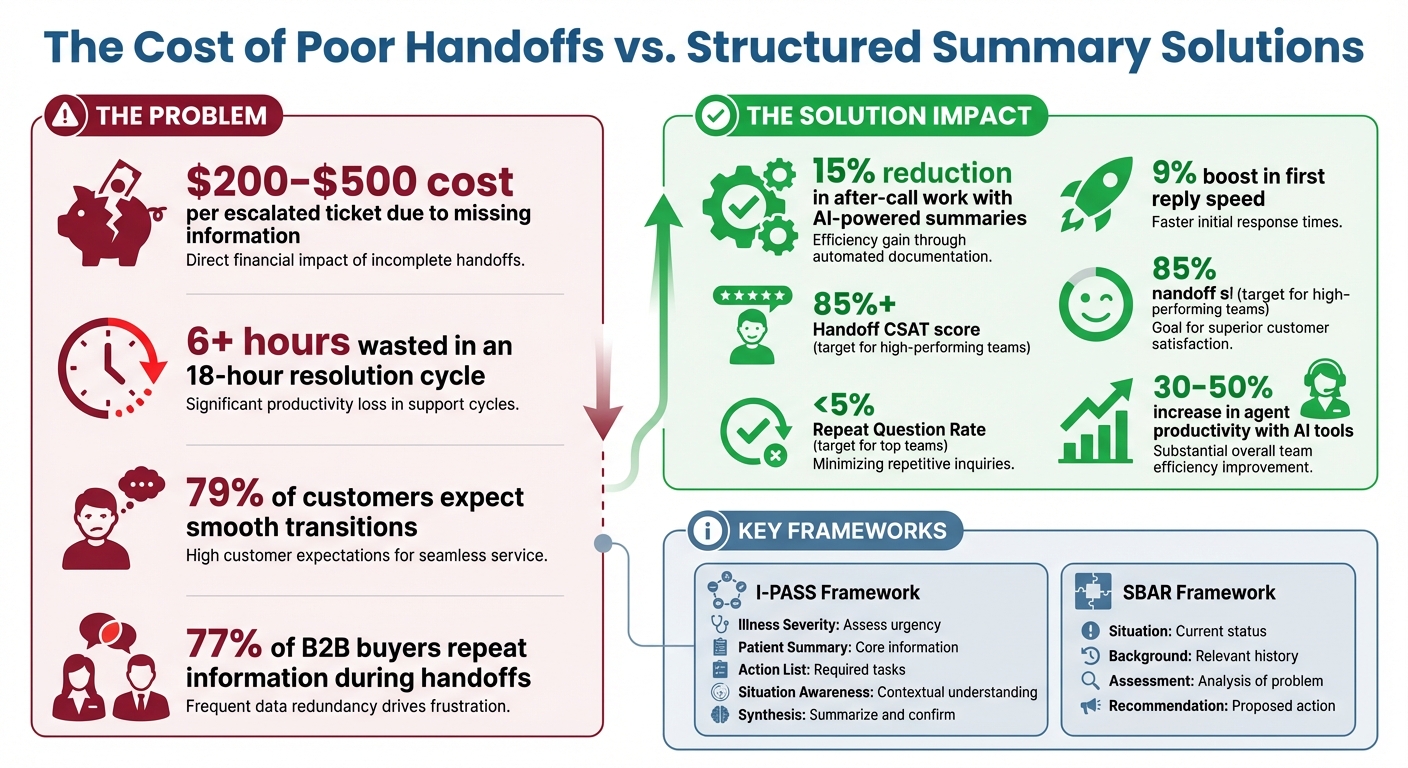
Cost and Impact of Support Handoff Mistakes: Key Statistics
A Good Customer Service Handoff Leads to Appreciation
sbb-itb-e60d259
Why Structured Summaries Reduce Handoff Mistakes
Handoff mistakes often happen when information gets lost or misunderstood. Structured summaries tackle this issue by offering a consistent format that every agent can follow. This ensures that customer context, case history, and next steps are captured clearly and reliably [4].
Teams using AI-powered summarization tools have reported impressive results, including a 15% reduction in after-call work and a 9% boost in first reply speed [4]. These improvements come from eliminating the need for agents to dig through lengthy conversation threads to piece together what happened. As Samuel Chenard, Co-founder of LobsterMail, puts it:
"The engineer receiving the ticket shouldn’t need to re-read the whole thread. They should be able to read your summary, confirm the technical details, and start investigating within a minute." [5]
Standardizing Case Information
A structured summary ensures that agents receive all the critical information without redundancy. Key components typically include:
- Request: What the customer needs.
- Resolution or Action: Steps already taken.
- Root Cause: The underlying issue.
- Customer Sentiment: Their emotional tone.
- Recommendations: Suggested next steps.
This "conversation bundle" can also include technical details like customer ID, AI confidence scores, or escalation triggers [2][3]. By standardizing these elements, teams prevent situations where customers are asked to repeat themselves. High-performing teams aim to keep repeat question rates below 5% during escalations [2]. For example, hearing, "I see you’re asking about refund options…" instead of "Can you explain your issue again?" shows the handoff process worked.
Improving Team Communication
Structured summaries also enhance team communication by providing transparency across the support workflow. During escalations, the receiving agent gets not just the conversation history but also critical information like the reason for escalation (e.g., sentiment spike, low AI confidence, or policy exception) and the last action taken [2]. Using bulleted lists and standardized templates improves readability, allowing agents to quickly focus on what’s important – especially during busy shifts [3][4].
Preventing Escalations and Errors
Summaries play a crucial role in avoiding errors that lead to escalations or incorrect resolutions. By including details such as business impact (e.g., "Blocking entire team from dashboard access") and technical environment (e.g., "macOS 14.3, Chrome 121, Staging"), the next agent can prioritize effectively and skip unnecessary troubleshooting steps [2][5]. Teams using this approach often achieve Handoff CSAT scores above 85% [2].
The alternative can be costly. As Thread Transfer highlights:
"The number one complaint about AI customer support isn’t accuracy – it’s the handoff. Customers start with AI, realize they need a human, and then have to repeat everything. That failure mode kills CSAT faster than any hallucination." [2]
Structured summaries prevent this issue by acting as a decision-support tool. When every handoff includes clear, verifiable details and actionable next steps, errors drop, and resolution times improve. This method aligns with modern AI-driven support practices, ensuring faster and more consistent responses.
Next, we’ll explore practical frameworks to turn these concepts into actionable strategies for daily operations.
Frameworks for Building Structured Summaries
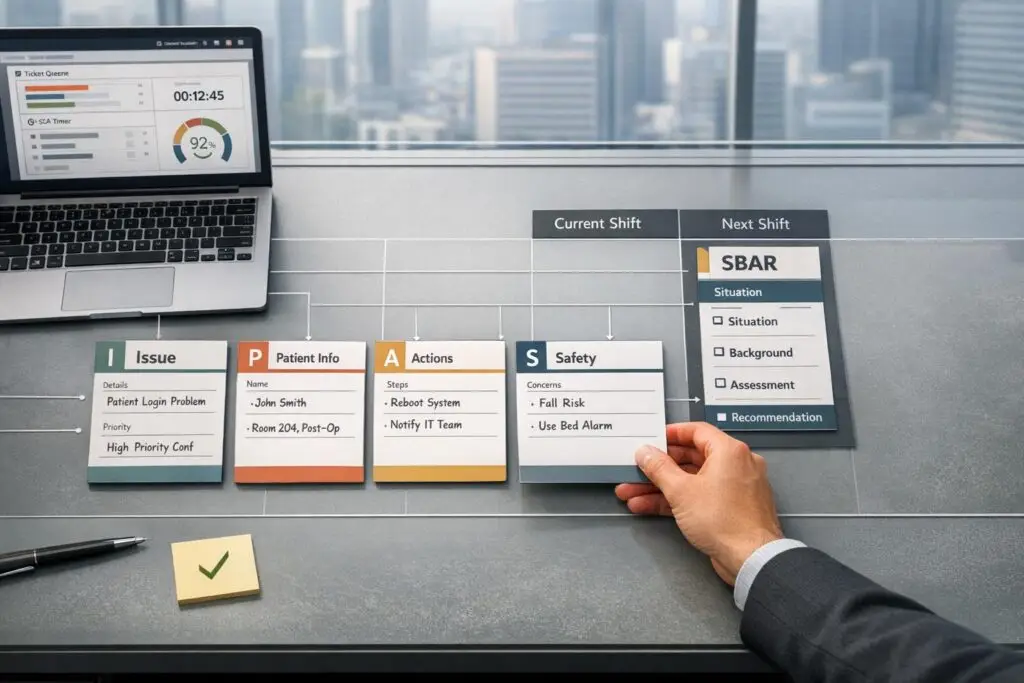
Standardized frameworks can make support handoffs smoother and more effective. Two models borrowed from healthcare – I-PASS and SBAR – offer clear structures that help agents capture critical details without overwhelming the next person in line.
The I-PASS Framework for Support Handoffs
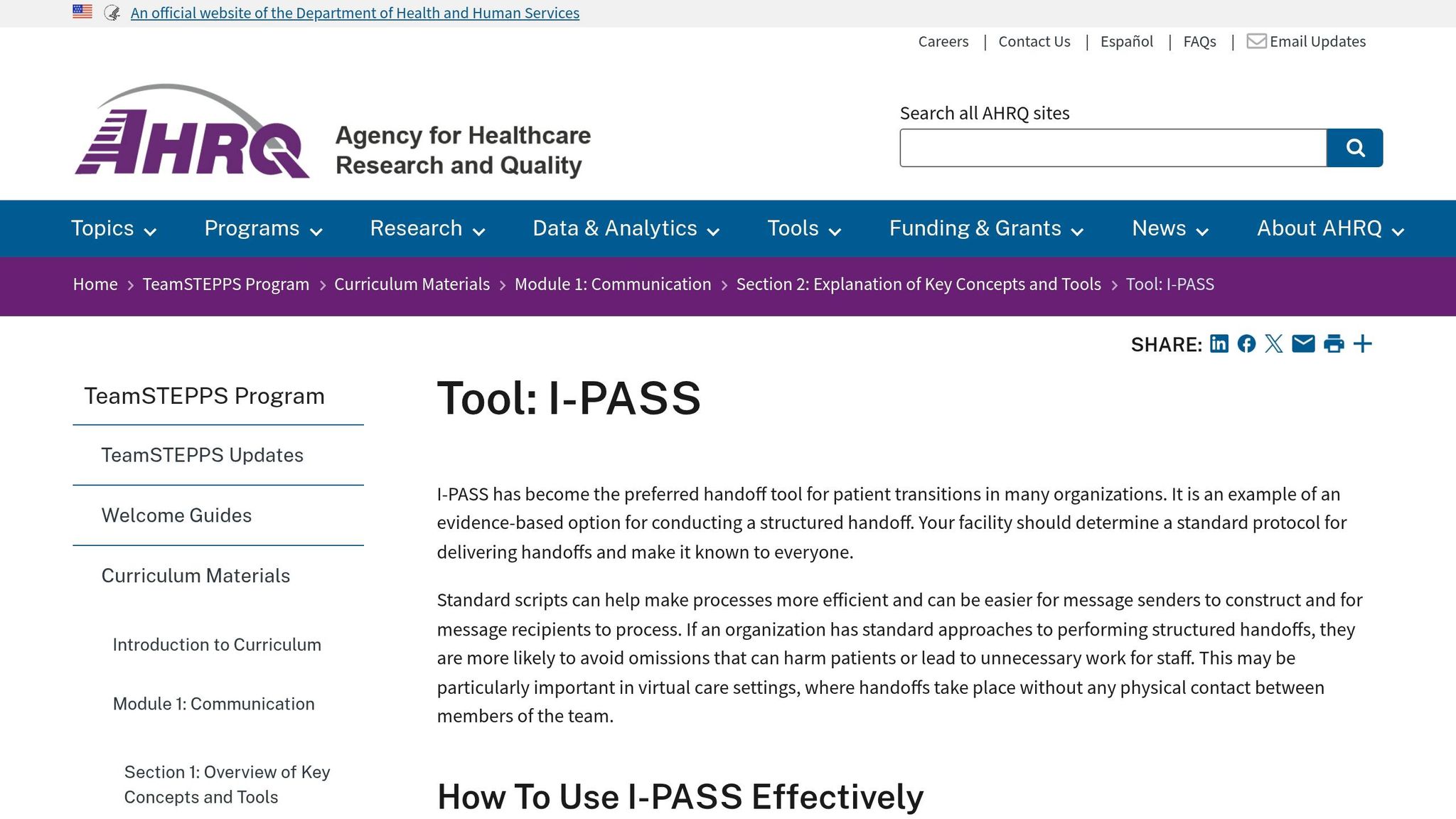
The I-PASS framework breaks handoffs into five key parts:
- Illness Severity/Priority: Assign a level of urgency, such as P1 for critical issues or P2 for standard ones. You can also classify by customer tier.
- Patient/Customer Summary: Provide a concise recap of the customer’s request and current status.
- Action List: Clearly list next steps to avoid redundant troubleshooting.
- Situation Awareness: Include useful context, such as customer sentiment or reasons for escalation.
- Synthesis: Confirm the receiving agent has acknowledged the summary to ensure nothing gets lost in translation [2].
Here’s an example of a P1 handoff: "Customer needs a refund for an annual plan due to a billing bug. Sentiment: frustrated. AI did not flag a policy exception. Next steps: verify the bug report and check billing override permissions." A final confirmation ensures the customer doesn’t have to repeat themselves [2].
By sticking to this framework, teams can reduce errors while ensuring all essential details are communicated.
The SBAR Framework for Quick Handoffs
The SBAR model – short for Situation, Background, Assessment, and Recommendation – is perfect for fast-paced environments where brevity is crucial.
- Situation: Clearly state the immediate issue (e.g., "Customer requesting label updates for support tickets").
- Background: Share relevant history, such as prior AI responses or earlier interactions with the customer.
- Assessment: Evaluate the root cause and note customer sentiment (e.g., "Sentiment: frustrated; root cause: recent billing bug").
- Recommendation: Propose a specific next step (e.g., "Update documentation or approve a one-time refund") [2][6].
Using SBAR, teams can create summaries in just 3–5 sentences, making them easy to scan and eliminating the need to sift through transcripts. For example, teams adopting SBAR have achieved live chat response times under 2 minutes while keeping handoff CSAT scores above 85% [2].
Building Templates for Common Scenarios
Templates ensure every handoff follows a consistent structure, focusing only on the essentials. Key fields to include are Request, Resolution (or current status), Root Cause, and Recommendations for next steps [6]. Add metadata as needed for clarity.
For recurring issues like billing escalations, technical bugs, or renewal requests, scenario-specific templates can save time. For instance:
- A billing escalation template might include fields for transaction ID, payment method, and refund eligibility.
- A technical bug template could capture environment details like "macOS 14.3, Chrome 121, Staging" [2].
To maintain clarity, filter out irrelevant system messages. Teams should also review template effectiveness monthly by surveying agents. If helpfulness ratings dip below 80%, it’s time to tweak the template [2].
These frameworks and templates set the stage for the AI-driven tools discussed later, which can take these summaries to the next level. Stay tuned for how automation can further streamline this process.
Using AI to Automate Summary Creation
AI is transforming how structured summaries are created, making the process faster and more accurate. By analyzing entire conversation histories – including public comments, internal notes, and even side conversations from platforms like Slack or email – AI tools can assess customer sentiment and reduce the workload for agents. This ensures that no critical details slip through during transitions.
AI-Generated Case Summaries
Supportbench has taken this a step further, with AI automatically generating concise case summaries and outlining next steps whenever tickets are updated[11]. The system scans all communication channels to piece together a complete view of the case, organizing key facts so agents can quickly understand the situation.
One standout feature is the AI’s ability to detect customer sentiment. For example, it flags cases where frustration is evident, enabling agents to adjust their approach accordingly[9][10]. To maintain accuracy, the AI marks uncertain information as "UNVERIFIED" and cross-checks user claims with system logs to identify any contradictions.
Connecting AI with Workflow Automation
AI-generated summaries become even more powerful when integrated into broader workflow automation. For instance, embedding these summaries into triage, routing, and escalation processes ensures that summaries are automatically generated and verified at critical transition points. This means that when a case moves to a new support tier or requires specialist intervention, all relevant context – like conversation history and prior solutions – is included. This saves time and prevents customers from having to repeat themselves.
"The AI agent system… knows when to hand off complex issues to a human with full context… handling repetitive tasks instantly and freeing human agents to focus on high-value, complex cases."
– Anubhav Sharma, Head of Agentic AI, Jeeva AI[9]
Fallback mechanisms are also crucial. If the AI’s confidence level is low, it automatically hands off the case to a human agent, preserving the full conversation history for continuity[8][9]. Tracking metrics such as response times and resolution rates can further refine the AI’s performance over time[7][8]. Additionally, a read-back verification step ensures that automated summaries meet quality standards before they are finalized.
Read-Back Verification
Even with advanced AI, human oversight is essential. Read-back protocols require agents to quickly verify the AI-generated summaries against the original data before moving forward. This final check helps catch any errors or omissions, ensuring that customer satisfaction remains a top priority[9].
Best Practices and Mistakes to Avoid
Creating structured summaries that are both concise and accurate requires a delicate balance. A frequent misstep is overloading summaries with unnecessary details, such as full transcripts, extensive apologies, or irrelevant links. These elements can bury the key facts that matter most. Instead, effective summaries should address four essential questions in just 3–5 sentences: What is the customer experiencing? What is their environment? What have they tried? What is the impact?[5] Following this approach ensures summaries remain clear and actionable during support transitions.
Use Verifiable Facts
When drafting summaries, rely on concrete, verifiable details to ensure accuracy. Avoid vague statements like "customer has login issues." Instead, be specific: "Customer on macOS 14.3 using Chrome 121 receives error code AUTH_401 when accessing the dashboard."[5] Adding inline links to source messages allows receiving agents to quickly verify the information. For AI-generated summaries, confidence scoring can highlight any uncertain points, signaling the need for manual review.[4]
Avoid Too Much Information
Including excessive or irrelevant details can slow down resolution times. In fact, overloading summaries with unnecessary information can waste more than 6 hours in an 18-hour resolution cycle due to delays caused by incomplete or unclear tickets.[1] Focus on preserving only the essential context for your AI-powered knowledge base while eliminating redundant or overly promotional language. The aim is to streamline decision-making without sacrificing clarity.
Measure and Improve Handoff Quality
To ensure smooth transitions, track key metrics that reflect handoff performance. For example, aim for a Repeat Question Rate below 5% and a Handoff CSAT above 85%.[2] Additionally, monitor the Correction Rate – the percentage of AI-generated summaries requiring edits – to assess accuracy.[4] In one 12-week technical support pilot, AI summaries played a significant role in improving efficiency.[4] Monthly agent surveys can help gauge satisfaction with context quality, targeting an 80% approval rate. Shadowing 5–10 escalations can also uncover where summaries may lose critical information or become overly detailed.[2]
Conclusion
Structured summaries play a key role in removing the friction that often plagues customer handoffs, which can lead to frustration and lower satisfaction scores. When done right, they ensure seamless context continuity, eliminating the need for customers to repeat themselves. They also save agents time by avoiding the hassle of combing through lengthy transcripts and help direct customers to the right specialist on the first attempt[2]. The impact is measurable: top-performing teams consistently maintain Handoff CSAT scores above 85% while keeping their Repeat Question Rate under 5%[2].
The data backs this up. As Thread Transfer points out:
"The number one complaint about AI customer support isn’t accuracy – it’s the handoff."[2]
By focusing on clear, concise summaries that address key issues, handoffs can become a strength rather than a weak point. AI-powered tools can increase agent productivity by 30–50%[2]. Teams using summarization techniques have also reported a 15% drop in after-call work and a 9% improvement in first reply speed[4].
To make this happen, consider implementing frameworks like I-PASS or SBAR to standardize the process. AI tools with read-back verification can further streamline summary creation. For instance, Supportbench offers AI-driven features tailored for these workflows, such as ticket summaries, case history search, and agent assistance – all included upfront without costly upgrades[11]. These tools and strategies can help build a more efficient and effective support system.
FAQs
Which handoff summary framework should we use: I-PASS or SBAR?
I-PASS is often preferred over SBAR for reducing handoff errors because it provides a more thorough and standardized approach. While SBAR offers a simpler framework, I-PASS ensures critical information is consistently communicated, minimizing the risk of missing essential details. For modern, AI-driven support operations, I-PASS aligns better with the need for improved communication and smoother transitions.
What fields should every support handoff summary include?
Every support handoff summary should cover the following key areas to ensure clarity and continuity:
- Issue history: A clear record of the customer’s problem and any previous interactions.
- Customer sentiment: Observations on the customer’s mood or urgency to help maintain trust and rapport.
- Urgency and business impact: An assessment of how critical the issue is and the effects it may have on the customer’s operations.
- Recent changes: Any new updates or developments related to the issue.
- Care plan: A detailed outline of the next steps, contingency plans, and assigned responsibilities.
Including these elements helps ensure a seamless transition, minimizing misunderstandings and errors.
How do we verify AI-generated summaries before acting on them?
To ensure the accuracy of AI-generated summaries, compare them directly with the original conversation or ticket. Pay close attention to key facts and details, including any internal notes, to maintain proper context. You can use manual review methods or rely on automated validation tools to verify the information. These practices are essential for catching errors or inaccuracies in summaries before they influence decisions or are passed along to others.