
Teams often leave Salesforce Service Cloud because it struggles to meet the specific needs of growing B2B support operations. While it offers many features, its design as a sales-focused CRM creates challenges for support teams trying to deliver fast, efficient service. Here’s why teams make the switch:
- Performance Issues: Service Cloud’s multi-tenant architecture and API limits can lead to slowdowns and errors during high ticket volumes, making it unreliable for scaling teams.
- Customization Challenges: Workflow adjustments often require IT intervention or consultants, delaying changes and frustrating managers.
- High Costs: Base pricing starts low but quickly escalates due to add-ons, implementation fees, and hidden charges. Advanced features like AI are priced separately, making total costs unpredictable.
- Complexity for Agents: Agents face fragmented interfaces, multiple tabs, and disconnected tools, slowing response times and increasing errors.
- Integration Limitations: Poor integration with collaboration tools like Slack or Teams and restrictive API limits disrupt workflows and hinder automation.
Dedicated support platforms address these issues with built-in AI, simpler interfaces, transparent pricing, and faster setup times. They’re designed to handle the complexities of B2B support without the inefficiencies of Service Cloud.
Top Salesforce Alternatives 2026 | Analyst Compares Competitors [3/3]
Main Problems with Service Cloud for B2B Support Teams
The challenges with Service Cloud become more apparent as B2B support teams grow or manage increasingly complex customer relationships. What works for smaller teams often falls short when scaling operations or handling the intricate demands of B2B environments.
Limits on Growth and Performance
Service Cloud operates on a multi-tenant architecture with strict API limits, capping the data requests teams can make daily. During periods of high ticket volumes, exceeding these limits can trigger runtime errors, effectively halting operations. For a support team, this isn’t just an inconvenience – it’s a roadblock.
B2B support adds another layer of complexity. Teams often deal with long sales cycles, technical questions from multiple stakeholders, and coordination across different time zones. Service Cloud struggles to manage this complexity, forcing agents to manually piece together data from various sources. This manual effort not only increases the risk of errors but also drives up support costs.
Another major hurdle? Constantly switching between platforms. Service Cloud lacks seamless, two-way integration with tools like Slack, Microsoft Teams, or Discord, which are essential for modern collaboration. Agents waste valuable time toggling between systems instead of resolving customer issues. As ticket volumes grow, this inefficiency becomes even more pronounced.
These challenges highlight the platform’s difficulty in supporting flexible processes and customization, both of which are crucial for B2B success.
Rigid Workflows and Limited Customization
Service Cloud’s rigidity adds another layer of frustration for support teams. Even minor workflow adjustments often require IT intervention or external consultants. This creates a bottleneck for managers trying to adapt quickly to changing business needs.
The stats back this up: 74% of B2B enterprise companies say their current tools lack the scalability and features needed for personalized customer experiences. On top of that, 87% of these companies prioritize delivering a seamless and personalized experience. Yet, Service Cloud’s rigid design makes bridging this gap incredibly difficult.
B2B support demands a deep understanding of customer context – renewals, entitlements, asset tracking, and account health are just a few examples. However, Service Cloud’s fragmented interface forces agents to juggle multiple tabs or rely on third-party integrations to get a full view of the customer. This complexity not only slows down onboarding but also diverts skilled agents from focusing on customer needs.
The consequences are clear: 47% of B2B clients switch vendors due to poor support, and teams dealing with constant delays experience a 33% higher attrition rate.
Rising Costs and Expensive Add-Ons
The financial strain of using Service Cloud grows as its limitations become more apparent. While the base plan starts at $50 per user per month, most B2B teams require advanced functionality, which bumps the cost to $165 per user per month. And that’s just the beginning.
AI features, for instance, come with hefty additional fees – $50 per seat for Copilot or $1.50 per resolution for AI agents. Custom implementation projects can take 4 to 12 weeks, with upfront costs often exceeding the software license fees due to reliance on consultants. Then there are hidden charges: fees for AI resolutions, storage overages, premium support, and integration marketplace apps.
In contrast, modern alternatives offer 40-70% cost savings by eliminating these hidden fees and reducing administrative burdens. For B2B teams with tight budgets, the total cost of ownership for Service Cloud can quickly become hard to justify.
Management and Integration Challenges
Service Cloud presents more than just performance and customization hurdles – it also brings significant management and integration challenges. These issues, both administrative and technical, can snowball, transforming a tool meant to aid support teams into one that hampers productivity.
Heavy Reliance on IT Teams
Service Cloud often functions more like a data repository than a streamlined communication tool, forcing teams to rely heavily on IT for even minor adjustments. Need to tweak a workflow or add a field? That likely means filing IT tickets or hiring external consultants, creating bottlenecks that slow processes to a crawl.
The statistics back this up: 49% of employees use less than half of their CRM’s features, largely because navigating these systems often requires extensive training. On top of that, 40% of the workforce spends significant time on repetitive tasks like manual data entry – tasks that should be automated. For support teams, this means skilled professionals are stuck managing software instead of resolving customer issues.
A great example of overcoming this challenge comes from Tinybird. In May 2025, Ramiro Aznar Ballarín, Support Manager at Tinybird, led a seamless migration from a legacy system that was overly reliant on IT. The transition took just two days, with no messages lost in the process. After switching to a B2B-focused platform, Tinybird slashed their enterprise first response time from 60 minutes to 12 minutes, an impressive 80% improvement.
"The migration took us two days, and we didn’t drop a single message." – Ramiro Aznar Ballarín, Support Manager, Tinybird
Unfortunately, the reliance on IT extends into integrating new AI capabilities, creating additional roadblocks.
Weak or Disconnected AI Features
Service Cloud’s AI capabilities often come from acquired technologies rather than being seamlessly integrated into the platform. This leads to fragmented workflows, where AI tools feel more like isolated add-ons than integral parts of the system.
This disjointed setup causes real headaches for support teams. Agents must juggle multiple modules to access AI features, which undermines the efficiency that automation is supposed to deliver. Adding to the frustration are restrictive API limits – some as low as 20 requests per minute – which disrupt custom integrations and make scaling nearly impossible.
A Solutions Engineer at a data orchestration company voiced their frustration:
"The API documentation is limited and heavily rate-limited at only 20 requests per minute, making it difficult to integrate custom AI agents and scale with increasing case volume"
For B2B teams managing complex, high-volume support, these limitations are more than just inconvenient – they’re deal-breakers.
Difficult Integration Management
Integrating Service Cloud with other essential tools often requires complex, point-to-point connections that are fragile and difficult to maintain. A single broken integration can ripple across the entire support stack, leading to widespread operational failures.
The data issues stemming from poor integration are staggering. Around 91% of CRM data is incomplete, and poor data quality costs businesses an average of $15 million annually. Every manual data entry error can cost anywhere from $50 to $150, depending on how far the error spreads before being corrected.
Buildkite, a software delivery platform, faced these challenges head-on. In May 2025, they transitioned to a new support system to escape the integration headaches of their previous setup. Jason Jacob, VP of Technical Services, expected a lengthy and painful migration process. Instead, he found it "ridiculously easy to get up and running". The new system allowed Buildkite to achieve their goal of a 5-minute response time for premium enterprise customers – something their old system struggled to deliver.
| Challenge | Impact on Support Teams |
|---|---|
| API Rate Limits | Disrupts custom AI operations and limits scaling |
| IT Dependency | Slows changes; forces skilled staff to focus on software instead of customers |
| Implementation Time | Setup periods of 4–12 weeks delay operational benefits |
| Fragmented AI | Forces admins to navigate disconnected modules |
These challenges highlight the growing need for platforms designed specifically to simplify and optimize B2B support workflows.
sbb-itb-e60d259
How Dedicated Support Platforms Solve These Problems
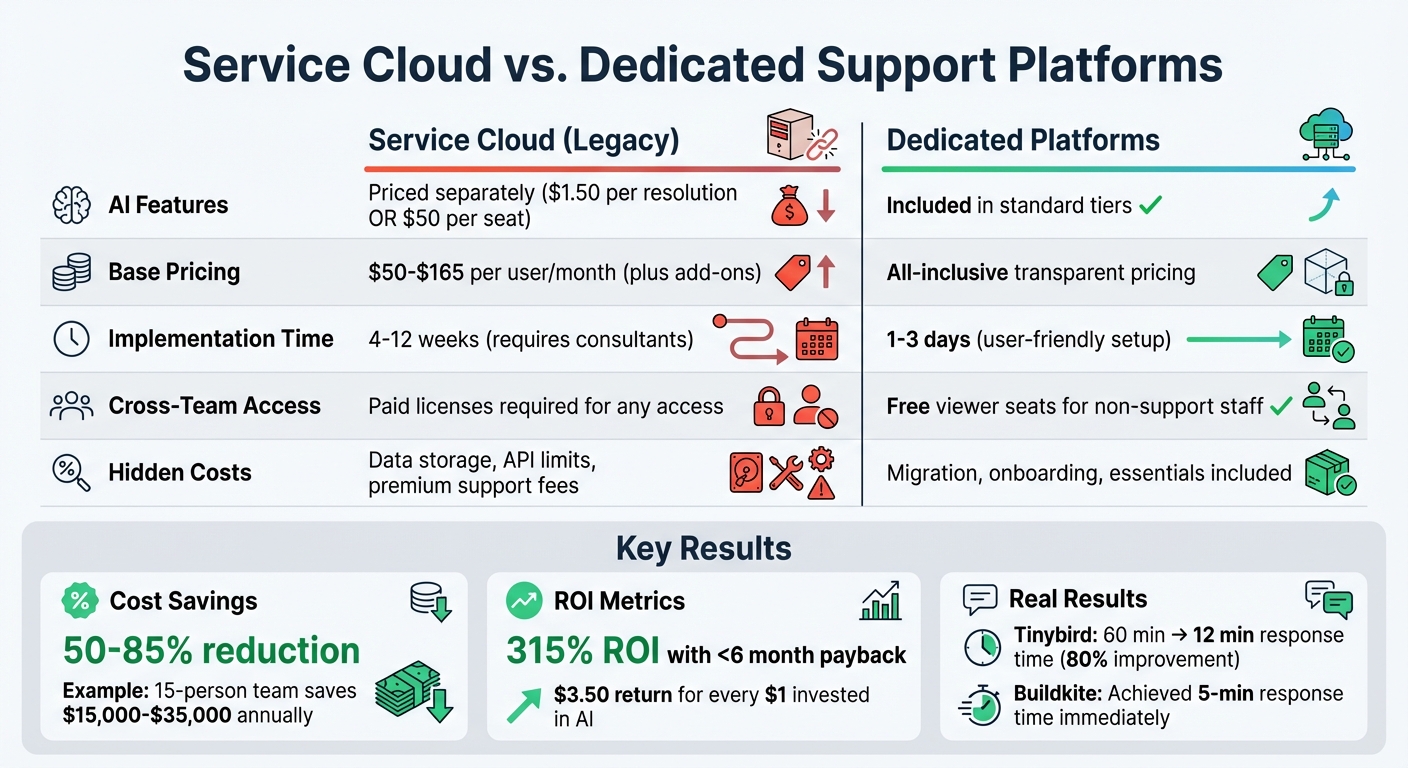
Service Cloud vs Dedicated Support Platforms: Cost and Feature Comparison
Dedicated support platforms combine AI, scalability, and specialized features tailored for B2B needs directly into their core offerings.
Native AI for Automated Workflows
These platforms integrate AI into support workflows to eliminate repetitive tasks and increase agent efficiency. For example, AI copilots analyze past case histories and knowledge base content to suggest responses automatically. Intelligent ticket routing prioritizes cases based on customer value and sentiment – no need for complex manual rules or IT setups.
AI also simplifies quality assurance by reviewing tickets for empathy, tone, and accuracy, removing the need for manual evaluations. Predictive tools calculate CSAT and CES scores before surveys are even sent, helping teams spot churn risks during ongoing support interactions.
Knowledge management becomes easier, too. AI can convert resolved tickets into well-organized, tagged knowledge base articles with just one click. Dynamic SLA management further enhances customer experience by adjusting service levels based on the urgency of the case.
This seamless integration of AI ensures that even the most complex B2B support demands are met efficiently.
Built to Handle Complex B2B Requirements
B2B support often involves intricate relationships, and dedicated platforms are designed to manage them effectively. These platforms provide account-level context, offering agents a complete view of client relationships, including historical interactions, health scores, and contract details. This ensures that tickets are treated as part of a larger relationship, not isolated events.
Features like parent/child case structures and approval workflows simplify managing multi-stakeholder issues. Case swarming allows teams from different departments to collaborate directly within the support platform to resolve complex technical challenges.
Bi-directional CRM sync is another game-changer, giving agents real-time access to product usage data and renewal milestones. This is critical for managing long-term B2B relationships, where every interaction can influence customer retention and revenue.
These capabilities not only streamline operations but also ensure pricing structures remain straightforward and predictable.
Clear and Predictable Pricing
Modern dedicated platforms offer all-in-one pricing that includes automation, analytics, and reporting – without surprise fees for data storage, API usage, or advanced security. For instance, while Service Cloud’s enterprise features can cost $165 per seat per month, dedicated platforms provide transparent per-user pricing with all essentials included.
Quick deployment further reduces costs. Teams can be operational in days, not months, without needing expensive consultants or specialized IT resources. Many platforms also offer unlimited free viewer seats, enabling cross-departmental visibility for teams like Success, Product, and Engineering – at no extra cost.
Switching from legacy systems can lead to significant savings – often between 50–85%. For example, a 15-person support team could save $15,000 to $35,000 annually, freeing up resources for hiring, training, or improving the customer experience.
| Cost Factor | Legacy | Dedicated |
|---|---|---|
| AI Features | Priced separately (e.g., $1.50 per resolution or $50 per seat) | Included in standard tiers |
| Implementation | Requires consultants; takes 4–12 weeks | Rapid setup (1–3 days); user-friendly |
| Cross-Team Access | Paid licenses needed for any access | Free viewer seats for non-support staff |
| Hidden Costs | Charges for data storage, API limits, etc. | Includes migration, onboarding, essentials |
Conclusion: Why B2B Teams Are Moving to Dedicated Support Platforms
B2B teams are making the shift to dedicated support platforms for several reasons: native AI capabilities, predictable pricing models, and workflows tailored to handle the complexities of multi-stakeholder relationships. These platforms eliminate the reliance on costly consultants, reduce IT involvement, and offer complete transparency into account health and renewal processes.
The numbers speak for themselves. Modern B2B support platforms boast a 315% return on investment (ROI) with payback periods of less than six months. For every $1 invested in AI, companies see a return of $3.50. These impressive metrics are backed by real-world examples.
Take Tinybird, for instance – their migration to a new platform took just two days and slashed their first response time from one hour to 12 minutes. Similarly, Buildkite achieved a near-instantaneous 5-minute response time right after switching platforms. These case studies highlight how quickly and effectively teams can see results.
Looking ahead, projections suggest that by 2025, 95% of customer interactions will involve AI. Teams clinging to outdated legacy systems risk falling behind competitors who are equipped to resolve issues faster, predict churn earlier, and deliver personalized service at scale.
If your team is struggling with Service Cloud or feeling the pinch of rising costs for diminishing returns, it might be time to explore platforms built specifically for modern B2B support. Prioritize solutions with transparent pricing, built-in AI, and rapid deployment timelines – measured in days, not months. These upgrades not only enhance customer and agent experiences but also streamline budgets and operations, addressing the challenges of scalability and personalization head-on.
FAQs
What advanced AI features make dedicated support platforms a better fit than Service Cloud?
Dedicated support platforms often come equipped with built-in AI tools, eliminating the need for extra add-ons. These features include predictive analytics, automated ticket triage, and real-time agent assistance, all aimed at simplifying workflows and cutting down on manual tasks.
Take AI-powered ticket routing, for instance – it ensures customer requests are handled promptly by prioritizing them effectively. Similarly, AI-driven knowledge management keeps resources updated and spots trends that enhance customer satisfaction. Unlike Service Cloud, which uses tiered add-ons like Einstein AI for similar functions, these platforms integrate such capabilities directly. This approach provides a more streamlined and budget-friendly solution for today’s support demands.
Why do B2B teams choose dedicated support platforms for more predictable pricing?
Dedicated support platforms offer clear and predictable pricing through straightforward, all-inclusive subscription plans. These plans typically include essential tools and features – like AI capabilities – without tacking on hidden fees. This eliminates the uncertainty of tiered add-ons or usage-based charges, making it easier for B2B teams to stay on top of their budgets.
By streamlining pricing models, these platforms help businesses cut down on long-term expenses while still providing access to advanced features. This setup is particularly helpful for companies prioritizing growth and keeping costs manageable.
Why do teams switch from Service Cloud to a dedicated support platform?
Many teams move from Service Cloud to a specialized support platform to tackle issues like limited scalability, restricted customization options, and rising costs. These dedicated platforms are built to manage expanding customer bases and the intricate needs of B2B support. They provide adaptable workflows, customized automation, and tools that can keep up with shifting operational demands.
Another major factor is cost management. Specialized platforms often streamline workflows, cut out unnecessary features, and lower expenses tied to licensing or customizations. Plus, they incorporate AI-driven tools and advanced analytics, enabling teams to deliver proactive, personalized support while boosting long-term customer satisfaction.
For modern B2B support teams, transitioning to a purpose-built platform can lead to operations that are more agile, scalable, and cost-efficient – better aligning with both their internal goals and their customers’ expectations.
Related Blog Posts
- Zendesk vs Freshdesk vs Supportbench: Which Support Platform is Better and for who in 2026?
- Tool Sprawl vs Unified Platforms: Key Differences
- What’s the best alternative to Salesforce Service Cloud for B2B support teams?
- Salesforce Service Cloud pricing vs helpdesk pricing: what are you really paying for?