NLP (Natural Language Processing) is transforming how businesses handle customer support tickets by automating the routing process. Instead of relying on manual sorting or rigid rule-based systems, NLP analyzes the content of support requests to determine intent, urgency, and context. This ensures tickets are assigned to the right agents quickly and accurately, improving response times and customer satisfaction.
Key Insights:
- Manual routing struggles with high ticket volumes, causing delays and misassignments.
- NLP automates routing by understanding ticket content, identifying intent, and detecting urgency or sentiment.
- Techniques like entity recognition and sentiment analysis help prioritize critical issues and match tickets to agents with the right skills.
- Companies using AI-driven routing have seen up to 80% fewer ticket transfers and improved SLA compliance.
How It Works:
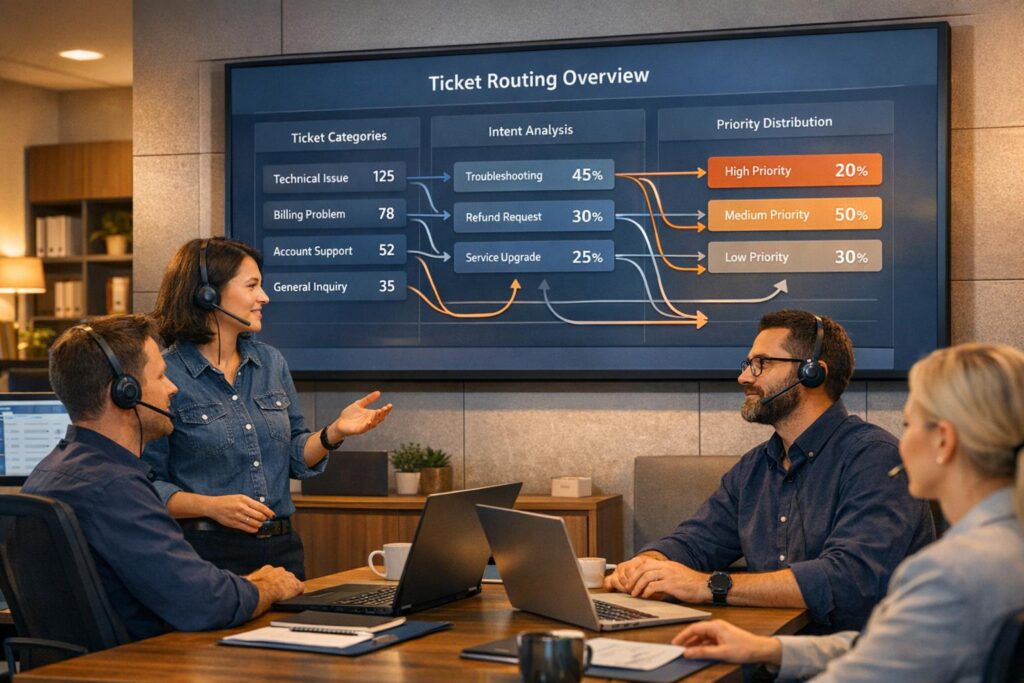
- Text Preprocessing: Cleans and organizes raw ticket data.
- Intent & Sentiment Analysis: Identifies the purpose and urgency of the request.
- Entity Recognition: Extracts specific details (e.g., product names, error codes) for precise categorization.
- Routing Logic: Combines NLP outputs with business rules to assign tickets to the best-suited agent.
Benefits:
- Faster ticket resolution.
- Reduced operational costs by cutting manual work.
- Improved customer experience through accurate and timely support.
NLP-driven platforms like Supportbench make these tools accessible with simple, no-code setups, starting at $32 per agent per month. By automating ticket routing, businesses can eliminate inefficiencies and focus on delivering high-quality support.
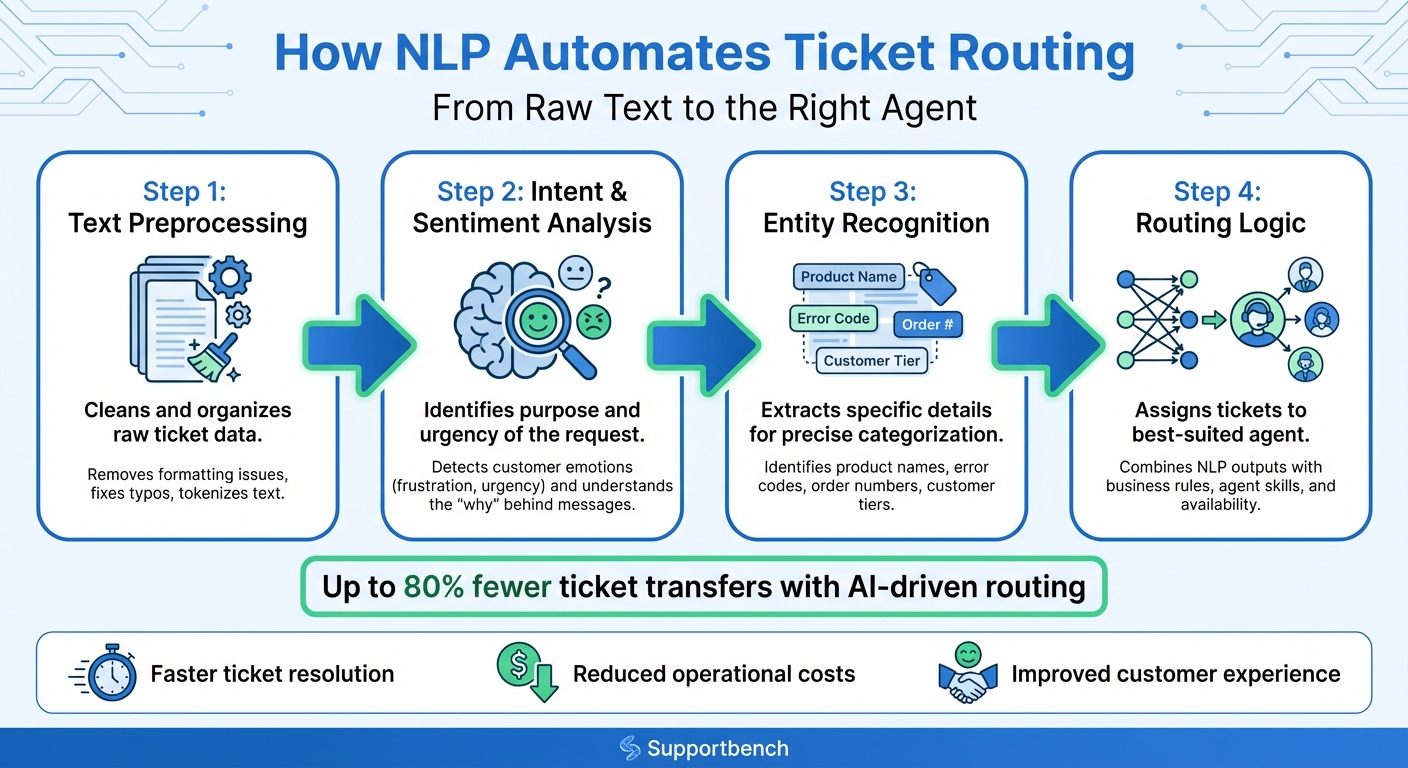
How NLP Automates Ticket Routing in 4 Steps
NLP Techniques for Ticket Routing
Text Preprocessing and Keyword Extraction
The first step in using NLP for ticket routing is to organize raw text through preprocessing. This involves cleaning up formatting issues, fixing typos, and breaking down text into smaller components (tokenization). By analyzing both subject lines and message bodies, the system identifies key elements like product names, error codes (e.g., "SAML 2.0" or "Attribute Assertion error"), and specific keywords that help categorize tickets accurately.
But this isn’t just about matching keywords. Modern NLP goes beyond that by focusing on meaningful terms while ignoring filler words. For example, it can pinpoint "Reporting V3" to ensure the ticket is routed to the right specialized team. This process transforms messy, unstructured customer emails into clean, actionable data, laying the groundwork for advanced analysis like intent and sentiment detection.
Sentiment and Intent Analysis
Once keywords are extracted and the text is cleaned up, the system dives deeper by analyzing the tone and purpose behind each ticket. Intent analysis focuses on understanding the "why" behind the message. For instance, phrases like "I’m locked out" and "system won’t accept my password" may use different wording but share the same intent – a login issue. With this context-driven approach, tickets can be routed directly to the right specialists, such as an API expert for integration problems, without the need for multiple handoffs [1].
Sentiment analysis adds another layer by detecting emotions like frustration, anger, or urgency. This helps prioritize tickets that might otherwise slip through traditional filters. For example, a seemingly polite message like "Quick question – our entire production system has been down for two hours" could signal a critical issue. Sentiment analysis catches the urgency hidden beneath the tone, especially for high-value clients or situations involving major business disruptions [1][2]. Combining sentiment, intent, and customer tier data allows platforms to dynamically adjust Service Level Agreements (SLAs) based on the customer’s emotional state [5].
"AI determines priority not just based on a selected field or a single keyword, but by analyzing a confluence of factors [including] Sentiment Analysis… and Urgency Keywords."
– Nooshin Alibhai, Founder and CEO, Supportbench [1]
Entity Recognition for Categorization
Named Entity Recognition (NER) takes ticket routing to the next level by extracting specific details like order numbers, product IDs, customer tiers, and technical terms from unstructured text. This makes tickets more context-rich before they even reach an agent. For instance, if a ticket mentions "SSO", "Okta", and "Attribute Assertion error", the NLP model identifies it as a complex integration issue. It then cross-references CRM data to confirm the customer’s "Premier" account status and prioritizes the ticket, ensuring it goes to an Integration Specialist instead of a general Tier 1 queue [1].
This automated process ensures consistent tagging, which is far more reliable than manual tagging by agents who might forget or use inconsistent labels. These NLP techniques not only streamline ticket assignment but also improve reporting and trend analysis, reinforcing the efficiency of AI-driven support platforms.
| NLP Technique | Function in Ticket Routing | Benefit |
|---|---|---|
| Intent Detection | Identifies the "why" (e.g., "Cancel subscription") | Routes to the correct specialized department |
| Sentiment Analysis | Detects emotion (e.g., "Frustration") | Prioritizes tickets based on emotional urgency |
| Entity Recognition | Extracts specific data (e.g., "Product X") | Matches tickets to agents with specific technical skills |
| Language Detection | Identifies the sender’s language | Eliminates manual transfers between regional teams |
How NLP Models Automate Ticket Routing
Building and Training Classification Models
Automated ticket routing relies heavily on classification models built using essential NLP techniques. These models are trained on historical support data that has been cleaned and standardized. By analyzing thousands of tickets labeled with details like intent, urgency, and outcomes, the model learns to identify patterns. For example, it can distinguish between bug reports, such as "Error 500 when uploading files", and feature requests like "Can we add bulk export?" It also extracts critical details like order numbers, product IDs, and error codes from the ticket content, including both the subject line and body.
The model becomes adept at recognizing high-priority issues based on specific language. For instance, phrases like "system down" or "production outage" are flagged as urgent, even if the customer doesn’t explicitly mark them as such. IBM provides an excellent example of this in action, using centralized machine learning tools to route over one million client tickets annually across 67 different support missions [3]. This demonstrates how NLP processes can scale across an enterprise without requiring separate teams for each department.
Once the model has been trained, its outputs are integrated into business logic, enabling seamless ticket routing to the most suitable agents.
Connecting NLP Outputs to Routing Logic
After classifying a ticket, the system combines the NLP outputs with business logic to finalize routing decisions. It incorporates factors like sentiment analysis, detected intent, and extracted entities, alongside external data – such as customer tier information from the CRM. For instance, if the system identifies a ticket as an "SSO integration issue" from a Premier-tier customer expressing frustration, it ensures the ticket is routed to a specialized agent rather than a general support queue.
The routing engine then matches tickets to agents based on a matrix of skills, language proficiency, and real-time availability. It checks for agents certified in specific product areas, who speak the customer’s language, and who have manageable workloads. To minimize errors, confidence thresholds are applied – if the model is unsure about a classification, the ticket is flagged for manual review by a human dispatcher.
Companies leveraging AI-driven ticket routing have reported impressive results, including up to an 80% reduction in ticket transfers [4].
Improving Models with Feedback Loops
NLP models are not static; they evolve through continuous feedback loops. Agent corrections play a critical role, serving as ground truth for retraining the model to handle nuanced language and shifting business requirements.
Monitoring for model drift is equally important, as factors like customer language, product updates, and policy changes can impact accuracy over time. Regular audits, such as tracking ticket reassignment rates, help identify when the model needs adjustments with updated data. By analyzing resolved tickets and their outcomes, the system refines its routing capabilities. These feedback loops ensure that the routing process adapts to meet changing support demands effectively.
NSDI ’13 – Juggling the Jigsaw: Towards Automated Problem Inference from Network Trouble Tickets
sbb-itb-e60d259
Benefits of NLP in AI-Native Support Platforms
These advancements are reshaping support operations and driving measurable results in B2B settings.
Easy Implementation Without IT Teams
AI-native platforms empower support leaders to implement NLP-driven routing using no-code tools. Unlike older systems that demand complex technical setups and constant maintenance, platforms like Supportbench offer visual builders and no-code configurations. This allows support managers to define routing rules without needing IT teams or external consultants.
This approach removes the delays caused by waiting for technical resources. Support teams can quickly adjust routing rules, refine AI models, and adapt to changing business needs. The platform handles the technical challenges, enabling support managers to focus on aligning agent expertise and customer priorities.
This simplified setup naturally boosts efficiency and reduces costs, as discussed below.
Better Efficiency and Lower Costs
NLP-driven routing not only simplifies implementation but also improves operational efficiency and reduces costs. By analyzing the content and context of support requests, these systems ensure tickets are assigned to the right agent on the first attempt, cutting down on time-wasting reassignments.
For high-volume support teams, manual routing often becomes a significant pain point. Automated systems that route tickets based on case details and client profiles solve these challenges while giving leadership visibility into agent performance and SLA compliance [2].
Cost savings extend beyond faster ticket handling. AI-powered routing reduces the need for manual sorting, freeing up dispatchers from hours of repetitive work. It also helps prevent SLA breaches by identifying urgency through sentiment analysis and context, even when customers don’t explicitly mark their requests as urgent. As Nooshin Alibhai, CEO of Supportbench, explains:
"AI determines priority not just based on a selected field or a single keyword, but by analyzing a confluence of factors [including] sentiment analysis, urgency keywords, and customer value."
– Nooshin Alibhai, Founder and CEO, Supportbench [1]
NLP Features in Supportbench
Supportbench integrates NLP directly into daily workflows, offering features that extend beyond simple ticket routing. For instance, the platform includes predictive FCR (First Contact Resolution) scoring, which helps managers identify tickets likely to be resolved in a single interaction. It also provides sentiment and emotion analysis, alerting managers to potential churn risks early, enabling proactive customer retention efforts.
The intent-based triage feature categorizes tickets by analyzing their content, eliminating reliance on customer-selected dropdown menus, which are often inaccurate. For B2B companies handling complex technical issues, this ensures that tickets – like those about SSO integration or API errors – are routed directly to specialists with the right expertise, avoiding unnecessary delays in general support queues.
Another standout feature is dynamic SLA management. The platform adjusts response targets in real-time based on urgency, customer tier data from the CRM, and issue complexity. This ensures high-value customers receive priority during critical incidents without requiring manual intervention. Best of all, these AI-driven capabilities are included in Supportbench’s core pricing – starting at $32 per agent per month (billed annually) – without the hidden fees often seen in legacy platforms.
Conclusion
The Future of Ticket Routing in B2B Support
Natural Language Processing (NLP)-driven ticket routing is becoming a game-changer for B2B support teams managing intricate queries and high-value clients. Traditional keyword-based systems just can’t keep up as support demands grow and language use becomes more nuanced. The future belongs to platforms that go beyond surface-level data, focusing instead on understanding context, intent, and sentiment.
"For support leaders aiming to optimize their operations, embracing intelligent automation is no longer optional; it’s essential" – Nooshin Alibhai, Founder and CEO, Supportbench [1]
This transformation is already underway. Take IBM, for example – they use NLP to handle over a million live client tickets annually across 67 distinct support missions [3]. The technology isn’t just proven; it’s scalable and increasingly within reach for businesses of all sizes. This shift signals a move away from outdated manual processes toward real-time, context-aware automation.
Why Choose AI-Driven Support Solutions
For leaders juggling cost pressures and the demand for consistent quality, AI-powered platforms offer a clear path forward. These solutions, like Supportbench, seamlessly integrate intelligent routing into their core services – starting at just $32 per agent per month (billed annually).
With these tools, teams can eliminate manual triage bottlenecks and reduce unnecessary ticket transfers, ensuring customers get the help they need without delays. This not only improves customer satisfaction but also helps protect revenue and loyalty. Plus, the built-in analytics and visibility empower teams to refine their performance over time, all without increasing headcount. When complex technical issues are routed to the right specialist on the first try, businesses can maintain strong customer relationships and safeguard their bottom line.
FAQs
How does natural language processing (NLP) enhance ticket routing accuracy?
Natural language processing (NLP) takes ticket routing to a whole new level by analyzing the entire content of customer messages. Instead of relying on simple keywords, it digs deeper to understand intent, topics, and contextual nuances. This leads to far more accurate ticket classification and assignment, reducing the errors that often plague keyword-based systems.
With NLP, support teams can cut down on misrouted tickets, simplify workflows, and ensure that every request lands with the right person or team right from the start. The result? Faster response times, smoother resolutions, and happier customers.
How does sentiment analysis help prioritize support tickets?
Sentiment analysis works by identifying the emotional tone within a support ticket – whether it’s frustration, dissatisfaction, or urgency. When negative sentiment is detected, tickets are automatically flagged, prioritized, and routed to the right team to ensure quicker resolution.
This process allows support teams to zero in on the most critical cases, speed up their response times, and boost customer satisfaction – all without adding extra manual work.
How can businesses set up NLP-based ticket routing without technical expertise?
Setting up NLP-based ticket routing is straightforward when using a platform with built-in AI features. Supportbench simplifies this process by automatically analyzing each incoming request for intent, priority, and sentiment. The system comes pre-trained, so there’s no need for custom coding or training models.
To get started, businesses simply enable the Intelligent Ticket Routing feature and use the platform’s visual workflow builder to configure routing rules. You can choose data sources like email or chat, define intent categories such as "billing" or "technical issue", and assign these categories to the appropriate teams or queues. The AI then tags and routes tickets in real time, ensuring tasks are handled efficiently and accurately.
Even non-technical staff can fine-tune the system with ease. They can review sample tickets, adjust confidence thresholds, or add keyword synonyms directly through the interface. These accessible tools allow businesses to deploy automated, intent-aware ticket routing quickly and affordably – streamlining support operations without needing assistance from IT teams.