
Want to resolve customer issues faster and more effectively? Integrating a knowledge base into support workflows can significantly boost first-contact resolution (FCR) – a key metric for customer satisfaction and operational efficiency. Here’s why it matters:
- FCR measures the percentage of issues resolved during the first interaction. Even a 1% improvement can increase satisfaction by 1% and reduce costs by cutting follow-ups.
- Disconnected systems hurt FCR. Agents waste 40% of their time searching for answers, and outdated knowledge bases discourage usage, leading to inefficiencies.
- Integrated knowledge systems solve this. AI-powered tools provide real-time answers directly in workflows, reducing search time and improving resolution rates by up to 23%.
Key Takeaways:
- Integrated knowledge bases reduce agent search time and improve FCR.
- AI tools deliver real-time suggestions, cutting ticket resolution time by up to 50%.
- Embedding knowledge into workflows lowers escalations, repeat contacts, and support costs by up to 25%.
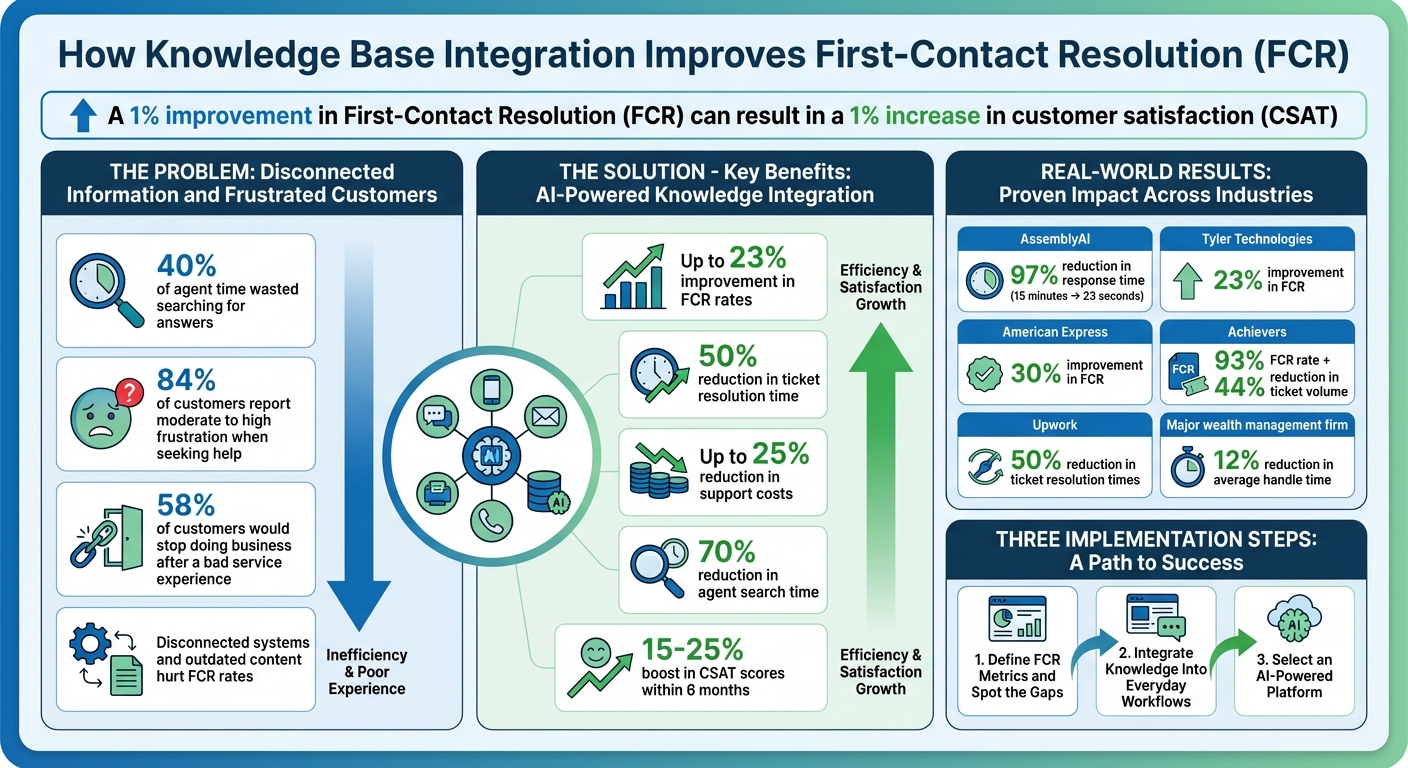
Knowledge Base Integration Impact on First-Contact Resolution: Key Statistics and Benefits
Why First-Contact Resolution Rates Stay Low
Disconnected Knowledge Systems Slow Down Agents
When information is scattered across disconnected systems, agents spend too much time searching for answers instead of assisting customers. Many support teams rely on a mix of tools – email chains, wikis, shared drives, and internal chats – forcing agents to jump between platforms to find what they need.
"The longer it takes to find what they need, the more FCR suffers." – Jacqueline Dooley, Coveo
This constant back-and-forth increases mental strain. Agents must remember where specific details are stored, navigate confusing folder hierarchies, and piece together information from multiple sources. The result? Customers are left waiting on hold while agents scramble for answers. In fact, 84% of people report moderate to high frustration when seeking help, with poor information accessibility being a top complaint. When agents can’t quickly locate accurate information, they resort to guessing, asking colleagues for help, or escalating cases – all of which hurt first-contact resolution. This inefficiency not only delays resolutions but also undermines trust in the system, paving the way for larger issues.
Outdated Content Reduces Knowledge Base Usage
Even when companies have knowledge bases, outdated or poorly maintained content can discourage agents from using them. When information is inaccurate or conflicting, agents lose trust in the system and turn to informal sources instead [14, 19].
The ripple effects of this problem are far-reaching. Customers lose confidence when they receive inconsistent answers from automated systems and human agents, making them more likely to bypass self-service options and demand direct assistance. This lack of trust comes at a high cost: 58% of customers say they would stop doing business with a brand after a bad service experience. Achievers tackled this issue by using gap detection to pinpoint and update missing or outdated information in their knowledge base, which helped them achieve an impressive 93% first-contact resolution rate. Beyond outdated content, separating knowledge systems from case management tools further slows down support teams.
Missing Integration with Case Management
While poor search functionality and outdated content are major hurdles, the lack of integration between knowledge bases and case management systems creates an even bigger challenge. The problem isn’t just about having knowledge – it’s about accessing it at the right moment. When these systems operate independently, agents are forced to leave their workspace, hunt for information elsewhere, and then manually apply it to resolve customer issues [14, 17].
"The single most significant barrier to achieving first call resolution (FCR) is delayed access to information." – DocsBot AI
This disconnect also leaves agents in the dark about what customers have already tried. Without visibility into previous searches or self-service attempts, agents often make customers repeat their story, adding unnecessary frustration. T-Mobile addressed this issue by creating a unified view of customer data, leading to a 25% improvement in FCR.
How Knowledge Base Integration Improves First-Contact Resolution
Bringing Knowledge Directly into Support Tools
Integrated knowledge panels simplify the workflow for support agents by displaying relevant articles right within their workspace – whether that’s a case record, email editor, or CRM system. This setup means agents no longer need to switch between tools to find answers. Plus, these panels provide valuable context by showing what customers searched for or clicked on before reaching out. This cuts down on the time agents spend diagnosing issues. Studies show that embedding knowledge into support tools boosts first-contact resolution (FCR) rates by turning knowledge into an easily accessible, on-the-spot resource. Agents can quickly refer to these panels while responding to tickets, reviewing case details, or escalating issues. When paired with AI, this seamless access gets even better, offering real-time recommendations that enhance efficiency.
Leveraging AI for Real-Time Recommendations
AI takes static search functionality to the next level by analyzing live conversations and delivering real-time suggestions. It can proactively provide troubleshooting guides, scripts, or next-best actions based on the context of the interaction. With natural language processing, agents can ask detailed questions like, "How do I handle a warranty claim for Model B?" and instantly receive specific, actionable answers – no need to memorize keywords or navigate complex folders.
For example, Upwork’s support team used an AI-powered tool called "Assist" to pull up relevant knowledge base articles and past case resolutions in real time. This integration slashed ticket resolution times by 50% and eventually enabled the team to clear their entire queue. The tool continuously updates its recommendations as the conversation evolves, ensuring agents always have the most up-to-date information. With 67% of support agents believing that generative AI will greatly enhance their ability to automate customer service, tools like these are becoming essential for maintaining competitive FCR rates. Real-time AI suggestions also contribute to a cycle of ongoing knowledge improvement.
Creating a Feedback Loop for Knowledge
Integrating a knowledge base into support workflows establishes a feedback system where resolved cases automatically enrich the knowledge base. This proactive approach addresses knowledge gaps before they become widespread issues. AI plays a key role by analyzing customer interactions, search queries, and support tickets to identify areas where the knowledge base falls short. Advanced platforms can even draft new articles based on these insights, reducing the need for manual updates.
This process aligns with the Knowledge-Centered Service (KCS) model, which treats knowledge creation as a natural outcome of the support process. Instead of viewing the knowledge base as a separate project, agents contribute by documenting solutions in real time. Each interaction becomes an opportunity to refine resources, ultimately improving FCR for the entire team.
Business Impact of Knowledge Base Integration
Faster and More Accurate First Responses
Integrating a knowledge base directly into case management workflows can dramatically speed up response times. For instance, in June 2025, AssemblyAI adopted Pylon‘s AI-powered support platform, which slashed their first response times from 15 minutes to just 23 seconds – a staggering 97% reduction.
"Our customers are developers who expect quick, actionable support. We needed a way to meet them where they work without slowing down".
- Lee Vaughn, Manager of Support Engineering at AssemblyAI
This instant access to relevant information significantly improves First Contact Resolution (FCR). AI-powered tools reduce the time agents spend searching for answers by over 70%, leading to more accurate responses. For example, one of the largest wealth management firms in the U.S. cut its average handle time by nearly 12% after implementing advanced search and knowledge tools. On average, organizations see a 15–25% boost in Customer Satisfaction (CSAT) scores within six months of deploying AI-integrated knowledge systems. By minimizing delays and improving accuracy, these systems also reduce the need for escalations.
Fewer Escalations and Repeat Contacts
When agents have instant access to technical manuals, troubleshooting guides, and historical data, they can resolve complex issues without escalating them to Tier-2 support. Tyler Technologies, for instance, achieved a 23% improvement in FCR across various departments by using insight panels that deliver contextually relevant information directly within their CRM. Similarly, American Express enhanced FCR by 30% by implementing an intelligent routing system that paired customers with agents equipped with the right expertise and immediate access to account-specific knowledge.
Integrated systems also help reduce repeat contacts. By allowing agents to view a customer’s previous searches and self-service attempts, these tools prevent redundant suggestions, sparing customers from frustration and unnecessary follow-ups. In fact, combining a knowledge base with self-service options can cut overall support costs by up to 25%. This reduction stems from fewer escalations and callbacks, which translate to fewer interactions per issue. Additionally, these systems provide robust analytics, enabling continuous improvement in how issues are handled.
Better Visibility into FCR and Knowledge Performance
AI-driven platforms offer detailed metrics that link knowledge base usage to FCR outcomes, making it easier to optimize support processes. Support leaders can identify which articles agents rely on most, spot gaps in the knowledge base, and track how access to information correlates with resolution rates. This creates a feedback loop where resolved cases enrich the knowledge base, addressing potential issues before they escalate.
Platforms like Supportbench take this a step further by embedding AI into case management. They can automatically identify first-contact resolution, a metric that has traditionally been hard to measure without AI analyzing case histories. Teams can also track predictive CSAT and Customer Effort Scores (CES) directly within the case list, offering insights into customer satisfaction before surveys are even sent. This real-time visibility allows managers to intervene in cases at risk of poor outcomes and update knowledge resources based on actual performance data. By using these insights, support teams can refine their operations and sustain improvements in FCR over time.
sbb-itb-e60d259
How to Implement Knowledge Base Integration
If you’re ready to tap into the benefits of an integrated knowledge base, here’s a practical three-step approach to help you get started.
Define FCR Metrics and Spot the Gaps
Before diving into integration, take a step back and evaluate where your current workflows are falling short. Start by calculating your baseline First Contact Resolution (FCR) rate, and track how often issues are escalated or transferred. This analysis will help pinpoint problem areas that require multiple contacts to resolve.
Dig into your analytics to find common search queries that return no results. These gaps in your knowledge base are often the root cause of customer frustration. In fact, over 50% of customers cite difficulty finding information as a major factor in high-effort support experiences.
Don’t stop at the data – get your agents involved. They know the ins and outs of your processes and can highlight outdated articles, missing product details, and overly complicated workflows. Conduct interviews with your team to uncover inefficiencies that metrics alone might miss. For example, Achievers used this approach to identify missing knowledge base content, leading to a 93% FCR rate and a 44% reduction in ticket volume.
Integrate Knowledge Into Everyday Workflows
Once you’ve identified the gaps, the next step is embedding the right knowledge where it’s needed most – directly into agent and customer workflows.
For agents, consider using tools like insight panels or AI-powered assistants within your case management system. These tools can surface relevant articles in real time, eliminating the need for agents to leave the ticket record. Tyler Technologies implemented this strategy with a Coveo Insight Panel, leading to a 23% improvement in FCR across multiple teams.
For customers, make your support portal as intuitive as possible. Place search bars front and center, and use intelligent site search with features like autocomplete. Since 43% of users head straight to the search bar when they visit a company website, ensuring a seamless search experience can significantly reduce ticket creation. Configure your portal to suggest helpful articles as users type, further deflecting unnecessary tickets.
To keep your knowledge base relevant, establish a feedback loop where agents can flag outdated content directly from their search results. Schedule quarterly reviews to update and refine your knowledge base. This approach ensures your content evolves alongside your customers’ and agents’ needs, keeping it fresh and useful.
With optimized workflows in place, the final step is choosing the right platform to support these capabilities.
Select an AI-Powered Platform
The platform you choose plays a big role in how seamlessly you can integrate knowledge into your workflows. Look for solutions that have AI capabilities built into their core, rather than as an afterthought.
Key features to prioritize include AI tools that analyze customer intent during interactions, predictive analytics to flag cases at risk of poor outcomes, and unified workflows that let your team work without constantly switching between systems. AI gap detection is another must-have, as it can automatically identify areas where your knowledge base is falling short.
Supportbench is one example of an AI-native platform designed for B2B organizations. It helps teams measure FCR by analyzing case histories – a task that’s historically been tough to track without AI. The platform also provides real-time insights into customer satisfaction by monitoring metrics like predictive CSAT and Customer Effort Scores (CES) directly within the case list. This allows support teams to intervene in at-risk cases and update knowledge resources based on actual performance data. Over time, this closed-loop system helps continuously improve FCR and overall customer experience.
Conclusion
We’ve highlighted how integrating knowledge seamlessly into support workflows is the cornerstone of improving first-contact resolution (FCR). FCR serves as a litmus test for how well your support system is functioning. When agents struggle to access the right information quickly, customers bear the brunt – longer wait times, repeated interactions, and overall frustration. It’s no surprise that 84% of customers report moderate to high effort when seeking help, with poor information accessibility being a major factor.
Embedding your knowledge base directly within agent workflows eliminates these barriers. By delivering contextual answers in real time, leveraging AI to suggest solutions, and empowering agents to update content as they go, you’re not just addressing current issues – you’re proactively preventing future ones. This approach can slash support costs by up to 25% while significantly enhancing customer satisfaction. It lays the groundwork for a more cohesive support operation, where the right tools amplify performance.
Choosing an AI-native platform is essential to unlocking these advantages. Platforms like Supportbench integrate intelligence into every aspect of the support process. From predicting cases at risk of poor outcomes to identifying knowledge base gaps, these solutions are purpose-built for the complexities of modern B2B environments. The results speak for themselves: quicker resolutions, fewer escalations, reduced costs, and happier customers. Data confirms that integrated knowledge systems can dramatically improve FCR and cut support expenses.
Relying on disconnected systems means missing out on opportunities to improve efficiency and customer satisfaction. By embracing integration, you pave the way for faster resolutions, lower costs, and a better overall experience for your customers.
FAQs
How does AI improve knowledge base integration and first-contact resolution?
AI takes a traditional knowledge base and turns it into a dynamic, ever-improving resource that boosts both efficiency and customer satisfaction. By analyzing resolved tickets, it can automatically draft articles, slashing the time agents spend on documentation by as much as 70%. This not only saves time but also significantly reduces costs. Plus, AI ensures the knowledge base stays up-to-date by flagging outdated content and suggesting real-time updates.
When it comes to search, AI doesn’t just rely on basic keyword matching. It understands user intent, delivering faster and more precise answers. This can cut search times by up to 35%, ensuring agents and customers quickly find what they need. AI tools also suggest relevant articles during ticket creation, redirecting up to 85% of inquiries to self-service options. This boosts first-contact resolution rates and reduces the workload on support teams. By optimizing workflows and offering context-aware support, AI empowers teams to achieve better results while keeping operational costs down.
What challenges do businesses face in keeping their knowledge base effective?
Maintaining a knowledge base that truly works can feel like an uphill battle. One major hurdle is the time and effort needed to create and keep content up to date. This is especially true for B2B products, where the complexity of information can be overwhelming. If updates aren’t made regularly, the knowledge base can quickly become outdated, leaving both agents and customers frustrated by missing or incorrect information.
Another challenge comes from disconnected systems and information silos. When knowledge is spread across multiple platforms, finding accurate answers becomes a time-consuming task. This not only slows down agents but can also hurt first-contact resolution rates, leaving customers waiting longer for solutions.
Lastly, as product lines expand, scalability and content accuracy become even tougher to handle. Without tools like AI to streamline article creation and automate updates, knowledge bases can struggle to keep up with product changes. This can lead to higher support costs and erode customer confidence over time.
How does integrating a knowledge base lower support costs?
Integrating a knowledge base (KB) can significantly cut support costs by automating repetitive tasks and simplifying workflows. For example, AI can review past tickets, draft new articles, and flag outdated content, slashing the time needed to create or update articles by as much as 70%. This efficiency can bring the average cost per ticket down from $22 to $11, all while allowing agents to handle more inquiries without the need to expand the team.
A well-implemented KB doesn’t just save money – it also boosts performance. By offering AI-driven self-service options, businesses can deflect up to 85% of routine inquiries, reducing the demand for extra agents or overtime. This approach not only lowers operational costs but also improves customer satisfaction, making it an ideal solution for B2B support teams dealing with large volumes of queries.