Handling out-of-contract support requests effectively is about balancing clear communication with maintaining good customer relationships. These requests fall outside agreed terms and can lead to operational challenges if not managed properly. Here’s the key to addressing them:
- Define Boundaries Clearly:
- Specify what is and isn’t included in agreements like SLAs or SOWs.
- Avoid vague terms like "reasonable support" to prevent misunderstandings.
- Communicate Early:
- Share support policies during onboarding and make them accessible.
- Reinforce boundaries to set proper expectations.
- Align Internally:
- Ensure all team members use consistent language and refer to the same policies.
- Establish clear escalation paths for complex cases.
- Verify Entitlement:
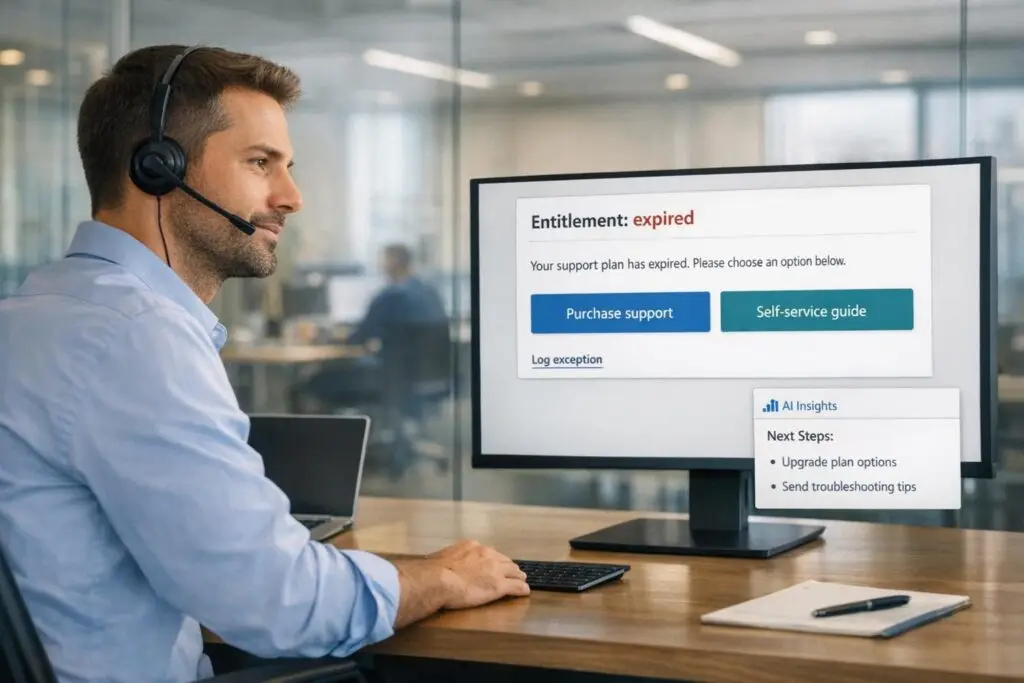
- Check the customer’s contract status and support tier before responding.
- Use tools that integrate contract data for efficiency.
- Respond Professionally:
- Acknowledge the request and explain policies without assigning blame.
- Offer actionable next steps, such as paid options or new agreements.
- Provide Alternatives:
- Suggest paid support, self-service resources, or workarounds to resolve issues.
- Use AI tools to automate responses and streamline processes.
- Track Exceptions:
- Log any exceptions to avoid setting unintended precedents.
- Review patterns to identify opportunities for contract updates or improvements.
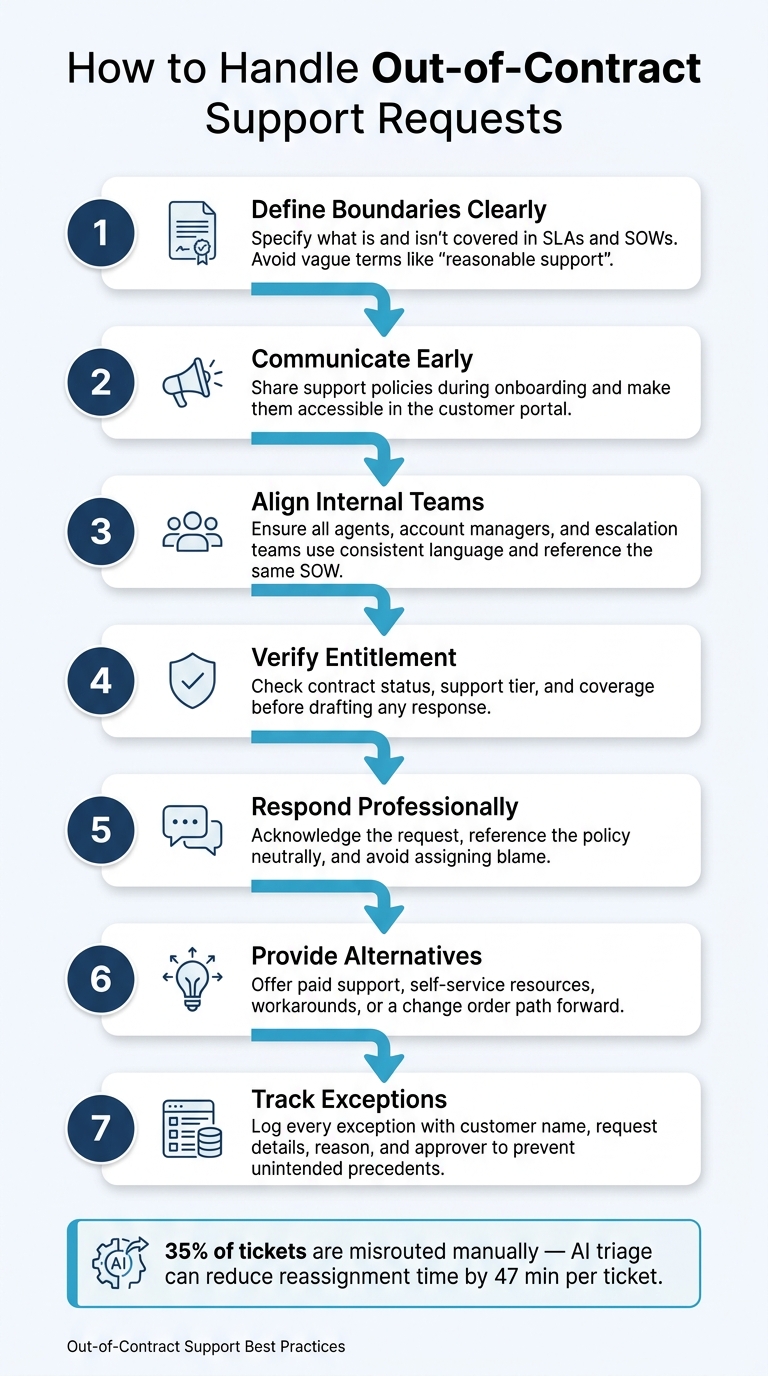
How to Handle Out-of-Contract Support Requests: 7-Step Process
Setting Clear Support Boundaries
To effectively manage out-of-contract requests, your team needs a clear and shared understanding of what "out-of-contract" actually means. Without this clarity, edge cases can lead to inconsistent decisions, which may undermine trust. Establishing and clearly defining these boundaries is essential to avoid ambiguity.
Define What Out-of-Contract Support Means
Out-of-contract support includes any request that falls outside the scope of what’s explicitly outlined in a signed agreement. This could involve an expired SLA, services not included in the customer’s purchased package, or tasks exceeding the agreed-upon service scope. The key is to ground these definitions in the Statement of Work (SOW) to avoid subjective interpretations.
Some specific categories to address in agreements include:
- Feature requests not included in the product roadmap
- Requests involving third-party libraries
- Issues related to the customer’s internal environment
- Tasks requiring new change orders, such as custom pricing negotiations
By explicitly defining these scenarios, you reduce the likelihood of disputes or misunderstandings.
"An agreement without enforceability is just a suggestion." – Sirion.ai [3]
Avoid vague language like "reasonable support" or "timely manner" in contracts. These terms are hard to enforce and often lead to unnecessary friction.
Share Policies with Customers Early
It’s critical to communicate support boundaries to customers from the start. This involves incorporating clear scope definitions into the initial contract, reinforcing them during onboarding, and making the information easily accessible in the customer portal.
When customers clearly understand what’s covered from day one, they’re less likely to feel blindsided when a request falls outside the agreement. Proactive communication can significantly reduce the number of out-of-contract requests. If such a request does arise, you can refer customers to the documentation they already have, keeping the discussion objective and professional rather than personal.
Align Internal Teams on Entitlement Rules
Clear customer-facing policies need to be backed by internal alignment to ensure consistent messaging. Even the most well-defined policy can fail if support agents, account managers, and escalation teams aren’t on the same page. Mixed messages from different team members can erode customer confidence.
To prevent this, all team members handling a customer account should reference the same SOW and use consistent language. For example, saying, "This is outside our SOW" is more effective than "We can’t help with that", as it points to the documented policy rather than individual discretion. Consistency fosters professionalism and avoids the perception of arbitrary decision-making.
Internal alignment also requires clear escalation paths. Pre-determining who handles borderline requests or approves one-time exceptions helps avoid ad-hoc decisions that might unintentionally set new precedents. This structured approach not only reinforces policy adherence but also lays the groundwork for AI-powered ticket routing and prioritization, which can be explored later.
sbb-itb-e60d259
How to Verify Entitlement and Sort Incoming Requests
Before drafting any response, it’s crucial to verify entitlements after aligning internally.
Review Contract and Account Status First
Start by checking the customer’s account against the active contract or Statement of Work (SOW). Confirm details like contract status, support tier, and whether the specific request is covered under their agreement.
Things can get messy fast when account data is scattered across disconnected systems. Agents might have to make judgment calls without all the necessary information. Avoid this by using a support platform that brings contract status, renewal dates, and entitlement details directly into the case view. For instance, Supportbench integrates licensing and account data from Salesforce, giving agents a clear picture of customer entitlements before they even begin drafting a response.
Sort Requests by Type and Priority
Not all requests outside the contract deserve the same response. For example, a customer asking for help with a licensed feature is entirely different from one requesting custom development work that’s not included in their agreement.
Organize requests into categories like break-fix issues, how-to questions, account or billing concerns, feature requests, and recurring bugs. Once categorized, apply consistent rules for each type – whether that means routing it to a paid support queue, pointing the customer to self-service resources, or escalating the case to account management.
Prioritization is equally important. Consider factors like urgency, customer value, proximity to renewal, and deployment impact. For example, a high-value customer nearing renewal may require more attention for an out-of-contract request than an account with expired support. This structured approach ensures requests are handled fairly and efficiently.
Use AI to Speed Up Request Triage
Manual triage often leads to mistakes, with 35% of tickets being misrouted and an additional 47 minutes lost per reassignment [5]. For a company handling 2,000 tickets per month, this could mean up to $320,000 in annual costs [5].
AI-powered triage eliminates these inefficiencies by going beyond simple keyword matching. It maps each ticket to an entity chain (e.g., customer → support plan → product → feature) and verifies entitlement data instantly. This ensures requests are automatically routed to the correct queue, saving agents from having to dig through account records.
"If a triage engine can’t connect support tickets to engineering work items, it’s clustering symptoms rather than diagnosing problems." – Neelabja Adkuloo, Member of marketing staff, DevRev [5]
The benefits of AI triage are evident. For example, Bolt reduced its average resolution time from 129.8 hours to 62.7 hours between February 2024 and January 2025 after adopting AI-driven routing and root cause analysis [5]. This improvement not only speeds up resolutions but also ensures out-of-contract requests are flagged and managed accurately, freeing up agents to focus on more critical tasks.
How to Respond to Out-of-Contract Requests Professionally
Handling out-of-contract requests with care is essential. A well-crafted response not only preserves the relationship but also sets the right expectations. The way you communicate "no" can make all the difference.
Start by Acknowledging the Request
Always begin by recognizing the customer’s request. Ignoring this step can make your response feel dismissive or impersonal. As highlighted by ScopeStack:
"Avoid simply saying the request is out of scope – this can seem abrupt or abrasive to the client. Instead, acknowledge the client’s request and demonstrate a willingness to discuss it. This approach shows you value their input, are open to accommodating their needs, and are working towards the same objectives."
Starting with something like, "Thank you for reaching out about [Request]. I understand how important this is and am here to support you", sets a positive and collaborative tone. It shows you’re listening, even if the request falls outside the agreed terms.
Explain the Policy Clearly and Without Blame
When it’s time to address the limits of your agreement, refer to the existing contract or Statement of Work (SOW) as a neutral point of reference. Avoid framing it as a rigid "no", but rather as a guideline for how such requests are handled. For example:
"[This task] isn’t included in our current scope of work, so we’d need to document this as a separate request."
If the request affects the budget or timeline, briefly explain why those boundaries exist, perhaps by using AI-powered ticket routing to show how resources are allocated. This approach ensures transparency and keeps the conversation constructive. Rather than treating the contract as a static document, use it as a shared tool that evolves with the partnership.
Give the Customer a Clear Next Step
Ending the conversation with just a policy explanation can leave the customer feeling stuck. Instead, provide a clear path forward. Depending on the nature of the request, you might:
- Offer a paid support package.
- Suggest speaking with account management to explore a new agreement.
- Propose a quick meeting to discuss adjustments.
For more complex requests, including a scheduling link can make it easier for the customer to take the next step. This small gesture shows you’re not dismissing their needs but are committed to finding a solution through the right channels.
Providing Alternatives and Automating the Process
Managing out-of-contract support can be tricky, but with the right alternatives and automation strategies, you can streamline the process while maintaining good relationships with your customers. These approaches help set clear boundaries and use AI tools to improve efficiency and consistency in handling requests.
Offer Paid Support or Self-Service Options
Instead of outright rejecting requests, consider offering a paid support option or guiding customers toward self-service solutions. In B2B scenarios, a paid path – such as a change order, a Statement of Work addendum, or an hourly rate – can be a practical way to address out-of-contract requests. This approach highlights the value of the work while keeping the relationship intact. For simpler issues, a well-organized knowledge base or tutorial can often resolve the problem without requiring direct agent involvement. If those options don’t work, suggesting a product workaround or referring the customer to a trusted partner can help them move forward.
The key is to focus on what you can offer before addressing what’s outside the agreement. As Etee Dubey of Kayako explains:
"Saying no to a customer means giving them an honest answer plus a workable next step, not a softened maybe, and not a closed door." [1]
| Alternative Type | Best For | Example Response |
|---|---|---|
| Paid Path | B2B / Complex Tasks | "We can treat this as a change order; we will provide a scope and quote by tomorrow." [1] |
| Self-Service | Technical / How-to | "I’d suggest taking a look at the official documentation for examples on this." [2] |
| Workaround | Feature Gaps | "While we don’t have that feature, [Existing Feature] might get you part of the way there." [1] |
Automate Responses and Escalations with AI
Manually managing these requests can lead to inconsistent outcomes. AI-driven platforms like Supportbench help eliminate this variability by automating repetitive tasks and ensuring a smoother process.
For example, when a request is submitted, Supportbench can automatically check contract status by syncing with CRM data. If the request is out-of-contract, the system can flag it and route it to Sales or Account Management for a renewal or upgrade discussion. This approach not only reduces the burden on support teams but also turns these cases into opportunities for revenue growth.
Additionally, Supportbench’s AI Agent-Copilot gathers the customer’s full case history, allowing agents to see if exceptions were previously made. This ensures that policies are applied consistently. For responses, the platform’s auto-response tools draft polite, policy-aligned messages that acknowledge the request and provide the next step – whether that’s a paid support option or a link to a self-service resource. This saves time and keeps the tone professional across all communications.
Log Exceptions and Keep Records
Whenever an exception is made – like offering a courtesy extension, waiving a fee, or providing a free fix – it’s crucial to log it. Without proper records, these exceptions can unintentionally set new expectations for customers, leading to future complications.
Consider this: businesses lose an average of 8–9% of annual revenue due to missed obligations and inefficient contract management [6]. Yet, only 11% of companies feel their contract management is "very effective" [6]. A structured exception log can address these challenges by capturing key details, such as the customer’s name, contract status, the specific request, the reason for the exception, and who approved it. Tools like Supportbench can automate this process, tagging and logging these cases to create an easily searchable audit trail without adding extra work for agents.
"Organizations need systems, not heroes." – Jose Leon, Founder, Expiration Reminder [6]
Regularly reviewing this log can also uncover patterns. For instance, if a customer repeatedly requests out-of-contract support, it may signal the need for a contract renegotiation or a proactive upgrade conversation. By maintaining a detailed record, businesses can refine their support operations and enforce policies more effectively.
Conclusion: Protecting Business Boundaries While Keeping Customers on Side
Managing out-of-contract requests effectively comes down to three key elements: clarity, consistency, and tone. When your team understands what’s covered, communicates policies without assigning blame, and provides actionable next steps, most customers will respond reasonably – even when the answer isn’t what they hoped for.
The approach is simple: verify entitlement, acknowledge the request, explain the policy clearly and professionally, suggest practical alternatives, and document any exceptions to avoid unintended precedents.
"The difference between a successful project with satisfied clients and an unsuccessful one with unhappy clients usually hinges on correctly managing out-of-scope work." – ScopeStack [4]
Scaling this process, however, can be tricky. Without consistent systems, agents may handle similar requests differently, exceptions might not be tracked, and customers could end up receiving mixed messages. AI-driven support platforms can help eliminate these challenges. Tools like Supportbench automate tasks such as checking contract details, routing complex cases to the right team, and ensuring all interactions are properly documented and easily searchable.
The aim isn’t to shield the business from customers but to strengthen relationships with them by being upfront about what’s included and what isn’t. Clear, professional boundaries build trust far more effectively than vague promises. By following these practices, support teams can stay efficient while preserving and enhancing customer relationships.
FAQs
When should we make an exception for out-of-contract support?
Exceptions for out-of-contract support should be handled with care, ensuring they are reasonable, inexpensive, and don’t create a precedent that’s hard to maintain. For example, it might make sense to make minor allowances for important clients or in situations where no other option is available. Always respond to such requests by acknowledging them, providing a concise explanation for why they can’t be accommodated, and suggesting an alternative solution or next step to uphold professionalism and keep the customer satisfied.
What should an out-of-contract reply template include?
When crafting a response for out-of-contract requests, it’s crucial to communicate clearly and professionally. The reply should:
- Acknowledge the request: Start by recognizing the client’s inquiry to show attentiveness.
- Reference contract terms: Politely explain that the request falls outside the agreed scope or exceeds available support hours, citing relevant terms from the contract.
- Summarize the current status: Provide a brief update on where things stand regarding the client’s needs or project.
- Outline next steps: Clearly explain the options available, such as deferring the task, providing a quote for additional work, or requiring formal approval to proceed.
- Request client input if needed: Specify any decisions or actions required from the client to move forward.
Throughout the reply, maintain a polite and professional tone, ensuring the client feels informed and respected. Transparency and clarity are key to avoiding misunderstandings and keeping the relationship positive.
How can AI verify entitlement and route tickets automatically?
AI streamlines the process of verifying entitlement and routing tickets by analyzing customer and ticket data in real time. It leverages tools such as natural language understanding, intent detection, sentiment analysis, and contextual data to evaluate factors like urgency, customer value, and entitlement. By automating these tasks, AI minimizes the need for manual intervention. It intelligently assigns tickets based on insights like support history, customer lifetime value, and known issues, leading to more accurate assignments and faster response times.