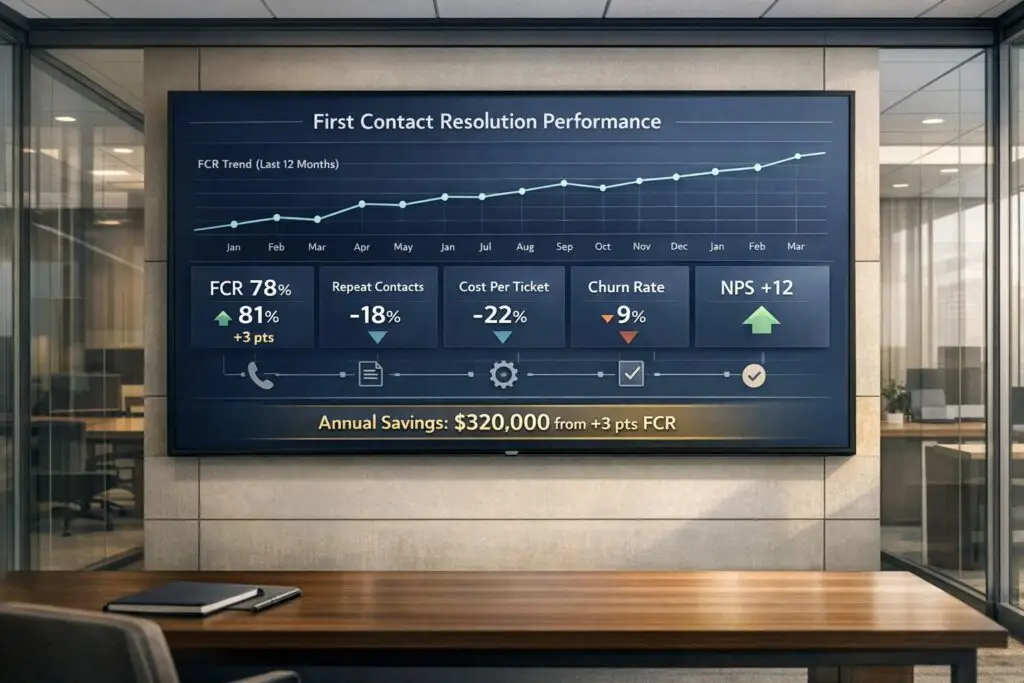
Improving First Contact Resolution (FCR) directly cuts costs, boosts customer satisfaction, and reduces churn. FCR measures how often customer issues are resolved during the first interaction. A 1% increase in FCR can save a 500-agent contact center up to $286,000 annually. Repeat interactions, which make up 23% of operating costs, not only drain budgets but also frustrate customers, leading to churn and lost revenue.
Key points:
- Low FCR costs more: Each unresolved issue averages 1.5 follow-up calls, adding significant expenses.
- Customer loyalty suffers: 70% of customers switch brands after one bad experience.
- AI knowledge-centric solutions improve FCR: Real-time guidance and intelligent routing help resolve issues faster, saving money and improving satisfaction.
For businesses, improving FCR isn’t just about better service – it’s a way to save money, retain customers, and protect revenue. Even small improvements in FCR can deliver measurable financial returns.
Why is First Contact Resolution Important and How Do You Measure It?
sbb-itb-e60d259
What is First Contact Resolution (FCR)?
First Contact Resolution (FCR) measures the percentage of customer issues resolved during their first interaction [1]. Chris Kontes, Co-Founder of Balto, explains that FCR isn’t about rushing through interactions but about solving problems effectively:
"The goal is to resolve the issue right the first time, not just close the ticket" [1].
In industries like SaaS and Tech, FCR acts as a key indicator of efficiency. A low FCR often points to problems like inadequate training, poor documentation, or ineffective ticket routing, which prevent customers from connecting with the right expert [1]. On the other hand, a high FCR reduces "cost-to-serve" by cutting down on repeated interactions. This allows agents to spend more time addressing complex issues rather than handling repetitive follow-ups [9].
To measure FCR accurately, businesses need to track unique ticket IDs across all communication channels. Many adopt a 48–72 hour resolution window, only marking a case as resolved if the customer doesn’t reach out again within that timeframe [1][4]. Companies also distinguish between two types of FCR:
- Gross FCR: Includes all cases, even those that are inherently unresolvable.
- Net FCR: Focuses only on resolvable cases, offering a clearer picture of agent performance [1].
This distinction helps refine FCR as a metric, paving the way for better measurement and benchmarking practices.
FCR Metrics and Industry Benchmarks
On average, the FCR rate across industries is just under 70%, with rates between 70% and 79% considered "Good", and anything above 80% deemed "World-Class" [3][9][4]. However, these benchmarks vary depending on the industry and the complexity of customer interactions.
| Industry | Average FCR Rate |
|---|---|
| Retail & Ecommerce | 75–85% |
| Technology & SaaS | 70–85% |
| Financial Services | 70–80% |
| Healthcare | 65–78% |
| Telecommunications | 65–75% |
Technical support interactions tend to have lower FCR rates, averaging around 60%, due to the complexity of the issues involved. In contrast, general inquiries average about 73%, while complaint calls lag behind at just 47% [2][5].
Interestingly, contact centers that use conversation analytics tools report an average FCR of 76%, compared to only 23% for those that don’t utilize such technology [5]. This highlights the transformative impact that advanced tools can have on resolution rates.
How FCR Affects Customer Satisfaction and Retention
FCR plays a critical role in boosting customer satisfaction (CSAT) and Net Promoter Scores (NPS) by reducing customer effort and eliminating the frustration of repeating issues [9][1]. The connection is quantifiable: a 1% improvement in FCR leads to a 1.4-point increase in NPS [2].
The stakes are even higher in B2B relationships. Between 50% and 70% of customers will switch to a competitor after just one poor support experience [3][4]. This is particularly concerning when you consider that 39% of customers cite "having to repeat the issue" as their biggest frustration during support interactions [3].
The Financial Cost of Low FCR Rates
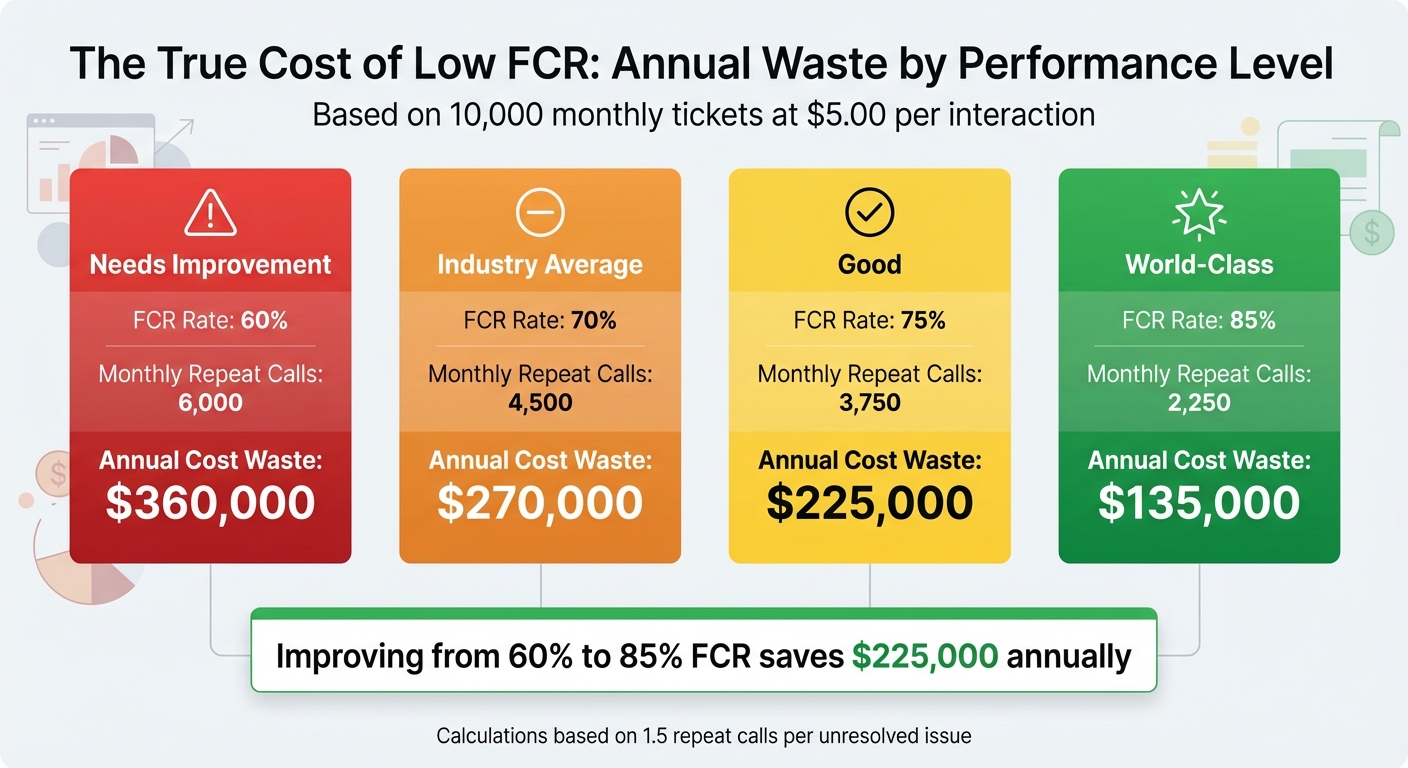
Financial Impact of FCR Rates: Cost Comparison Across Performance Levels
Low First Contact Resolution (FCR) rates can significantly inflate costs by creating the need for more customer follow-ups. On average, unresolved inquiries require 1.5 additional calls per issue, which leads to extra workload and expenses for support teams [6][5].
The financial impact is substantial. Repeat calls consume around 23% of an average contact center’s operating budget [5]. With the typical cost per resolution hovering at $5.00 (ranging from $3.00 to $9.00 depending on complexity) [3], even a mid-sized support operation could be losing hundreds of thousands of dollars annually on unnecessary rework. This problem doesn’t just strain budgets – it also increases agent workloads and overall operating costs.
Higher Operating Costs from Repeat Contacts
Unresolved issues lead to repeated interactions. When agents have to revisit cases or customers call back, the total handle time for a single issue can double [3]. This isn’t just about paying for extra agent time – it’s also about the inefficiencies caused by managing multiple interactions and the productivity lost to constant context switching.
Let’s break it down: a support center handling 10,000 tickets per month with a 70% FCR rate (the industry average) leaves 3,000 tickets unresolved. With an average of 1.5 follow-up interactions per unresolved ticket, this generates 4,500 additional contacts [6][5]. At $5.00 per interaction, that’s an extra $22,500 per month, or $270,000 annually, spent on issues that should have been resolved during the first contact [3].
Lost Revenue from Customer Churn and Missed Opportunities
The costs go beyond operations – low FCR can also erode revenue. Nearly a third of customers require multiple interactions to resolve a single issue [3], and every repeat contact increases frustration. In B2B settings, where strong relationships are crucial, this frustration often leads to customer churn. Research reveals that 57% of customers abandon purchases due to poor support, and 70% would switch brands after just one bad experience [3].
Additionally, overwhelmed support teams miss opportunities to upsell or engage proactively. Instead of focusing on enhancing customer relationships and driving revenue growth, agents are stuck revisiting the same problems with dissatisfied customers.
"Ignoring First Contact Resolution is paying twice for the same problem – once in agent hours, again in customer loyalty" [3].
Cost Comparison: Low FCR vs. High FCR
The financial disparity between low and high FCR performance is striking. For example, an organization operating at 60% FCR (below the industry average) generates 6,000 repeat calls per 10,000 tickets, equating to an annual waste of $360,000. In contrast, a "World-Class" performer with an 85% FCR rate reduces repeat calls to 2,250, resulting in just $135,000 in annual waste – a savings of $225,000 [3][6][5].
| Performance Level | FCR Rate | Monthly Repeat Calls (per 10k tickets) | Estimated Annual Cost Waste |
|---|---|---|---|
| Needs Improvement | 60% | 6,000 | $360,000 |
| Industry Average | 70% | 4,500 | $270,000 |
| Good | 75% | 3,750 | $225,000 |
| World-Class | 85% | 2,250 | $135,000 |
Calculations based on 1.5 repeat calls per unresolved issue at a $5.00 cost per call [3][6][5].
Financial Benefits of Higher FCR Rates
Boosting your First Contact Resolution (FCR) rate isn’t just about improving service – it’s a direct path to significant cost savings. For instance, every 1% increase in FCR can cut operating expenses by 1% [5]. For a mid-sized operation with 500 agents, that translates to about $286,000 in annual savings [2][3]. These savings not only reduce costs but also create a foundation for stronger customer engagement and more stable revenue.
Lower Operating Costs
When issues are resolved on the first contact, the ripple effect is clear: fewer repeat interactions and lower costs. Without FCR, unresolved cases typically lead to 1.5 extra interactions per issue [6][5]. By solving problems upfront, businesses reduce the "cost to serve" and avoid overstaffing to manage unnecessary follow-ups [1][3].
Additionally, agents spend less time on redundant tasks. Currently, 60–70% of escalations are reworked by agents, which adds unnecessary labor costs [3]. Empowering agents with the tools and authority to handle issues during the first contact minimizes these inefficiencies. It also eliminates the hidden costs of context switching, where agents lose productivity when juggling multiple unresolved cases.
Better Retention and Higher Customer Lifetime Value
Beyond cost savings, higher FCR strengthens customer loyalty and protects revenue streams. Addressing issues on the first attempt prevents customers from seeking alternatives. A staggering 80% of customers who left a company due to poor service said they would have stayed if their issue had been resolved right away [10].
In B2B environments, where long-term relationships and contract renewals are key, this is especially important. Improved FCR also boosts Net Promoter Scores (NPS): for every 1% increase in FCR, NPS rises by 1.4 points [2]. Satisfied customers are more likely to renew contracts, expand their business, and stick around for the long haul, increasing their lifetime value while reducing the constant churn-and-replace cycle.
Increased Referrals and Reduced Acquisition Costs
Happy customers don’t just stick around – they spread the word. When issues are resolved quickly and efficiently, customers are more likely to recommend your business to others. This organic growth reduces the need for costly acquisition campaigns. For example, cross-selling acceptance rates jump by 20% when a customer’s problem is resolved on the first contact [10].
As customer care expert Cyril Fontaine puts it:
"It is easier to sell when we have responded effectively to the customer’s initial request" [10].
High FCR transforms customer support from a cost center into a driver of growth. By creating loyal advocates, businesses not only enhance referrals but also lower the expenses tied to acquiring new customers.
How AI Improves FCR and Reduces Costs
AI is reshaping customer support by enhancing first contact resolution (FCR) rates, which directly reduces costs and strengthens customer trust. By automating repetitive tasks, offering real-time guidance, and providing instant access to essential information, AI eliminates many of the causes behind repeat customer contacts. The outcome? Faster resolutions, reduced operational costs, and scalable support systems that don’t require constant headcount increases.
AI Tools That Improve FCR
AI tools are designed to give support agents everything they need to resolve issues on the first attempt. For instance, AI Copilots act as on-the-spot assistants, drafting responses, summarizing previous interactions, and pulling up relevant knowledge base articles – saving agents from tedious manual searches [4][7][11]. Supportbench‘s AI Agent-Copilot takes this further by connecting to historical cases and internal knowledge, suggesting precise responses that help agents resolve issues more efficiently.
Intelligent routing uses Natural Language Processing (NLP) to interpret customer intent and urgency, ensuring inquiries are directed to the right agent from the start [5][11]. Meanwhile, autonomous AI agents handle repetitive, high-volume tasks like password resets and order tracking independently, delivering instant resolutions without human involvement. Additionally, unified knowledge access simplifies the process by consolidating data from multiple sources into a single, reliable system [4][7][13]. Supportbench’s AI First Contact Resolution Detection even analyzes conversation outcomes to confirm whether an issue was fully resolved on the first contact.
Take Comcast, for example. By integrating over 20 desktop applications into a single AI-powered tool, the company saw 91% of its agents rely on AI data for first-contact resolutions [12]. Similarly, toll road operator 407 ETR used AI to boost compliance and increase FCR rates by 5% to 15% [12]. These tools do more than improve FCR – they also significantly cut costs.
Cost Savings from AI Automation
The cost benefits of AI automation become clear when you look at reduced handling times and lower support expenses. For instance, AI chatbots cost under $1 per interaction, compared to $6–$12 or more for phone support [13]. AI-assisted tools can also reduce Average Handle Time (AHT) by up to 25% [13], enabling agents to manage more cases without compromising service quality.
Repeat calls are a major expense, accounting for about 23% of an average call center’s budget [5]. AI solutions can lower repeat call rates by roughly 25%, leading to significant savings [5]. Even a 1% improvement in FCR can reduce operating costs by 1%, which translates to over $280,000 in annual savings for a mid-sized call center [5][12].
Supportbench offers these AI-driven benefits at a cost-effective price point, starting at $32 per agent per month – without requiring additional costly add-ons. With built-in features like case summaries, agent copilots, and automated knowledge base tools, teams can improve FCR without stretching their budgets. By focusing on this "magic metric", AI helps turn support operations into efficient systems that resolve problems faster, protect customer relationships, and reduce costs.
How to Measure and Calculate FCR’s Financial Impact
How to Track and Measure FCR
To calculate First Contact Resolution (FCR), use this straightforward formula:
FCR% = (Total issues resolved on first contact / Total issues handled) × 100 [1].
For accurate tracking, monitor follow-ups within a 48–72 hour window and confirm resolutions through post-call surveys. It’s also helpful to distinguish between total cases and those that are resolvable, as this provides a clearer picture of performance.
AI-native tools make FCR tracking even easier. For instance, platforms like Supportbench use AI to analyze interactions. Their AI First Contact Resolution Detection evaluates conversation outcomes to confirm whether issues were resolved during the initial contact. This eliminates guesswork and ensures precise measurement, which is critical for assessing FCR’s financial impact.
Methods for Improving FCR in B2B Operations
Once you have reliable FCR data, the next step is addressing its root causes. Studies show that FCR failures often stem from three main areas: agent knowledge gaps (38%), customer miscommunication (13%), and organizational policies that restrict frontline resolution (49%) [12]. Tackling these challenges can lead to noticeable improvements.
Here are some strategies to boost FCR:
- Dynamic SLAs: Adjust response priorities based on context, such as accelerating timelines for customers nearing renewal dates. This ensures high-value accounts receive the attention they need.
- Streamlined Workflows: Empower agents to resolve issues like refunds or exceptions without requiring transfers. This reduces repeat contacts and improves customer satisfaction.
- AI-Driven Agent Training: Use AI-enabled conversation analytics [5] to identify common issues that lead to follow-ups and provide targeted training to address them.
- Real-Time AI Copilots: AI tools that surface relevant knowledge base articles during live interactions can cut down on transfers and callbacks.
- Proactive Updates: For cases requiring additional steps – such as technical fixes or refunds – proactively updating customers on the status of their issue can help minimize repeat inquiries.
Calculating ROI from FCR Improvements
Once FCR is accurately tracked, you can calculate its financial impact by linking improvements to cost savings. Start by determining your cost per call, which averages around $5.00 (with a range of $3 to $9) [3]. Then, compare your FCR to industry benchmarks: 70–79% is solid, while 80%+ is considered exceptional.
Here’s an example: A midsize contact center handles 3,000,000 calls annually at an average cost of $6 per call. Improving FCR by just 1% – say, from 68% to 69% – results in 30,000 additional resolved calls (3,000,000 × 0.01). By applying a 1.5 repeat multiplier, this translates to 45,000 fewer repeat interactions. The result? About $270,000 in annual savings.
"For every 1% improvement in FCR, you reduce your operating costs by 1%." – Mike Desmarais, CEO, SQM Group [12]
When factoring in AI, the savings can be even greater. Human-handled tickets typically cost $6 to $12, while AI-powered resolutions range from $0.99 to $2.00 [8]. With Supportbench’s pricing – starting at $32 per agent per month, including all AI features – you can easily project ROI based on your current ticket volume and resolution costs. Even small improvements can lead to substantial financial benefits.
Conclusion
Improving First Contact Resolution (FCR) offers clear benefits: reduced costs, stronger customer loyalty, and measurable returns. Consider this – repeat calls account for 23% of operating budgets, and just a 1% improvement in FCR can save mid-sized operations more than $286,000 annually [3][5][12]. The stakes are high, with 40% of customers leaving after unresolved issues [12].
"I consider First Contact Resolution (FCR) the ‘magic metric’ for call centers, because it has impact on both quality and costs." – Bruce Belfiore, CEO, BenchmarkPortal [6]
AI tools make achieving these results more attainable. For example, Supportbench offers AI-driven solutions that enhance FCR at just $32 per agent per month, delivering real-time data and automated support. These tools can cut call costs by up to 50% while boosting customer satisfaction [3][4].
To truly capitalize on FCR, organizations need a structured approach: measure current FCR rates, identify the root causes of repeat calls, and implement AI solutions to fill knowledge gaps and streamline processes. Even small improvements in FCR can lead to significant cost savings and long-term customer loyalty. In today’s competitive B2B environment, treating FCR as a core operational philosophy isn’t just smart – it’s necessary for long-term success.
FAQs
How do I calculate the real ROI of improving FCR in my support team?
To figure out the ROI of improving First Call Resolution (FCR), start by gathering some key baseline metrics: your current FCR rate, the cost per ticket, and customer retention rates. These numbers give you a starting point to measure progress.
Next, track the changes that occur as you improve FCR. Look at reductions in repeat tickets and follow-ups – these directly translate into cost savings. To quantify this, multiply the drop in follow-up requests by the average cost per ticket.
But don’t stop there. Consider the bigger picture: better FCR often leads to happier customers, which can boost retention and lifetime value. Tools powered by AI can help you dig deeper into these numbers, offering clearer insights into cost reductions and how customer satisfaction improves over time.
What’s the best way to measure FCR across email, chat, and phone?
To measure First Contact Resolution (FCR) across email, chat, and phone, calculate the percentage of issues resolved during the first interaction using this formula:
FCR = (Issues Resolved on First Contact / Total Issues Handled) x 100
For accurate tracking, it’s crucial to standardize what "resolved" means across all channels. Tools like conversation analytics can help monitor and evaluate outcomes consistently.
Which AI features most reliably increase FCR without adding headcount?
AI tools that consistently improve First Call Resolution (FCR) without requiring more staff include intelligent routing, AI-driven agent assistance, and self-service options like chatbots and virtual agents. These technologies simplify problem-solving, enabling quicker responses for customers while keeping staffing levels unchanged.