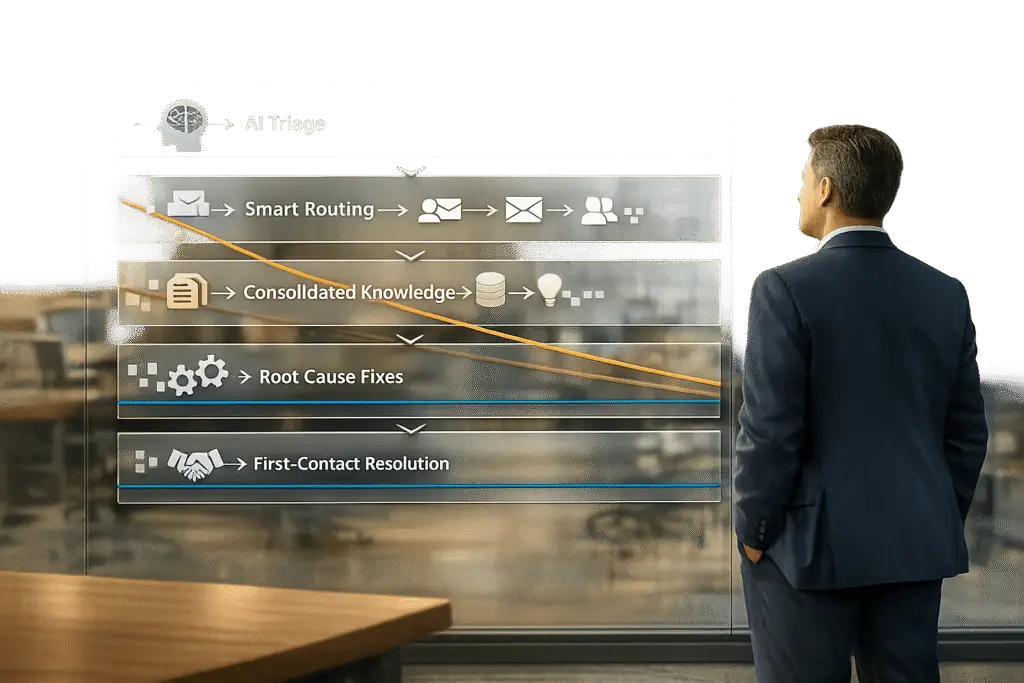
Reducing repeat contacts while keeping handle time under control is a balancing act. Here’s how you can achieve it:
- Identify why customers call back: Use data to find patterns, such as common issues or unresolved problems. Analyze call transcripts for phrases like "I already called about this."
- Improve first-contact resolutions: Ensure agents fully resolve issues by asking, "Is there anything else I can help you with?" and avoid leaving tasks incomplete, like sending follow-up links.
- Use AI to assist agents: AI tools can detect potential repeat issues, recommend solutions, and route cases to the right person, saving time and improving outcomes.
- Track the right metrics: Focus on Repeat Call Rate (RCR), First Contact Resolution (FCR), and Customer Effort Score (CES) to measure success.
- Refine workflows: Streamline processes, update knowledge bases, and assign clear ownership of cases to avoid confusion and delays.
- Follow up proactively: Send confirmation messages or check-ins to verify that issues are resolved and prevent unnecessary callbacks.
This approach helps reduce customer frustration, improves satisfaction, and lowers support costs without sacrificing efficiency.
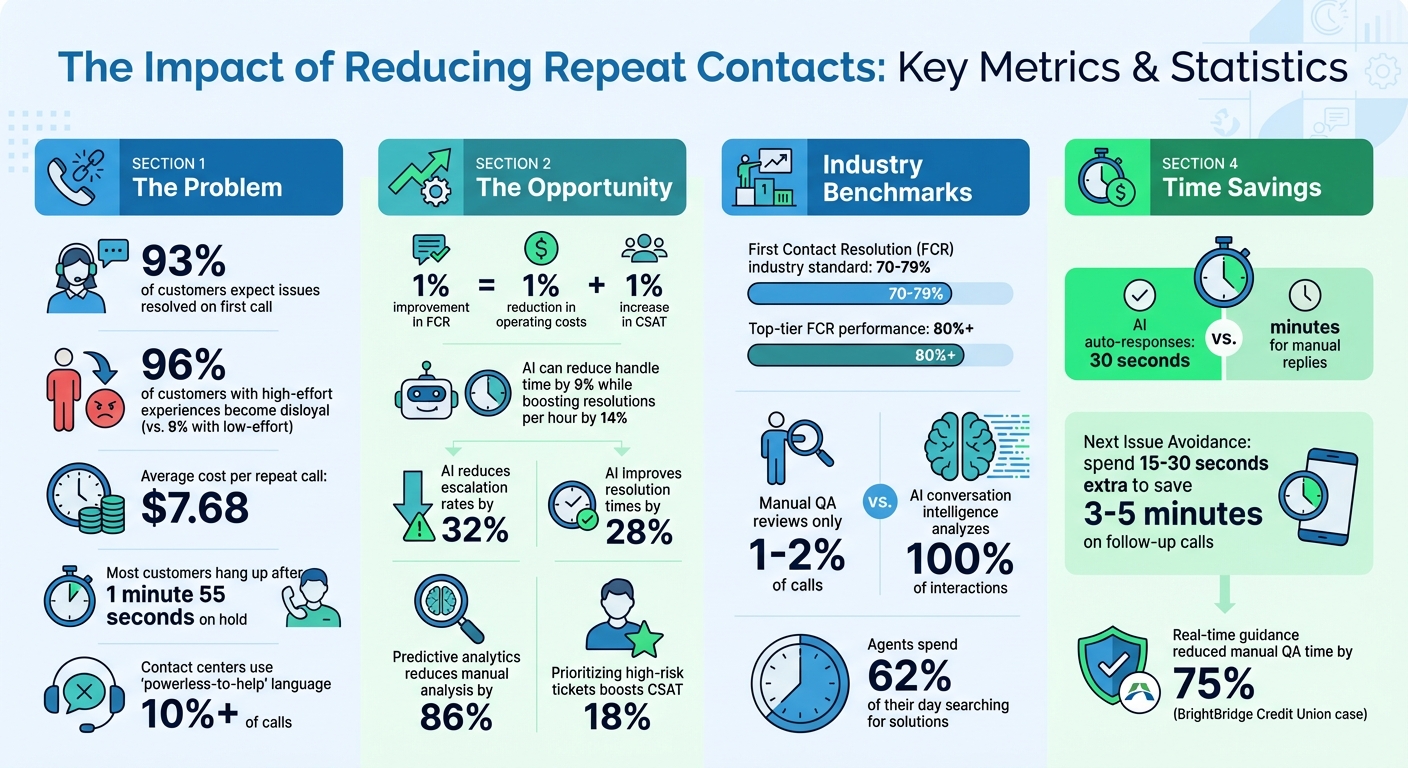
Key Metrics and Impact of Reducing Repeat Customer Contacts
How To Reduce Call Center AHT & Stop Repeat Calls? – Call Center Pro Strategies
Finding the Root Causes of Repeat Contacts
Before jumping into solutions, it’s essential to understand why customers keep reaching out to support. This involves a structured approach that combines data analysis, quality checks, and a review of workflows.
Analyzing Historical Data and Trends
Start by calculating the Repeat Call Rate (RCR) using the formula: (repeat calls ÷ total calls) × 100. This is typically measured over a specific timeframe, such as 7, 14, or 30 days. Use identifiers like Customer ID or ticket numbers to connect interactions and uncover patterns. For instance, a single issue might lead a customer to switch between channels. Intent tagging can further categorize conversations into scenarios like billing disputes, login issues, or onboarding challenges, helping you identify the top reasons customers call back.
"We’re using Creovai to understand not only the cost, sentiment, and potential NPS impact of repeat callers, but also what we can do about it to help get that number down."
- Keith Parris, VP of Contact Center Operations and Technologies at BCU
Parris’ team evaluates the cost impact by analyzing total call volume and the time spent on these interactions.
Look for "repeat trigger" phrases in call transcripts. AI tools can flag statements like "I already called about this", "this is my third call", or "it still isn’t working". Additionally, monitor transfer hold times – most customers hang up after 1 minute and 55 seconds, which often results in another call.
This kind of data analysis lays the groundwork for more effective quality assurance (QA) reviews to address gaps in resolutions.
Conducting QA Reviews and Feedback Analysis
Update QA scorecards to focus on resolution completeness and the likelihood of repeat contacts. Pay close attention to transcripts for "powerless-to-help" language – phrases that indicate an agent couldn’t fully resolve the issue. On average, contact centers use this type of language in over 10% of calls, which often leads to customers calling back to find someone who can actually help.
Ensure agents are asking, "Is there anything else I can help you with today?", before ending calls. This simple question can help catch secondary issues before the interaction closes. Since manual QA typically reviews only 1–2% of calls, consider using conversation intelligence tools to analyze 100% of interactions. These tools can identify signs of frustration, confusion, or unresolved issues.
Also, examine self-service metrics like "reopen notes" and "no results" searches. These can highlight gaps in documentation that may be causing customers to call back.
Insights from QA can then guide a deeper review of resolution workflows.
Auditing Resolution Processes and Workflows
Map out customer journeys across different channels and analyze routing data to uncover handoff issues that lead to repeat contacts. Compare system-logged "closed" statuses with actual customer outcomes. Just because a case is marked as resolved in your CRM doesn’t mean the customer agrees – it could still result in a repeat call.
Pressure to minimize Average Handle Time (AHT) can sometimes lead to incomplete resolutions. Use the "5 Whys" technique to dig into the root causes of these process issues.
Review workflows where agents send follow-up links for tasks like payments, document signing, or account verification.
"The moment a customer hears, ‘We’ll send you a link after this call,’ you’ve broken the resolution loop."
These pending tasks often fail, leading to unnecessary repeat calls that cost about $7.68 per interaction.
Building Feedback Loops to Confirm Resolutions
Refining workflows and addressing root causes is only part of the equation – it’s just as important to confirm that solutions actually work. Marking a ticket as "Solved" doesn’t guarantee the issue is permanently resolved or that the customer won’t reach out again. To truly close the loop, you need systems in place to verify that fixes stick and customers remain satisfied. Here’s how to make that happen.
Trigger-Based Confirmation Messages
Automated messages – sent via email, SMS, or within your app – can be a game-changer. These messages go out right after a support interaction ends, reassuring customers that their issue is being addressed and giving them an easy way to flag unresolved problems.
For example, if an agent promises a refund, you could send a follow-up SMS 24 hours later confirming the refund has been processed. Include an option for the customer to reply if the issue isn’t resolved. This approach reduces "uncertainty calls", where customers contact support just to check on actions like password resets or order updates.
Keep an eye on how often customers use the "Reply if Unresolved" feature. If it’s happening frequently, it might point to gaps in your processes or highlight agents who need additional training.
Post-Resolution Validation Workflows
For more complex issues, like refunds or system updates, automate backend checks to ensure promises are fulfilled. For instance, if a refund is supposed to process within 48 hours, set up a webhook to check your ERP system and flag tickets where the refund hasn’t gone through.
Additionally, schedule follow-ups 24–48 hours after resolving complex issues to confirm everything is running smoothly. This is especially critical for enterprise clients, where unresolved problems can lead to churn. Research shows that improving first contact resolution by just 1% can translate to a 1% reduction in total operating costs.
Updating Knowledge Bases with Feedback Insights
Customer feedback is a goldmine for improving internal resources. Use insights from confirmation messages and validation workflows to keep your knowledge base up to date. If customers frequently report that an issue is "still not working", it’s a clear sign that your documentation might need a refresh.
Monitor failed chatbot interactions and "no results" searches to identify gaps in your knowledge base. Then, create new articles using the exact language your customers are using to search for solutions.
Set up regular review cycles to keep your knowledge base accurate and effective. For example:
- Address articles flagged as "not helpful" every 30 days.
- Review your top 20 articles for accuracy every 90 days.
Each article should include a concise summary for AI tools, clear step-by-step instructions, and expected outcomes. If agents frequently skip suggested articles, capture their reasoning to identify what’s missing or unclear in your documentation.
These steps not only improve customer satisfaction but also equip your team with better tools to deliver consistent results.
Optimizing Workflows and Routing to Reduce Repetition
Even the best feedback loops can crumble if internal processes aren’t up to par. When agents spend too much time searching for answers, cases get misrouted, or no one takes responsibility for resolution, handle times skyrocket, and customer frustration grows. The solution isn’t hiring more staff – it’s smarter workflows and better routing. By focusing on these process improvements, you can speed up resolutions, reduce follow-up contacts, and improve overall efficiency. Let’s dive into key strategies like centralizing your knowledge base, refining routing, and assigning clear ownership.
Reorganizing Knowledge Base Content
A knowledge base is only helpful if agents can quickly find the right answers. Scattered information in ticketing systems, Slack threads, or outdated CRM notes forces agents to spend up to 62% of their day searching for solutions. This inefficiency calls for consolidation.
Create a single, searchable hub for all your content. Make sure articles are detailed, with step-by-step instructions and clear outcomes. Regularly review "failed searches" – queries where agents or customers couldn’t find answers – and use this data to build a weekly repair list to address gaps. If agents skip suggested articles or spend too long on calls, it’s a sign your content might be outdated or too vague.
For instance, instead of vaguely explaining password resets, provide a detailed walkthrough, complete with what the customer should see at each step. This approach shifts your knowledge base from providing information to delivering actionable instructions, helping agents resolve issues faster. Regular updates and a centralized system ensure your content stays relevant and effective.
Using Context-Aware Routing
Traditional routing systems often lead to unnecessary transfers and repeated explanations, which frustrate customers. Context-aware routing changes this by matching cases with the agent most likely to resolve them on the first attempt, using real-time data like customer history, issue type, and sentiment.
For example, if a customer calls back about a billing issue from three days ago, the system should route them to the same agent – or at least to someone with billing expertise who can see the full interaction history. This approach eliminates the "support maze", where customers have to re-explain their problem to multiple agents. Studies show that each additional call required to resolve an issue reduces customer satisfaction by 16%.
Start small by focusing on two high-volume categories where transfers are common. Define specific routing rules and provide agents with a "context bundle" that includes account details and interaction history. If AI triage isn’t confident about the issue, route the case to a generalist instead of guessing – misrouted cases waste more time than a careful handoff. Effective routing not only improves resolution rates but also sets the stage for seamless case ownership.
Assigning Case Ownership
Without clear ownership, cases often get passed around until customers lose patience. Assigning ownership ensures one agent is responsible for resolving an issue from start to finish, including follow-ups to confirm the problem is fully resolved. This approach strengthens first-contact resolution and supports broader operational goals.
Ownership doesn’t mean isolating agents – it means empowering them to act without constant escalations. For instance, allowing agents to issue small refunds or reset passwords without manager approval can turn a "call back later" scenario into a one-and-done resolution.
"If you grant the agent three approvals a day without asking, it not only empowers the agent, it improves morale and supercharges the customer experience, without much of a risk."
- Geoff Maxwell, Microsoft
Implementing last-agent routing can also reconnect repeat callers with the same agent, cutting down on re-explanations and reinforcing continuity. When agents know they’re responsible for the outcome, they’re more likely to address the root cause of the issue rather than just treating the symptoms. This proactive approach is key to reducing repeat contacts and improving customer satisfaction.
sbb-itb-e60d259
Using AI to Prevent Repeat Contacts and Speed Up Resolutions
AI helps reduce repeat customer contacts by identifying escalation risks, offering immediate solutions, and predicting potential problems. With advanced tools, AI can assess urgency, route cases efficiently, and address issues before they grow. When paired effectively with human teams, AI can decrease escalation rates by up to 32% and improve resolution times by 28%, significantly cutting down on repeat interactions. Let’s dive into how AI triage, automated responses, and predictive analytics work together to achieve this.
AI Triage, Sentiment, and Escalation Detection
From the moment a ticket is submitted, AI can analyze its content, assess its urgency, and gauge the likelihood of escalation. Using automated intent and sentiment detection, AI ensures cases are routed correctly on the first attempt, avoiding unnecessary transfers or errors that force customers to repeat themselves. For example, if AI identifies a billing issue combined with negative sentiment and multiple prior contacts, it flags the ticket as high-risk, sends it to a senior agent, and gathers missing details – like requesting an order number for a refund – before the agent even engages.
During live interactions, AI continuously monitors sentiment and response delays, flagging potential escalation risks. If a customer mentions phrases like "I already called about this" or "It’s still not resolved", the system provides real-time prompts to help agents confirm the resolution before the conversation ends.
A great example of this in action is BrightBridge Credit Union. In 2025, they implemented Balto’s real-time guidance to address repeat contact issues. The AI offered on-screen prompts to agents, enabling them to confirm resolutions and clarify next steps. This approach reduced manual QA time by 75% and significantly improved first-call resolution rates, as agents were able to resolve issues during the initial interaction, cutting back on callbacks entirely.
AI Auto-Responses and Knowledge Base Integration
Fast, precise responses are critical to reducing follow-up contacts. AI-driven auto-responses use Retrieval-Augmented Generation (RAG) to pull verified information directly from your knowledge base, ensuring responses align with company policies and avoid inaccuracies. Instead of spending minutes crafting replies, agents can review and send AI-generated responses in just 30 seconds, saving time while maintaining accuracy. If the AI lacks confidence in its answer, it escalates the case to a human agent with a full transcript, avoiding potentially incorrect guesses.
This system also identifies gaps in your knowledge base. When AI encounters searches or chatbot interactions that yield no results, it flags these as opportunities to create new articles, ensuring agents always have the resources they need for effective first-contact resolutions.
AI also helps prevent follow-up calls by addressing secondary issues during the initial interaction. For example, if a customer calls to reset a password, the AI might prompt the agent to confirm the customer’s email address is up to date and explain how to enable two-factor authentication. By resolving related issues proactively, AI reduces the chances of customers needing to call back later.
Predictive Analytics for CSAT and FCR
AI isn’t just reactive – it anticipates problems before they arise. Predictive analytics can estimate customer satisfaction (CSAT) and first-contact resolution (FCR) outcomes by analyzing case history, sentiment, and interaction trends. This allows teams to intervene early and prevent cases from escalating into repeat contacts.
Modern platforms analyze factors like sentiment changes, response delays, and issue severity to score tickets for escalation risk. This predictive approach reduces the need for manual analysis by 86%, lowers escalation rates by 32%, and accelerates resolution times by 28%. Prioritizing high-risk tickets can also boost customer satisfaction by 18%.
"A 1% increase in FCR can lead to a 1% reduction in operating costs and a 1% increase in Customer Satisfaction (CSAT)."
- Balto
These predictive capabilities not only improve customer satisfaction but also streamline operations, resulting in fewer repeat interactions and reduced costs.
Measuring Success and Improving Over Time
Cutting down on repeat customer contacts isn’t a one-and-done effort – it’s an ongoing process. Regularly tracking the right metrics keeps you on course, helps pinpoint areas for improvement, and shows leadership the tangible results of your efforts.
Key Metrics to Track
One of the most critical metrics is Repeat Call Rate (RCR), which measures the percentage of customers who reach out again within a specific timeframe (like 7, 14, or 30 days) about the same issue. This ties closely to First Contact Resolution (FCR), which tracks how often issues are resolved during the first interaction. Industry benchmarks for FCR usually fall between 70% and 79%, with anything above 80% considered top-tier. Even a modest 1% improvement in FCR can lead to lower operating costs and happier customers, proving how impactful first-contact resolutions can be.
To get the full picture, pair FCR with metrics like Average Handle Time (AHT) and Customer Effort Score (CES). These help ensure that speedy resolutions don’t come at the cost of quality. High-effort experiences are a major red flag – 96% of customers who encounter them report disloyalty, compared to just 9% who experience low-effort interactions.
Other valuable metrics include Next Issue Avoidance (NIA), which measures how well agents anticipate and address potential follow-up problems during the initial contact, and Durable Resolution Rate, which tracks tickets that don’t result in a follow-up within 14 days. Another essential metric is Cost Per Resolution, calculated by dividing total operational costs by the number of resolved issues. Reducing repeat contacts directly impacts this figure, cutting operational expenses.
These measurements work hand-in-hand with AI tools and workflow improvements to keep repeat contacts in check. Regular analysis and quick adjustments ensure long-term success in resolving issues on the first try.
Collaborating with Product Teams
Support teams often find themselves solving problems they didn’t create – like unclear policies, product glitches, or onboarding hiccups. Tackling these systemic issues requires collaboration with product and engineering teams. One way to do this is by enabling agents to flag recurring system-related problems in the ticketing system, such as confusing billing processes or rare product bugs.
Quantify the financial impact of these repeat issues to push for cross-departmental fixes.
"Too often, the contact center bears the weight of resolving issues it didn’t create. A confusing policy, product edge case, or an unaddressed friction point in onboarding."
- Sycurio
Structured feedback loops, like weekly triage meetings or shared friction boards, can help teams identify and prioritize the root causes of repeat contacts. Real-time dashboards that show emerging trends keep everyone focused on the biggest obstacles, while quarterly reviews centered on FCR can uncover technology gaps or policy-related challenges.
Use these insights to automate solutions that proactively reduce repeat calls.
Automating Proactive Outreach
Automation is a game-changer when it comes to preventing repeat contacts. AI can identify customers likely to call back by analyzing patterns, sentiment, or risk signals – like someone saying, “I’ll check again tomorrow”. Automated follow-ups via email or SMS can confirm that an issue has been resolved, cutting down on unnecessary calls.
You can also automate updates like shipping notifications, status alerts, and incident reports to handle routine inquiries before they arise. For more complex situations, set up workflows that automatically check in with customers to confirm everything is working as expected.
Another effective tool is last agent routing, which reconnects repeat callers with the same agent they spoke to previously. This eliminates the need for customers to re-explain their situation and can reduce handle time for follow-up calls.
To track the impact of these efforts, publish a Monthly Deltas Report that highlights improvements and setbacks. Connect automation efforts to specific outcomes – like self-service password resets or billing inquiries resolved without human help. Sharing these reports with leadership and other teams not only demonstrates progress but also uncovers fresh opportunities for automation.
Conclusion
Reducing repeat contacts without increasing handle time isn’t about choosing between speed and quality – it’s about balancing both. By addressing root causes, streamlining workflows, and using AI wisely, you can resolve customer issues faster and more thoroughly.
Even small improvements in first contact resolution (FCR) can cut costs and improve customer satisfaction. For instance, AI can reduce handle time by about 9% while boosting resolutions per hour by 14%. These benefits are sustainable when efficiency and quality metrics are aligned.
The real transformation happens when support teams shift from reactive fixes to proactive strategies, combining AI tools with optimized workflows. For example, conversation intelligence can analyze 100% of interactions, uncovering trends that manual QA – limited to 1–2% of cases – would miss. Intent-based routing ensures customers are connected to the right specialist immediately, while Next Issue Avoidance allows agents to spend an extra 15–30 seconds addressing potential future concerns, saving 3–5 minutes on follow-up calls.
Consider this: 93% of customers expect their issues to be resolved on the first call, and 96% of those who endure high-effort interactions are likely to become disloyal. Each repeat contact erodes trust and adds unnecessary costs.
Focus on the metrics that matter, equip your agents with the right tools and authority, and let AI handle repetitive tasks so your team can tackle more complex challenges. The payoff? Reduced costs, loyal customers, and a support operation ready to scale.
FAQs
How can AI help reduce repeat customer contacts without increasing handle time?
AI has the potential to cut down on repeat customer contacts by making issue resolution faster and more precise. For example, AI tools can dig into customer interactions to uncover the root causes of recurring problems, enabling teams to tackle issues at their core. They can also use techniques like Next Issue Avoidance to predict future concerns, giving agents the chance to address secondary issues during the initial conversation.
On top of that, AI-powered systems excel at automating routine tasks, prioritizing customer inquiries intelligently, and delivering consistent, real-time responses. This reduces unresolved problems and limits the need for customers to follow up. By streamlining workflows and offering actionable insights, AI helps support teams proactively cut down on repeat contacts while keeping operations efficient – or even improving them.
How can I improve first-contact resolution while reducing repeat customer interactions?
Improving first-contact resolution (FCR) starts with pinpointing why customers need to reach out more than once. Identifying these root causes is key, and that’s where AI tools can make a big difference. By analyzing customer conversations, AI can highlight recurring issues and offer actionable insights to help train agents. This way, you can tackle the underlying problems and reduce repeat interactions.
Another way to boost FCR is by strengthening self-service options like FAQs or chatbots. These tools empower customers to solve simple problems on their own. Automating routine tasks is another smart move – it speeds up resolutions and frees up agents to handle more complex issues. On top of that, standardizing what qualifies as a "resolved" issue across all channels ensures consistency, while better agent training focused on proactive support can prevent problems before they escalate. Together, these strategies not only enhance customer satisfaction but also help cut operational costs in the long run.
Why should you monitor metrics like Repeat Call Rate and Customer Effort Score?
Monitoring metrics such as Repeat Call Rate and Customer Effort Score plays a key role in understanding customer satisfaction, frustration, and loyalty. These indicators shed light on why customers might need to reach out multiple times, helping you identify issues and fine-tune processes for quicker resolutions.
Minimizing repeat contacts not only boosts service efficiency but also cuts operational costs and delivers a more seamless experience for your customers – all without compromising on the quality of support.