Customer health scoring helps support teams identify at-risk customers 60–90 days before renewal discussions, preventing churn before it happens. Unlike CSAT or NPS, which reflect past customer sentiment, health scores predict future risks by analyzing behavioral data like product usage, ticket trends, and escalation rates. Think of it as a credit score for customer relationships – providing actionable insights to prioritize resources effectively.
Here’s why it matters:
- 47% of customers consider switching after one bad support experience.
- Resolving issues quickly makes customers 2.4x more likely to stay loyal.
- Retaining customers can boost revenue by 25–95%.
Modern AI-driven tools make health scoring dynamic, updating in real time and integrating insights from multiple systems. This allows teams to act faster, manage more accounts, and focus on high-risk cases.
Key Benefits of Health Scoring:
- Predict churn early using behavioral signals.
- Combine multiple data points into a single actionable metric.
- Focus resources on high-risk accounts, improving retention.
How to Create a Customer Health Score With 4 Metrics
What Customer Health Scoring Is and Why It’s Different from CSAT or NPS
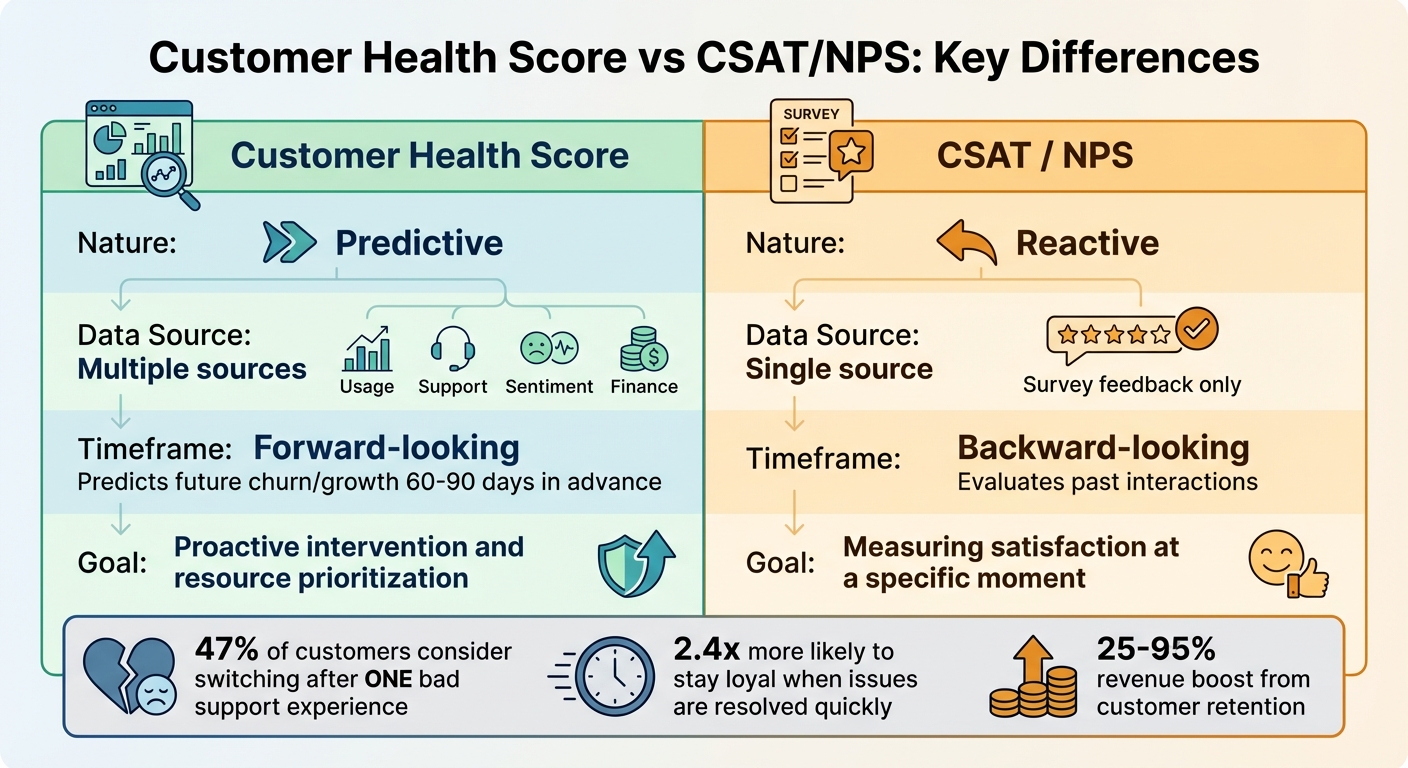
Customer Health Score vs CSAT and NPS: Key Differences
What Customer Health Scoring Means
A customer health score is a combined metric – often shown as a number between 0 and 100 or as a color-coded indicator (red, yellow, green) – that pulls together multiple data points to predict renewals, expansions, or churn. Instead of relying on single-point measurements, it factors in product usage trends, support activity, engagement levels, SLA performance, and relationship quality, all rolled into one actionable figure.
For support teams, this means looking beyond individual ticket resolutions and identifying larger patterns. For instance, a sudden rise in ticket volume, recurring escalations, or reduced customer engagement might indicate dissatisfaction brewing beneath the surface. The health score simplifies these complex signals into a single metric that teams can act on.
This approach replaces guesswork with data. Instead of relying on hunches like, "I think this account might be struggling", support leaders can use this measurable score to identify which accounts need immediate attention and which are stable enough to require less focus.
How Health Scores Differ from CSAT and NPS
The main difference boils down to timing and scope. CSAT and NPS are lagging indicators – they measure how customers felt about a past interaction or their sentiment at a specific moment in time. For example, a high CSAT score on one ticket doesn’t necessarily reflect the overall health of the account or long-term risks.
On the other hand, health scores are leading indicators. They’re designed to predict churn risk or growth opportunities well in advance – often 60 to 90 days before renewal discussions even happen.
| Feature | Customer Health Score | CSAT / NPS |
|---|---|---|
| Nature | Predictive | Reactive |
| Data Source | Multiple sources (Usage, Support, Sentiment, Finance) | Single source (Survey feedback) |
| Timeframe | Forward-looking (Predicts future churn/growth) | Backward-looking (Evaluates past interaction) |
| Goal | Proactive intervention and resource prioritization | Measuring satisfaction at a specific moment |
Another major distinction lies in data depth. CSAT and NPS rely on survey feedback, which depends on customers taking the time to respond. In contrast, health scores integrate input from various systems, such as support platforms, product analytics, CRM tools, and even qualitative feedback from account managers. This broader perspective captures not just what customers say but also what they do, enabling teams to spot potential issues – like rising ticket escalations or declining service quality – before they escalate.
Why Support Teams Need Health Scoring
These differences highlight why a dedicated, support-focused health score is essential. Support teams are often the first to pick up on warning signs – whether it’s an increase in frustrated emails, slower resolution times, or even a customer who suddenly stops reaching out. Health scoring brings these scattered signals together into a single, actionable metric, helping teams allocate their resources where they’re needed most. This ensures that high-risk accounts receive immediate attention while stable accounts don’t unnecessarily drain resources.
The financial impact is hard to ignore. For example, increasing customer retention by just 5% can lead to a revenue boost of 25% to 95%. Additionally, customers are 2.4 times more likely to stay loyal to a company when their issues are resolved quickly. On the flip side, 47% of customers consider switching to a competitor within just 24 hours of a poor support experience. Health scoring equips support teams with the insights they need to address problems early – before they snowball into major churn risks.
"Ryan Radcliff, Director of Product Marketing at SupportLogic, describes the Support Health Score as a companion metric that uses AI to analyze every customer’s support cases and calculate overall support health".
This method allows teams to "catch the smoke before the fire", addressing potential issues before they turn into retention nightmares. For support leaders, it’s about shifting from a reactive stance – constantly putting out fires – to a proactive approach that prevents those fires from starting in the first place. By using these metrics, support teams can take the necessary steps to improve retention and reduce churn, laying the groundwork for effective health score models.
What Data Goes Into a Customer Health Score
Support Metrics That Matter for Health Scoring
A customer health score draws on various support metrics to measure how customers interact with and perceive your service. For instance, trends in ticket volume can reveal potential issues – an increase might indicate struggles, while a sudden drop to zero could mean the customer has stopped using your product altogether. Escalation frequency is another key factor, showing how often customers need advanced assistance, which may suggest that standard support processes aren’t meeting their needs. Interestingly, AI tools can now predict escalations up to 72 hours in advance by analyzing customer language and specific phrases.
Sentiment analysis plays a critical role, as it captures the emotional tone of customer interactions. This is particularly important because a customer might heavily rely on your product while still exploring competitors. Ryan Radcliff, Director of Product Marketing at SupportLogic, explains:
"Support Health Score uses an AI-driven model to analyze every customer’s support cases and calculate overall support health".
Metrics like resolution speed and quality also directly affect customer loyalty. Tracking time-to-resolution, case age, and SLA performance can pinpoint friction points. Customers are 2.4 times more likely to stay loyal when their issues are resolved quickly, and nearly half – 47% – consider switching to a competitor within 24 hours of a poor support experience. High-severity cases or unresolved issues weigh more heavily in the scoring process than the sheer number of tickets.
Other important factors include case complexity, technical challenges like recurring bugs, and customer effort scores derived from CSAT and NPS ratings. Support health typically contributes 10% to 30% of the overall health score, depending on whether the account is a high-touch enterprise client or a tech-touch SMB.
| Support Metric Category | Key Data Points | Impact on Health Score |
|---|---|---|
| Responsiveness | Time-to-resolution, Case age, SLA performance | High: Affects customer frustration levels |
| Sentiment | Positive/Negative language, CSAT, NPS | High: Uncovers hidden churn risks even when usage appears stable |
| Friction | Escalation frequency, Ticket volume, Bug reports | Medium: Highlights product challenges or technical instability |
| Engagement | Knowledge base usage, Community activity | Low: Indicates self-service interest but is less predictive of churn |
These metrics, when monitored over time, provide insights into evolving customer risks.
Tracking Changes Over Time
Static snapshots of support metrics don’t tell the full story. Trends over time are what truly reveal customer risk. For instance, a health score of 75 might seem fine, but if it was 95 just two weeks earlier, that decline signals trouble that needs immediate attention. Keeping an eye on whether scores are improving or declining helps teams prioritize which accounts need urgent focus versus those that are stable.
Modern systems allow real-time updates – sometimes as frequently as every 15 minutes – capturing sudden shifts in sentiment or activity. This eliminates the delays of quarterly manual reviews, which often provide outdated insights. As Planhat puts it:
"A health score that is three weeks old is not a health score. It is a history report".
AI tools excel at spotting patterns across multiple accounts, such as recurring medium-priority tickets within a short timeframe, which might indicate rising frustration. Szymon Gołyski from BOLD highlights the importance of acting on these patterns:
"We determine what actions (or lack of them) are the most common in the users that churned and we react each time the pattern starts".
Historical context also enhances accuracy. Comparing current scores with past trends and contract terms can help identify whether a dip is a short-term issue or part of a larger decline. Additionally, adjusting metric weights based on the customer’s lifecycle stage is essential – onboarding milestones matter more early on, while resolution time and sentiment take precedence for established accounts.
Using Renewal Data and Support Activity to Predict Churn
Combining support activity with renewal timelines creates a powerful tool for predicting churn. By analyzing support patterns 60 to 90 days before a contract expires, teams can identify at-risk accounts and address issues before renewal discussions even begin. This proactive approach gives teams time to act strategically rather than scrambling at the last minute.
Support activity near renewal dates is especially telling. For example, a sudden spike in escalations or a drop in sentiment within the 90-day window signals increased risk, particularly when combined with usage trends.
Automated triggers can alert teams when health scores fall below a certain threshold – say, 40 out of 100 – or when support patterns match historical churn indicators. This allows customer success managers to implement structured playbooks instead of uncovering issues during routine reviews.
The financial impact of proactive support is hard to ignore. A mere 5% increase in customer retention can boost revenue by 25% to 95%, and 96% of customers say customer service directly influences their loyalty. Platforms like Supportbench simplify this process by automatically flagging risk patterns and predicting outcomes like CSAT and CES, saving teams from the hassle of manual data analysis or complex integrations.
sbb-itb-e60d259
How to Build Health Score Models That Actually Work
Using Weighted Scoring Systems
A good health score model starts with assigning weights to metrics based on their impact on customer retention. For example, you might allocate 40% to product usage and 25% to support activity like ticket trends or resolution time.
These weights should align with the needs of your customer segments. For enterprise accounts, factors like relationship quality and executive engagement could take up to 30%, while SMB models might lean heavily on behavioral data, sometimes as much as 50%. A common framework might look like this:
- 40%: Product usage
- 25%: Support activity (e.g., ticket trends, resolution time)
- 20%: Customer sentiment (e.g., NPS or CSAT)
- 15%: Relationship pulse (e.g., QBR attendance, CSM evaluations)
Once you’ve calculated a score, map it to actionable categories on a 0–100 scale:
- Red (0–40): Critical risk requiring immediate intervention
- Yellow (41–70): Accounts needing proactive outreach
- Green (71–100): Healthy customers ready for growth discussions
This structure helps teams quickly identify and address risks. As Realm emphasizes:
"The number doesn’t save customers. Your response does. Build playbooks that trigger when scores cross critical thresholds."
It’s not just about setting weights; keeping scores updated in real time is equally important.
Making Health Scores Dynamic
Static health scores are outdated. Modern systems update scores continuously – sometimes every 15 minutes – to reflect real-time changes in customer behavior and sentiment. This constant recalibration acts as an early warning system, giving teams time to act before small issues become major problems.
Scores should also evolve with the customer lifecycle. During onboarding, focus on milestones like time-to-first-value, while for mature accounts, metrics such as feature adoption, ROI, and support sentiment take precedence. Trends are often more telling than a single score. For instance, a customer improving from 45 to 65 (Yellow) is in better shape than one dropping from 95 to 75 (Green).
Regular feedback loops are essential. If "healthy" customers are still churning, it’s a sign your model needs adjustment. For example, Planable switched from manual tracking to an automated weighted system and saw immediate improvements in retention and satisfaction metrics.
After ensuring your scores are both weighted and dynamic, focus only on metrics that truly matter.
Avoiding Metrics That Don’t Matter
Not all metrics are useful. For instance, raw login counts can be misleading – frequent logins might indicate problems rather than value. Instead, prioritize metrics that reflect depth, like core feature adoption or the frequency of workflows that deliver meaningful results.
Be cautious with ticket volume. A spike during onboarding could indicate healthy engagement, but the same spike in a mature account might signal frustration with recurring issues. Similarly, activities like knowledge base views or community logins may show interest but don’t strongly predict retention.
Instead, use AI to analyze support ticket sentiment in real time. By evaluating tone and severity, automated systems can flag risk patterns and predict outcomes far more effectively than manual methods. This approach ensures your model focuses on actionable insights rather than surface-level engagement data, keeping your efforts aligned with what truly drives retention.
Why Legacy Tools Struggle with Health Scoring and How AI Helps
Problems with Legacy Support Tools
Legacy systems make accurate health scoring nearly impossible due to fragmented data and time-consuming manual processes. Customer information is often spread across multiple systems, leaving teams to piece together the full picture manually – a process that can take 4 to 6 hours per review.
This approach quickly becomes unsustainable as customer numbers grow. Once a team manages more than 50 customers, the sheer volume of data overwhelms them. As a result, many fall back on "CSM pulse" ratings – subjective judgments that vary from one team member to another, introducing bias and inconsistency into the scores.
Another major flaw in legacy tools is their reliance on static formulas. These formulas don’t adapt to evolving customer behavior or product changes. They often miss subtle warning signs and only flag issues after customers have already disengaged. For instance, 47% of customers consider switching to a competitor within 24 hours of a poor support experience. By the time retroactive scoring catches the problem, it’s often too late to repair the damage. These shortcomings highlight the need for more advanced, real-time solutions – enter AI.
How AI Improves Health Scoring
AI-powered platforms revolutionize health scoring by integrating data from 100+ sources into a unified view. Instead of spending hours compiling spreadsheets, support teams receive continuous updates – sometimes as frequently as every 15 minutes – allowing them to identify risks as they emerge. This shift from delayed reporting to real-time monitoring changes the game entirely.
AI eliminates subjectivity by using Natural Language Processing to analyze the sentiment and tone of support tickets, replacing "gut feel" assessments with objective, data-driven insights. These systems can even predict escalations up to 72 hours in advance, spotting patterns in case histories that humans often overlook. Ryan Radcliff, Director of Product Marketing at SupportLogic, puts it succinctly:
"Support health score is a fluid calculation that can change in a matter of moments – which is why this score is critical to providing proactive support."
AI also makes health scoring scalable. With automated systems, Customer Success Managers (CSMs) can manage 150+ accounts – three times the usual capacity – by focusing only on high-risk cases instead of spending time on manual data gathering. In fact, 73% of CSMs see AI as a tool to automate the identification of at-risk accounts. The results speak for themselves: one global software company increased customer health scores by 15 points and business value scores by 25 points using AI-driven scoring. This real-time, data-centered approach not only improves accuracy but also integrates seamlessly into everyday workflows.
Getting Real-Time Insights Without Extra Work
Modern AI platforms take things a step further by embedding health data directly into daily operations. Support teams receive instant updates as customer interactions occur – no need to wait for quarterly reviews or refresh dashboards. When a health score dips below a set threshold, automated playbooks trigger tasks and send proactive messages immediately, saving teams from constant monitoring.
This automation allows support teams to focus on building strong customer relationships. AI takes care of analyzing signals from usage patterns, support activity, and engagement data, while agents concentrate on actions that prevent churn. Considering that 96% of customers say customer service impacts their loyalty to a brand, AI ensures your team can act before loyalty is lost. By handling the heavy lifting, AI empowers teams to deliver the kind of support that keeps customers coming back.
Conclusion
Customer health scoring shifts support teams from merely reacting to problems toward actively driving customer retention. By pinpointing at-risk customers 60–90 days before renewal discussions, teams can step in early to resolve issues before they spiral out of control.
When managing more than 50 accounts, manual scoring becomes impractical, often leading to subjective, "gut-feel" decisions. AI-native platforms solve this by automating data collection across support tickets, usage patterns, and sentiment signals. This automation allows a single customer success manager to oversee more than 150 accounts effectively.
Modern support operations demand real-time insights to replace manual processes. With health scores updating every 15 minutes and triggering automated playbooks as soon as a customer enters the "At-Risk" category, support teams can concentrate on what truly matters – strengthening relationships and resolving issues. The stakes are high: 96% of customers say their loyalty is influenced by customer service, customers are 2.4 times more likely to stay when their problems are resolved quickly, and nearly half (47%) consider switching to a competitor within 24 hours of a poor support experience.
To capitalize on these advantages, it’s time to modernize your support systems. Ditch fragmented, outdated platforms and embrace AI-native solutions that seamlessly integrate health scoring into everyday workflows. Platforms like Supportbench offer this functionality right out of the box – no costly add-ons, complex setups, or IT teams required. With built-in predictive CSAT and CES scoring, automated risk detection, and full customer visibility in every case, support teams gain the tools they need to safeguard retention and drive revenue.
FAQs
How can customer health scoring help identify churn risks before renewal?
Customer health scoring combines crucial support indicators – such as ticket volume, resolution quality, customer sentiment, escalation frequency, and SLA performance – into one weighted metric. This score gives teams a clear view of which accounts might be at risk, often up to 60–90 days before their renewal date.
By identifying these accounts early, support teams can step in proactively, resolve problems, and reinforce customer relationships. This forward-thinking strategy not only reduces churn but also ensures that customers feel valued, leading to better retention and higher satisfaction.
How is a customer health score different from CSAT or NPS?
A customer health score is a predictive metric built from a mix of data points like support ticket volume, resolution quality, SLA performance, customer effort, sentiment, and renewal patterns. Its main purpose? Spot potential risks of churn before they escalate into serious problems. On the other hand, CSAT (Customer Satisfaction) and NPS (Net Promoter Score) are simpler, single-question tools that measure customer sentiment at a specific moment, often right after an interaction or survey.
The key difference is in their scope. While CSAT and NPS give a quick snapshot of how a customer feels at a particular time, health scores provide an ongoing, broader perspective on a customer’s overall experience. This continuous view enables support teams to catch warning signs – like a spike in ticket volume or missed SLAs – that might slip through the cracks with traditional satisfaction metrics. Plus, health scores draw from operational data, making them more actionable and less dependent on surveys, which can sometimes be incomplete or skewed.
How does AI improve customer health scoring for support teams?
AI is reshaping customer health scoring by analyzing support data in real time, delivering predictive insights that are both precise and actionable. It processes signals like ticket volume, resolution times, SLA performance, customer sentiment, and escalation frequency, converting them into a dynamic health score – no manual effort required. This means support teams can spot risks or opportunities as they arise.
It also streamlines data collection by pulling information from multiple systems, such as ticketing platforms, voice recordings, and usage logs, and merging it into a single, unified health score. This eliminates the delays that come with fragmented data or manual updates, giving teams a constant, up-to-date view of customer health. By identifying early signs of churn, AI enables support teams to focus on high-risk cases and take proactive steps to boost customer retention and satisfaction.
In essence, AI turns health scoring into a real-time tool that helps reduce churn, enhance retention, and ensure support efforts align with customers’ immediate needs.