When choosing a helpdesk platform in Canada, businesses must navigate strict data residency laws to ensure compliance and maintain customer trust. Here’s what you need to know:
- PIPEDA Compliance: Canadian businesses are responsible for protecting personal data, even when using third-party vendors. Data stored outside Canada can be subject to foreign laws, so transparency about storage locations is crucial.
- Provincial Laws: Alberta, British Columbia, Quebec, and Nova Scotia have additional privacy regulations. These may apply to employee data, government contracts, and sensitive information like health records.
- Vendor Evaluation: Key factors include data storage location, encryption standards (e.g., AES256), subprocessor transparency, and audit rights. Contracts should ensure secure data handling and disposal.
- AI Solutions: AI-powered helpdesk tools can automate compliance tasks like consent management and data redaction, but they must adhere to privacy standards and provide clear documentation.
Data Sovereignty in Canada: Why It Matters for Every Business
Canadian Data Privacy Laws That Affect Helpdesk Platforms
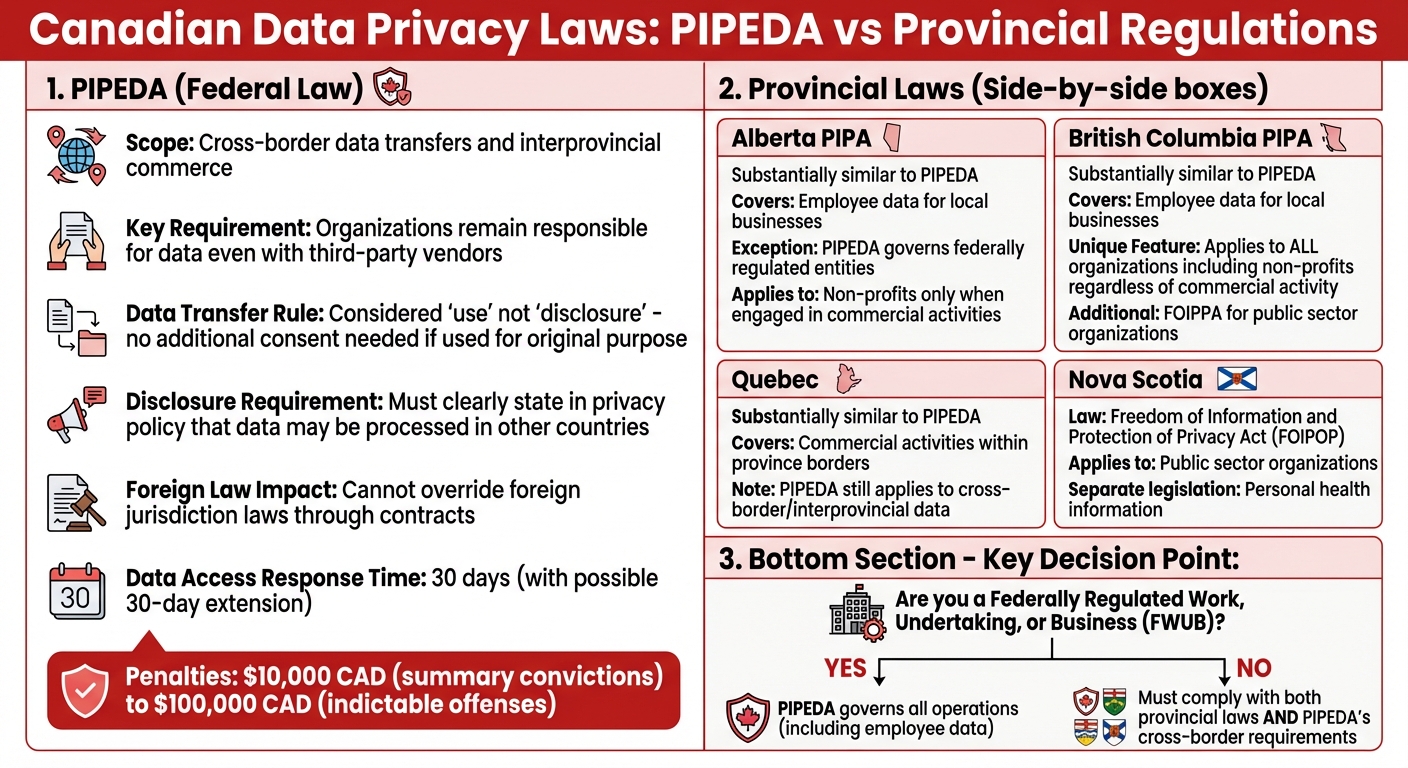
Canadian Data Privacy Laws Comparison: PIPEDA vs Provincial Regulations
PIPEDA and Cross-Border Data Transfers
Under PIPEDA, businesses remain responsible for personal data even when it’s transferred to a third-party helpdesk vendor. While contracts can ensure similar levels of data protection, they cannot shield data stored in the U.S. from being subject to American legal processes. As the Office of the Privacy Commissioner of Canada states:
What the organization cannot do through contract – or indeed by any other means – is to override the laws of a foreign jurisdiction.
PIPEDA considers data transfers as "use" rather than "disclosure", meaning additional consent isn’t necessary as long as the data is used for its original purpose. However, it’s critical to clearly disclose in your privacy policy that data may be processed in other countries and could be accessed by foreign authorities.
When evaluating helpdesk platforms, it’s a good idea to include audit rights in your service agreements. This allows you to verify how vendors handle and store personal information. You’ll also need to assess whether storing sensitive customer data in countries with extensive surveillance powers is an acceptable risk. These cross-border considerations become even more complex when factoring in specific provincial regulations.
Provincial Regulations: Alberta, Quebec, BC, and Nova Scotia
Certain provinces – Alberta, British Columbia, and Quebec – have privacy laws that are considered "substantially similar" to PIPEDA, governing commercial activities within their borders. However, PIPEDA still applies to personal data that crosses provincial or national boundaries.
In Alberta and British Columbia, provincial laws cover employee data for local businesses, but PIPEDA governs federally regulated entities. This distinction matters if your helpdesk platform handles support tickets or HR-related inquiries.
British Columbia’s PIPA applies to all organizations, including non-profits, regardless of commercial activity. In contrast, PIPEDA (and Alberta’s PIPA) typically applies to non-profits only when they engage in commercial activities. Meanwhile, Nova Scotia enforces the Freedom of Information and Protection of Privacy Act (FOIPOP) for public sector organizations, which could affect your operations if your support services involve government contracts. Separate legislation addresses personal health information in this province.
Violating PIPEDA can result in fines ranging from $10,000 CAD for summary convictions to $100,000 CAD for indictable offenses. Additionally, organizations must respond to individual data access requests within 30 days, with a possible 30-day extension in specific cases. These regional differences make selecting a helpdesk platform more challenging. Start by determining whether your business qualifies as a Federally Regulated Work, Undertaking, or Business (FWUB). If so, PIPEDA governs all operations, including employee data. Provincially regulated businesses, however, must ensure their helpdesk vendor complies with both provincial laws and PIPEDA’s cross-border data requirements.
How to Evaluate Helpdesk Vendors for Compliance
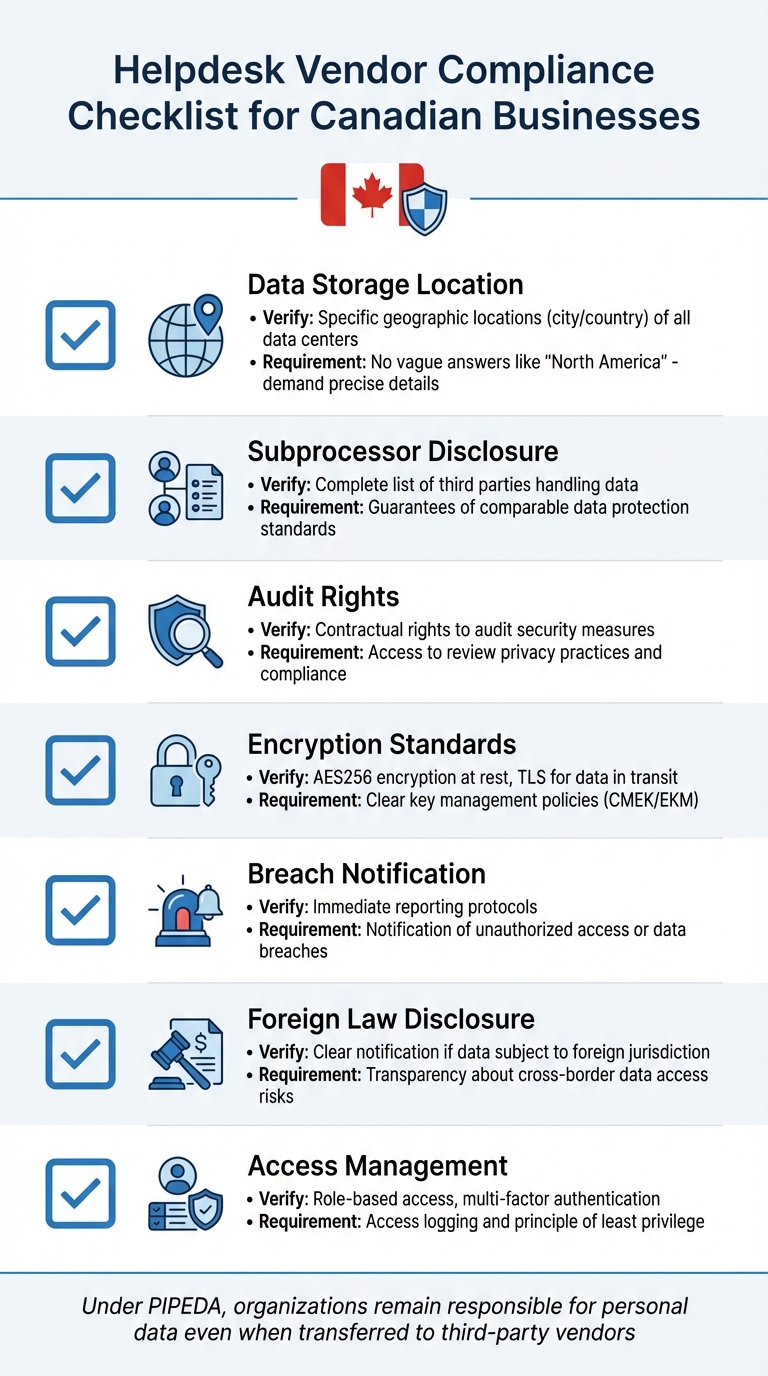
Canadian Data Privacy Laws Compliance Checklist for Helpdesk Vendors
Data Storage Location and Subprocessor Transparency
Start by pinpointing exactly where your customer data will be stored. Don’t settle for vague responses like "North America" or "secure cloud infrastructure." Insist on precise details – city and country – for each data center. This is crucial because when data crosses into another jurisdiction, it becomes subject to that country’s laws. This aligns with the accountability principles discussed earlier.
Your vendor should also provide a detailed list of subprocessors – third parties that handle or process customer data on their behalf. Under PIPEDA, you are still responsible for the personal information even after it’s transferred to these processors. As the Office of the Privacy Commissioner of Canada explains:
"The organization shall use contractual or other means to provide a comparable level of protection while the information is being processed by a third party."
Make sure your service agreement includes requirements for subprocessors to designate a privacy contact, restrict data use to authorized purposes, and report on their security practices. If you’re managing sensitive information, like health records or financial data, and operating under British Columbia’s FOIPPA, you might need to conduct an additional review before storing data outside Canada.
Encryption Standards and Data Security Practices
Encryption is non-negotiable. Your helpdesk platform should use AES256 encryption to secure data at rest and TLS protocols for data in transit. Pay close attention to key management practices, such as Customer-Managed Encryption Keys (CMEK) or External Key Managers (EKM), as well as identity and access control measures.
Evaluate identity and access management features, including role-based permissions, multi-factor authentication, and the principle of least privilege. Ask if the platform supports time-limited access to minimize "standing access" risks, where service providers maintain ongoing access to your data.
Check for independent security certifications like ISO/IEC 27001, 27017, 27018, 27701, or SOC 2 and SOC 3. These certifications provide confidence in the vendor’s security practices, which are critical for compliance.
Compliance Checklist for Vendor Evaluation
Use the following checklist to assess vendors based on technical and contractual standards:
| Criteria | Verification |
|---|---|
| Data Storage Location | Confirm specific geographic locations (city/country) of all data centers. |
| Subprocessor Disclosure | Ensure a complete list of third parties with guarantees of comparable data protection. |
| Audit Rights | Verify contractual rights to audit security measures and privacy practices. |
| Encryption Standards | Look for AES256 encryption at rest, TLS for transit, and clear key management policies. |
| Breach Notification | Confirm the vendor will report unauthorized access or data breaches immediately. |
| Foreign Law Disclosure | Require clear notification if data may be subject to foreign jurisdiction access. |
| Access Management | Check for role-based access, multi-person authorization, and access logging. |
Your agreement should also include a clause requiring the vendor to securely delete or return all transferred data once the contract ends. These safeguards are key to maintaining compliance with Canadian data privacy laws.
sbb-itb-e60d259
Building Compliant Helpdesk Workflows with AI-Driven Solutions
AI-Powered Tools for Compliance and Efficiency
AI-native helpdesk platforms streamline compliance tasks by automating key processes. For instance, automated purpose identification ensures that data is collected only for predefined and compliant reasons, reducing manual oversight and creating a clear audit trail . This approach eliminates uncertainty while minimizing extra administrative work.
Consent management workflows are another critical feature. These systems track customer consent and immediately halt data processing if consent is withdrawn. Predictive analytics further aid compliance by redacting unnecessary personal information from tickets, ensuring only the essential data for resolving issues is retained .
When it comes to automated workflows – like AI-driven ticket triage or priority assignment – documenting the logic behind each decision is essential for meeting transparency standards. Additionally, AI safeguards monitor for unauthorized access or potential breaches, sending alerts and maintaining encryption protocols in line with PIPEDA requirements .
A great example of these measures in action is Lexis+ AI, launched by LexisNexis Canada in June 2025. This legal AI platform adheres to strict data residency rules by processing and storing customer data within Canadian or EU borders. It employs AES-256 encryption, TLS 1.2, and a "zero data sharing" policy, ensuring user prompts are not used to train third-party language models. Furthermore, session data is automatically deleted after 90 days of inactivity. Alan Votary, Head of Product at LexisNexis Canada, emphasized the importance of this approach:
"Regionalization has emerged as a critical strategy… in how technology products are built, deployed, and secured."
These AI-driven solutions provide a strong foundation for creating compliant and automated workflows in B2B support environments.
Examples of Compliant Workflows in B2B Support
AI-powered compliance tools enable the creation of workflows that maintain both data residency and security. For example, when a Canadian customer submits a ticket, the AI platform ensures all data is processed and stored within Canada, meeting residency requirements without requiring manual oversight. For stricter needs, tokenization can replace sensitive data before offsite processing, with token mappings securely stored locally.
Performing Privacy Impact Assessments (PIAs) before deploying new AI features is another best practice. This helps identify and address potential risks early on . Additionally, helpdesk interfaces with built-in consent toggles allow users to opt in for AI-driven features like sentiment analysis or knowledge base updates. For sensitive data categories – such as medical or financial information – explicit consent is required, ensuring compliance with stricter privacy standards.
Subprocessor monitoring is also crucial. These tools track where data is sent to third parties, ensuring that privacy protections remain intact during any cross-border transfers . Automated retention schedules further enhance compliance by securely disposing of personal data once its purpose has been fulfilled. Lastly, human oversight mechanisms are essential for high-impact AI decisions, such as those involving ticket triage or determining service access. This adds an extra layer of accountability and intervention when needed.
How to Reduce Risks and Avoid Fines
Regular Vendor Auditing and Monitoring
Under PIPEDA, your organization is ultimately responsible for safeguarding personal information, making continuous oversight a non-negotiable requirement. These efforts are a crucial part of a strong compliance plan that protects your operations and helps you steer clear of penalties.
Start by designating a Privacy Officer to lead vendor evaluations and oversee periodic compliance checks. This role ensures accountability and keeps privacy efforts on track. Contracts with vendors should include clear terms: assign a specific individual at the vendor to handle privacy responsibilities, restrict data use to approved purposes, prohibit unauthorized sharing, and require secure disposal of data once the contract ends.
Make audit rights a standard part of your contracts and insist on regular updates from vendors regarding their privacy controls. Vendors should provide detailed reports on how they are maintaining security and protecting personal information.
To further strengthen your approach, use diagnostic tools from the Office of the Privacy Commissioner. These checklists can help identify weaknesses in your privacy practices and vendor management processes. They also allow you to measure your efforts against the 10 Fair Information Principles. Keep in mind, if your data is stored outside of Canada, it may be subject to foreign legal access.
Finally, pair vendor oversight with ongoing staff training to ensure compliance is upheld across your organization.
Training and Awareness for Support Teams
While vendor management is key, your support team also plays a critical role in maintaining privacy compliance. Even the most secure systems can fail if your team isn’t equipped to handle privacy-related responsibilities. Support staff need to understand data collection practices, consent requirements, and how to handle access requests.
Equip your team with standardized scripts to ensure they communicate data collection purposes and the implications of withdrawing consent clearly and consistently. Update job descriptions to explicitly include privacy-related duties. The Office of the Privacy Commissioner of Canada underscores this necessity:
"Train all front-line and management staff and keep them informed, so that they… can recognize and process requests for access to personal information."
Establish clear referral processes so that complex privacy concerns are escalated to your Privacy Officer instead of being resolved without proper oversight. If your helpdesk operates in another country, train staff to explain this clearly to customers, including the possibility of foreign authorities accessing their data.
Selecting the Right Helpdesk for Canadian Businesses
Picking a helpdesk that aligns with Canadian data residency requirements isn’t just about sidestepping penalties – it’s about earning customer trust and gaining an edge in the market. As the Office of the Privacy Commissioner of Canada explains:
"Your customers will appreciate doing business with an organization that shows respect for their privacy rights. This appreciation can lead to a competitive advantage for your business."
When evaluating helpdesk platforms, look for regionalization controls that allow data storage within specific Canadian regions. Ensure the platform uses AES256 encryption to secure data at rest, TLS for data in transit, and offers Customer-Managed Encryption Keys (CMEK) for maximum control. Vendors should also provide clear transparency regarding subprocessors and detailed audit trails to support your compliance efforts.
Strong contractual safeguards are non-negotiable. Under PIPEDA, businesses remain accountable even when third parties handle their data. Contracts should include clauses that restrict data usage and mandate secure disposal to maintain a "comparable level of protection." As the Office of the Privacy Commissioner highlights:
"Organizations must take all reasonable steps to protect that information from unauthorized uses and disclosures while it is in the hands of the third-party processor."
These technical and contractual measures lay the groundwork for integrating AI-native solutions that simplify compliance and improve efficiency.
AI-native platforms, like Supportbench, embed compliance features directly into workflows – covering case management, knowledge creation, and regulatory adherence – without requiring costly add-ons. Automated tools for handling data subject rights, consent management, and privacy impact assessments reduce the workload on support teams while ensuring legal obligations are met. By aligning technology with regulatory requirements, businesses can strengthen their support operations while staying compliant.
The best helpdesk solution strikes a balance between regulatory compliance, operational scalability, and cost management, ensuring your business stays efficient and adaptable.
FAQs
What are the risks of storing customer data outside Canada?
Storing customer data outside Canada may lead to violations of Canadian privacy laws, such as PIPEDA. These laws enforce strict requirements for managing and transferring personal information across borders. Failing to comply can result in fines, legal troubles, and harm to your company’s reputation.
On top of that, housing data internationally can heighten the risk of unauthorized access by foreign governments or security agencies, which could erode customer confidence. To maintain compliance and protect your business, it’s crucial to choose helpdesk platforms that emphasize strong data residency and security measures aligned with Canadian regulations.
How can AI tools help ensure data privacy compliance in helpdesk operations?
AI tools are key players in ensuring data privacy compliance for helpdesk operations, especially when dealing with regulations like PIPEDA. These tools can handle critical security tasks such as encryption, tokenization, and access controls, protecting sensitive customer information during both storage and processing. For example, tokenization swaps out sensitive data for non-sensitive placeholders, minimizing the chances of breaches or unauthorized access.
AI-driven systems also keep an eye on data usage and access patterns in real time, flagging anything unusual to help businesses meet data residency requirements. They make compliance easier by documenting how data is handled, promoting both transparency and accountability. By using AI, helpdesk teams can protect personal information more effectively, lower risks, and navigate privacy regulations with greater ease.
What factors should businesses consider to ensure helpdesk vendors comply with Canadian data residency laws?
When selecting a helpdesk vendor, businesses operating in Canada must ensure compliance with Canadian data residency laws, such as PIPEDA. These laws govern how personal information is stored, used, and shared. A critical step is confirming that the vendor can store and process data within Canada or in regions offering equivalent privacy protections. Vendors should provide clear details about their data residency policies, including where the data is stored and who has access to it.
Equally important is evaluating the vendor’s security measures. Look for features like encryption, robust access controls, and protections against unauthorized access. If the vendor processes data outside of Canada, ensure they adhere to strict cross-border data transfer standards to reduce exposure to risks.
For an extra layer of protection, prioritize vendors that implement advanced practices such as tokenization and regionalization. These measures not only help maintain compliance but also safeguard sensitive information effectively.