
Balancing AI tools and human agents is the key to effective customer support in 2026. With AI resolutions costing $0.99–$2.00 compared to $6.00–$35.00 for human-handled tickets, companies are adopting hybrid models where AI handles routine tasks, and humans focus on complex issues. This approach reduces costs by 15–40% while improving efficiency and customer satisfaction.
Key Takeaways:
- AI Tools: Cost-efficient for routine tasks; scalable and available 24/7. Setup costs include $30,000–$60,000 for data preparation and $15,000–$50,000 for integration.
- Human Agents: Essential for tasks requiring empathy and judgment. Full costs range from $20–$30/hour, including benefits and training.
- Hybrid Model Benefits: AI manages 70–90% of routine inquiries, freeing human agents for high-value tasks. Combined, this boosts productivity by 14% and cuts training time by 50%.
Bottom Line: Use AI for Tier 1 tasks like password resets and order tracking, while reserving human expertise for Tier 2 and Tier 3 issues. This strategy optimizes budgets and enhances customer experiences.
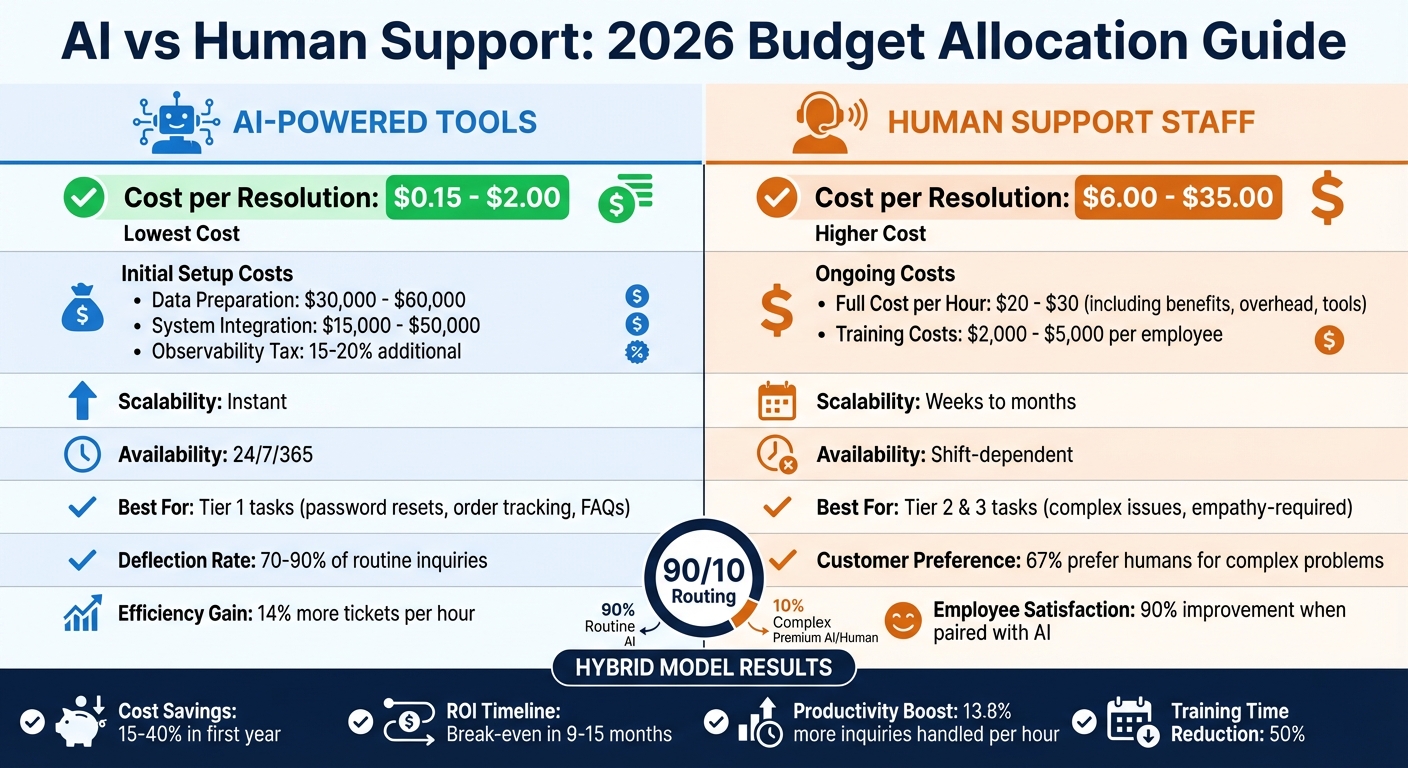
AI vs Human Support Costs: 2026 Budget Allocation Comparison
1. AI-Powered Tools (e.g., Supportbench)
Cost
Budgeting for AI-powered support tools in 2026 requires a clear view of both upfront and hidden expenses. Pricing has shifted from traditional per-seat licenses to outcome-based models, often charging around $0.99 per successful resolution [4]. Additionally, companies should factor in the "Observability Tax", which adds 15–20% for monitoring tools like LangSmith or Arize to oversee AI behavior and control costs [7]. Data preparation is another major expense, consuming 40–60% of project time and costing between $30,000 and $60,000 for initial setup. Integration with legacy systems or proprietary databases adds another $15,000 to $50,000 [7][8][4][1].
To budget effectively, many organizations adopt a 90/10 routing model: 90% of traffic goes to cost-efficient models like Gemini 3 Flash (about $0.50 per 1M input tokens), while premium models like GPT-5.2 (approximately $1.75 per 1M tokens) handle the remaining 10% of complex tasks [7].
"Frame the investment in the Knowledge Base, not the Bot. A clean, comprehensive knowledge base is an asset that appreciates in value as AI gets smarter." – DigitalApplied [4]
Ongoing costs include allocating 15–20% of the initial investment annually for updates and prompt tuning [4][8]. For autonomous agents handling multi-step tasks, costs range from $0.10 to $0.50 per task, rather than per simple query [7]. These models not only optimize budgets but also lay the foundation for scalable AI support.
Scalability
Scalability is a key factor when planning budgets in 2026. AI tools offer instant scalability that human teams can’t match. While scaling human teams involves recruiting, hiring, and training (a process that can take months), AI expands effortlessly through API calls, managing unlimited interactions simultaneously without additional staff [9][12].
Platforms like Supportbench excel at handling routine inquiries – things like password resets, order tracking, and account updates – deflecting 70–90% of these requests depending on the query type [3][4][9]. For example:
- FAQ and general information queries: 70–85% deflection rate
- Order and account status inquiries: 80–90% deflection rate [4]
This frees up human agents to focus on complex, high-value tasks requiring judgment and creativity. During peak periods, AI ensures consistent 24/7 availability across time zones without overtime, shift differentials, or burnout [9][11]. In fact, organizations using a hybrid AI-human model handle 13.8% more inquiries per hour compared to human-only teams [9][11]. This scalability not only smooths operations but also boosts productivity.
Operational Efficiency
Operational efficiency is another compelling reason to invest in AI. These tools streamline workflows by automating repetitive tasks. AI copilots can draft responses, suggest relevant knowledge articles, auto-fill case summaries, and categorize and route incoming requests based on urgency and complexity – all within seconds [3]. For example, post-call documentation time drops from 15 minutes to under 2 minutes, enabling agents to handle 14% more tickets per hour while cutting training time in half [3][4].
AI also transforms quality assurance (QA). Traditional QA methods review only 2–5% of conversations, but AI evaluates 100% of interactions for quality and compliance. It identifies coaching opportunities and flags knowledge gaps in real time, ensuring agents are always equipped with accurate information [3]. Additionally, AI performs predictive maintenance on knowledge bases, spotting outdated or missing content before it becomes an issue.
Companies adopting AI for customer service report 15–40% cost savings in the first year, with most mid-sized companies breaking even within 9–15 months [3]. Self-service AI platforms can slash support costs by 40–50% within 90 days [5]. Even agents in the lowest-performing 20% see 35% improvements in task throughput when assisted by AI [9].
Impact on Customer Satisfaction
In 2026, balancing AI tools and human agents is critical for customer satisfaction. The success of AI tools is measured by ROAR (Resolved on Automation Rate), which tracks whether a user receives a final resolution without human help – not merely if they interacted with a bot [4]. This metric reflects a shift away from vanity metrics like basic deflection rates.
The cost savings and scalability discussed earlier directly enhance customer satisfaction. AI provides fast, consistent responses, while human agents focus on more complex, emotionally charged issues. While 49% of consumers are comfortable with AI for routine tasks, 67% still prefer human agents for more intricate problems [1][9][12]. The key is seamless handoffs – transferring full conversation context so customers never have to repeat themselves [3][12].
AI-powered interactions cost between $0.03 and $0.25 per minute, compared to $3.00 to $6.50 for live agents [10]. This affordability allows companies to offer 24/7 instant support while reserving human agents for high-stakes interactions where empathy and nuanced judgment are essential.
"While AI can automate repetitive tasks and provide rapid responses, it cannot replicate the nuanced understanding, empathy and emotional intelligence that human agents offer." – Charles Kergaravat, CMO, Apizee [9]
Successful implementations often begin with "quick wins", such as deploying AI for password resets, order tracking, and account updates. These tasks typically achieve success rates above 90%, building trust in the technology while freeing human agents to focus on relationship-building and revenue-driving activities [3].
sbb-itb-e60d259
2. Support Staff (Agents and Specialists)
Cost
When planning for support staff in 2026, it’s essential to account for the full cost of human agents – not just their base pay. Many organizations underestimate this, but when you factor in benefits, overhead, tools, workspace, and management, the actual cost typically ranges between $20–$30 per hour [4]. Beyond salaries, companies need to allocate 10–15% of implementation costs for agent training and change management, as well as an additional 15–20% annually for ongoing upskilling and maintaining AI models [4].
Rather than hiring costly AI/ML specialists – who can command salaries of $150,000 to $300,000+ – businesses are focusing on training their existing teams for higher-value roles. Upskilling current staff costs around $2,000–$5,000 per employee and leverages their institutional knowledge. These employees are being prepared to take on roles like "Conversation Architects", where they manage AI logic and handle complex Tier 3 issues [6][1].
"Your remaining support staff should not be answering tickets; they should be ‘Conversation Architects’ who manage the AI’s logic." – Allen Seavert, Founder, SetupBots [6]
Scalability
AI has the advantage of scaling instantly through API calls, but human teams scale much more slowly. Expanding human capacity requires recruiting, hiring, onboarding, and training – a process that can take weeks or even months [6]. This is why a hybrid model works so well: AI can handle 30–70% of routine B2B inquiries (like password resets, order tracking, and billing), while human agents focus on the 25–35% of cases that demand judgment, empathy, or nuanced problem-solving [3][14][1].
This tiered approach allows businesses to scale more strategically. Instead of increasing headcount during busy periods, companies rely on AI for Tier 1 tasks while reserving human expertise for Tier 2 and Tier 3 issues, where emotional intelligence and accountability are crucial [1][2]. The result? Customers get faster resolutions for simple problems, while 67% of customers, who prefer human agents for complex issues, receive the focused attention they need [1]. This balance improves both cost management and service quality.
Operational Efficiency
Even with AI-driven efficiencies, human agents remain vital for building trust and satisfaction. In 2026, support staff focus on judgment-intensive, high-value tasks, as human labor accounts for 60–70% of the total cost of resolving a support ticket [5]. Deploying agents where their skills are most impactful is critical.
Roles are shifting from generalist positions to more specialized ones, such as billing experts or technical troubleshooters [13][2]. Companies are also using streamlined coaching loops – regular ticket reviews – to maintain quality without slowing down case resolution [13]. This approach allows human agents to take ownership of cases from start to finish, while AI handles repetitive tasks. The result? Teams become more productive without compromising on quality, striking a balance that boosts both operational efficiency and customer satisfaction.
Impact on Customer Satisfaction
Skilled support staff play a key role in retaining customers and building trust. While AI is great at delivering speed and consistency, humans excel in situations that require empathy, nuance, and accountability [13][3][2]. This combination creates a powerful dynamic: 90% of enterprises report improved employee satisfaction in departments using AI, as it eliminates repetitive tasks and lets staff focus on meaningful interactions [2].
With access to complete customer histories – such as account details, recent activity, and past conversations – agents can resolve issues more quickly and avoid frustrating customers by making them repeat information [13]. Clear tiering systems (self-service for simple tasks, frontline agents for medium complexity, and specialists for high-value issues) prevent highly skilled staff from being bogged down with basic requests [13]. Companies that strike the right balance between AI and human expertise typically achieve 15–40% cost savings in their first year, all while maintaining or improving customer satisfaction [3].
AI in Customer Support isn’t replacing people. It’s levelling them up
Pros and Cons
When weighing the differences between AI tools and human agents, it’s essential to recognize the unique strengths and weaknesses each brings to the table. Striking the right balance between the two can lead to a more efficient and cost-effective operation.
AI tools shine in speed and cost-efficiency. These systems are capable of managing over 500 tickets simultaneously, 24/7, with costs ranging from just $0.15 to $2.00 per resolution. Compared to the $6.00 to $35.00 typically spent on human-handled tickets, AI can slash costs by an impressive 85–98%, especially for repetitive tasks like password resets or tracking orders.
But AI has its challenges. It struggles with situations requiring emotional intelligence, nuanced judgment, or the ability to navigate high-stakes decisions. Additionally, the total cost of ownership for AI isn’t just the upfront expense – it includes ongoing costs for data preparation, integration, and regular updates. Without consistent maintenance, the return on investment (ROI) can drop by 15–30% in just a few months.
Human agents excel where AI falls short. They bring empathy, adaptability, and critical thinking to complex or sensitive situations, ensuring customer satisfaction in ways AI cannot. When AI handles the repetitive tasks, human agents can dedicate their time to solving more intricate problems. This shift has led to nearly 90% of businesses reporting improved employee satisfaction, as workers spend less time on monotonous tasks and more on meaningful challenges.
This combination of capabilities highlights why a hybrid approach is becoming the go-to strategy for many organizations. By 2026, more businesses are expected to adopt this model – using AI for routine inquiries while reserving human expertise for moments that require a personal touch.
| Factor | AI-Powered Tools | Support Staff (Human) |
|---|---|---|
| Cost per Interaction | $0.15 – $2.00 | $6.00 – $35.00 |
| Scalability | Instant scaling | Requires hiring and training |
| Availability | 24/7, year-round | Limited to shifts and business hours |
| Operational Efficiency | Ideal for routine tasks | Best for complex, non-standard issues |
| Customer Satisfaction | High for speed and simplicity | High for empathy and problem-solving |
| Training Time | Quick setup and deployment | Longer onboarding process |
Conclusion
Support budgeting in 2026 requires a thoughtful balance – neither complete automation nor an entirely human-driven approach will cut it. The key lies in combining AI’s efficiency for repetitive tasks with human expertise for situations that demand empathy and judgment [2].
A tiered support structure is the way forward. Start by deploying AI-powered tools for Tier 1 tasks like password resets, order tracking, and basic troubleshooting. These tasks, with resolution costs ranging from $0.15 to $2.00, offer clear savings [6]. For more complex needs, invest in your human team to manage Tier 2 AI-assisted cases and Tier 3 high-stakes issues. This approach isn’t about replacing humans – it’s about scaling effectively while retaining the customer trust that drives loyalty [6][17].
Rather than slashing headcount based on automation projections, redirect resources toward high-impact initiatives. Focus on proactive customer success, advanced technical troubleshooting, and fine-tuning AI systems [15]. Additionally, empower your team to take on critical system-level work, such as reviewing AI interactions, updating documentation, and collaborating with product teams. This not only improves operations but also transforms support into a strategic asset [15].
Before investing in new tools, audit your existing documentation to ensure accuracy. Poor data quality often hinders AI’s potential ROI [16]. Also, budget for ongoing AI maintenance – expect monthly tuning costs of $2,000 to $5,000 to keep systems running efficiently and prevent performance degradation.
Finally, focus on metrics that matter. Traditional volume-based KPIs are outdated. Instead, track metrics like Resolved on Automation Rate (ROAR) to measure efficiency and align spending with outcomes such as capacity improvements, stable margins, and customer satisfaction – not just ticket deflection [4][15]. Companies that treat support spending as a strategic investment will lead the way in 2026.
FAQs
What’s a good tools vs. people budget split in 2026?
In 2026, businesses can achieve a more efficient budget split by using AI-powered tools to handle routine tasks. This approach could cut human support costs by 15–40%, freeing up human agents to tackle more complex problems. The result? Improved efficiency and better customer satisfaction. To get the best results, focus on balancing spending between automation technologies and skilled personnel to match your support objectives and boost ROI.
How do I calculate ROI for AI support in my org?
To figure out ROI for AI support, start by focusing on key metrics such as cost savings, efficiency improvements, and better customer satisfaction. Break it down by quantifying upfront expenses – like the cost of tools, integration, and training. Then, measure tangible outcomes, such as lower staffing costs, quicker resolution times, and changes in support volume.
Don’t overlook indirect benefits. Improved Customer Satisfaction Scores (CSAT) and higher customer retention can also play a big role in the overall value. Once you have these numbers, calculate ROI as the ratio of net benefits (total gains minus costs) to the total investment. This gives you a clear picture of the financial impact AI support brings to your business.
When should a ticket escalate from AI to a human?
When should a ticket move from AI to a human? It’s simple: when the situation calls for a human touch or deeper expertise. This happens in cases of complex issues that automated systems can’t handle, situations where empathy is crucial, or when specific escalation rules are triggered.
These triggers might include:
- Urgency: Time-sensitive problems that demand immediate attention.
- SLA breaches: When service level agreements are at risk of being violated.
- Customer frustration: Indicators like negative sentiment analysis or visible signs of anger.
In such scenarios, handing the issue off to a human ensures the customer gets the attention and resolution they need.
Related Blog Posts
- 9 Tips for Scaling Support Without Hiring More Staff
- How do you build a support org chart that scales (roles, ratios, and when to hire ops)?
- How do you calculate the real cost per ticket (and use it to justify headcount)?
- Help Scout alternatives for B2B teams: what to choose when you outgrow shared inbox