Creating a scalable VIP support model that works for high-value customers without alienating others comes down to three key strategies:
- Define VIPs Clearly: Use objective metrics like spending, renewal timelines, or customer health scores to identify high-value accounts. Sync CRM tools to ensure VIP status is always up to date.
- Use AI for Efficiency: Automate ticket triage, prioritization, and routing using AI tools. This reduces delays, predicts customer needs, and ensures consistent service for all tiers.
- Balance Resources: Avoid overloading VIP queues by using dynamic resource pooling. Regularly audit performance metrics (like CSAT and response times) to ensure non-VIPs aren’t neglected.
The goal is to deliver premium service to VIPs while maintaining strong support for everyone else. Smart automation, clear workflows, and regular reviews make this possible.
How to Define VIP Criteria and Set Fair Service Standards
How to Identify High-Value Customers
When identifying high-value customers, rely on objective criteria like financial metrics, lifecycle timing, and risk indicators. Financial metrics might include total spending, revenue contributions, or accounts exceeding a set dollar amount. Lifecycle timing focuses on customers nearing key moments, such as being within 30 days of renewal or launching a critical product. Risk indicators could involve customer health scores, predictive CSAT ratings, or sentiment analysis from past interactions.
Your CRM should act as the central hub for tracking VIP status. By syncing platforms like Salesforce or HubSpot with your support tools, you can ensure tags like "vip_customer" or "key_account" automatically trigger prioritization workflows. AI tools can enhance this process by performing real-time CRM lookups. This ensures that newly upgraded accounts are recognized immediately, avoiding delays caused by scheduled data syncs.
"An SLA might tighten automatically when a renewal is 30 days out, ensuring top-tier support when it matters most."
Technical identifiers like email domains, client IDs, or user profile tags simplify the process further by enabling instant recognition and proper ticket routing.
Once VIPs are identified, the next challenge is ensuring all customers receive fair and timely support.
Setting Standards for Fair Treatment Across All Customers
Balancing VIP service with fair treatment for all customers is crucial for maintaining scalable and effective operations.
For non-VIPs, establish a maximum first response time of 24 hours, and create clear prioritization rules that consider both urgency and customer tier. For example, a critical network outage impacting 50 users should take precedence over a VIP’s personal printer issue, no matter who submits the request. Clearly outline what tasks fall "in-scope" and "out-of-scope" for VIP support to avoid wasting resources on minor, non-essential requests like personal device setups.
"The reality for most organizations is that VIPs need special treatment. But providing VIP service shouldn’t be at the expense of good service delivery for the rest of the organization."
- Natalie Sansone, Research Director, Info-Tech Research Group
One organization eliminated a dedicated VIP technician role, reallocating that resource to the general service desk. They maintained VIP prioritization through automated routing instead. The result? Incident resolution times improved by 28%, and request fulfillment times dropped by 33% across the board. This example highlights how smart routing and clear rules can outperform relying solely on dedicated staff.
Lastly, communicate your service policies to all customer segments. Make sure they understand their specific SLAs and the proper contact methods. This transparency helps reduce feelings of unfairness and minimizes instances where VIPs try to bypass the system by reaching out directly to executives.
Using AI to Segment Customers Automatically
Manually tagging VIP customers can be slow and prone to bias. AI steps in to solve these problems by instantly identifying high-value customers using domains, client IDs, or user profiles. When a ticket comes in, the system performs a real-time CRM lookup to confirm the customer’s current status at that exact moment. This ensures segmentation is always up-to-date, while pulling data from multiple platforms to get a fuller view of what defines a VIP – whether it’s inclusion on a "key accounts" list or a high point balance. By combining data from various sources, this process removes guesswork and creates standardized support protocols. Accurate segmentation like this sets the stage for predictive support strategies.
AI-Driven Customer Health Scoring and Predictive Analytics
AI doesn’t stop at segmentation – it also predicts customer needs. Predictive CSAT (Customer Satisfaction) and CES (Customer Effort Score) models use past data to classify customers and predict dissatisfaction. For example, if a predictive CSAT score drops below a certain threshold, the system can automatically escalate the case to a senior agent or initiate a warm transfer to a specialist.
"AI determines priority not just based on a selected field or a single keyword, but by analyzing a confluence of factors."
- Nooshin Alibhai, Founder and CEO, Supportbench
With tools like Natural Language Processing (NLP) and Machine Learning (ML), AI can interpret the tone and context of customer requests, identifying urgency even when it’s not explicitly stated. For instance, a subject line like "quick question" could mask a critical production issue. By analyzing the message body, AI can pick up on frustration or negative language, elevating the ticket’s priority regardless of the urgency level selected by the customer. Companies using AI to flag high-risk tickets have reported a 32% reduction in escalation rates and an 18% boost in CSAT for those high-risk cases.
These predictive capabilities also enable dynamic adjustments to SLAs, tailoring support to the customer’s immediate needs.
Dynamic SLA Adjustments Based on Customer Context
AI insights make it possible for SLAs (Service Level Agreements) to adapt in real time, prioritizing critical situations without neglecting other customers. AI continuously evaluates active tickets, updating risk scores based on factors like sentiment changes, response delays, and interaction trends. For example, if a customer is within 30 days of renewal, the SLA might tighten automatically to ensure they receive top-tier support during this crucial period. Once the renewal window closes, the SLA reverts to standard levels, maintaining balance across all customer segments.
To avoid bias, AI routes predictions with low confidence to human reviewers, and its performance is assessed across all customer groups. This ensures that urgent issues, like production outages, are addressed promptly regardless of whether the customer is a VIP. By automating much of the manual analysis, AI can cut analysis time by 86% and reduce Mean Time to Resolution (MTTR) by 28%. Treating segmentation as a flexible, data-driven process rather than a fixed label allows businesses to scale efficiently while maintaining fairness – a core principle of AI-driven support models.
Building Scalable AI-Human Workflows
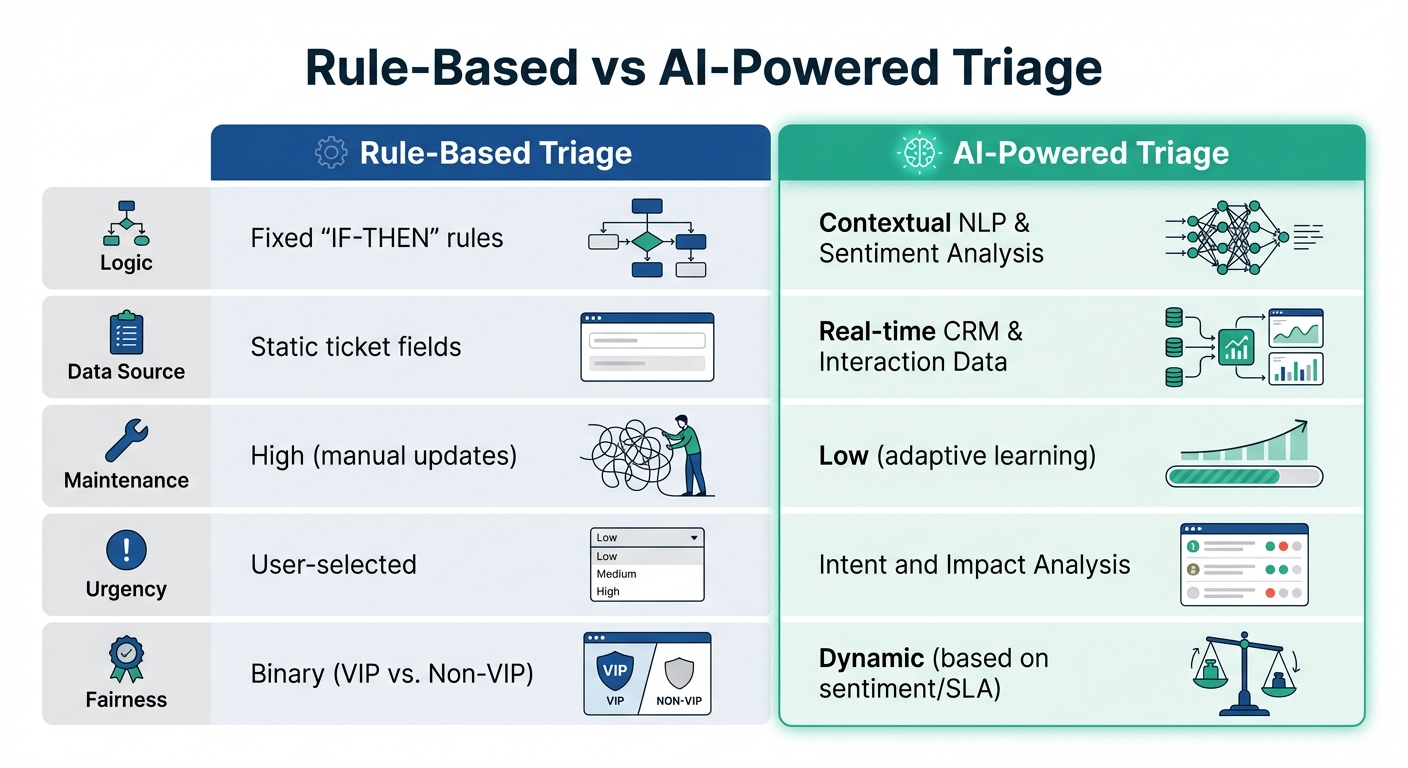
Rule-Based vs AI-Powered Customer Support Triage Comparison
Scaling VIP support effectively means creating workflows where AI handles repetitive tasks, freeing human agents to tackle complex problems and build stronger customer relationships. The goal isn’t to replace skilled agents but to redefine their role – letting automation handle routine processes while agents focus on higher-value activities like problem-solving and customer care. For instance, when a ticket arrives, AI can perform real-time CRM lookups, ensuring prioritization is based on up-to-date information rather than outdated tags. Let’s explore how AI enhances triage and prioritization in these workflows.
AI for Triage and Case Prioritization
AI leverages Natural Language Processing (NLP) to identify sentiment and urgency in customer messages. Keywords like "outage" or "cannot log in" trigger escalation to specialists for immediate attention. Unlike rule-based systems that rely on exact keywords, AI understands the context and meaning behind words, even if phrased differently or misspelled. For example, a polite email titled "quick question" might hide a critical production issue. AI can analyze the message body, detect its urgency, and prioritize the ticket appropriately.
To ensure fair treatment across all customer segments, organizations introduce fairness checks and maintain "holdout queues" to measure how prioritization impacts standard service levels. Low-confidence AI predictions are routed to human supervisors to prevent errors from unfairly deprioritizing any customer. Additionally, AI deflects routine inquiries – like password resets – through automated bots, increasing the bandwidth for human agents to manage both VIP escalations and complex non-VIP cases.
| Feature | Rule-Based Triage | AI-Powered Triage |
|---|---|---|
| Logic | Fixed "IF-THEN" rules | Contextual NLP & Sentiment Analysis |
| Data Source | Static ticket fields | Real-time CRM & Interaction Data |
| Maintenance | High (manual updates) | Low (adaptive learning) |
| Urgency | User-selected | Intent and Impact Analysis |
| Fairness | Binary (VIP vs. Non-VIP) | Dynamic (based on sentiment/SLA) |
AI doesn’t stop at triage – it also supports VIP agents with tools that streamline their work.
AI Copilot for Dedicated VIP Agents
AI copilots are invaluable for VIP agents, offering instant access to knowledge, summarizing cases, and drafting personalized responses that align with the brand’s tone. Before escalating a ticket to a human, AI gathers critical details like order numbers and account IDs, saving agents from searching for this information themselves. This efficient handoff allows agents to focus immediately on solving the issue. For example, AI can automatically retrieve the last three orders or recent interaction history and add it as a private note when a VIP ticket is assigned.
"AI isn’t primarily eliminating the need for skilled agents; instead, it’s fundamentally transforming their role, automating the routine to elevate the human contribution towards higher-value activities."
- Eric Klimuk, Founder and CTO, Supportbench
AI-powered routing further improves efficiency by directing complex issues – like SSO/SAML errors – straight to specialists based on their skills and workload. This ensures VIP customers connect with the right expert on the first attempt, reducing resolution times and boosting satisfaction.
Scaling Through Automation
Automation makes it possible to handle growth without expanding headcount, cutting analysis time by 86%. Companies using AI for escalation prediction report a 28% faster Mean Time to Resolution (MTTR) and a 32% drop in escalation rates overall. High-risk tickets managed with AI assistance also see an 18% boost in customer satisfaction (CSAT) scores.
To maintain service quality, it’s essential to set automation limits. For example, configure thresholds to ensure AI only handles a set number of conversational turns before transferring complex VIP issues to a human specialist. Availability blocks can also restrict messaging escalations to times when VIP agents are on duty; otherwise, tickets can be routed to email or logged for later follow-up. AI can even monitor sentiment in non-VIP tickets, dynamically prioritizing cases where frustration levels rise to avoid service failures. Before deploying these systems, organizations should test AI models on thousands of historical tickets in a "risk-free simulation" to predict their impact on wait times and refine workflows without jeopardizing customer relationships. This approach ensures VIP customers receive premium service without compromising fairness for others.
sbb-itb-e60d259
How to Allocate Resources Without Creating Inequity
Balancing support for VIP customers while maintaining a smooth experience for everyone else can feel like walking a tightrope. If too many resources are funneled toward high-value customers, the standard queues often suffer, leading to longer wait times and frustrated users. The challenge lies in creating a system where VIPs get top-tier service without leaving others feeling neglected. Let’s dive into different approaches and how dynamic pooling can help maximize team efficiency.
Comparing Resource Allocation Models
When it comes to structuring VIP support, two main models stand out: dedicated VIP queues and dynamic resource pooling. Each has its strengths and weaknesses, and choosing the right one depends on your goals and resources.
| Model | Pros | Cons |
|---|---|---|
| Dedicated VIP Queues | Ensures a premium experience for high-value customers; allows agents to build expertise on specific accounts. | Can leave VIP agents underutilized during slow periods while the general queue struggles to keep up. |
| Dynamic Resource Pooling | Uses AI to assign tickets to the most qualified available agent, regardless of customer tier, improving overall efficiency. | Requires precise skill-matching and configuration to maintain consistent service quality. |
Dedicated VIP queues are ideal for small, stable groups of high-value clients, especially if you can afford to assign specialized agents to them full-time. However, this approach often leads to inefficiencies, such as VIP agents having downtime while the general queue gets overwhelmed. On the other hand, dynamic pooling, driven by AI, addresses these issues by routing tickets based on factors like urgency, agent skills, and workload – not just customer status. This ensures resources are used effectively while still maintaining quick response times for VIPs.
To make these systems work, transparency is key. Clearly explain the VIP workflow to your entire support team so everyone understands why certain tickets are prioritized. This helps maintain morale and ensures the process feels fair. Additionally, assign experienced agents to the VIP queue who can handle complex issues without needing to escalate, keeping the system efficient. Ultimately, the best model depends on the nature of your customer base and how well your AI tools can support these processes.
Using AI to Monitor and Adjust Resource Allocation
AI plays a critical role in maintaining balance and fairness across customer support systems. By continuously monitoring resource allocation, AI can detect and flag potential inequities. For instance, it tracks customer sentiment across all segments and alerts managers when satisfaction in the general queue begins to dip, signaling the need for adjustments.
"AI ensures rules and logic are applied consistently 24/7, reducing variability based on individual dispatcher judgment or agent workload pressures."
- Nooshin Alibhai, Founder and CEO, Supportbench
AI also enables intelligent triage, which analyzes the context and urgency of every ticket. This ensures that critical issues – like a production outage reported by a standard customer – don’t get buried under less urgent VIP requests. Testing new prioritization rules in simulation mode is another way AI helps refine workflows and identify potential problems before they affect real customers.
Tracking Metrics and Conducting Regular Service Audits
To maintain a scalable and balanced VIP support model, it’s essential to measure both system efficiency and service quality consistently. Without the right metrics and routine audits, you risk undermining both scalability and fairness in your support operations.
Key Metrics for Measuring Success
The metrics you monitor should address two fundamental questions: Are you managing the workload efficiently? And is the quality of service consistent across all customer tiers? Start with efficiency-focused metrics like First Response Time and Average Resolution Time to ensure your system isn’t bogged down by high volumes. Keep an eye on Ticket Backlog to identify and address resource gaps before they escalate into larger problems. Once operational efficiency is under control, you can shift focus to quality metrics.
Quality metrics are crucial for ensuring your VIP model doesn’t create an unfair, two-tier system. Track Customer Satisfaction (CSAT) and Net Promoter Score (NPS) across all customer groups – not just VIPs. For instance, if CSAT scores for general customers drop while VIP scores remain high, it’s a clear sign that your support strategy may need rebalancing. Additionally, Customer Effort Score (CES) can be a more reliable predictor of long-term loyalty than CSAT. Research shows that high-effort experiences drive 96% of customers away, while low-effort interactions lead to 94% of customers becoming more loyal.
Other valuable metrics include Escalation Likelihood and Predictive CSAT, which help identify and address high-risk tickets before they escalate. Improving First Contact Resolution (FCR) by just 1% can reduce operating costs by 1% and simultaneously improve customer satisfaction by 1%. These metrics work together to ensure your support system remains efficient and fair.
Conducting Regular Service Audits
While metrics provide a snapshot of performance, regular audits dig deeper to uncover the root causes of issues. Metrics tell you what’s happening; audits explain why. For example, before implementing new VIP routing rules, run simulations to predict their impact without disrupting live operations.
Monthly trend reviews are another critical step, especially for high-risk or high-value segments. These reviews help fine-tune AI thresholds by identifying patterns like repeated ticket transfers, which often indicate flawed routing logic. To measure the true impact of VIP interventions, maintain holdout queues (control groups) during audits. This allows you to quantify the effectiveness of prioritization models and ensure they aren’t unintentionally introducing biases.
It’s also helpful to tag specific interventions – like expert routing or goodwill credits – and correlate them with resolution outcomes. This approach helps you identify which VIP strategies are genuinely effective. Regular audits ensure that premium VIP services don’t come at the expense of overall customer satisfaction. Submitting resolved-case data monthly to retrain AI models further reduces false positives and keeps the system aligned with evolving customer behavior. By combining metrics with thorough audits, you can maintain a support model that’s both efficient and equitable.
Conclusion: Building a Scalable VIP Support Model That Works for Everyone
To create a balanced and scalable VIP support model, the key lies in blending smart automation with consistent oversight. This approach reduces administrative strain while ensuring high-value customers get fast, expert-level assistance. By using AI-driven triage, routine tasks are automated, freeing agents to focus on more complex issues. This capacity boost benefits all customer tiers – not just VIPs – by enabling quicker resolutions across the board.
Clear and objective criteria for defining VIPs, such as spending over $500 or strategic account importance, are essential. Real-time CRM lookups keep prioritization up to date, ensuring support is always aligned with current customer value. AI copilots enhance this process by providing instant insights, which speed up resolution times for both VIP and general customer inquiries.
"AI isn’t primarily eliminating the need for skilled agents; instead, it’s fundamentally transforming their role, automating the routine to elevate the human contribution towards higher-value activities." – Eric Klimuk, Founder and CTO, Supportbench
Regular fairness checks and audits are critical to maintaining balance. For example, holdout queues can validate the impact of VIP prioritization, while monthly reviews of CSAT trends across all customer segments ensure non-VIP customers also receive excellent service. Monitoring low-confidence AI predictions further ensures decisions remain fair and unbiased.
This approach creates a system where VIPs get outstanding service, general customers benefit from efficient automation, and your team can focus on tasks that add the most value. With ongoing audits and transparent metrics reinforcing these practices, the VIP support model achieves both excellence and fairness.
FAQs
How can AI help provide fair support for VIPs and regular customers?
AI plays a key role in balancing support for VIP and regular customers by analyzing real-time data to prioritize requests. It considers factors like urgency, customer value, and sentiment to ensure VIPs get quicker responses without sidelining other customers. For example, AI can adjust response times or route tickets based on a customer’s history and current context, keeping service delivery fair and efficient.
It also helps streamline resource allocation by analyzing incoming requests and fine-tuning workflows as they happen. This ensures VIPs experience minimal delays while maintaining quality support for everyone else. By using AI to make smart, data-driven decisions, businesses can provide scalable VIP support while treating all customers fairly.
What key metrics help ensure a scalable and fair VIP support model?
To build a scalable and fair VIP support model, tracking the right metrics is key. These metrics should highlight the needs of high-value customers while ensuring fairness across the board. Two critical ones are Response Time and Support Level Metrics. These help ensure VIPs receive prompt and tailored assistance. Using AI to manage Service Level Agreements (SLAs) dynamically can further refine this process, prioritizing VIPs based on factors like their value, sentiment, or the complexity of their issues – all while keeping overall support balanced.
Equally important are Customer Satisfaction (CSAT), Net Promoter Score (NPS), and First Contact Resolution (FCR). These metrics assess the quality of service delivered to VIPs and the general customer base. They reveal whether VIPs are receiving the premium experience they expect and help maintain effective and fair issue resolution for everyone.
What is dynamic resource pooling, and how does it make customer support more efficient?
Dynamic resource pooling transforms customer support by enabling teams to adjust resources flexibly based on real-time needs. Instead of locking agents into specific tasks, this method allows resources to shift dynamically, ensuring high-priority customers or urgent issues get immediate attention. The result? A smoother balance between delivering top-tier service to VIPs and maintaining fairness for all customers.
With AI-powered insights, support teams can anticipate potential escalations or missed SLAs and reassign skilled agents proactively. This approach minimizes wait times, speeds up issue resolution, and ensures agents are utilized efficiently – all of which contribute to happier customers and a more scalable support system.