
Standing Offers (SO) and Supply Arrangements (SA) are procurement tools used by the Canadian government to simplify purchasing goods and services. They save time by pre-qualifying suppliers and setting terms in advance, eliminating the need for a full procurement process each time.
- Standing Offers: Pre-approved agreements with fixed prices for specific goods or services. A contract forms only when a government department places an order (call-up). Ideal for recurring, well-defined needs like office supplies or IT equipment.
- Supply Arrangements: Flexible frameworks that pre-qualify suppliers for goods or services with varying requirements. Contracts are awarded through competitive bids for each specific need, making them suitable for projects like consulting or IT services.
Key Differences:
- SOs have fixed pricing and use call-ups to create contracts.
- SAs allow for competitive bidding and negotiation based on project scope.
Both tools reduce administrative work, ensure compliance with procurement rules, and help the government achieve cost efficiency.
What Are Standing Offers?
Definition and Purpose
A Standing Offer is essentially a pre-approved agreement where a supplier agrees to provide certain goods or services at fixed prices under specific terms and conditions. Think of it as a ready-made catalog that includes set pricing, delivery terms, and service specifications. However, it’s important to note that no legal commitment exists until a government buyer places an order, known as a call-up. This arrangement simplifies procurement for recurring needs, such as office supplies, furniture, or standard IT equipment, by removing the need to start a new procurement process every time.
How Call-Ups Work
When a government department needs to make a purchase, they issue a call-up – a purchase order using form PWGSC-TPSGC 942. This call-up acts as the official acceptance of the supplier’s offer, instantly creating a binding contract for that specific transaction.
"A standing offer is not a contract. It is an offer from a potential supplier to provide goods or services at pre-arranged prices, under set terms and conditions. Once the government issues a call-up against the standing offer it then becomes a contract." – CanadaBuys
Each call-up represents a separate contract with a maximum value. When multiple suppliers hold Standing Offers for the same product or service, buyers follow specific ranking systems. For instance, under the "Right of First Refusal" method, the buyer approaches the top-ranked supplier first. If that supplier cannot fulfill the order, the buyer moves to the next in line. Another approach, the "Proportional Basis" method, divides work among suppliers based on pre-set percentages (e.g., 50% for the highest-ranked, 30% for the second, and 20% for the third). Before issuing a call-up, buyers must confirm the supplier’s security clearance if required. For smaller purchases, they can even use the Canada acquisition card (Visa or MasterCard) to further streamline the process.
Benefits of Using Standing Offers
Standing Offers remove the hassle of renegotiation for routine purchases. Since prices are fixed during the initial competitive process, buyers enjoy faster transactions, less paperwork, and predictable costs. Unlike traditional contracts, Standing Offers don’t commit funds upfront or guarantee a minimum volume of work. This means the government’s liability is limited to the value of the call-ups issued during the offer’s validity. This flexibility allows departments to meet operational needs efficiently while keeping budgets under control and avoiding excess inventory.
What Are Supply Arrangements?
Definition and Purpose
A Supply Arrangement (SA) is a flexible framework that pre-qualifies a group of suppliers for goods and services that are purchased regularly. Unlike Standing Offers, which lock in fixed prices, Supply Arrangements are designed for situations where requirements can change, making it hard to define everything upfront.
"A supply arrangement is a method of supply used by PSPC to procure goods and services. Like standing offers, it is not a contract and neither party is legally bound as a result of signing a supply arrangement alone." – CanadaBuys
Public Services and Procurement Canada (PSPC) uses Supply Arrangements for recurring needs where the exact details – such as quantity, scope, or specifications – can vary. This makes them ideal for dynamic or complex requirements like IT projects, consulting services, or professional expertise, where each task may differ from the last.
2-Step Procurement Process
The process for Supply Arrangements unfolds in two stages:
- Step one: PSPC issues a Request for Supply Arrangement (RFSA) to pre-qualify suppliers and set general terms and conditions for future purchases.
- Step two: When a specific need arises, bids are solicited from the pre-qualified suppliers. Once a bid is accepted, it becomes a legally binding contract.
Only suppliers who are already pre-qualified at the time of the solicitation can bid on these contracts, ensuring a streamlined process.
Advantages of Supply Arrangements
Supply Arrangements come with several benefits. They allow buyers to negotiate prices or run competitive bids for specific needs, even when "ceiling prices" (maximum rates) are established. This flexibility ensures that pricing reflects the complexity and scope of individual projects, delivering better value for varying requirements.
Another key advantage is the reduction in administrative workload. By pre-qualifying suppliers and setting standard terms in advance, buyers can skip the lengthy process of starting from scratch each time. Instead, they can quickly solicit bids from suppliers who are already familiar with the requirements.
For certain categories, such as Professional Services (R0) or Informatics Professional Services (D3), the use of mandatory Supply Arrangements ensures departments check these frameworks before initiating new procurements, further streamlining the process.
Inside the Buyer and Contracting Authority’s Mind How Federal Procurement Works
Standing Offers vs. Supply Arrangements: Key Differences
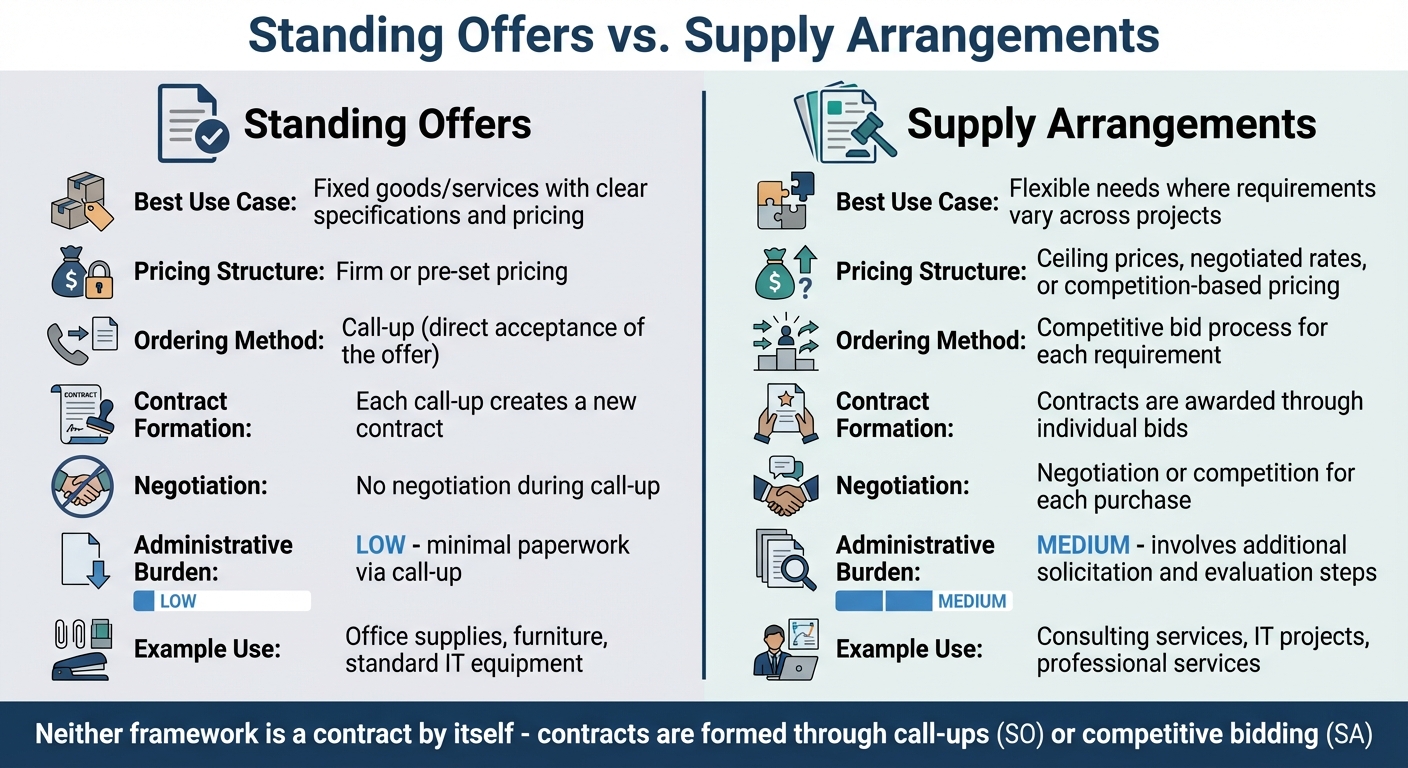
Standing Offers vs Supply Arrangements: Key Differences for Canadian Government Procurement
Comparison Table
Let’s break down the main differences between Standing Offers (SO) and Supply Arrangements (SA) to help you decide which framework fits your procurement needs.
Both frameworks simplify procurement processes, but they serve distinct purposes. Standing Offers are ideal for repeat orders of well-defined goods or services, while Supply Arrangements are better suited for situations where project requirements vary, such as consulting services that demand a tailored scope of work.
It’s also important to note that neither framework is a contract by itself. For Standing Offers, a binding contract is formed with each call-up. In contrast, Supply Arrangements require a competitive bidding process to award a contract.
| Feature | Standing Offer (SO) | Supply Arrangement (SA) |
|---|---|---|
| Best Use Case | Fixed goods/services with clear specifications and pricing | Flexible needs where requirements vary across projects |
| Pricing Structure | Firm or pre-set pricing | Ceiling prices, negotiated rates, or competition-based pricing |
| Ordering Method | Call-up (direct acceptance of the offer) | Competitive bid process for each requirement |
| Contract Formation | Each call-up creates a new contract | Contracts are awarded through individual bids |
| Negotiation | No negotiation during call-up | Negotiation or competition for each purchase |
| Administrative Burden | Low; minimal paperwork via call-up | Medium; involves additional solicitation and evaluation steps |
These distinctions make it easier to match the framework to your procurement goals.
When to Use Each Method
Choose Standing Offers for straightforward, recurring purchases where specifications and pricing are consistent. For instance, ordering standard office furniture under the N71 category or routine IT equipment becomes hassle-free with the call-up process. It reduces administrative effort while locking in predictable costs.
Supply Arrangements, on the other hand, are better for projects with evolving requirements. Categories like Professional Services (R0) and Informatics Professional Services (D3) rely on Supply Arrangements because each engagement demands unique expertise, timelines, and deliverables. The ceiling prices offer room for negotiation based on the specific scope, and the pre-approved supplier pool saves time by ensuring you’re working with qualified vendors from the start.
sbb-itb-e60d259
Compliance and Policy Requirements
Mandatory Use Policies
Canadian federal departments and agencies are required to use Public Services and Procurement Canada (PSPC) standing offers and supply arrangements for specific commodity groups before considering other procurement options. This requirement is part of the Treasury Board Directive on Procurement Management, which enforces these categories.
The mandatory categories include clothing and insignia (N84), furniture (N71), IT equipment (N70), office supplies (N75), and professional services (R), among others. The goal here is to promote cost efficiency and simplify procurement processes. If these mandatory instruments don’t meet operational needs, buyers must document their reasons and secure approval from their manager or director.
Competition and Transparency Requirements
Federal procurement rules emphasize competition and transparency. Buyers must solicit bids unless specific exceptions apply, such as emergencies or purchases of minimal value. To ensure public visibility, all Requests for Standing Offers (RFSO) and Requests for Supply Arrangements (RFSA) are published on the Government Electronic Tendering Service (GETS) via CanadaBuys.
Procurement activities must align with domestic and international trade agreements, including the Canadian Free Trade Agreement (CFTA), the Canada-European Union Comprehensive Economic and Trade Agreement (CETA), and the World Trade Organization Agreement on Government Procurement. For procurements covered by these agreements, award notices must be posted on GETS within 72 days of the contract award.
"A debriefing demonstrates the fairness, openness, and transparency of the federal government contracting process." – Public Services and Procurement Canada
Solicitations must include provisions for debriefings, allowing unsuccessful bidders to request one within 15 working days after receiving the results. When multiple standing offers are available for the same need, buyers must follow established ranking methods, such as Right of First Refusal or Proportional Basis, to ensure fair distribution of work.
With bidding and transparency addressed, it’s important to understand how framework durations and renewals are managed.
Duration and Renewal Standards
Standing offers and supply arrangements are valid for a specific period – often one or more years – depending on the commodity or service. Many of these frameworks align with the federal fiscal year (April 1 to March 31). Due to the complexities involved, procurement planning typically starts months in advance.
Extensions or revisions require approval based on the total estimated value of the agreement, including any extension periods. For agreements worth $1 million or more (including taxes), contractors with 100 or more employees must certify their commitment to employment equity under the Federal Contractors Program before the framework is issued.
Canada’s liability under standing offers is limited to the actual value of call-ups made during the agreement period, with no guarantee of minimum work. The creation, renewal, and extension of these instruments undergo formal departmental reviews to ensure they remain consistent with government procurement policies.
How to Use Standing Offers and Supply Arrangements
How to Find Available Frameworks
To locate standing offers and supply arrangements, start with the CanadaBuys Buyer’s Portal. Since January 30, 2026, this portal has replaced the archived PSPC Supply Manual, becoming the go-to source for all Acquisitions Program details. You can also access updated framework information weekly through the Government Electronic Tendering Service (GETS).
Before diving into procurement, check if your requirement falls under mandatory categories such as Professional Services (R), IT Software/Hardware (N70), Furniture (N71), or Office Supplies (N75). The Standing Offers and Supply Arrangements Application (SOSA App) is a handy tool that allows you to search by commodity code to determine if a framework is mandatory for your department. Frameworks are labeled (e.g., National Master, Regional Master, National Individual) to indicate their scope. If you’re unsure or need extra guidance, reach out to your local Procurement Assistance Canada (PAC) regional office or connect with an Acquisitions Account Manager.
Once you’ve identified the right framework, follow the outlined steps to begin your procurement process.
Steps for Using Standing Offers
Start by reviewing the "Standing Offer and Call-Up Authority" document to confirm your department is authorized to use the standing offer and to understand any call-up limits. Remember, a standing offer only becomes a contract when you issue a call-up. Before proceeding, verify the supplier’s security clearance through the appropriate government program.
If multiple standing offers are available for the same requirement, follow the ranking rules outlined in the framework. For example:
- Right of First Refusal: Contact the highest-ranked supplier first. If they’re unable to meet your needs, move to the next on the list.
- Proportional Basis: Divide the work based on predetermined percentages (e.g., 50% to the top-ranked supplier, 30% to the second, and 20% to the third).
When issuing a call-up, use the proper forms: the Canada acquisition card for smaller purchases, form PWGSC-TPSGC 942 for standard call-ups, or PWGSC-TPSGC 942-2 for multiple deliveries. Keep track of your spending to ensure it stays within the authorized limits set by the standing offer.
If your procurement needs are more flexible, the steps for using supply arrangements may be a better fit.
Steps for Using Supply Arrangements
Supply arrangements involve a two-step process. First, identify the pre-qualified suppliers listed within the arrangement. Then, request bids from this pool based on your specific needs. Review the supply arrangement document carefully to understand its scope, financial limits, and any ceiling prices. Ceiling prices can often be adjusted depending on project details and volume.
Before awarding a contract, double-check the supplier’s security clearance and confirm they are not on a suspension list. If trade agreements apply, you’ll need to issue a Notice of Proposed Procurement (NPP). If a mandatory supply arrangement doesn’t meet your operational needs or delivery timelines, document your justification thoroughly in the procurement file.
Conclusion
Standing Offers and Supply Arrangements simplify procurement for the Canadian government by using pre-negotiated frameworks that cut down on administrative work and ensure compliance. As CanadaBuys explains, "The standing offer is a convenient method of supply that saves time and money".
With Standing Offers, fixed pricing provides clear cost predictability, while Supply Arrangements allow for negotiable rates, offering flexibility. Together, these approaches deliver both financial and administrative advantages.
Prequalified suppliers and standardized terms further ease the process. For Standing Offers, call-ups immediately create legally binding contracts. In the case of Supply Arrangements, the two-step process begins with a prequalified supplier pool, streamlining competitive bidding.
These frameworks also adhere to international and national trade agreements, ensuring fairness and transparency at every step.
To get the most out of these systems, it’s important to confirm mandatory frameworks, negotiate within defined limits, and keep track of call-up thresholds. By incorporating these pre-negotiated frameworks into modern procurement workflows, organizations can achieve efficiency and cost savings like never before.
FAQs
What are the key advantages of using Standing Offers and Supply Arrangements?
Standing Offers and Supply Arrangements make life easier for Canadian government buyers by simplifying how they procure goods and services. These tools cut through red tape by using pre-negotiated terms, allowing buyers to quickly get what they need without wasting time on lengthy procurement processes.
With this framework in place, buyers can handle urgent requirements more efficiently while staying aligned with procurement standards. This not only speeds up operations but also helps build stronger, more reliable relationships with suppliers. Plus, the time saved translates into cost savings, making the entire process more effective.
What is the call-up process for a Standing Offer, and how does it work?
When working with a Standing Offer, the call-up process lets government buyers request goods or services on an as-needed basis. Once a call-up is issued, it turns into a binding contract between the buyer and the supplier. This approach streamlines procurement by removing the need to renegotiate terms for every purchase.
Since Standing Offers are pre-arranged agreements, all pricing, terms, and conditions are predetermined. This ensures transactions are quicker and more straightforward for both parties involved.
When should a government agency use a Supply Arrangement instead of a Standing Offer?
When flexibility is the main focus, a Supply Arrangement is the better choice for a government agency. Unlike a Standing Offer, which locks in fixed pricing and predefined quantities, a Supply Arrangement provides a more open-ended procurement framework. This setup works well for supporting multiple departments or agencies, especially when exact quantities, timelines, or specific needs haven’t been finalized.
Supply Arrangements shine in handling complex procurement scenarios or when coordinating with multiple suppliers. They allow for a more adaptable and scalable approach, making them ideal for long-term projects, large-scale initiatives, or situations that demand greater customization and collaboration.
Related Blog Posts
- What are the best non-US helpdesk platforms for Canadian companies in 2026?
- What should Canadian teams check before switching to a non-US SaaS helpdesk?
- What does “Buy Canadian” mean for software and SaaS procurement in Canada?
- How can vendors qualify for Canada’s federal SaaS supply arrangement (SaaSSA)?