
AI is changing how businesses manage SLAs (service level agreements) and escalations, making support faster and more accurate. Instead of relying on rigid rules, dynamic SLAs adjust in real-time based on customer needs, urgency, and context. Here’s what you need to know:
- Dynamic SLAs: These systems adjust response times by analyzing factors like customer value, sentiment, and issue complexity. For example, a frustrated high-value customer gets faster attention automatically.
- AI-Powered Insights: AI predicts potential SLA breaches by analyzing patterns, tone, and historical data, allowing teams to act before problems escalate.
- Escalation Control: AI triggers workflows when risks are detected, such as routing critical cases to senior agents or notifying managers.
Platforms like Supportbench integrate AI directly into SLA management, eliminating the need for manual processes or IT involvement. This helps reduce escalation rates by up to 50%, saving costs and improving customer satisfaction.
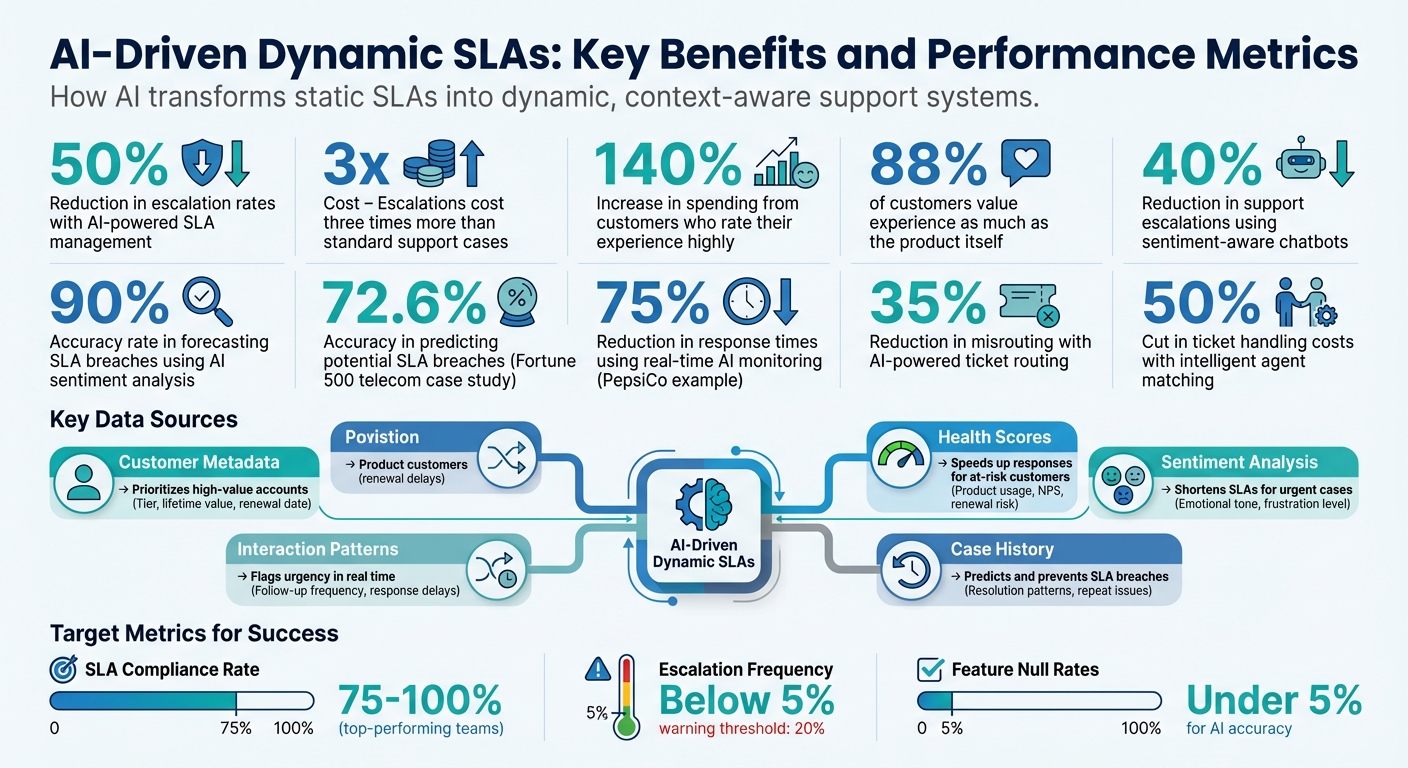
AI-Driven Dynamic SLAs: Key Benefits and Performance Metrics
What Makes SLAs Dynamic in AI-Driven Support
Dynamic SLAs adapt in real time by considering factors like customer importance, the complexity of requests, and the emotional tone of interactions. Instead of sticking to a fixed response time for all cases, these systems constantly analyze and adjust targets to match the actual urgency and business impact of each situation.
Unlike traditional SLAs that rely on rigid rules, dynamic SLAs use context and sentiment analysis to define appropriate response goals. This allows them to identify urgency even when customers use vague or unclear language.
Adjusting SLA Targets Based on Customer Context
AI-powered SLAs pull data from various sources to determine the right response time for each case. They analyze customer metadata – such as lifetime value, support tier, and loyalty status – along with health metrics like product usage, renewal rates, and NPS scores. This enables the system to prioritize high-value or at-risk customers by tightening response times when needed. For example, if a customer’s health score drops or their renewal date is near, the SLA automatically adjusts to prevent churn, turning traditional SLAs into dynamic tools that enhance customer experiences.
Sentiment analysis plays a key role here, using natural language processing to pick up on emotions like frustration or urgency that might not be evident in structured data. If a customer’s message shows signs of escalating frustration, the system can tighten the SLA – even if the ticket isn’t marked as urgent.
"AI-driven sentiment analysis in customer service is no longer a luxury. It’s a necessity for understanding your customers and delivering the personalized service they demand".
These real-time adjustments align seamlessly with escalation processes, ensuring smooth workflows.
Connecting SLA Changes to Escalation Triggers
Dynamic SLAs are tightly linked to escalation workflows. When AI identifies risk signals – such as repeated issues from the same customer, mentions of critical phrases like "system down" or "production outage", or sudden shifts in sentiment – it automatically adjusts SLA targets and escalation paths. For instance, if a customer sends multiple follow-ups without a response, the system flags the urgency and routes the case to a senior agent. Similarly, phrases like "considering other options" or "canceling" can trigger immediate notifications to Customer Success teams while tightening SLA targets.
Research shows that integrating SLA adjustments with real-time escalation triggers can reduce escalations by over 50%. This proactive approach helps teams address problems before they escalate further.
Data Requirements for Dynamic SLAs
To make these dynamic adjustments and seamless escalations possible, access to robust data sources is crucial. At a minimum, teams need historical case data to understand resolution patterns, customer metadata from CRM systems (including account tier, contract details, and value), and real-time sentiment scores from ongoing interactions.
Customer health scoring is especially important. By combining data like product usage, ticket frequency, survey feedback (NPS, CSAT, CES), and renewal rates into a single metric, the system can prioritize cases for customers with declining health scores.
Case content also provides essential context. AI analyzes subject lines, message bodies, and technical details like error codes or affected product modules to gauge the complexity and urgency of requests. This helps prevent cases from being misrouted or delayed due to confusion.
| Data Source | Output | SLA Impact |
|---|---|---|
| Customer Metadata | Tier, lifetime value, renewal date | Prioritizes high-value accounts |
| Health Scores | Product usage, NPS, renewal risk | Speeds up responses for at-risk customers |
| Sentiment Analysis | Emotional tone, frustration level | Shortens SLAs for urgent or negative cases |
| Case History | Resolution patterns, repeat issues | Predicts and prevents SLA breaches |
| Interaction Patterns | Follow-up frequency, response delays | Flags urgency and adjusts SLAs in real time |
The effectiveness of dynamic SLAs depends heavily on the quality of these data sources. Outdated health scores or incomplete customer metadata can lead to poor prioritization. Platforms like Supportbench address this by integrating these data sources directly into their AI-driven B2B support systems. They pull customer context from CRMs, analyze sentiment in real time, and keep health scores updated – eliminating the need for custom integrations or IT support.
AI Features That Enable Dynamic SLA and Escalation Control
AI is reshaping SLA management by analyzing incoming requests, spotting potential risks, and predicting breaches before they happen. This allows teams to step in early and address issues proactively, keeping service levels on track and customers satisfied.
Automated Case Triage and Priority Assignment
Gone are the days of rigid, rule-based ticket management. AI now uses advanced natural language processing (NLP) and machine learning (ML) to interpret the content and sentiment of requests. Instead of just scanning for keywords, it dives into subject lines and message bodies to classify tickets, apply relevant tags, and pinpoint product-specific issues instantly.
Prioritization gets smarter, too. By combining factors like shifts in sentiment, urgency keywords, customer value from CRM systems, and rapid follow-ups, AI can adjust SLAs on the fly. For instance, if a premier customer shows signs of extreme frustration in what might seem like a routine request, the system can automatically shorten the SLA to ensure quicker resolution.
AI also improves routing by matching tickets to agents based on their expertise and current workload. This approach reduces misrouting by 35%, nearly doubles productivity, and cuts ticket handling costs in half.
Detecting Early Warning Signs Through Sentiment Analysis
AI-driven sentiment analysis is a game-changer for catching potential issues before they spiral out of control. By analyzing the tone of customer messages, AI can spot when a conversation shifts from neutral to frustrated – long before it escalates into a missed deadline or formal complaint. This allows the system to prioritize critical issues and even shorten SLA targets when necessary.
High-frustration cases are automatically flagged and routed to specialized teams, helping prevent SLA breaches. Supervisors are also alerted to negative trends early enough to step in and preserve customer relationships. AI tools that analyze both historical and real-time sentiment data have achieved a 90% accuracy rate in forecasting SLA breaches. Sentiment-aware chatbots, meanwhile, have cut support escalations by up to 40%.
A real-world example? In April 2017, PepsiCo used AI-powered sentiment analysis during a social media crisis over a controversial ad. By monitoring the situation in real time, they reduced response times by 75% compared to manual methods and recovered 90% of positive sentiment within just 48 hours.
"Service management is shifting from tracking SLAs to continuously improving them. With AI automation, service desks move from reactive responses to predictive, problem-solving operations."
- Sean O’Connor, monday.com
This ability to detect sentiment shifts early lays the groundwork for AI to predict SLA breaches with remarkable precision.
Predicting SLA Breaches Before They Occur
AI takes SLA management a step further by predicting breaches before they happen. Using machine learning models, it identifies cases likely to escalate and enables teams to act preemptively. Instead of waiting for a breach, teams can reassign resources, escalate high-priority cases to senior agents, or trigger immediate managerial intervention.
These predictive models rely on techniques like gradient boosting and decision trees to analyze historical data and uncover patterns linked to past escalations. For example, in February 2023, a Fortune 500 telecom company implemented a machine learning alert system that processed over 659,000 historical tickets. The system achieved a 72.6% accuracy rate in spotting potential breaches and significantly reduced Mean Time to Repair (MTTR).
Supportbench integrates these predictive capabilities directly into its platform, allowing B2B support teams to manage dynamic SLAs without needing additional IT resources. By analyzing factors like customer tier, health scores, sentiment, and interaction patterns, the system has helped reduce escalation rates by up to 50%. This ensures consistent customer experiences, even in complex, long-term cases.
This predictive, data-driven approach is at the heart of how AI is transforming SLA management, making it more responsive and effective than ever.
How to Implement Dynamic SLAs and AI Escalation Workflows
Switching from static SLA rules to AI-driven workflows might sound complex, but it’s all about creating a smarter, more responsive system. The aim? Replace rigid timeframes with intelligent solutions that adjust based on customer context, sentiment, and risk – right when it matters. Here’s how B2B support leaders can make this shift without throwing daily operations into chaos. Let’s break it down step by step.
Reviewing Your Current SLA and Escalation Processes
First things first: take a hard look at your current SLA and escalation setup. If your system relies on strict, one-size-fits-all rules, chances are it’s missing subtle cues buried in customer messages.
Start by mapping out your workflows and identifying pain points. For example:
- Are high-value customers stuck waiting because their issues weren’t marked as urgent?
- Are agents manually escalating cases they know will breach SLAs?
- How much are escalations costing you? (Hint: they’re typically three times more expensive than standard support cases.)
If your team is relying on manual processes to catch warning signs, you’re likely losing opportunities to step in early. Once you’ve pinpointed the gaps, you can start building SLA models that truly focus on what matters most: delivering value to your customers.
Creating Risk-Based and Value-Driven SLA Models
Now that you know what’s not working, it’s time to design SLA models that prioritize customer value. Instead of treating every ticket labeled "Medium" the same, create categories like "at-risk", "needs attention", and "healthy" based on customer health scores and interaction history.
Think about what’s most important for your business. For instance, if a loyal customer with a renewal coming up in 30 days submits a request, your system should automatically set a tighter SLA target. Why? Because customers who rate their experience highly are likely to spend 140% more than those who don’t. Aligning SLA priorities with customer value isn’t just good service – it’s protecting your bottom line.
To take it a step further, integrate Customer Health Scoring (CHS) as a key input. If a customer’s health score dips – whether due to reduced product usage or poor feedback – your AI system should respond by fast-tracking their cases and routing them to senior agents. This proactive approach moves you away from reactive metrics and into a system that anticipates and manages risks before they escalate.
Setting Up AI-Powered Escalation Workflows
Once your new SLA model is ready, it’s time to set up AI workflows that respond to real-time signals. Platforms like Supportbench make this easy. Use their Workflow configuration to create AI triggers (e.g., "Priority is High" or "Customer Health Score < 50") and define custom response times. The beauty of this setup? It adjusts service levels automatically – no IT team required.
Here’s how to enhance your escalation process:
- Multi-level handoffs: If sentiment analysis flags a case as "Likely to Escalate", the system can instantly notify a manager on Slack or Teams and reassign the case to a specialist. One leading platform reduced escalations by over 50% by using AI workflows to analyze sentiment and urgency across case histories.
- Pre-escalation alerts: AI can predict when a case is heading toward escalation by spotting patterns like frequent follow-ups, negative sentiment, or historical trends. This allows your team to act early – whether that’s reallocating resources, sending proactive updates, or escalating to senior staff before the customer even notices a delay.
- De-escalation processes: Not every flagged case will escalate. Build workflows that let agents mark false positives and feed that information back into the AI. Over time, this feedback loop sharpens the system’s accuracy and ensures it keeps improving.
sbb-itb-e60d259
Tracking Performance and Improving AI-Driven SLA Programs
When it comes to AI-driven SLA programs, keeping a close eye on performance and making ongoing adjustments is essential. By measuring outcomes, fine-tuning processes, and using real-world data, you can ensure your SLA programs remain effective and responsive, ultimately boosting customer satisfaction.
Metrics That Matter for Dynamic SLA Programs
To manage AI-powered SLA programs effectively, focus on metrics that truly reflect system performance. One of the most important is the SLA compliance rate – top-performing teams typically hit compliance rates between 75% and 100%. Another key metric is escalation frequency. Ideally, this should stay below 5%. If it climbs above 20%, it may signal underlying issues that need attention.
In escalation prediction, prioritize recall over precision. Why? Recall captures the percentage of cases that were flagged early and eventually escalated, which is crucial for identifying potential problems in advance. Precision, on the other hand, can be misleading. For instance, if the system successfully prevents an escalation, the precision score might drop – even though the AI performed exactly as intended.
"The better the model is at predicting to-be-escalated cases, the worse the precision will be, assuming that the agents take actions based on the LTE flags." – Shuo Chen, Director of Engineering, SupportLogic
Another valuable tool is sentiment analysis. Real-time monitoring helps you adjust SLAs as situations evolve, while analyzing historical sentiment data can uncover trends that inform long-term improvements. Additionally, integrating a Customer Health Score (CHS) into your SLA tracking can help identify at-risk accounts and assess whether dynamic SLA adjustments are making a difference.
Refining AI Models Based on Real Performance Data
AI models thrive on real-world feedback. For example, Nutanix’s predictive AI for escalation management achieved impressive results in 2022–2023, cutting escalations by 40% and improving both NPS and CSAT scores through a continuous feedback loop.
To measure AI performance more effectively, consider using a "modified precision" metric. This approach counts cases where agents took proactive steps based on AI alerts as successful predictions, even if the case didn’t escalate. To avoid overloading resources, limit proactive alerts to the top 10 highest-probability cases per day. Qlik applied similar strategies and reduced escalations for its core analytics product by 30% within six months by closely tracking sentiment and attention metrics.
Managing Data Quality and Escalation Policy Risks
The success of AI systems depends heavily on the quality of the data they rely on. Keep feature null rates under 5% to maintain accuracy. You can also enhance tracking by adding a "SLAMissed" boolean field in your ticketing system, which updates automatically based on breach outcomes.
Historical data is another powerful resource. In February 2023, a Fortune 500 telecom company processed nearly 660,000 historical tickets with 78 attributes to train its machine learning system, achieving a 72.6% accuracy rate in identifying potential SLA breaches. This kind of validation helps fine-tune rules and prevents alert fatigue.
Be mindful of AI bias, which can arise from regional dialects, slang, or gaps in the data. For edge cases – like sarcasm or passive-aggressive language – human oversight is critical to avoid misinterpretations. Lastly, protect sensitive customer information with role-based access controls and robust encryption, especially when using prediction models that handle personal data.
Conclusion
The strategies discussed earlier highlight the transformative role of AI in shaping dynamic SLAs, and the results speak for themselves. By leveraging AI-driven dynamic SLAs, B2B support teams can anticipate and address potential issues before they escalate, ensuring smoother customer interactions. In fact, industry leaders have reported up to a 56% decrease in escalation rates by adopting predictive AI models.
Considering that escalations cost three times more than standard cases, prevention isn’t just a smart move – it’s a cost-effective one. Combine this with the fact that 88% of customers value their experience as much as the product itself, and higher customer satisfaction often leads to a 140% increase in spending. Dynamic SLAs, therefore, not only enhance service quality but also contribute directly to revenue growth.
"By shifting from reactive to proactive SLA management, you can stay ahead of customer issues and secure smoother experiences."
- Eric Klimuk, Founder and CTO, Supportbench
Supportbench exemplifies this proactive approach by embedding AI into case management and escalation workflows. Through features like sentiment-based routing, SLA breach predictions, and Customer Health Scoring, the platform ensures that accounts at risk receive immediate attention. This approach allows teams to scale efficiently through automation rather than adding headcount, safeguarding both customer retention and revenue.
For B2B support leaders tasked with delivering more while managing costs, AI-powered dynamic SLAs are no longer just an option – they’re a necessity to stay competitive in today’s fast-paced market.
FAQs
How do dynamic SLAs enhance customer satisfaction compared to traditional ones?
Dynamic SLAs take customer support to the next level by automatically tailoring response and resolution times based on urgency, specific context, and the risk of missing an SLA. This approach ensures quicker, more personalized support, which helps reduce escalations and enhances the overall customer experience.
On the other hand, traditional SLAs often rely on a fixed, one-size-fits-all framework that struggles to keep up with shifting priorities. This can lead to slower resolutions and, ultimately, lower customer retention. In fact, dynamic SLAs have been shown to boost customer retention by 17%, proving their ability to meet the demands of modern support environments.
How does sentiment analysis help adjust SLA targets in customer support?
Sentiment analysis is like a window into a customer’s emotions, using AI to interpret the tone of their communication. If a ticket carries negative language or hints of frustration, the system can flag it as a high-priority issue. From there, it can automatically adjust the SLA (Service Level Agreement) target – think faster response or resolution times. This kind of proactive adjustment helps teams tackle serious problems before they grow into bigger headaches.
On the flip side, tickets with neutral or positive sentiment can afford more flexible SLA targets. This allows support teams to focus their energy on urgent cases without compromising efficiency. In Supportbench, sentiment analysis doesn’t work in isolation. It’s paired with other factors like response delays and case history to dynamically re-prioritize tasks. The result? Critical issues are resolved faster, and overall service quality stays intact.
How can businesses maintain data quality for effective AI-driven SLA management?
Maintaining top-notch data quality is a must for any AI-powered SLA management system. The process starts with defining clear SLA metrics that align with your business objectives. Consistent data capture during ticket creation is equally important. Using standardized fields like priority levels, contract types, and response-time targets helps eliminate discrepancies, ensuring AI can draw accurate comparisons.
Another key step is to centralize and clean historical ticket data before feeding it into AI training models. This involves tasks like removing duplicate entries, standardizing status codes, and fixing timestamp errors. These actions significantly improve the accuracy of predictions. To maintain long-term data reliability, real-time data validation is crucial. Automated alerts can flag missing or incorrect values as tickets are logged, keeping your data accurate and actionable.
Supportbench makes these practices seamless. Its dynamic SLA engine leverages structured ticket data to automate AI-based prioritization, eliminating the need for manual intervention. Real-time alerts and AI copilots further enhance data consistency. By combining disciplined data practices with AI capabilities, businesses can anticipate SLA breaches, dynamically adjust priorities, and cut operational costs with ease.