
Running customer support for global teams is tough. Language barriers, time zones, and high costs make scaling operations challenging. Here’s the good news: modern platforms with AI-powered tools are solving these problems. From automated translations to global ticket routing, these tools help teams manage multilingual support efficiently and cost-effectively.
Key Takeaways:
- Language Support Matters: 64% of customers expect support in their native language.
- AI Solutions Save Costs: AI-driven translation reduces reliance on expensive native-speaking agents.
- Top Platforms Reviewed: Supportbench, Zendesk, Kustomer, Crescendo.ai, and Intercom Fin.
Quick Overview:
- Supportbench: Flat-rate pricing, AI translation, and advanced routing for B2B teams.
- Zendesk: Dynamic content and AI tools, but costs can rise with higher volumes.
- Kustomer: Timeline-based system with flexible pricing for global teams.
- Crescendo.ai: Per-resolution pricing with strong language capabilities and human-AI collaboration.
- Intercom Fin: Affordable resolution-based pricing with robust translation tools.
These platforms offer distinct features to help businesses scale globally. The right choice depends on your team’s needs, budget, and priorities.
1. Supportbench
Multi-language support
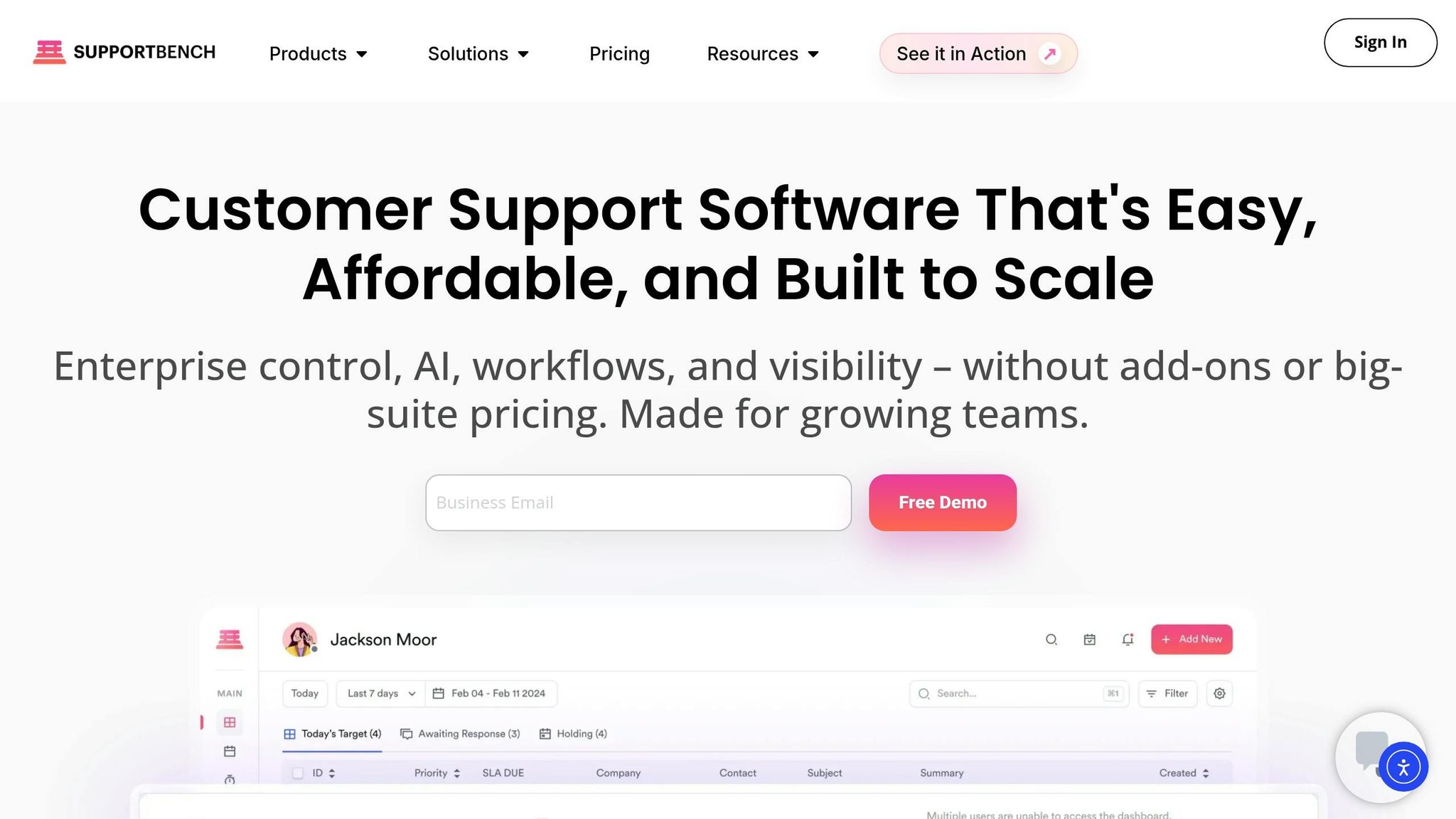
Supportbench seamlessly integrates language support into its core routing and workflow system, eliminating the need for extra add-ons. Using AI, the platform analyzes incoming ticket content and automatically routes requests to agents based on their language skills. It also adjusts ticket urgency through language-driven prioritization, ensuring critical issues in specific markets are addressed promptly[5][6]. For example, a Spanish-speaking customer is automatically connected to a Spanish-speaking agent, and tickets in certain languages can be escalated faster to meet regional needs.
On the self-service side, Supportbench allows businesses to create multiple brand portals with region-specific knowledge base content. A German customer can access German-language documentation, while a French customer sees content in French – all managed within the same platform. There’s no need to duplicate your entire support infrastructure for different regions[5].
These automated features enable smooth multilingual interactions, powered by AI.
AI-powered translation
Supportbench leverages GPT-4o to enhance its Knowledge Base and FAQ GenAI bots. These tools can understand and respond to customer inquiries in multiple languages. Additionally, AI analyzes and summarizes customer communications, helping agents quickly grasp the context of multi-message conversations. Sentiment and emotion analysis runs in the background, offering global managers a clear view of customer experiences across different regions[5].
Global routing capabilities
Supportbench goes beyond language support and translation by offering global routing for 24/7 support. Its Follow-the-Sun model handles time zones, regional workflows, and escalations between geographic locations seamlessly[5]. For instance, when your London team finishes their shift, cases are automatically routed to your New York team based on language requirements and expertise.
The platform also provides a 360-degree view of customers through multi-level parent-child company relationships[5]. If you’re managing a multinational corporation with multiple subsidiaries, Supportbench tracks the entire account structure and health scoring across all regions, ensuring nothing slips through the cracks.
Pricing and scalability
Supportbench’s pricing starts at $32 per agent per month (billed annually) for the Professional plan, which includes AI features, ticketing, and customer health scoring. The Enterprise plan, priced at $100 per agent per month (annual billing), adds features like sandboxing, white labeling, and a dedicated success manager[5].
The pricing model is transparent and scales with team size. For teams over 15 agents, an additional $2.50 per agent is charged, capped at $150. Teams with 60 or more agents automatically upgrade to the Enterprise plan[5]. This structure prevents unexpected cost increases as your team grows or expands into new markets.
"Supportbench centralizes client communications and offers full oversight across accounts." – Hugh Dauterman, Data Operations Director[5]
B2B-specific features
Supportbench is tailored for the complexities of B2B global accounts, unlike platforms designed for high-volume B2C support. Dynamic SLAs automatically tighten response times during critical phases, such as when customer renewals are approaching[5].
The platform also offers scorecards for over 35 KPIs, allowing you to track agent and team performance across regions. Its knowledge base supports up to a 6-level hierarchy, making it easier to organize documentation across product lines, languages, and regional variations[5].
sbb-itb-e60d259
2. Zendesk
Multi-language support
Zendesk’s Suite plans include language support that scales with your subscription tier. On the Professional and Enterprise plans, the platform uses Dynamic Content to manage multiple language versions through a single placeholder. This means you can create one macro or system message that automatically adjusts to the language preferences of the requester’s profile[9].
The platform’s triggers recognize the "Requester’s Language" and direct tickets to agents who speak the same language. For real-time interactions, AI Agent Translation enables live chat translation, but this feature is only available on Suite Growth and higher plans. Zendesk’s AI tools further enhance these capabilities by offering automated translation options.
AI-powered translation
Zendesk supports automated translations in over 80 languages through its AI agents. Companies using these tools have reported automated resolution rates ranging from 39% to 66%[7]. The Article AI Translation feature, integrated into the knowledge base editor, leverages generative AI but requires the Copilot Add-on to function.
That said, there are some limitations. The system relies on native scripts for accurate translations, and updates to pricing or policies may not be reflected immediately in the translated content[7]. Additionally, email-based AI agents are restricted to pre-scripted dialogues[7].
"AI-generated translations are a fantastic way to scale support… However, one persistent challenge has been the mistranslation or alteration of critical terms." – Hugo Richard, Gravity CX[8]
Pricing and scalability
Cost efficiency is another key factor when implementing global support. Zendesk charges per automated resolution, with rates set at $1.50 for committed usage and $2.00 for pay-as-you-go resolutions[7]. Monthly allowances vary by plan: 5 resolutions for Team, 10 for Professional, and 15 for Enterprise[7].
However, as support volumes grow across multiple languages and regions, this pricing model can become less predictable. Scaling effectively requires careful planning to manage costs and maintain consistent performance.
"The practical reality: you can get something live quickly, but if you want good automation (and predictable behavior), you should treat it like a real implementation – not a toggle." – Mike Heap, Product Manager, My AskAI[7]
3. Kustomer
Multi-language support
Kustomer uses a timeline-based system that captures ongoing, multi-language interactions to streamline support resolutions. This setup gives agents a complete view of customer interactions across different languages and channels, ensuring they always have the context they need to resolve issues effectively [11].
The platform also features an i18n framework, which matches locales to specific text strings. This ensures that app interfaces, workflows, and UI elements appear in the preferred language of both your team and customers [10]. If a translation isn’t available, the system defaults to English.
This language-focused framework supports efficient global operations, making it a strong choice for businesses operating across different regions.
Pricing and scalability
Kustomer’s pricing starts at $89 per seat/month for the Enterprise plan and $139 per seat/month for the Ultimate plan. AI-driven tools like real-time translation and automated responses are available as add-ons, which could raise the overall cost. The platform’s flexible data model is particularly useful for handling repeat interactions in multi-language B2B environments. However, this flexibility can also lead to added technical challenges when setting up the system for distributed teams. To address these complexities, the Ultimate plan caters specifically to global teams, offering detailed reporting and advanced workforce management features [11].
4. Crescendo.ai
Multi-language Support
Crescendo.ai is equipped to handle over 50 languages, including English, Spanish, French, Mandarin, Hindi, Arabic, and Japanese [12][13]. It facilitates seamless translations across chat, voice, email, and SMS while also delivering localized knowledge base articles [12][13][14]. Additionally, the platform provides AI-generated reports – like sentiment analysis and conversation summaries – in multiple languages, enabling customer experience (CX) leaders to assess performance effectively in global markets [12][13].
Its advanced language capabilities are complemented by AI-driven routing, simplifying global support workflows.
AI-Powered Translation and Routing
Crescendo.ai’s agile AI architecture autonomously determines the best resolution path [17]. For unresolved queries, it connects users to a network of over 3,000 global support professionals, ensuring 24/7 assistance while maintaining conversation context [12][14]. A standout example: in early 2026, Meister relied on Crescendo.ai to tackle a backlog of more than 1,000 multilingual tickets, achieving an impressive 99.2% quality score [18].
"The blend of agents and AI-powered automation makes everyday feel like the slow season for our internal support team." – Thomas Mayerhofer, Customer Success Team Lead at Meister [16]
Pricing and Scalability
Crescendo.ai offers a straightforward, results-focused pricing model. The standard plan starts at $1.25 per resolution plus a $2,900 monthly service fee [15][16]. For more comprehensive coverage, the All-Inclusive plan begins at $2.99 per resolution, offering 24/7 human backup, support for 50+ languages, and guaranteed 100% quality assurance [16]. Unlike traditional seat-based pricing, this model ties costs directly to resolved cases, providing predictable expenses as businesses grow.
Designed for high-volume B2B support, the platform manages over 15,000 tickets annually, boasts 99.8% resolution accuracy, and automates up to 90% of tickets [12]. Its multi-provider setup leverages several large language models simultaneously, ensuring uninterrupted service and low latency. Most enterprise deployments are operational within four weeks [19]. These features make Crescendo.ai a cost-effective, AI-driven solution tailored for the demands of modern global support systems.
5. Intercom Fin
Intercom Fin tackles the challenges of global customer support with an AI-focused design that ensures seamless language transitions and efficient workflows.
Multi-Language Support
Intercom Fin supports an impressive 45 languages, including Arabic, Simplified and Traditional Chinese, French, German, Japanese, Hindi, and Spanish [23]. It automatically detects the customer’s language at the start of a conversation and applies it across all AI-generated responses and workflows [20]. This feature extends across major communication channels, ensuring smooth and consistent support [22].
For teams dealing with global operations but lacking fully localized content, Fin’s fallback language feature steps in. If a customer’s preferred language isn’t available in the knowledge base, Fin retrieves content in a designated primary language (usually English) and translates it in real time [20]. This approach reduces the need for manual translations and cuts down operational overhead.
These multilingual capabilities, combined with advanced translation tools, simplify global customer interactions significantly.
AI-Powered Translation
Fin’s AI translation works on two levels. First, its AI-generated responses boast 99.9% translation accuracy and achieve a 51% resolution rate. Second, its AI Inbox Translation feature converts customer messages into the agent’s language (and vice versa), while offering tone customization options [23][21]. When human agents step in, AI Inbox Translation ensures instant, two-way translations between agents and customers [21]. To maintain brand consistency, teams can adjust the tone of translations – choosing from Friendly, Neutral, or Professional [21].
While unlimited AI Inbox Translation is available with the Copilot add-on, agents without it are limited to 10 free translations per month [21]. Fin also connects seamlessly with essential B2B tools like Salesforce, Shopify, and Stripe [22].
Pricing and Scalability
Fin’s automation and translation features offer a cost-efficient solution for scaling support operations. It charges $0.99 per successful resolution, with no fee for unresolved issues [24]. For enterprise users, the Expert plan starts at $132 per seat per month (billed annually) and includes perks like single sign-on (SSO), HIPAA compliance, and service level agreements (SLAs) [24]. The AI Copilot add-on is priced at $29 per agent per month for unlimited translation use [24].
The results speak for themselves. Synthesia resolved over 6,000 conversations in six months, saving more than 1,300 hours and achieving an 87% self-serve rate. Lightspeed saw a 31% boost in daily closures with Copilot [24][25][26].
"Agents using Copilot closed 31% more customer conversations daily during testing." – Angelo Livanos, Vice President of Global Support at Lightspeed [26]
Platform Comparison
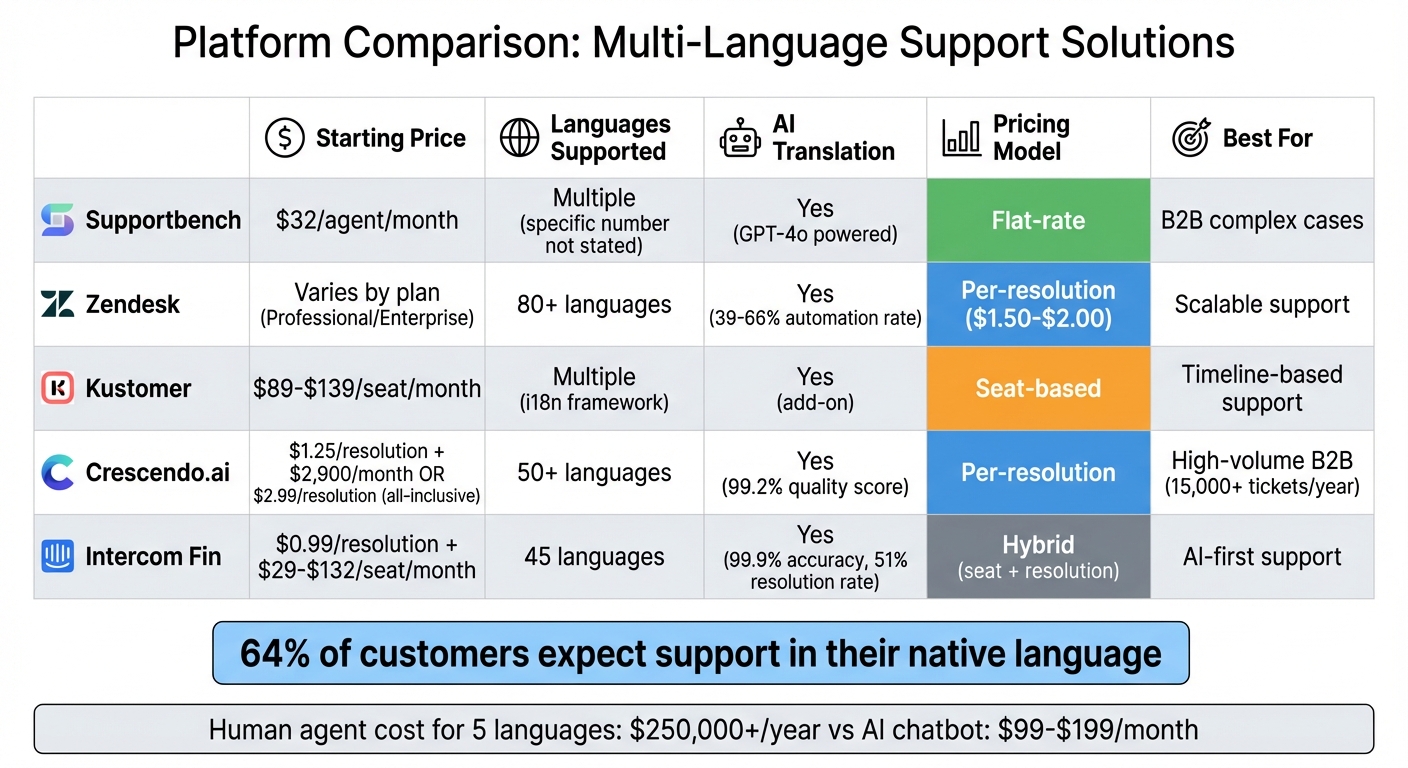
Multi-Language Support Platform Comparison: Pricing, Features, and Languages
When selecting a platform for global support, the key factors to consider include its ability to handle diverse languages, deliver accurate AI-driven translations, optimize routing, and maintain a predictable cost structure. Each platform takes a unique approach to these challenges, so comparing elements like cost, translation accuracy, and agent productivity is essential.
Supportbench caters specifically to B2B teams managing complex, long-term cases across multiple languages. The platform offers built-in AI tools such as ticket summaries, case history search, and automated knowledge article creation – all included in a flat-rate pricing model of $32 per agent per month. Unlike many competitors that charge extra for AI features, Supportbench bundles multilingual AI support, dynamic SLAs, and customer health scoring at no additional cost. This makes it an appealing choice for industries like manufacturing, logistics, and managed services, where enterprise-level functionality is needed without the hefty price tag. Its pricing aligns well with modern B2B strategies that emphasize efficiency and cost predictability.
Translation accuracy is another area where platforms differ significantly. Some boast up to 99% brand tone accuracy across 120+ languages, leveraging advanced AI Context technology [27]. Zendesk, by comparison, supports 40 languages but relies on more traditional translation methods [2][4]. For teams targeting niche markets, Helpshift offers support for an impressive 150 languages, powered by its proprietary Language AI [2][27].
Pricing structures also vary widely. Intercom Fin uses a tiered seat-based model, with costs ranging from $29 to $132 per agent per month, combined with a $0.99 per-resolution fee. Crescendo.ai charges $1.25 per resolution plus a fixed monthly cost, while Tolto provides an all-inclusive plan at $10 per agent per month [27]. On the other hand, Kustomer offers custom pricing. For B2B teams, per-resolution pricing can become harder to manage as support volumes grow, making flat-rate options like Supportbench’s more appealing for businesses aiming to scale without unpredictable costs.
These pricing and performance differences also influence operational efficiency. Platforms report various productivity gains, such as a 45% increase in overall efficiency, a threefold boost in support capacity, a 20% improvement in efficiency with 96% customer satisfaction, and significant reductions in administrative workloads through automated translations into 13 languages [27][28][1]. These improvements highlight how AI-driven translation can simplify global customer support and enhance productivity.
Conclusion
Choosing the right platform hinges on aligning it with your core priorities: managing costs, leveraging AI-driven automation, and ensuring top-notch security.
For B2B teams managing complex, multilingual support cases, Supportbench offers a robust suite of AI-native tools. Features like ticket summaries, automated knowledge base creation, and customer health scoring are all bundled under a predictable flat-rate pricing model. This approach ensures stable budgeting as your team grows, avoiding the headaches of per-resolution fees that can complicate cost control.
Some flat-rate platforms start as low as $10 per agent per month and support multiple languages [27]. For industries like finance or healthcare, where data sensitivity is paramount, certain platforms also deliver strong security measures, including GDPR and HIPAA compliance, while helping reduce overall support costs [3].
"Customers now engage with our support team instantly in their native language, leading to faster resolutions and higher satisfaction rates."
If phone support is a cornerstone of your operations, look for platforms with built-in voice translation. On the other hand, if self-service is your focus, prioritize tools that automate help center localization. With 64% of customers expecting support in their native language [4], the cost implications are clear: supporting five language markets with human agents can exceed $250,000 annually, while a multilingual AI chatbot can handle the same workload for just $99–$199 per month [29].
Analyze your support ticket data to identify which languages drive your operations. Flat-rate, AI-powered solutions not only eliminate surprise expenses but also provide the tools needed to manage multilingual support effectively. The right platform should break down language barriers, boost agent efficiency, and deliver measurable returns – without becoming just another cost burden.
Integrated AI-native solutions are the key to reducing language challenges and streamlining global B2B support.
FAQs
How do I decide which languages to support first?
To determine which languages to prioritize, take a close look at your customer base. Identify the languages most commonly spoken in your primary markets or in regions where support demand is high. It’s also smart to factor in potential growth opportunities in specific areas. Additionally, assess the availability of tools like real-time translation and automatic language detection, which can make multilingual support more manageable. Begin with languages that have the highest demand and gradually expand as your business scales, ensuring you align customer needs with your broader global strategy.
How can I keep AI translations accurate for industry terms and product names?
To get precise AI translations for industry-specific terms and product names, custom glossaries are essential. These glossaries serve as a centralized reference for critical terminology, helping to avoid mistakes and maintain consistency across translations. On top of that, using AI-powered terminology management tools can streamline updates and ensure branding stays consistent. This method not only cuts down on recurring errors but also boosts accuracy when dealing with specialized language.
What’s the best way to scale 24/7 global routing without costs spiking?
AI-powered platforms are the smartest way to scale 24/7 global routing without driving up costs. These tools can manage 80–90% of inquiries through real-time translation and automation, cutting down the need for round-the-clock human staffing. By offering smooth, multilingual support across different time zones and integrating directly with CRM systems, AI ensures operations remain cost-effective and scalable – all while keeping service quality high and expenses low.
Related Blog Posts
- What’s the best alternative to Salesforce Service Cloud for B2B support teams?
- What are the best Intercom alternatives for B2B support teams that need ticketing?
- Help Scout alternatives for B2B teams: what to choose when you outgrow shared inbox
- Jira Service Management vs. Supportbench: Which is Better for External B2B Support?