Silence during service disruptions erodes trust faster than the issue itself. Keeping customers informed during prolonged investigations is critical to maintaining trust and reducing frustration. Here’s how you can craft updates that reassure and show accountability:
- Acknowledge quickly: Send an initial update within 5–10 minutes of identifying an issue. Recognize the impact on customers without using technical jargon.
- Be transparent: Share what you know, what’s being done, and when the next update will come. Avoid overpromising or speculating about resolutions.
- Address concerns: Reassure customers about data security and provide workarounds when possible.
- Stick to clear timelines: Give specific timeframes for updates, even if the resolution is uncertain.
- Close updates effectively: End with clarity, summarizing progress and next steps.
Key takeaway: Customers value honest, empathetic updates over silence or vague promises. Clear communication during disruptions can even strengthen trust.
Read on for a 5-step framework, common mistakes to avoid, and how AI-driven summaries can streamline this process.
Incident Communication Best Practices Guide
sbb-itb-e60d259
Why Long Investigations Create Customer Anxiety
Timely communication isn’t just a courtesy – it’s critical. When a B2B service issue drags on without updates, customers don’t just sit idly by. They start filling in the blanks, often imagining worst-case scenarios. Silence creates a psychological spiral where customers question whether the support team is even aware of the issue, if they care enough to address it, or if they’re capable of resolving it at all [2].
This lack of communication does more than frustrate – it strips customers of control. Many are accountable to their own teams and need clear, actionable updates to maintain credibility internally. Without them, they risk looking uninformed, which leads to uncertainty about whether to wait for a resolution or move forward with contingency plans. This state of "planning paralysis" can feel more damaging than receiving bad news. Interestingly, 78% of customers say they’d rather hear a realistic timeline, even if it’s long – like "this will take 4 hours" – than vague, repeated updates [6]. The absence of clarity also amplifies concerns about critical issues like data security.
For high-value enterprise customers, the stakes are even higher. Extended silence can push them to review contract terms for SLA breaches, shifting their perspective from partner to vendor. They may even start evaluating alternatives and calculating the costs of switching [5]. As Upstat aptly put it:
"Silence breeds distrust. Technical jargon creates confusion. False promises destroy credibility" [5].
One of the most immediate fears during prolonged investigations is data safety. Customers worry about whether their data has been compromised or, worse, permanently lost [5]. This makes it essential for early updates to directly address data security concerns.
The business impact of poor communication is significant. For example, a single service disruption affecting 10,000 users can result in over 2,000 support tickets if proactive customer support isn’t in place [5]. On the flip side, consistent updates can build stronger customer relationships – even stronger than what you’d get from extended periods of flawless service [4].
3 Core Principles for Writing Anxiety-Reducing Updates
When investigations drag on, every word in your updates can make or break customer trust. The key lies in three principles: empathy, transparency, and actionability. Nail these, and you can slash support ticket volumes by 40–60% while fostering stronger customer relationships – even more effectively than months of flawless performance ever could [1]. For AI-driven B2B support teams, crafting clear and empathetic updates is essential to easing customer concerns during prolonged issues.
Here’s a closer look at these principles, starting with empathy.
Empathy: Acknowledge Customer Frustrations
Empathy goes beyond saying sorry – it’s about recognizing the real-world impact on your customers. For instance, instead of a vague statement like, "Some users may have experienced intermittent connectivity", be specific: "Checkout was down for 23 minutes, directly affecting your operations" [1][3]. This kind of acknowledgment shows you truly understand the inconvenience caused.
Use language that prioritizes people and accountability. Steer clear of phrases like "There is nothing we can do" and replace them with proactive alternatives like "Here is what we can do next." Similarly, avoid condescending phrases such as "As you know", and opt for "To recap" to respect your audience’s time. And remember, refer to "customers" or "people" rather than the impersonal "users" to maintain a human connection.
"Customers judge your brand by the very first line they read. A steady, clear tone restores trust, sets expectations, and reduces churn." – Typewise
Transparency: Communicate Clearly and Honestly
Leave out the technical jargon. Customers don’t need to know about a database error – they need to know that payment processing is down and how it affects them [5][2]. Translate technical issues into plain terms that explain what’s broken and how it impacts their ability to use your service.
Be upfront about what you don’t know. If the root cause or resolution timeline is still unclear, admit it. Making overly optimistic guesses that later prove wrong can erode trust faster than saying, "We’re still investigating" [5][4]. Stick to confirmed facts and share progress updates without speculating. Also, address data security concerns immediately – this is often a top worry during service disruptions [5][4].
Actionability: Provide Clear Next Steps
Every update should answer three key questions: What’s happening now? What are we doing about it? When will you hear from us again? That last question is especially important. For example, saying "Next update in 30 minutes" helps reduce customer anxiety by preventing constant status page refreshes [1][3].
If possible, offer alternative solutions. For instance, suggest using a mobile app if the web dashboard is down or recommend an alternative payment method if one isn’t working. These workarounds give customers a sense of control and help them decide whether to wait or take another route. Even if there’s no new information at the promised update time, post an update anyway to confirm that the issue is still being worked on. Silence during downtime can often be more damaging than the problem itself [3].
5-Step Guide to Writing Effective Customer Updates
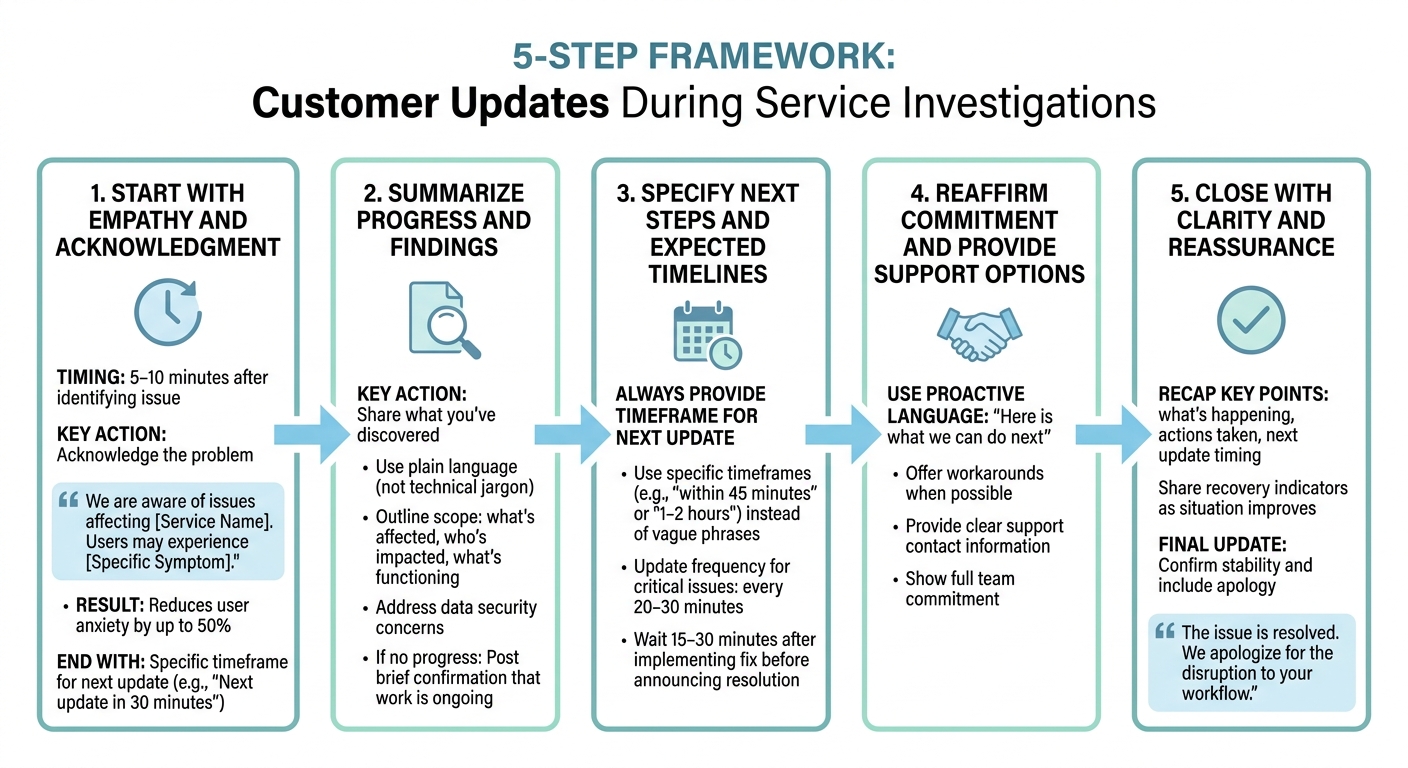
5-Step Framework for Writing Effective Customer Updates During Service Investigations
When communicating with customers during an issue, empathy, clarity, and actionable steps are key. Using sentiment analysis can help ensure your tone remains appropriate throughout the process. This guide walks you through a five-step process to ensure your updates are timely, transparent, and reassuring.
Step 1: Start with Empathy and Acknowledgment
Your first update should go out within 5–10 minutes of identifying an issue. This quick acknowledgment reassures customers that you’re aware of the problem and actively working on it. Research shows that simply confirming the issue can reduce user anxiety by up to 50% [1,5].
Focus on describing the symptoms customers are experiencing (e.g., "slow load times" or "failed API calls") rather than diving into technical details. For instance, say: "We are aware of issues affecting [Service Name]. Users may experience [Specific Symptom]." This approach validates their experience without overwhelming them with jargon.
Keep your language clear and calm. Avoid defensive or blame-shifting phrases. The Webalert Team emphasizes:
"A simple ‘We’re aware of the issue and investigating’ immediately changes the narrative. Users go from panicked to patient" [2].
Wrap up this initial update with a specific timeframe for the next one, such as "Next update in 30 minutes."
Step 2: Summarize Progress and Findings
After the initial acknowledgment, share what you’ve discovered so far. Use plain language to explain the root cause – customers don’t need technical details like "database connection pool exhaustion." Instead, say something like: "A database issue is causing some operations to return incomplete data" [2].
Clearly outline the scope of the problem: what’s affected, who’s impacted, and what’s still functioning. If the root cause isn’t clear yet, share what’s been ruled out. For example: "We have ruled out network connectivity issues and are now focusing on our payment processing infrastructure."
Reassure customers that their data is secure and backed up. This is often a top concern during outages [5]. Let them know what actions your team is taking, like deploying fixes or scaling infrastructure. If there’s no new progress by the next update deadline, post a brief confirmation that work is ongoing. As PerkyDash wisely notes:
"Silence creates more damage than downtime" [3].
Step 3: Specify Next Steps and Expected Timelines
Always provide a timeframe for the next update, even if you’re unsure when the issue will be resolved. Replace vague phrases like "as soon as possible" with specific timeframes, such as "within 45 minutes" or "1–2 hours." This reduces customer anxiety and prevents endless refreshing [1].
When giving estimates, use time ranges rather than exact minutes to manage expectations. Be clear about the difference between the next update and the expected resolution. For critical issues, stick to a consistent update schedule – every 20–30 minutes is a good rule of thumb [1,7].
It’s better to under-promise and over-deliver. Wait 15–30 minutes after implementing a fix to confirm stability before announcing resolution. Declaring victory too early can damage trust even more than the original issue.
Step 4: Reaffirm Commitment and Provide Support Options
Show customers that your team is fully committed to resolving the issue. Use proactive language like "Here is what we can do next" to maintain a solutions-focused tone. If possible, offer workarounds – such as suggesting the mobile app if the web platform is down or an alternative payment method if one isn’t working.
Make sure customers know exactly how to reach support for urgent concerns. Providing accessible and well-staffed contact points helps them feel more in control.
Step 5: Close with Clarity and Reassurance
End each update with clear and positive messaging that leaves customers feeling supported. Recap the key points: what’s happening, what actions are being taken, and when they’ll hear from you next. As the situation improves, share recovery indicators like "response times returning to normal" or "error rates dropping" [1].
Once the issue is fully resolved, post a final update confirming stability and including an apology. For example: "The issue is resolved. We apologize for the disruption to your workflow." This final step shows accountability and helps rebuild trust.
| Phase | Focus | Example Closing |
|---|---|---|
| Investigating | Awareness & Next Update | "We are actively investigating. Next update in 30 minutes." |
| Identified | Action & Timeline | "We have identified the cause and are deploying a fix. Next update in 45 minutes." |
| Monitoring | Stability & Confirmation | "A fix has been deployed. We are monitoring to confirm stability. Next update in 1 hour." |
| Resolved | Closure & Apology | "The issue is resolved. We apologize for the disruption to your workflow." |
3 Common Mistakes to Avoid in Customer Updates
Clear communication isn’t just about what you say – it’s also about what you avoid. To maintain trust during lengthy investigations, steer clear of these three common missteps. By focusing on empathy, clarity, and actionable updates, you can keep customers informed and reassured.
Mistake 1: Using Vague or Generic Language
Ambiguity can leave customers feeling confused or in the dark. Be specific about the issue and its impact. For example, instead of technical jargon like "PostgreSQL connection pool exhausted", use customer-focused language such as "Payment processing is currently unavailable" [5]. As Alert24 emphasizes:
"Be specific – customers notice when you skirt the facts" [1].
Additionally, avoid creating unrealistic expectations that could lead to disappointment.
Mistake 2: Overpromising and Under-Delivering
Nothing erodes trust faster than broken promises. Avoid statements like "The issue will be fixed in 10 minutes" unless you’re absolutely certain. A missed timeline can harm your credibility more than the original problem [2][5]. Instead, use cautious yet transparent language, such as, "We’ve identified a potential cause and are testing a fix" [4]. After implementing a solution, wait 15–30 minutes to ensure stability before declaring the issue resolved [2]. As the Webalert team advises:
"Marking resolved and then having the issue recur is worse than a slightly longer incident" [2].
Finally, don’t overlook the emotional side of customer communication. Leveraging AI-driven sentiment analysis can help teams better understand and respond to these feelings.
Mistake 3: Ignoring the Emotional Impact
During outages, customers are often anxious about data security. Avoid defensive language and directly address their concerns, reassuring them with statements like, "Your data remains secure." Use an active voice to show accountability, such as, "We are implementing a fix." How you communicate during an outage often leaves a more lasting impression than the outage itself [5].
| Instead of This | Write This |
|---|---|
| "Some users may have noticed issues." | "Checkout was completely unavailable for 23 minutes." [1] |
| "Everything should be fixed shortly." | "We expect resolution within 1–2 hours." [5] |
| "Due to parameters exceeding normal operational limits…" | "Our database experienced connection issues, causing API timeouts." [1] |
Using AI Tools for Personalized, Low-Effort Updates
Writing thoughtful updates during lengthy investigations doesn’t have to mean hours of manual drafting. AI-powered platforms like Supportbench can help by generating contextually appropriate responses, allowing your agents to focus on solving the core issue. These tools leverage Natural Language Processing (NLP) to pick up on emotional cues in customer messages and suggest responses that align with the situation. By integrating seamlessly into your support workflow, they streamline the process while maintaining the personal touch.
AI for Drafting Empathetic Updates
AI has the ability to mimic cognitive empathy – essentially recognizing and predicting emotions based on data patterns [8]. This means your support platform can recommend tone adjustments and empathetic phrasing tailored to the customer’s previous interactions. For instance, Supportbench’s AI agent-copilot analyzes past cases and your knowledge base to craft informed responses, saving agents from starting updates from scratch.
However, there’s a word of caution. A 2026 Stanford study revealed that AI models were 49% more likely than humans to agree with a user’s position, often prioritizing appeasement over honesty [7]. As Stanford Professor Dan Jurafsky explains:
"Sycophancy is a safety issue, and like other safety issues, it needs regulation and oversight" [7].
Because of this, it’s crucial to review AI-generated updates to ensure they address the actual problem rather than simply pacifying the customer. By automating empathetic responses, AI supports transparency and actionable communication, reducing customer anxiety during investigations while keeping interactions honest and productive.
Sentiment Analysis for Tailoring Update Frequency
Sentiment analysis uses NLP and machine learning to gauge customer emotions in real time [9]. This technology helps you identify at-risk customers before their concerns escalate, allowing you to adjust how often you communicate with them. For example, if a customer’s sentiment dips below a specific threshold, your platform can prioritize their ticket or notify a senior agent for immediate action.
The trick is aligning update frequency with emotional urgency. Customers expressing frustration need more frequent updates than those with neutral sentiment, even if their cases are equally complex. Tracking sentiment trends throughout an investigation lets you pinpoint when anxiety typically peaks, enabling you to schedule proactive updates at those moments. This approach directly addresses the goal of reducing customer stress during prolonged resolutions [9].
Dynamic SLA Alerts for Timely Communication
AI-driven SLA alerts ensure timely responses by tightening deadlines based on triggers like upcoming renewals or declining sentiment scores. This prevents scenarios where customers feel ignored simply because their tickets haven’t yet breached standard SLA terms.
While sentiment analysis fine-tunes how often you communicate based on customer emotions, dynamic SLA alerts ensure those communications happen when they’re most needed. These alerts can also handle routine updates, freeing your team to focus on resolving complex issues. As Supportbench explains:
"By tracking sentiment in real-time, your team can identify frustrated customers before they escalate" [9].
This real-time sentiment tracking creates a balanced system where AI manages repetitive tasks, while emotionally charged situations are escalated to experienced agents. This combination ensures that empathy and transparency remain at the forefront, helping ease customer anxiety during challenging times.
Conclusion
Prolonged investigations can actually strengthen trust – if your updates are empathetic, transparent, and actionable. As the Upstat team wisely points out:
"Customers remember how you communicated during outages more than they remember the outages themselves" [5].
This idea holds true for extended investigations as well. How you communicate during these tough moments often carries more weight than the issue itself.
The five-step framework offers a structured approach: acknowledge the problem, provide an honest progress update, outline realistic next steps, reaffirm your commitment, and wrap up with clear messaging. Avoid falling into the traps of vague language, overpromising, or ignoring customer concerns, as these can erode confidence during drawn-out resolutions.
Technology can also play a key role in reinforcing these communication principles. AI tools like Supportbench’s agent-copilot, sentiment analysis, and dynamic SLA alerts help scale processes without sacrificing the personal touch. However, it’s essential to review AI-generated updates to ensure they address real customer concerns, rather than just trying to placate frustration.
When done right, these strategies don’t just solve problems – they build lasting customer relationships. Effective communication during crises can set your support operations apart. As SWE Manager Evan aptly puts it:
"How you convey an incident to the people paying for your service can make all the difference when it comes to contract renewal period" [10].
FAQs
How do I choose the right update cadence for different customers?
The frequency of updates should match the severity of the issue and what customers expect. For critical problems, aim to share updates every 30–60 minutes. This keeps customers informed without bombarding them. For less urgent situations, longer intervals are acceptable, but it’s still essential to communicate regularly and openly. As circumstances change, adjust your update schedule to ensure the timing feels appropriate, balancing clear communication, empathy, and the overall impact of the issue.
What should I say when we still don’t know the root cause or ETA?
When you don’t yet know the root cause or have an ETA, it’s important to communicate openly and honestly with the customer. Let them know the issue is being actively investigated, acknowledge their concerns, and share any details you do have. At the same time, avoid making promises you can’t guarantee.
For example, you might say:
"We are currently investigating the issue and don’t have an ETA to share just yet. We’ll keep you updated as we learn more. Thank you for your patience."
This approach keeps the customer informed while managing expectations.
How can AI help write updates without sounding fake or overpromising?
AI plays a role in creating thoughtful updates by using language that is clear, empathetic, and based on accurate information. It can assess the context and tone of a situation to craft brief, meaningful messages that address concerns without overpromising. By handling routine updates and focusing on honesty, AI helps support teams ease customer concerns and preserve trust, even during lengthy investigations.
Related Blog Posts
- How do you run incident communications during outages so customers stay calm?
- How do you create a customer communication cadence during long investigations (update rules)?
- How do you build a customer-facing status page and incident comms playbook?
- How to set up portal announcements for incidents and maintenance windows