Want to improve SLA reporting without compromising trust? Here’s how you can build transparent systems that focus on customer outcomes rather than just hitting numbers.
Key takeaways:
- Define clear, customer-focused metrics: Avoid the "watermelon effect" where metrics look good but fail to reflect real service quality. Use metrics like first human response time, resolution time (p95/p99), and reopen rates.
- Prevent metric manipulation: Exclude automated replies from response time calculations and align uptime metrics with peak usage hours.
- Automate SLA monitoring: Use tools that track performance in real time, predict breaches, and eliminate manual interference.
- Share transparent reports: Standardize formats, give customers access to real-time dashboards, and focus on actionable insights.
- Handle breaches responsibly: Set predefined protocols, ensure accountability, and use breaches as opportunities to improve.
- Use AI tools: Leverage AI for predictive analytics, anomaly detection, and exception handling to maintain accuracy and prevent issues.
- Regularly review SLAs: Update agreements to match current business needs and customer priorities.
With these steps, you can create SLA reporting systems that improve service quality, reduce disputes, and build stronger customer relationships.
Service Level Agreements (SLAs): Response and Resolution Targets | Incident Management Guide
sbb-itb-e60d259
Define Clear and Customer-Focused SLA Metrics
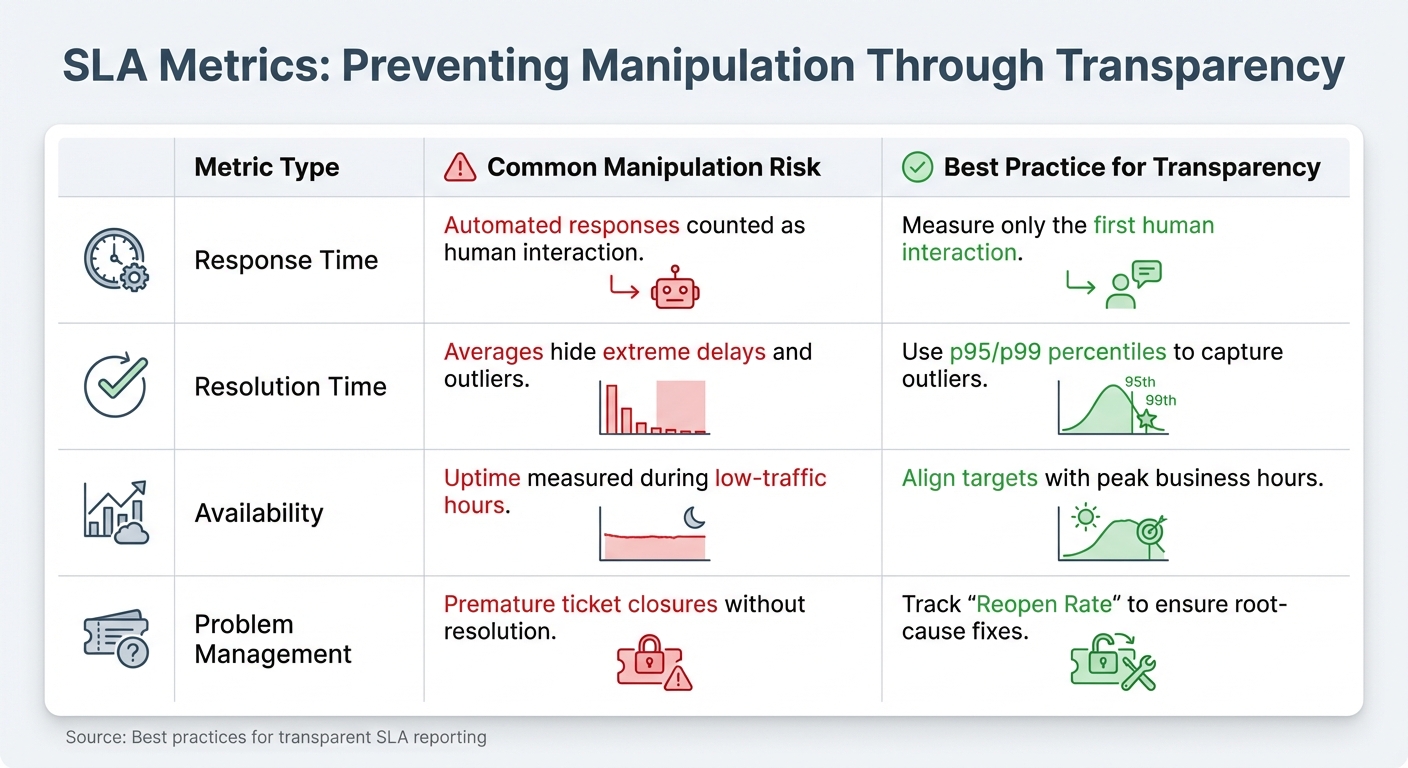
SLA Metrics: Common Manipulation Risks and Transparency Best Practices
One of the most common pitfalls in SLA reporting is relying on metrics that look impressive but fail to capture the customer’s actual experience. This is often referred to as the "watermelon effect" – where metrics appear green on the outside (indicating success) but are red on the inside (showing real customer dissatisfaction). For instance, a system may boast high overall availability, but if it frequently fails during peak usage periods, that metric becomes meaningless for the customer [3].
"SLAs should be created for the desired outcomes of the customer. Be aware of the ‘watermelon effect’, where the service provider is meeting the metrics of the SLA… while failing to support your customer’s real goals." – Joe Hertvik, PMP and IT Consultant [3]
To avoid this, ensure that each metric aligns with specific business goals and customer needs. Instead of focusing solely on overall uptime, track metrics like uninterrupted access during peak hours. Similarly, measure the time to the first human response – excluding automated replies, which often do little to help customers [4]. Shifting the focus from operational statistics to outcome-based goals ensures your metrics reflect true service quality and encourage the right behaviors [3].
Choose Metrics That Match Business Goals
The right metrics should directly influence customer satisfaction and business results. Here are some examples:
- Time to First Response (TFR): Measures how quickly a real person acknowledges a customer issue. This metric strongly correlates with customer satisfaction (CSAT, CES, and NPS) [4].
- Resolution Time: Tracks the time it takes to fully resolve an issue. Using the 95th or 99th percentile instead of averages helps identify outliers and delays that averages might mask [4].
- Escalation Rate: Indicates whether your frontline team can resolve issues effectively without unnecessary escalations [4].
- Reopen Rate: Highlights whether tickets are being closed prematurely without resolving the underlying problem [4].
Each metric should adhere to SMART principles – Specific, Measurable, Achievable, Relevant, and Timely [3]. Unrealistic targets, like 99.999% availability (which allows for just over five minutes of downtime per year), may be appropriate in high-stakes environments but can demotivate teams or lead to counterproductive practices in other contexts [1].
Avoid Metrics That Can Be Easily Manipulated
Before finalizing any metric, test it for potential loopholes that could encourage gaming the system. For example, response time metrics are often exploited by using automated replies to meet targets while failing to address the actual issue [1]. To prevent this, define "response" as the first human interaction, not an automated acknowledgment [4].
| Metric Type | Common Manipulation Risk | Best Practice for Transparency |
|---|---|---|
| Response Time | Automated responses [1] | Measure only the first human interaction [4] |
| Resolution Time | Averages hide extreme delays [4] | Use p95/p99 percentiles to capture outliers [4] |
| Availability | Uptime during low-traffic hours [3] | Align targets with peak business hours [3] |
| Problem Management | Premature ticket closures [1] | Track "Reopen Rate" to ensure root-cause fixes [4] |
Build Automated and Transparent SLA Monitoring Systems
Relying on manual processes to track SLA compliance can lead to selective reporting and even manipulation of data. A better approach is to implement systems that automatically initiate timers as soon as an incident is created, while also disabling manual resets through ticket recategorization [8]. This eliminates human interference from the tracking process and sets the stage for seamless, real-time monitoring.
"SLA automation is the use of workflow and AI to track, prioritize, route, escalate, and document support work so response and resolution targets are met consistently." – Ameya Deshmukh, EverWorker [5]
Automation transforms deadlines into proactive alerts, helping teams re-prioritize tasks and adjust routing before SLA breaches occur. Instead of reacting after the fact, AI-powered systems can predict breaches with over 90% accuracy by analyzing factors like queue dynamics, agent workload, and ticket complexity – often providing a warning 60 to 90 minutes in advance [9]. This predictive capability allows teams to act early, preventing breaches and preserving customer satisfaction.
Use Real-Time Monitoring Tools
Real-time dashboards give your team instant visibility into consistent SLA performance across the board. Design shared dashboards with color-coded timers that clearly show which tickets are on track, at risk, or have already breached SLAs [6][8]. Integrate these dashboards directly with your helpdesk and CRM systems via APIs to ensure the data reflects actual system performance, not manually entered updates [9].
Set up tiered triggers that detect when the predicted time-to-touch exceeds the remaining SLA time, automatically reprioritizing tickets before escalating to a person [5]. For high-priority accounts, create alerts at 50%, 75%, and 90% SLA consumption, and send notifications through multiple channels like Slack, SMS, or other on-call systems to make sure critical warnings are impossible to miss [9]. Start by automating these processes for your top 20% revenue-generating accounts to protect your most important customer relationships [9].
Set Up Independent SLA Data Collection
Independent monitoring ensures transparency by removing the possibility of data manipulation. Use synthetic monitoring to simulate real user interactions and measure performance metrics such as latency and response times without relying on actual user activity [6][7]. Advanced tools can measure performance as frequently as every 500 milliseconds, generating a continuous audit trail that cannot be altered retroactively [6].
Leverage percentile metrics (like p95/p99) to focus on worst-case scenarios, and let automated systems handle pause rules (e.g., "waiting on customer") to maintain an unalterable ticket history [5][7]. This approach ensures a complete, tamper-proof record of ticket activity and status changes, providing transparency across your tech stack [5]. When paired with automated monitoring, independent data collection delivers a comprehensive and trustworthy SLA tracking system.
Create Transparent SLA Reporting Processes
To complement automated SLA monitoring, it’s crucial to establish reporting processes that promote accountability and openness. This begins with standardizing the way performance data is documented and shared across all stakeholders. Clearly define measurement criteria, reporting methods, and schedules within your SLA contracts to ensure everyone has a consistent understanding [1]. This approach guarantees stakeholders receive accurate and unbiased performance insights.
When creating reports, focus on tying the data to the customer’s actual business outcomes. Avoid presenting raw numbers that may look impressive but fail to convey true service quality.
Standardize Reporting Formats and Schedules
Use standardized report formats based on the SMART framework. This means clearly defining essential support metrics – such as availability, mean time to recovery (MTTR), and response times – to avoid disputes caused by vague or ambiguous data [10].
"SLAs clearly state metrics, responsibilities, and expectations so that, in the event of issues with the service, neither party can plead ignorance." – CIO [1]
Set a regular schedule for performance reviews – weekly for more involved accounts and monthly for standard services [2]. Store all SLA-related documents in a centralized location that stakeholders can easily access, reducing the risk of "compliance misunderstandings" [11]. Additionally, outline how exceptions like scheduled maintenance or natural disasters are documented and excluded from performance calculations for greater clarity [3].
Taking transparency a step further, allow customers to monitor performance in real-time.
Give Customers Direct Access to SLA Dashboards
Provide customers with real-time dashboards or online portals where they can independently verify SLA compliance and determine eligibility for service credits [1][11]. This empowers customers with an unbiased view of performance, eliminating the possibility of selective reporting or hiding unfavorable metrics.
"Real-time reporting allows service providers to take immediate action and make necessary adjustments to meet SLA requirements." – Field Nation [12]
For critical services, consider integrating third-party monitoring tools to enhance credibility [1]. However, keep the dashboard design straightforward – overly complex dashboards can overwhelm users and discourage meaningful analysis [1].
Handle SLA Breaches with Accountability
Even the most reliable monitoring systems can’t catch every SLA breach. But how you handle these breaches can make or break customer trust. By putting structured protocols in place, you can turn breaches into opportunities for improvement and use them to refine your service delivery.
"Best-in-class IT organizations avoid using SLA provisions as punishment for their IT partners and use SLA metrics as an opening for productive conversations around performance, priorities, and the future direction of the engagement or relationship." – CIO [1]
The goal should be to move away from assigning blame and instead focus on collaboration. Both parties – service providers and clients – should work together to understand what went wrong and figure out how to prevent it in the future. A key part of this process is having clear protocols that outline how breaches will be managed and who is responsible for each step.
Create Predefined Breach Management Protocols
Your SLA contract should spell out exactly who gets notified in the event of a breach and how those notifications will be sent [1][2]. Don’t wait for a breach to occur – define the processes ahead of time. This includes a step-by-step plan for reporting compliance violations and discussing any related penalties [2].
Consider adding an indemnification clause to protect customers from legal costs and clearly outline service credit penalties. These penalties are typically calculated as a percentage of monthly fees, often aligning with the vendor’s profit margins [1]. For perspective, a "five-nines" availability guarantee (99.999% uptime) allows for just over 5 minutes of downtime annually [1], meaning even minor breaches can have a big impact.
Another useful tool is "earn back" provisions. These allow service providers to recover paid service credits by exceeding standard service levels over a set period after a breach [1]. This approach encourages ongoing improvement rather than one-off fixes. With these protocols in place, you can also maintain a centralized record of breaches to track and address recurring issues.
Keep Centralized Breach Records for Improvement
Maintaining detailed records of SLA breaches helps you spot patterns and uncover root causes [11]. For example, if resolution times regularly exceed agreed-upon targets, analyze the specific factors causing delays [11]. Use metrics like defect rates to identify whether the issue stems from isolated incidents or broader systemic problems [10].
Post-incident reviews are another critical step. These reviews help clarify roles, responsibilities, and prevention strategies [12]. It’s important to distinguish between factors controlled by the provider and delays caused by the client to ensure accountability is fairly assigned [1].
Be mindful of the "watermelon effect" – where metrics look "green" (meeting targets) while customer satisfaction is "red" (unhappy). To avoid this, evaluate not just the duration of outages but also their timing and context [3]. By combining breach trends with AI-driven predictive insights, you can close the loop and continuously improve service outcomes.
Use AI Tools to Improve SLA Reporting
AI-powered platforms are reshaping how SLA reporting is handled, eliminating manual errors and addressing blind spots. These tools continuously monitor data pipelines, identify anomalies, and predict potential breaches, allowing organizations to shift from reactive problem-solving to proactive prevention. This proactive approach enhances transparency and trust without compromising the integrity of the system.
One key feature is auto-schema mapping, which automatically adjusts to changes in source systems – like renamed fields or new columns – ensuring data pipelines remain intact. This prevents schema drift, a common cause of reporting failures. Additionally, anomaly detection flags unusual patterns, such as unexpected null values, sudden drops in row counts, or mismatched data types, before they can distort metrics [13].
For real-time SLA monitoring, the bar is set high: sub-60-second data freshness, over 99.5% data completeness, and 99.9% system uptime are typical targets [13]. To meet these expectations, automated alert thresholds can be set at 80% of the SLA timeframe for warnings and 95% for critical escalations [13]. AI tools also save time, automating approximately one hour of daily tasks – a number expected to triple by 2030 [15]. These capabilities integrate seamlessly with existing SLA systems, boosting both efficiency and transparency.
Use AI for Automated Exception Handling
AI doesn’t just monitor SLAs – it also handles exceptions with precision. Not all delays signify SLA breaches. AI can identify and manage these exceptions without relying on manual interventions that might skew performance metrics. For example, concept drift tracking identifies changes in data patterns compared to the training baseline, such as new document types or legal requirements [14]. Instead of marking these shifts as failures, AI flags them as exceptions and adjusts processes accordingly.
Multi-agent orchestration takes this a step further by coordinating specialized digital agents. These agents handle tasks like ingesting raw data, performing anomaly detection, cross-checking against regulations, and generating audit-ready logs for accountability [15]. To evaluate the effectiveness of AI-driven reporting, it’s essential to measure core accuracy metrics, including Recall (how much data is captured), Precision (classification accuracy), and Concept Drift (variances in data patterns) [14].
"Accuracy SLAs are critical components of transparent, understandable, and reliable AI solutions. They do more than provide insights; they build trust and confidence for key stakeholders." – Tom Oscherwitz, General Counsel at Informed [14]
Use Predictive Analytics to Prevent Breaches
The best SLA reporting systems don’t just track current performance – they also predict potential issues. Predictive analytics uses a combination of historical trends, real-time data, and external factors to calculate breach probabilities, enabling teams to act before problems arise.
For instance, in March 2026, Telecom Solutions Ltd., a provider with 2.3 million customers, adopted a predictive analytics solution using an AI-native CLM platform. The system processed 1,200 data fields from 15,000 contracts and integrated them with real-time network data. Within a year, the company reduced dispute cases by 50%, improved breach detection by 81% (cutting detection time from 4.2 days to just 0.8 days), and avoided $2.4 million in penalties [16].
To achieve similar results, organizations can implement a multi-tier alerting system. At a breach probability of 30–50%, notify service delivery managers with suggested preventive actions. If the probability rises to 51–75%, escalate the issue to operations directors and prepare proactive communications for customers. When the likelihood exceeds 76%, activate emergency response teams and inform executives to assess potential financial impacts while maintaining transparency and trust [16]. With predictions that by 2028, 15% of daily work decisions will be autonomously made by AI [15], these predictive tools are becoming essential for managing SLA risks effectively.
Review and Update SLA Agreements Regularly
Keeping SLA agreements aligned with current business and operational realities is crucial for achieving effective and transparent B2B support. Business needs change, and technology evolves – your SLA should reflect that. Treating SLAs as adaptable documents ensures you’re measuring what truly matters to your customers. If you let SLAs stagnate, you risk relying on outdated metrics and overlooking critical service gaps.
"An SLA should not be viewed as a static document. In fact, SLAs should include a clearly defined framework for modification during the term of the contract." – CIO [1]
A well-designed SLA should include a framework for making updates. This allows you to adjust metrics – like increasing availability targets for a new e-commerce launch or upgrading performance standards – without the hassle of renegotiating the entire agreement. Below are some steps to help you regularly review and refine your SLAs.
Set Up a Review Schedule
Make SLA reviews a regular part of your routine. Some organizations integrate these reviews into weekly IT meetings, while others hold dedicated quarterly sessions [2]. The key isn’t the format but the consistency. Regular check-ins ensure providers and customers stay on the same page about performance expectations.
Additionally, schedule extra reviews when major changes occur, such as launching new business channels, experiencing shifts in workload, or adopting better measurement tools and dynamic SLAs [1]. These event-driven reviews help identify service gaps before they become issues. Assign specific contacts on both sides to manage daily communication about performance concerns, and involve your legal team early to approve any changes [2].
Include Customer and Team Feedback
Your SLA updates should reflect input from both your team and your customers. Support teams can highlight which metrics improve customer satisfaction and which ones might unintentionally encourage unproductive behaviors. Meanwhile, customers can provide insights into whether the targets truly align with their business priorities.
Clearly document the roles and responsibilities of both parties to ensure shared accountability. For example, if delays are caused by customers failing to provide necessary specifications on time, the SLA should not penalize the provider. This balanced approach keeps the focus on solving problems rather than assigning blame.
If you’re working without historical data, establish provisional targets and plan a review to set a baseline [1]. Be transparent about how data is collected, how often reviews will happen, and who will be involved. This level of clarity helps avoid misunderstandings and disputes down the line.
Conclusion
Creating SLA reporting systems that emphasize transparency over manipulation isn’t just about crunching numbers – it’s about building trust with your customers. By concentrating on meaningful metrics, automating data collection, and sticking to honest reporting practices, you can deliver real, measurable service outcomes.
Modern tools play a key role in this process. AI-powered automation eliminates the risk of manual data tampering, while real-time dashboards give customers direct insights into performance. As Forrester noted: "The future of service management shifts from reactive reporting to proactive assurance – using AI and automation to prevent issues before they impact users" [5]. This approach turns SLAs into a shared roadmap for collaboration.
However, tools alone aren’t enough. Structured accountability is equally important. Clear protocols for addressing breaches, centralized record-keeping, and regular reviews ensure both sides remain accountable. When SLAs are treated as evolving agreements rather than static contracts, they can adapt to meet changing business demands and technological advancements.
The benefits of honest SLA reporting go far beyond avoiding disputes. It fosters continuous improvement, offers legal and financial safeguards, and steers clear of misleading internal metrics. Most importantly, it builds lasting trust, turning customers into genuine partners. This partnership transforms SLAs into powerful tools for driving ongoing service excellence.
FAQs
What’s the fastest way to spot “watermelon” SLA metrics?
The fastest way to spot "watermelon" SLA metrics – where everything looks "green" on the surface but hides problems underneath – is to compare external status indicators (like green status boxes) with actual performance data. Pay attention to red flags such as misleading KPIs, irregular reports, or overly rosy metrics. To address this, use tools like real-time monitoring, anomaly detection, and thorough auditing of SLA logic. These steps can help expose hidden breaches and ensure compliance is tracked accurately.
How do we pause SLA timers fairly without enabling gaming?
To ensure SLA timers are paused fairly, it’s important to establish clear, specific conditions that align with legitimate delays – like waiting for a customer’s response or conducting an internal review. Avoid using vague or overly broad rules that could be misused. Instead, focus on creating transparent policies and consider using AI tools for real-time tracking. This approach helps ensure that pauses are tied to genuine resolution efforts, promoting fairness and minimizing opportunities for misuse.
Which AI signals best predict an SLA breach early?
Predicting SLA breaches early is possible with predictive analytics models. These models analyze historical performance data alongside contract details to identify potential risks. By forecasting breaches and triggering automated alerts, businesses can address issues before they escalate.
This approach is particularly useful in industries like telecom, where maintaining accountability and improving service outcomes is critical. Early detection helps ensure smoother operations and better adherence to agreed-upon service levels.