ITIL workflows don’t work for external customer support. Why? They were designed for internal IT needs, not for the fast, customer-focused demands of external users. Here’s the problem:
- Rigid processes slow down responses, frustrating customers who expect quick resolutions.
- Escalation bottlenecks lead to lost information and higher costs.
- Prioritization issues ignore customer value, risking churn and dissatisfaction.
The result? Poor customer experiences, higher support costs, and lost revenue. Businesses lose $75 billion annually due to bad support.
The solution: AI-powered workflows that focus on customer needs. These systems prioritize customer value over rigid rules, reduce delays with smarter escalation, and automate repetitive tasks. The outcome? Happier customers, lower costs, and better retention.
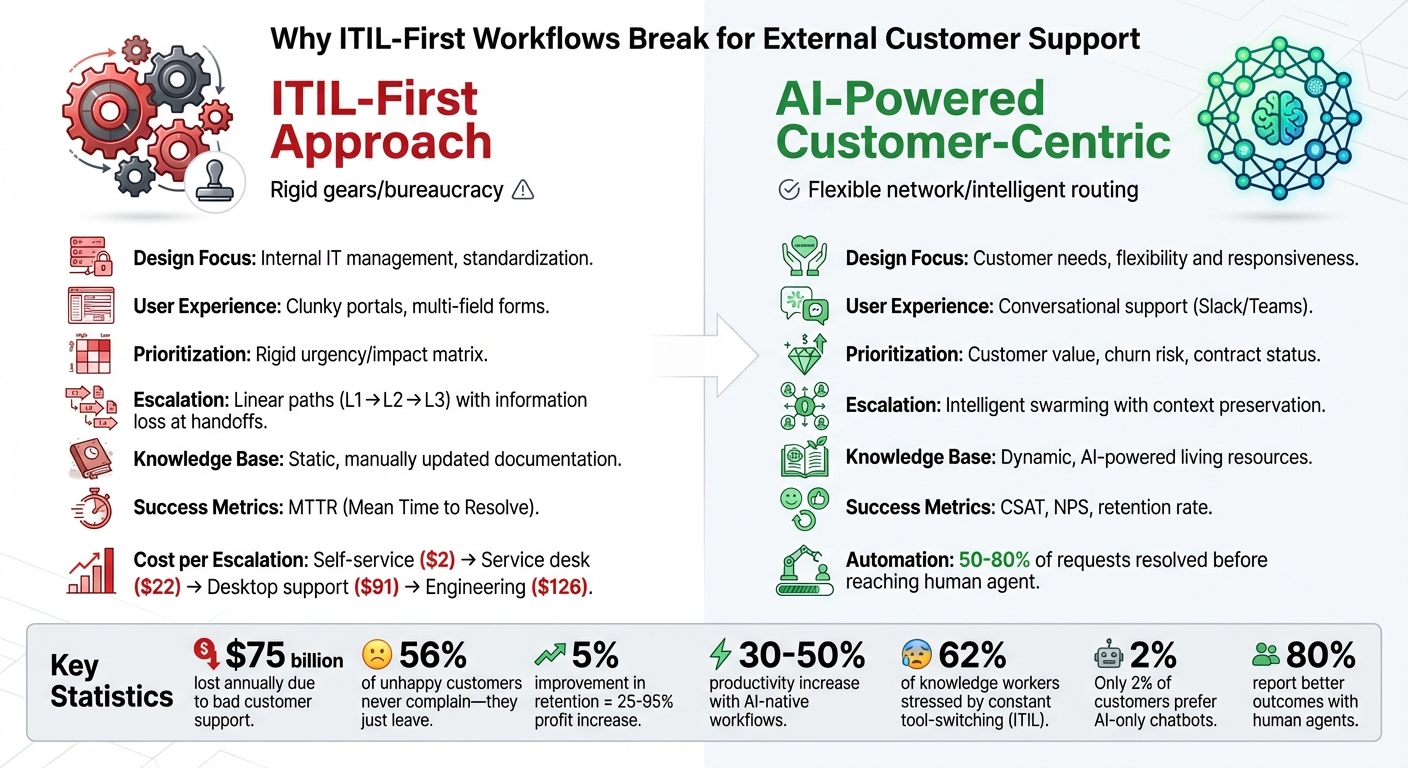
ITIL vs Customer-Centric Support: Key Differences and Impact
Why ITIL-First Workflows Don’t Work for External Customer Support
ITIL’s Internal Focus vs. External Customer Needs
ITIL was built with internal IT management in mind, prioritizing standardized processes over the kind of quick, seamless interaction external customers now expect. Kevin Coleman from Ravenna.ai explains it well: "ITIL was designed for a time of on-premise servers and email chains… its rigidity is now its greatest weakness" [6]. In other words, while ITIL excels at enforcing consistency, it struggles to deliver the conversational and adaptable support external users demand.
Take ITIL-based workflows, for example. They often require customers to navigate clunky portals and fill out endless forms just to get help with basic issues. Meanwhile, external users prefer engaging through familiar tools like Slack or Microsoft Teams [6]. This disconnect frustrates customers, pushing them toward unmanaged channels like direct emails or phone calls, which can make tracking support effectiveness a nightmare. Studies show businesses can lose up to 30% of their productive time wrestling with disconnected systems and outdated workflows. On top of that, 62% of knowledge workers report feeling more stressed due to constant tool-switching [8]. ITIL’s internal-first design simply falls apart because most customer support ticketing systems were not designed for B2B needs involving multi-team collaboration.
Rigid Escalation Paths and Multi-Stakeholder Problems
ITIL’s linear escalation model is another stumbling block, especially in situations involving multiple stakeholders. Richie Aharonian, Head of Customer Experience at Unito, calls these handoff points "compression points", where critical details often get lost. He explains, "Every handoff is a compression point. Information gets compressed into whatever the receiving system can accept. Everything else either gets manually summarized in a comment (if you’re lucky) or simply disappears" [7].
For example, when a ticket moves from a customer-facing team to engineering in Jira, essential details – like how many users are affected or the broader customer impact – can vanish because the receiving system doesn’t have the right fields to capture that context [7]. This problem becomes even more pronounced in B2B support, where multiple stakeholders, such as vendors or implementation teams, are involved. Delays caused by external dependencies, like vendor bottlenecks, only highlight the inefficiency of ITIL’s rigid paths [4]. Worse still, these repeated handoffs drive up support costs while customers are left waiting for a resolution.
Limited Flexibility in Customer-Centric Scenarios
ITIL’s rigid prioritization system is another area where it struggles to meet the needs of external customers. Its urgency-impact matrix forces low-priority tickets to take a backseat, which often leads customers to label every request as high priority just to get attention [1]. While this system ensures high-impact business issues are addressed first, it also means quick-to-resolve, low-priority tickets can miss SLA targets as agents focus on more complex problems.
For high-value B2B relationships, this rigidity can erode trust. Imagine a customer waiting weeks for a low-priority feature request while seeing visible activity on other accounts. In such cases, customers care less about internal prioritization models and more about feeling valued. ITIL’s process-driven approach simply doesn’t leave room for the relationship-based decisions that external customer support often requires.
| Feature | ITIL-First (Internal Focus) | External Customer Needs |
|---|---|---|
| Primary Goal | Standardization and process adherence [6] | Flexibility and responsiveness [6] |
| User Interface | Clunky web portals with multi-field forms [6] | Conversational support in Slack/Teams [6] |
| Prioritization | Rigid urgency/impact matrix [1] | Business value and customer retention [1] |
| Escalation | Linear paths with information loss [7] | Context-rich, multi-stakeholder coordination [7] |
| Knowledge Base | Static, manually updated documentation [6] | Dynamic, AI-powered "living" resources [6] |
sbb-itb-e60d259
The Operational Problems with ITIL for External Support
Internal vs. External Support Requirements
ITIL-first workflows are great for maintaining internal stability, but they fall short when applied to external customer support. Why? Because ITIL is designed to manage internal operations, not to handle the complexities of customer relationships or prevent churn. This fundamental disconnect leads to serious operational challenges.
The differences between internal and external support needs highlight the problem. Internal IT support works within a controlled environment, dealing with known users and predictable technical systems. On the other hand, external support – especially in B2B SaaS – faces a completely different world. It has to manage diverse customer setups, varying API integrations, and users with a wide range of technical skills [5]. ITIL’s rigid processes and standardized scripts just can’t keep up with this level of complexity.
| Feature | Internal IT Support (ITIL Strength) | External Customer Support (ITIL Weakness) |
|---|---|---|
| User Base | Employees (known, controlled environment) [2] | Customers (diverse, unpredictable environments) [5] |
| Primary Goal | Operational stability and cost control | Customer retention, lifetime value, and brand loyalty [5] |
| Prioritization Basis | Technical urgency and business-wide impact [1] | Contract value, churn risk, and relationship health [5] |
| Success Metric | Mean Time to Resolve (MTTR) [9][2] | CSAT, CES, and NPS and retention rate [5] |
| Escalation Model | Linear tiers (L1-L3) within one organization | Cross-functional teams (Support, Success, Engineering, Sales) [5] |
This table makes one thing clear: ITIL was never built to handle the dynamic, customer-centric demands of external support.
Take prioritization, for example. ITIL focuses on what’s best for the business as a whole, which works fine internally. But in external support, a "low priority" ticket might be a real customer who’s on the verge of walking away. Research shows that 56% of unhappy customers never complain – they just leave [5]. ITIL’s cost-cutting approach often traps customers in automated loops, leaving them frustrated and disengaged. This leads to what’s called "passive defeat", where customers give up on finding help and quietly abandon your brand [5].
Impact on Cost Efficiency and Customer Retention
These operational mismatches don’t just hurt customer satisfaction – they also hit your bottom line. ITIL-first workflows frustrate customers, escalate costs, and damage retention. The rigid prioritization system creates chaos: low-priority tickets get ignored, customers start flagging everything as "high priority" to get attention, and your support team ends up overwhelmed [1]. As Vivantio points out:
"Ordering work by a ticket’s priority only will likely have the following result: the high priority tickets will be resolved within their target resolution time. However, the lower priority tickets will fail to be resolved within their target time" [1].
This neglect isn’t just bad for customer experience – it’s expensive. Studies show that a 5% improvement in customer retention can boost profits by 25% to 95% [5]. Yet ITIL workflows often treat individual customer needs as low-priority noise, actively working against retention.
The cost structure of ITIL escalation adds another layer of inefficiency. Moving a ticket from self-service ($2) to the service desk ($22), then to desktop support ($91), and finally to engineering ($126) drives costs up dramatically [3]. On top of that, businesses lose up to 30% of productive time due to disconnected systems and manual handoffs between ITIL’s rigid tiers [8]. And the stress doesn’t stop there – 62% of knowledge workers report increased stress from the constant tool-switching these workflows require [8].
The human element also takes a hit. While ITIL emphasizes automation, customers still prefer human interaction. In fact, 80% of consumers report better outcomes when working with a human agent compared to automated systems [5]. Only 2% of customers prefer interacting exclusively with AI chatbots [5], yet ITIL-first portals often lock users into automated loops with no clear way to escalate. This leaves customers feeling stuck, leading to the "passive defeat" phenomenon where they give up on your system – and your brand – altogether. Worse yet, they stop paying.
AI-Native Alternatives: Rethinking External Support Workflows
Dynamic and Predictive SLAs
Traditional ITIL workflows often rely on rigid, time-based SLAs that don’t account for the unique needs of each case. For example, a customer nearing renewal might receive the same response time as someone with a routine inquiry. AI-native platforms, however, bring a more flexible approach. They use dynamic SLAs that adapt in real time by factoring in elements like customer value, churn risk, contract status, and the complexity of the issue. AI constantly monitors cases for potential escalation risks and takes action before SLA breaches occur[11][13].
This shift transforms support operations from reactive problem-solving to proactive relationship management. For instance, SLAs can automatically tighten for high-priority customers, such as those approaching renewal, or flag cases showing warning signs like declining sentiment or repeated unresolved issues. By aligning SLA priorities with business goals, AI ensures that support efforts are focused where they matter most. This proactive approach also lays the groundwork for further automation and efficiency in support workflows.
AI Features for Faster, Smarter Support
AI-native workflows go beyond just ticket routing – they can resolve many issues automatically. Some platforms handle 50–80% of requests before they even reach a human agent[14]. By using contextual data – like user identity, asset details, system information, and service history – AI triggers intelligent workflows and notifications, effectively reducing manual intervention[10][13].
One standout feature is AI-powered case summarization, which condenses long ticket histories into concise overviews. This saves agents significant time during handoffs by eliminating the need to sift through extensive records[10][12]. Natural-language routing rules simplify ticket assignments, too. Instead of building complicated rule trees, you can set straightforward rules like, "Send all hardware issues to the endpoint team." AI also automates repetitive tasks like tagging, prioritization, and categorization, which lightens the administrative load on support teams.
The financial impact of these efficiencies is clear. Average IT spending per user dropped from $9,647 in 2022 to $7,614, thanks to automation[10]. In industries like eCommerce, AI now manages up to 65% of routine support tasks[12]. These capabilities not only streamline operations but also pave the way for smarter escalation management, especially in complex B2B settings.
Escalation Management for B2B Needs
AI-driven automation also revolutionizes escalation management, particularly in B2B environments where resolving issues often involves multiple teams – like Support, Customer Success, Engineering, and Sales. Traditional tiered escalation paths can create bottlenecks, but AI-native platforms solve this with intelligent swarming. This approach dynamically identifies the right experts and teams based on the case context, bypassing rigid escalation structures[11].
Supportbench, for example, integrates this escalation management system directly into its platform. It helps agents navigate multi-level escalations, tracks the escalation history, and even allows for de-escalation when appropriate. Escalations are tied to scorecards, offering better visibility into performance. Additionally, AI enriches tickets with critical context, enabling smarter routing without requiring complex manual configurations[14]. These advancements lead to quicker resolutions, reduced costs, and better customer satisfaction – areas where traditional ITIL workflows often fall short.
Conclusion: Building Flexible, Cost-Efficient Customer Support Workflows
Here’s the problem: ITIL’s internal focus doesn’t align with the needs of external customer support. Workflows designed with ITIL-first principles – meant for internal IT – struggle to meet the expectations of external customers. Rigid escalation processes and inflexible SLAs create frustrating bottlenecks, leading to silent churn as unhappy customers quietly walk away. Forcing customers to repeat themselves or navigate endless loops in the support process only makes matters worse.
AI-native solutions tackle these pain points by eliminating areas where context is lost and shifting the focus from deflecting tickets to actually resolving them. Through tools like sentiment analysis, these systems can identify customer frustration early and trigger timely human intervention. Research shows that AI can increase team productivity by 30–50% and improve customer retention, which can lead to profit increases ranging from 25–95% [15][5]. Avoiding poor support experiences is critical, as businesses lose an estimated $75 billion annually due to customers switching brands after bad service [2].
Fixing ITIL’s limitations requires a shift in how support workflows are designed. Moving to AI-driven workflows means adding an intelligent layer that retains context, ensures smooth information routing, and proactively escalates issues when necessary. Modern AI platforms can autonomously manage routine tasks while escalating complex cases with all relevant context intact. This approach transforms support from reactive problem-solving into proactive relationship management.
"The cost of bad AI customer support is not what you spent on the tool. It is the customer lifetime value you destroyed by deploying it poorly." – Zeyad, Chatbase [5]
Adopting AI-native workflows isn’t just a nice-to-have for B2B organizations – it’s a must. For companies managing complex accounts and renewal-driven relationships, blending AI’s efficiency with human understanding is critical. By focusing on resolution rather than deflection, training AI on live conversations instead of static guides, and making escalation paths transparent from the start, businesses can cut costs while improving customer satisfaction. In the end, embracing a customer-first, AI-powered approach is the key to driving value and ensuring long-term growth.
FAQs
When should we keep ITIL for internal IT but not for customer support?
ITIL is a great fit for internal IT operations, especially in environments where stability, consistency, and compliance are top priorities. It excels in managing structured processes such as incident resolution and knowledge management, ensuring that workflows remain predictable and efficient.
However, when it comes to external customer support, ITIL’s rigid workflows often fall short. The lack of flexibility can make it harder to handle quick escalations or adapt to rapidly changing customer needs. For external support, customer-focused, AI-driven approaches are often a better match. These methods align more closely with modern customer expectations and the fast-paced demands of today’s support landscape.
How can we prioritize tickets by churn risk and account value without breaking fairness?
To fairly prioritize tickets based on churn risk and account value, leverage AI-driven analytics. These tools can dynamically evaluate key factors like the likelihood of churn, the importance of the account, the severity of the issue, and the customer’s history. To maintain fairness, establish transparent criteria and review them regularly to minimize bias.
Pair these insights with well-defined escalation policies and clear SLA commitments. This approach ensures a balance between fairness and efficiency, giving both high-value accounts and other customers the support they need.
What’s the safest way to add AI automation without trapping customers in bot loops?
The best way to maintain a reliable customer experience is by blending automation with human involvement. Incorporate human handoff mechanisms to ensure smooth transitions when AI systems face uncertainty. This prevents frustration and keeps interactions productive.
To make automation more effective, train AI using your own data. This helps the system provide more precise responses tailored to your needs. Additionally, pairing generative AI with human oversight, such as human-in-the-loop strategies, can refine conversational quality. This approach prevents repetitive loops and ensures the system feels more natural and efficient for users.