Canadian organizations often need helpdesks with Canadian hosting to comply with privacy laws like PIPEDA, GDPR adequacy standards, and provincial regulations (e.g., PHIPA, FIPPA). Hosting data in Canada ensures better legal compliance, data sovereignty, and operational control. It also avoids exposure to foreign laws like the U.S. CLOUD Act, which could compromise sensitive information.
Here’s what you need to know:
- Why Canadian hosting matters: Simplifies compliance, protects data from foreign jurisdictions, and ensures better performance with low latency.
- Top platforms with Canadian hosting:
- Comm100: Canadian-owned, AI-driven, resolves 68% of queries without human help.
- Supportbench: AI-native design, SOC 2 and HIPAA compliant, starts at $32/agent/month.
- Vortex Solution: Private cloud with fully Canadian operations, ideal for sensitive data.
- Key certifications to look for: SOC 2 Type II, ISO 27001/27017/27018, HIPAA, PCI DSS.
- Questions to ask vendors:
- Where are your data centers located?
- Do you comply with PIPEDA, GDPR, and other relevant laws?
- What encryption and security measures do you use?
- How do you handle data migration and ensure scalability?
For businesses handling sensitive data or operating in regulated sectors, choosing a helpdesk with Canadian hosting is critical to maintaining trust, compliance, and seamless operations.
Helpdesk Platforms That Offer Canadian Hosting
Vendors with Canadian Data Centers
When selecting a helpdesk platform, it’s crucial to ensure the vendor operates physical data centers in Canada and guarantees that all customer data – backups and metadata included – remains within Canadian borders.
Comm100 is a Canadian-based omnichannel platform that hosts its data in dedicated Canadian data centers. It’s tailored for modern B2B support needs while ensuring data stays within Canada’s borders. For instance, in 2026, Canadian Blood Services used Comm100’s AI Agent to handle 70% of live chat queries, resolving 68% without requiring human intervention. Denny Michaud, Customer Relations Manager at Canadian Blood Services, shared:
"The chatbot (now AI Agent) is equipped to handle all the basic, common queries that were previously taking up so much of the agents’ time".
Supportbench offers Canadian hosting alongside its AI-native platform. Unlike platforms that adapt older systems to include AI, Supportbench was designed with AI at its core. It also supports AES-256 encryption, role-based access, and detailed logging – helping organizations align with PIPEDA requirements.
Vortex Solution operates a private cloud supported by 80 Canadian-based staff located in major cities. Their focus on data sovereignty ensures that the entire operational supply chain remains Canada-based, protecting data from potential access by foreign governments. This makes it especially suitable for B2B operations.
These vendors highlight the importance of balancing compliance, data security, and performance benchmarks.
Compliance Certifications That Matter
While Canadian hosting is a key factor, certifications demonstrate a vendor’s commitment to protecting your data according to both Canadian and international standards.
SOC 2 Type II is a must for B2B organizations. Unlike Type I, which only confirms the existence of security controls, Type II evaluates their effectiveness over at least six months. This certification covers areas like security, availability, confidentiality, and privacy. Always request the audit report to confirm it covers their Canadian data centers and is up to date.
ISO 27001 serves as a global standard for Information Security Management Systems (ISMS). For cloud-focused security, look for ISO 27017 (cloud service controls) and ISO 27018 (protection of personal data in public clouds).
If your organization operates in regulated sectors, additional certifications may apply. For example:
- PCI DSS is essential for platforms handling payment card data.
- HIPAA compliance is critical for healthcare organizations managing sensitive health information.
Encryption standards are equally important. Data should be encrypted at rest using AES-256 and in transit with TLS 1.2 or higher. Platforms should also incorporate Role-Based Access Control (RBAC) and Multi-Factor Authentication (MFA) to safeguard sensitive information.
Supportbench: AI-Native Platform with Canadian Hosting
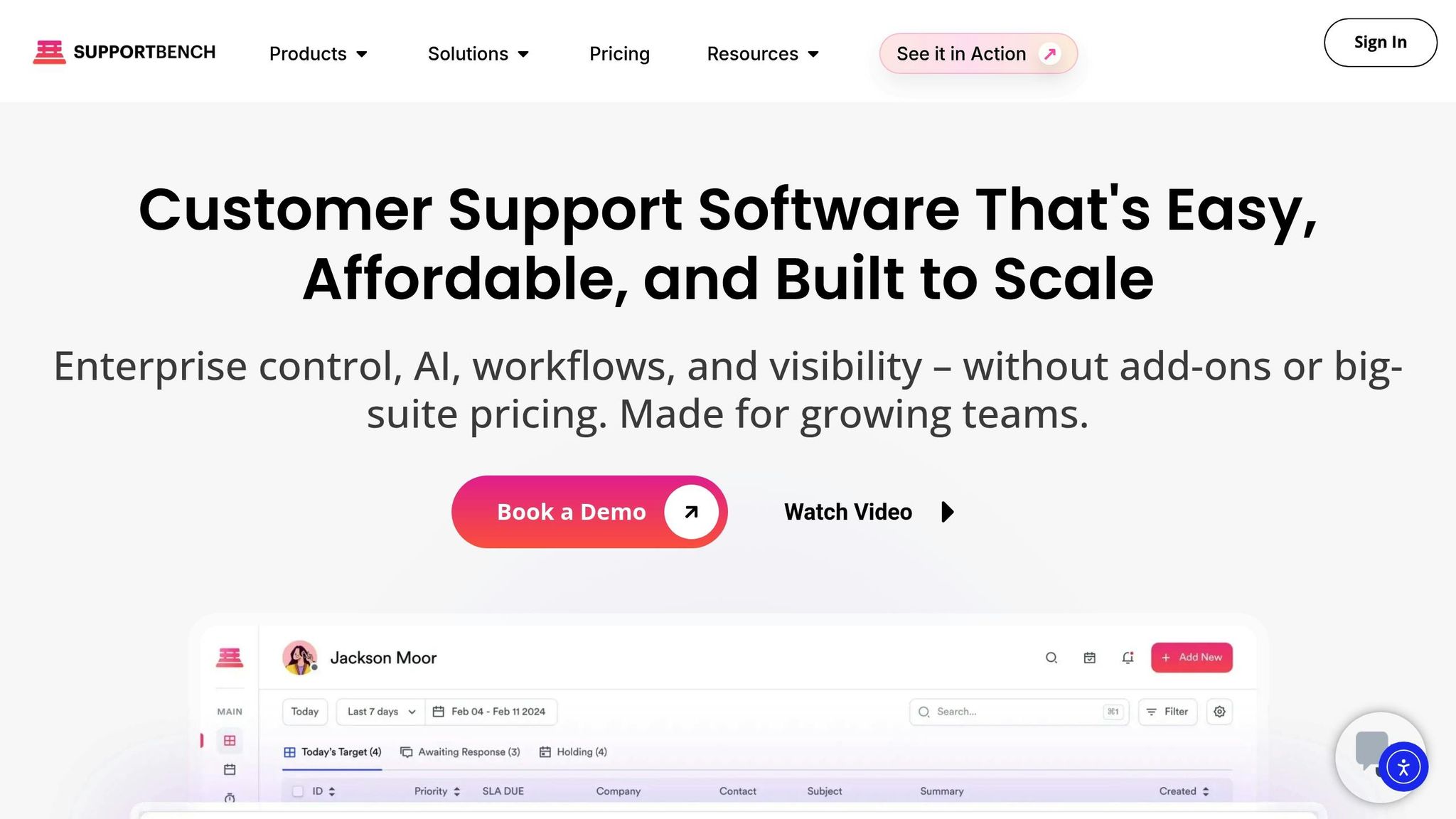
Supportbench stands out by combining Canadian hosting with an AI-native design. Instead of retrofitting AI features onto an older system, the platform was built from the ground up with AI integrated into every aspect of its functionality.
It offers Canadian hosting options and comes with built-in SOC 2 and HIPAA compliance. Nooshin Alibhai, Founder and CEO of Supportbench, explains:
"Supportbench includes encrypted data handling, customizable access roles, and comprehensive logging, so MSPs can stay compliant and build long-term client confidence".
What makes Supportbench particularly effective is its seamless AI integration. The AI Co-Pilot helps agents by summarizing tickets, drafting knowledge base articles, and analyzing customer sentiment to identify accounts at risk of churning. Automation features streamline time-consuming tasks like case prioritization, issue type assignment, and tagging. Additionally, AI-powered tools like Predictive CSAT and CES provide insights into customer satisfaction and effort levels without relying solely on survey responses.
For B2B organizations with complex needs, Supportbench offers features like multi-brand portals, integrated SLA management, and a 360-degree customer view – all designed to work together without requiring extensive third-party integrations. As of January 2026, the platform has a 4.9/5 rating based on 80 reviews, with users highlighting its intuitive AI features and the reduction in case backlogs.
Pricing starts at $32 per agent per month, with all features – including AI tools and live support – available from the start. Special discounts are available for startups and non-profits, making it an accessible choice for a range of organizations.
Data Sovereignty in Canada: Why It Matters for Every Business
Questions to Ask Vendors About Canadian Hosting
When considering Canadian hosting providers, it’s crucial to evaluate their approach to data residency, security, migration processes, and scalability. Here’s a breakdown of key areas to focus on when assessing potential vendors.
Data Residency and Compliance Questions
Start by asking vendors to specify the location of their Canadian data centers – whether they are in Montreal, Calgary, or Toronto. It’s important to confirm that your data will remain in Canada. For instance, AWS operates two Canadian regions: one near Montreal (Canada Central) and another near Calgary (Canada West).
Ensure the vendor complies with PIPEDA (Personal Information Protection and Electronic Documents Act). While PIPEDA allows data to be stored offshore, it holds your organization accountable for protecting any data processed by third parties. The Office of the Privacy Commissioner of Canada emphasizes this responsibility:
"Your organization is responsible for the personal information under its control, including information transferred to a third party (like a software vendor) for processing".
Request a SOC 2 Type 2 report under an NDA and verify certifications such as ISO 27001, 27017, and 27018. If your operations involve healthcare or payment data, confirm compliance with HIPAA or PCI-DSS standards as well.
Additionally, inquire about the vendor’s sub-processors. Ask whether their suppliers also meet Canadian residency and security requirements. Your Service Level Agreement (SLA) should include a clear commitment to data residency, ensuring the vendor does not replicate or back up data to regions outside Canada.
Once residency and compliance are confirmed, shift your focus to the vendor’s security protocols.
Data Privacy and Security Questions
Confirm that the vendor uses industry-standard encryption and access controls, such as AES-256 encryption and TLS 1.2+. Platforms should also support advanced security measures like Role-Based Access Control (RBAC) and Multi-Factor Authentication (MFA) to limit access to sensitive data.
Request a comprehensive breach response plan that outlines notification timelines and remediation steps. Ask whether the platform supports the "right to be forgotten" under GDPR and PIPEDA, with clear processes for exporting or deleting data upon request.
Find out how frequently the vendor conducts security audits and whether the results are shared with customers. As Birdview PSA highlights:
"A vendor’s promise of ‘compliance’ is not enough. You need explicit confirmation that your data will be stored on Canadian soil".
Beyond security, assess how smoothly you can transition your operations to or from the platform.
Migration and Vendor Lock-in Questions
Ask the vendor to detail their migration process, including timelines and steps. Tools like Help Desk Migration offer automated workflows and checklists tailored to specific platforms, helping streamline the transition. Ensure your current helpdesk can remain operational during the migration to avoid downtime.
Request a trial period – ideally 30 days – before making a commitment. This allows you to test the platform’s capabilities. In fact, 85% of software professionals prefer a trial period before finalizing their decision. Additionally, request a live demo to see how the vendor handles multi-channel data and complex workflows during migration.
Make sure the vendor provides full API access for seamless data extraction, which can help you avoid vendor lock-in and ensure flexibility.
Scalability and Operational Fit Questions
For businesses with complex operations, it’s important to confirm that the platform can handle long-running cases, renewal-driven relationships, and multi-brand portals. Ask whether the system can manage cases that span weeks or months and if it supports multi-tenant designs to separate data across brands or departments.
Verify whether the platform includes integrated SLA management, a 360-degree customer view, and automation features like case prioritization and tagging. These features should work cohesively without relying heavily on third-party integrations. Additionally, inquire about AI-powered features. Platforms built with AI from the ground up often perform better than those that add AI capabilities to older systems.
Lastly, ensure the platform can scale with your organization, from startup to enterprise-level needs, without requiring a future migration. Switching platforms can be both costly and disruptive, so choosing a system that grows with your business is a safer bet. Ask for references from customers in similar industries and sizes to validate the vendor’s performance and reliability.
sbb-itb-e60d259
Comparing Canadian Hosting Options
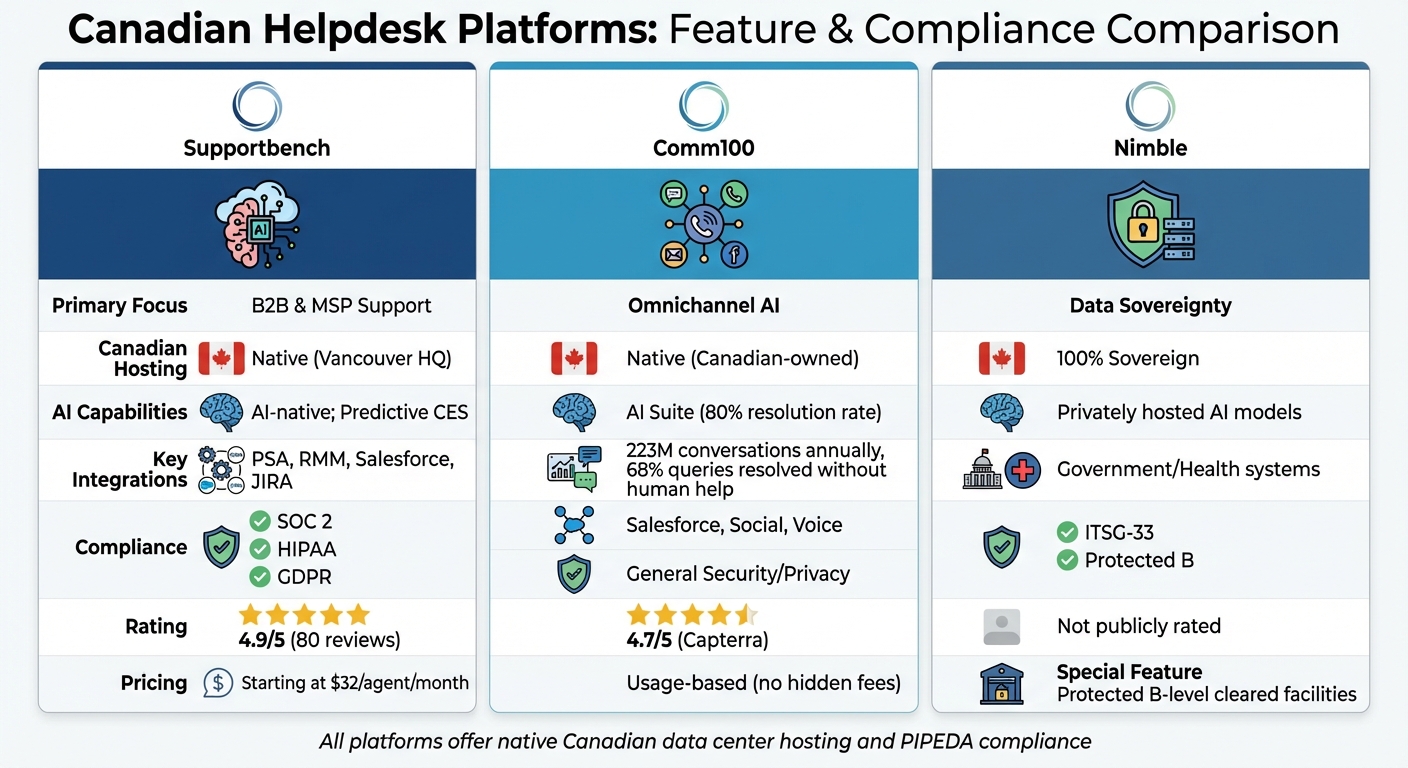
Canadian Helpdesk Platforms Comparison: Features, Pricing, and Compliance
Vendor Comparison Table
When looking at helpdesk platforms with Canadian hosting, the differences in architecture, compliance, and AI features stand out. Supportbench, based in Vancouver, is an AI-driven platform tailored for B2B and MSP support. It offers a multi-tenant design and integrates with tools like PSA and RMM. As of January 31, 2026, it holds a 4.9/5 rating from 80 reviews. Key features include predictive Customer Effort Score (CES) analysis and built-in sentiment analysis.
Comm100, an omnichannel platform owned in Canada, boasts an 80% AI resolution rate while managing 223 million conversations annually. For example, Canadian Blood Services resolved 68% of live chat queries without human intervention using Comm100’s AI Agent. Similarly, Global Affairs Canada processes 78% of incoming chats through AI. The platform operates on usage-based pricing with no hidden fees.
For organizations prioritizing 100% data sovereignty, Nimble offers Protected B–level cleared facilities, ensuring data remains exclusively within Canadian borders. As Nimble emphasizes:
"Nimble isn’t just compliant with Canadian data laws – we’re built around them."
| Feature | Supportbench | Comm100 | Nimble |
|---|---|---|---|
| Primary Focus | B2B & MSP Support | Omnichannel AI | Data Sovereignty |
| Canadian Hosting | Native (Vancouver HQ) | Native (Canadian-owned) | 100% Sovereign |
| AI Capabilities | AI-native; Predictive CES | AI Suite (80% resolution) | Privately hosted AI models |
| Key Integrations | PSA, RMM, Salesforce, JIRA | Salesforce, Social, Voice | Government/Health systems |
| Compliance | SOC 2, HIPAA, GDPR | General Security/Privacy | ITSG-33, Protected B |
| Rating | 4.9/5 (80 reviews) | 4.7/5 (Capterra) | Not publicly rated |
Cost vs. Compliance Trade-offs
Understanding the architecture of these platforms is just the first step – next comes weighing costs against compliance. For companies managing Canadian data residency and regulatory demands, the balance between affordability and operational complexity is critical.
Supportbench, for instance, starts at $32 per agent per month, bundling AI tools, workflows, and live support. On the other hand, global providers often require premium subscriptions and additional compliance fees for Canadian hosting and HIPAA adherence. These platforms may offer certifications like FedRAMP or HDS, but cross-border data transfers bring legal challenges and potential risks, such as exposure under the U.S. CLOUD Act.
For businesses focused on domestic data residency and PIPEDA compliance, Canadian-native platforms like Comm100 and Supportbench provide better cost efficiency without compromising functionality. As Ksenia Kartamysheva from Birdview PSA highlights:
"Choosing the right Professional Services Automation (PSA) software is about more than features; it’s about securing your data and simplifying compliance."
This analysis underscores the importance of selecting a Canadian-hosted, AI-powered platform that meets both operational needs and strict compliance requirements.
Conclusion
Key Factors for Vendor Evaluation
When selecting a helpdesk with Canadian hosting, the key is finding the right balance between compliance, cost, and scalability. Start by ensuring your data resides exclusively in Canada – not just in generic North American data centers, which may include U.S. facilities. Check that the SLA explicitly states all data stays within Canada to avoid exposure to U.S. legal jurisdictions.
Ask for SOC 2 Type 2 reports under an NDA to confirm the platform’s security measures are effective over time. If your organization deals with sensitive information, make sure the helpdesk supports Role-Based Access Control (RBAC). This ensures that agents and third-party vendors only access the data they need, minimizing unnecessary exposure.
Additionally, focus on platforms with AI-driven capabilities that can help cut operational costs as your business grows. Modern tools can automate tasks like ticket summarization, sentiment analysis, and creating knowledge base articles, reducing the need for manual effort. As Nooshin Alibhai, Founder and CEO of Supportbench, explains:
"Choosing the right helpdesk software isn’t just a technical upgrade. It’s a strategic move."
These steps can guide you toward a platform that aligns with both your compliance requirements and operational goals.
Choosing the Right Platform
Supportbench is an example of a platform that pairs Canadian hosting with robust AI automation, offering a solution designed for operational efficiency and scalable growth. At $32 per agent per month, Supportbench provides features like predictive Customer Effort Score (CES) analysis, sentiment tracking, and dynamic SLAs. It’s a comprehensive package tailored for B2B teams managing complex support needs, combining enterprise-grade compliance with automation from the start.
Before committing to any platform, double-check the vendor’s policies on data portability and destruction. Ensure you retain full legal ownership of your data stored on the platform. Running a pilot program with a small team can also help you evaluate usability and the quality of automation in a practical setting.
FAQs
Why should you choose helpdesk software with Canadian hosting?
Choosing helpdesk software with Canadian hosting offers several important benefits, particularly for organizations that need to comply with strict data residency requirements. Hosting data in Canada ensures data sovereignty, making it easier to adhere to local regulations such as PIPEDA. This approach also allows for greater control over sensitive customer and internal information.
On top of that, Canadian hosting can strengthen data security and foster trust with privacy-conscious customers. For businesses managing complex support operations, this combination of compliance and control can play a key role in safeguarding operations and maintaining customer confidence.
How can I confirm my helpdesk vendor meets Canadian data privacy requirements?
To ensure your helpdesk vendor aligns with Canadian data privacy requirements, first confirm that they store data within Canada and comply with the country’s data residency laws. It’s also crucial to ask about their compliance with regulations like PIPEDA and review their data privacy policies. Look for details on encryption, access controls, and any security certifications they hold.
You should also dig into how they manage audits, respond to data breaches, and handle oversight by Canadian authorities. This will help you verify that their practices meet both legal standards and your organization’s specific compliance requirements.
What AI features should I prioritize when choosing a helpdesk platform?
When choosing a helpdesk platform, it’s important to focus on AI tools that improve workflow and make life easier for both your team and your customers. Start with automated ticket management, which uses AI to prioritize and route requests intelligently. This reduces the need for manual sorting and ensures issues get to the right person faster.
Next, consider AI-powered virtual agents or chatbots. These tools can handle common questions, provide instant answers, and smoothly hand off more complicated issues to human agents when needed. They’re a great way to speed up response times and free up your team for more complex tasks.
You’ll also want AI-driven analytics to spot trends, refine workflows, and help make better decisions. A strong self-service portal with AI recommendations can guide customers to the right answers quickly, boosting resolution rates. Finally, look for platforms that use natural language processing (NLP) to understand customer requests accurately, no matter how they’re phrased.
With these AI features, your helpdesk can run more efficiently, keep costs down, and deliver a smoother, more enjoyable experience for your customers.
Related Blog Posts
- What are the best non-US helpdesk platforms for Canadian companies in 2026?
- Which helpdesk tools are built outside the United States (UK/EU/Canada/Australia)?
- What should Canadian teams check before switching to a non-US SaaS helpdesk?
- How do Canadian data residency requirements affect helpdesk selection?