Reducing escalations in call centers boils down to smart case handling and proactive strategies. Escalations are costly and disruptive, but 80% of them can be avoided with the right tools and training. Modern AI-powered systems can lower escalation rates by 32% and speed up resolutions by 28%. Here’s how:
- AI Triage & Routing: Assign cases to the right agent based on urgency, sentiment, and expertise, cutting analysis time by up to 86%.
- Sentiment Detection & Predictive Metrics: Identify frustration early and act before issues escalate.
- Dynamic SLAs: Adjust deadlines based on customer importance or issue severity.
- AI Tools for Agents: Provide real-time guidance, knowledge resources, and automate routine tasks to resolve cases faster.
- Performance Tracking: Use AI to monitor First Contact Resolution (FCR) and escalation rates, analyzing trends to fix recurring problems.
These strategies ensure faster resolutions, fewer escalations, and higher customer satisfaction.
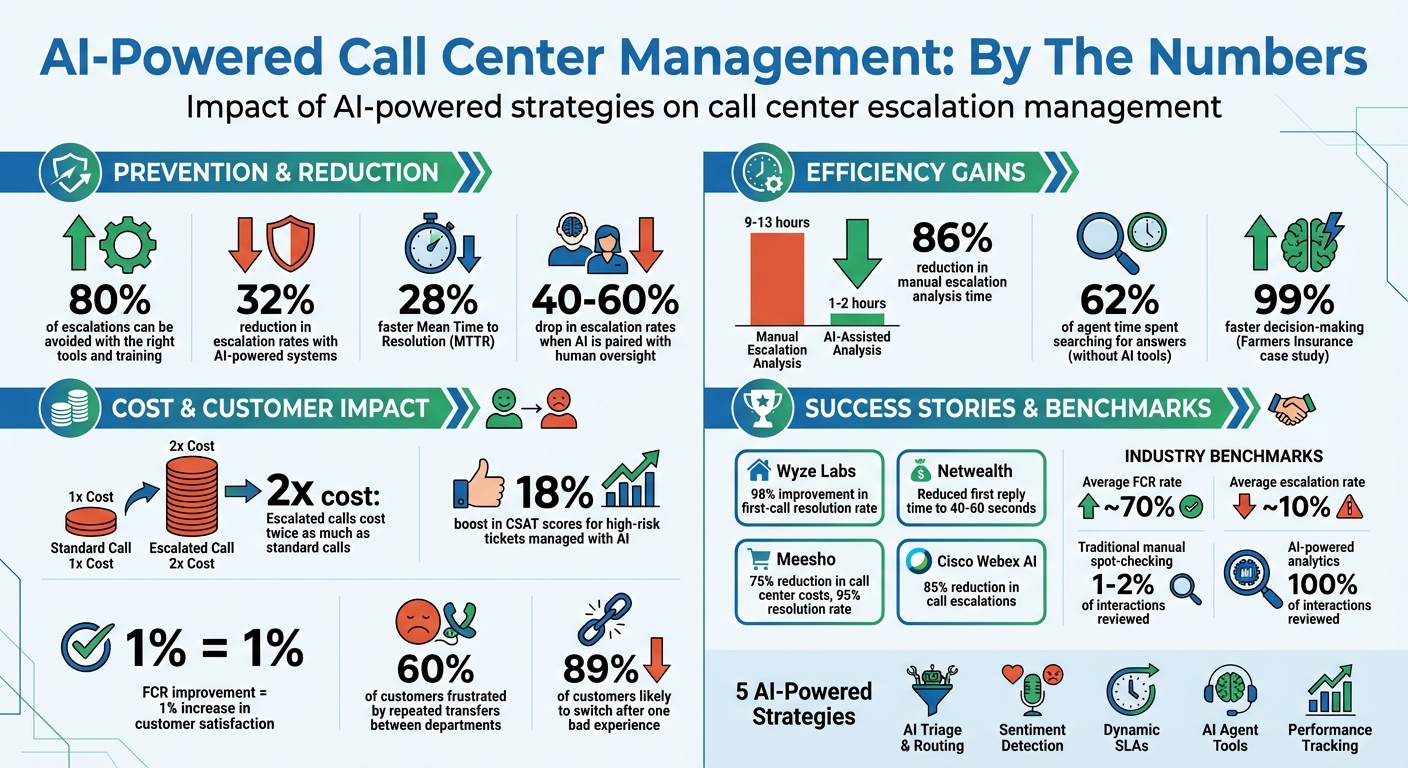
AI-Powered Call Center Escalation Reduction Statistics and Impact
De-Escalation Techniques for Customer Service: Establishing Boundaries
Use AI-Powered Triage and Routing to Assign Cases Correctly
When cases are misrouted, frustrations escalate – literally. Customers often end up explaining their issue multiple times, which is a major pain point. In fact, 60% of consumers report feeling frustrated when they’re transferred between departments repeatedly. AI-powered triage can solve this problem by analyzing the intent, urgency, and sentiment of a case right away, ensuring it lands with the right agent or team from the start.
This approach isn’t just about convenience – it’s a game-changer for efficiency. AI-assisted workflows can cut manual escalation analysis time by a whopping 86%, reducing the process from 9–13 hours to just 1–2 hours. And when AI is paired with human oversight, escalation rates drop by 40–60%. The goal is simple: get the case to the right person the first time. By doing so, support teams can prioritize effectively, responding faster and with more precision.
Prioritize Cases Based on Urgency and Context
AI doesn’t just sort cases by when they arrive – it considers the bigger picture. Modern triage systems pull in real-time CRM data, like a customer’s VIP status, subscription level, purchase history, and even churn risk, to prioritize high-value or high-risk cases ahead of others. Sentiment analysis also plays a critical role: for example, cases with sentiment scores between -0.8 and -1.0 are escalated to senior agents immediately, while scores in the -0.3 to -0.7 range are sent to agents trained in de-escalation techniques.
Take Wyze Labs, a smart home tech company that handles over 300 calls daily. By integrating AI-powered routing, they boosted their first-call resolution rate by an incredible 98%.
Their system paired customers with agents based on urgency and expertise, preventing cases from being stuck in generic queues or assigned to agents who couldn’t resolve them. It’s a practical, cost-efficient example of how AI can transform B2B customer support.
AI also enables predictive escalation scoring, which identifies tickets at risk of escalation by analyzing factors like sentiment changes, response delays, and patterns from similar past cases. This kind of foresight allows teams to step in before issues spiral out of control.
Route Cases to Agents With the Right Skills
Intelligent routing ensures that cases are matched to agents with the necessary skills, expertise, and availability. Dynamic agent profiles track everything from specializations (like billing or technical support) to certifications, language skills, and performance metrics. For example, routing billing disputes directly to experienced agents increases the odds of resolving the issue on the first contact.
Once urgent cases are flagged, advanced algorithms assign them to the best-suited agents based on their current workload and availability.
Netwealth, a wealth management firm, used AI-driven routing to analyze call center response times and pinpoint inefficiencies. By tweaking their strategy, they reduced their first reply time to just 40–60 seconds.
Their system also incorporated "Reroute On No Answer" protocols, ensuring cases didn’t get stuck with unavailable or overwhelmed agents.
Another key feature is the warm transfer, where the full interaction history is passed along with the case. This spares customers from repeating themselves and gives agents the context they need to address the issue effectively. It’s a small detail with a big impact – especially since 89% of customers are likely to switch to a competitor after just one bad experience.
Identify Problems Early With AI Sentiment Detection and Predictive Metrics
Stopping issues before they spiral out of control is a game-changer for support teams. AI-powered sentiment detection and predictive metrics offer a key advantage: spotting trouble early and stepping in before things escalate. These systems monitor every interaction in real time, flagging conversations that show signs of heading toward escalation.
But this isn’t just about catching problems – it’s about understanding how emotions shift during a conversation. AI tools can analyze the emotional tone of an interaction, identifying moments where frustration starts to build. They go beyond words, picking up on subtleties like pauses or overlapping speech – details that plain text analysis can miss. When a customer’s sentiment takes a sharp dive, the system flags the case for senior review or intervention. Let’s look at how tracking these emotional shifts and using predictive metrics can help prevent escalations.
"Emotion is no longer a soft metric – it’s a hard business outcome driver." – Forrester
The results speak for themselves. In October 2025, Farmers Insurance teamed up with Uniphore to implement AI-driven agent scoring and dashboards. By leveraging emotion AI to uncover hidden patterns and sentiment trends across all conversations, the company sped up decision-making by 99%, cutting down on customer effort and reducing manual review time. This kind of efficiency matters – especially when 60% of customers are likely to hang up after being on hold for just one minute.
Track Customer Sentiment During Interactions
Real-time sentiment tracking doesn’t just look at how a conversation ends; it examines the entire "arc" of the interaction. For example, a customer might start off frustrated but leave the call satisfied – or the reverse – and both scenarios offer insights into agent performance and the risk of escalation. AI systems can identify behavioral markers like low empathy from agents, rising urgency in a customer’s tone, or unresolved issues after multiple exchanges – all of which point to potential escalations.
These tools also pick up on signs of vulnerability, such as indicators of mental distress or significant personal stress. This allows teams to redirect these cases to specialized care protocols. Such precision is nearly impossible with manual monitoring, and AI can reduce the time spent on analyzing escalations by up to 86%.
Automated alerts play a critical role too. If phrases linked to escalation risks appear in a live transcript, the system immediately notifies team leads, giving them a chance to step in before the situation worsens. The system can also tag calls with root causes like "Agent Knowledge Gap" or "Policy Restriction", helping teams address broader issues rather than focusing blame on individual agents. By closely monitoring sentiment shifts during interactions, teams can intervene early and minimize the chances of escalation.
Use Predictive CSAT and CES Scores to Prevent Escalations
Taking sentiment analysis further, predictive metrics can forecast customer satisfaction (CSAT) and customer effort (CES) scores, enabling teams to act proactively. These metrics predict outcomes even before customers fill out surveys. By analyzing factors like sentiment changes, response delays, SLA status, and ticket reopen rates, AI models can score active tickets for escalation risk in real time. With training on historical data, these models often achieve around 88% accuracy.
The benefits are clear. Predictive escalation models can cut overall escalation rates by 32% to 45%. High-risk tickets managed through these interventions see an 18% boost in CSAT scores. Plus, since escalated calls cost twice as much to resolve as standard ones, preventing them leads to immediate savings.
Supportbench integrates AI Predictive CSAT and CES features directly into its platform, giving teams instant visibility into potential customer outcomes. This allows agents and managers to act quickly – whether it’s escalating a case to a senior agent, scheduling a callback, or offering a goodwill gesture – before the customer experience takes a hit. Unlike older platforms where these tools are costly extras, Supportbench includes them as part of its core offering at no additional charge.
For predictive metrics to stay effective, it’s crucial to close the feedback loop. Teams need to regularly feed resolved case outcomes back into the AI models to improve accuracy and cut down on false positives. Weekly risk calibration reviews help ensure the system is flagging the right cases, and maintaining holdout queues – small groups of cases without AI intervention – lets teams measure the system’s true impact. By predicting satisfaction and effort scores, these metrics empower teams to prevent escalations and keep customer satisfaction high.
Manage Escalations With Clear Workflows and Dynamic SLAs
Even the best prevention tools can’t stop every escalation. When issues arise, having structured workflows and context-aware SLAs ensures your team handles them effectively. About 85% of customer dissatisfaction stems from unresolved problems, often tied to flawed escalation processes. The key isn’t just responding faster – it’s about creating systems that route cases to the right people and ensure accountability at every step.
Well-defined escalation paths prevent cases from bouncing between departments without clear ownership. Dynamic SLAs adapt deadlines based on real-time factors, like a customer’s VIP status or an upcoming renewal, to speed up resolutions and keep customers from being overlooked. This operational discipline complements earlier prevention efforts, turning AI insights into actionable escalation management.
By combining early detection with clear workflows and adaptive SLAs, flagged cases are handled with precision and care.
Create Clear Escalation Paths for Your Team
When a case escalates, agents shouldn’t have to guess who takes over. A tiered framework – L1 generalists, L2 technical specialists, and L3 experts – provides clear steps for resolution and ensures accountability. Each tier has specific responsibilities and defined triggers for escalation, such as technical complexity, SLA breaches, or a shift in customer sentiment. Keeping a detailed record of diagnostic steps also prevents customers from having to repeat themselves.
For instance, in 2023, Amazon Web Services (AWS) used RACI matrices for incident management. This approach clearly defined roles, cutting their Mean Time to Resolution (MTTR) by 35%. Assigning one person as accountable for each task removes confusion during high-pressure situations.
Businesses that establish clear escalation guidelines can reduce resolution times by up to 40%. Supportbench simplifies this process with features that let you define multi-level escalation paths, categorize cases, and track progress – all within the same case record.
Adjust SLAs Based on Case Context
Not all escalations are created equal. A billing question from a trial user doesn’t need the same urgency as a critical bug affecting a customer about to renew. Dynamic SLAs adjust deadlines based on factors like customer tier, issue severity, or overall business impact, avoiding a one-size-fits-all approach.
AI risk scoring takes SLA management a step further. By analyzing shifts in sentiment, response delays, and historical patterns, AI can continuously update risk scores for active tickets. If a ticket’s risk score spikes, the system can tighten the SLA or notify a senior agent – often before the customer even requests help.
Supportbench includes dynamic SLA capabilities, allowing you to tailor response and resolution times to real-time case details. For example, if a renewal date is near, the system can shorten the SLA to prioritize faster resolution. Automated alerts also notify team leads when service levels drop below acceptable thresholds, giving them a chance to act before an SLA breach occurs.
sbb-itb-e60d259
Give Agents AI Tools and Knowledge Resources to Resolve Cases Faster
Agents spend a significant portion of their day – up to 62% – searching for answers instead of resolving issues. This inefficiency can be addressed with AI tools that provide real-time guidance, surface relevant knowledge instantly, and handle routine inquiries automatically. By giving agents immediate access to the right resources, they can resolve cases faster and more confidently, minimizing the chances of escalations.
AI tools work best when they enhance human judgment rather than replace it. For example, AI copilots act as real-time advisors during active cases, while dynamic knowledge bases and automated responses streamline repetitive tasks. Together, these tools create an environment where agents focus on solving complex problems instead of wasting time searching for solutions.
Use AI Agent Copilots to Speed Up Resolutions
AI copilots are designed to provide live, context-aware suggestions, instantly pulling relevant information to reduce average handle time (AHT). They also use real-time sentiment analysis – leveraging natural language processing and acoustic cues – to detect customer frustration, prompting agents to respond with empathy before issues escalate.
In Q4 2025, a major equipment rental company using Cisco Webex AI Agent’s "Context Summaries" and "Mid-call Summary" features achieved an 85% reduction in call escalations. These tools ensured agents had complete context from prior bot interactions, eliminating "cold handoffs" where customers had to repeat themselves.
"AI doesn’t just automate – it augments. It listens, learns, and adapts in real time." – Chris Kontes, Co-Founder of Balto
Supportbench’s AI Agent Copilot goes a step further by reviewing prior cases and knowledge bases to suggest relevant answers during live interactions. Additionally, the AI Activity Creation Helper generates personalized responses based on past case interactions, allowing agents to reply faster without sacrificing quality or personalization.
Build an AI-Powered Knowledge Base From Resolved Cases
AI can automatically turn resolved cases into updated knowledge base articles, keeping content accurate and ensuring agents have access to tried-and-true solutions.
In August 2025, Wyze Labs adopted AI-powered knowledge management in their omnichannel contact center. This move led to a 78% increase in call acceptance rates and reduced first contact resolution time from a week to just one hour. By automating the creation of knowledge articles from resolved cases, agents could quickly find proven solutions instead of starting from scratch every time.
Supportbench’s AI KB Article Creation from Case History feature simplifies this process by generating complete knowledge base articles – including the subject, summary, and keywords – based on case communication history. This ensures the knowledge base stays up-to-date without requiring agents to manually document every resolution.
Handle Routine Inquiries With AI Auto-Responses
Tasks like password resets, order updates, and shipping inquiries are ideal for AI auto-responses, which 74% of customers prefer. Automating these routine requests frees agents to focus on more complex cases.
It’s important to design AI auto-responses with clear exit options, allowing customers to reach a human agent at any time. This prevents frustration caused by getting stuck in automation loops.
In February 2025, eCommerce company Meesho implemented a multilingual generative AI voice bot capable of handling 60,000 calls daily. This reduced call center costs by 75%, cut average handle time by 50%, and achieved a 95% resolution rate. By delegating Tier 1 inquiries to AI, human agents could concentrate on solving more intricate problems.
Supportbench’s AI auto-responses further enhance efficiency by generating replies based on case history and knowledge base content. Meanwhile, the Customer QA AI Bot uses FAQ and structured QA content to answer customer questions intelligently. If the bot is unable to find an answer, it escalates the issue by creating a new case and initiating a chat session, ensuring no customer is left without a solution.
With these tools in place, agents can focus on higher-value tasks, setting the stage for even greater efficiency and performance improvements in the next section.
Track Performance With AI-Enhanced Metrics and Improve Over Time
Building on the benefits of AI-driven escalation prevention, continuous performance monitoring takes support operations to the next level.
Focusing on the right metrics is key to reducing escalations. Traditional manual spot-checking only reviews around 1–2% of interactions, leaving large gaps in oversight. In contrast, AI-powered analytics evaluate 100% of customer interactions, offering a complete picture of team strengths and areas for improvement. This proactive monitoring uncovers patterns and refines processes without the need for manual case reviews.
By keeping an eye on metrics that directly influence escalations – like First Contact Resolution (FCR) and escalation rates – and using AI to uncover root causes, teams can address issues before they escalate. For example, improving FCR by just 1% can result in a 1% boost in customer satisfaction. AI tools that combine real-time data with summaries of escalated cases allow teams to quickly identify gaps in training, knowledge resources, or workflows, preventing minor problems from becoming major challenges. Let’s break down how metrics like FCR and escalation rates can guide improvement efforts.
Monitor First Contact Resolution and Escalation Rates
FCR evaluates whether customer issues are resolved during the first interaction, with industry averages hovering just below 70%. AI tools can accurately determine whether a case has been resolved on the first contact. Research shows that up to 80% of escalations could be avoided if agents are equipped with the right tools and information.
Escalation rate, calculated by dividing the number of escalations by total customer interactions, typically averages around 10%. AI systems automatically tag calls with escalation triggers, making it easier to spot which issues, agents, or workflows are causing the most escalations. Organizations that use AI for escalation prediction have seen a 32% drop in escalation rates and a 28% faster Mean Time to Resolution (MTTR).
Tools like Supportbench’s AI First Contact Resolution Detection analyze case histories to confirm whether an issue was resolved on the first attempt, removing the guesswork from FCR measurement. Additionally, AI Predictive CSAT and AI Predictive CES provide real-time satisfaction and effort scores directly within the case list, even for customers who haven’t completed a survey.
Review Escalated Cases With AI-Generated Summaries
Manually reviewing escalated cases can take 9–13 hours, but AI reduces this time to just 1–2 hours – an 86% time savings. AI-generated summaries highlight key points, action items, and customer sentiment from escalated cases, allowing managers to quickly identify trends without digging through lengthy call logs.
These summaries help pinpoint specific escalation triggers, such as billing issues, gaps in agent knowledge, or unclear policies. For instance, if AI reveals that confusion about a particular policy is causing multiple escalations, managers can proactively address the issue by updating scripts or creating a knowledge base article. This feedback loop helps teams prevent recurring problems and refine their escalation management processes.
Supportbench’s AI Case Summaries provide overviews whenever new cases are created, while AI Customer Activity Summaries offer concise snapshots of customer interactions. When a case is closed, the system compiles a complete summary of the engagement, making it easier for managers to review escalations and identify areas for improvement. Additionally, the AI KB Article Creation from Case History feature transforms resolved escalations into knowledge base articles, ensuring that effective solutions are documented and readily available for future use.
Conclusion
Reducing escalations in call centers hinges on having well-designed systems in place. The strategies discussed here demonstrate how AI-native tools can revolutionize operations by identifying potential issues early, ensuring cases are routed to the right teams, and equipping agents with the tools they need to resolve problems on the first try. These methods align seamlessly with the AI-native frameworks outlined earlier.
The numbers back this up: Companies leveraging AI for escalation prediction report a 32% drop in escalation rates and a 28% faster Mean Time to Resolution. Escalated calls, on average, cost twice as much to handle compared to standard interactions. Meanwhile, high-risk tickets managed with AI support see an 18% boost in CSAT scores, directly influencing customer loyalty.
Transitioning from AI-enhanced to AI-native operations marks a significant evolution in call center functionality. As Nooshin Alibhai, Founder and CEO of Supportbench, aptly states:
"Striking the right balance between automation and the human touch is crucial. While AI handles routine tasks efficiently, human agents are indispensable for complex, empathetic interactions".
This balance underscores the transformative potential of AI-native support systems, as explored throughout this guide.
FAQs
How does AI-powered triage and routing enhance call center performance?
AI-driven triage and routing transform call center operations by sorting and directing customer inquiries based on factors like urgency, context, and sentiment. This approach helps cut down wait times, ensures customers are connected to the most suitable agent, and reduces the chances of issues escalating further.
By automating routine tasks and processing customer data instantly, AI simplifies workflows, enhances resolution rates, and elevates customer satisfaction. The result? A smoother, more efficient support system that saves both time and resources.
How does sentiment detection help reduce call escalations?
Sentiment detection plays a key role in reducing call escalations by picking up on customer emotions like frustration or dissatisfaction during interactions. By analyzing these emotional signals in real time, support agents can adapt their responses to defuse tension and avoid the need for escalation.
This tool also helps teams focus on high-priority interactions, ensuring emotionally sensitive issues get prompt attention. Tackling concerns early not only cuts down on escalations but also boosts customer satisfaction and builds stronger, trust-based relationships.
What role do dynamic SLAs play in reducing customer escalations?
Dynamic SLAs enable support teams to manage customer issues more effectively by adjusting response and resolution times based on the urgency and context of each case. This approach ensures that high-priority matters receive immediate attention, while less critical requests are handled efficiently without unnecessary delays.
By responding to real-time customer needs, dynamic SLAs help boost resolution rates, improve customer satisfaction, and stop minor issues from spiraling into bigger challenges. They also give teams the ability to provide timely, tailored support for every unique situation.