AI is transforming support by automating repetitive tasks, improving ticket management, and enhancing agent productivity. Here’s how:
- Efficient Ticket Management: AI automates ticket routing, prioritizing cases based on urgency, customer sentiment, and account value. This reduces delays and ensures the right agent handles the issue.
- Streamlined Workflows: Automated case summaries save agents time by providing clear, concise overviews of customer interactions, cutting average call times by up to 35%.
- Agent Productivity Boost: AI copilots suggest real-time responses, assist with quality assurance, and convert resolved cases into knowledge base articles, reducing manual effort by up to 90%.
- Predictive Analytics: AI predicts customer satisfaction, effort scores, and resolution likelihood, enabling teams to address issues proactively and allocate resources effectively.
- Dynamic SLAs: AI adjusts service deadlines based on case context, ensuring critical issues are resolved promptly.
These tools allow support teams to handle growing workloads without increasing staff, improving efficiency and customer satisfaction while reducing costs.
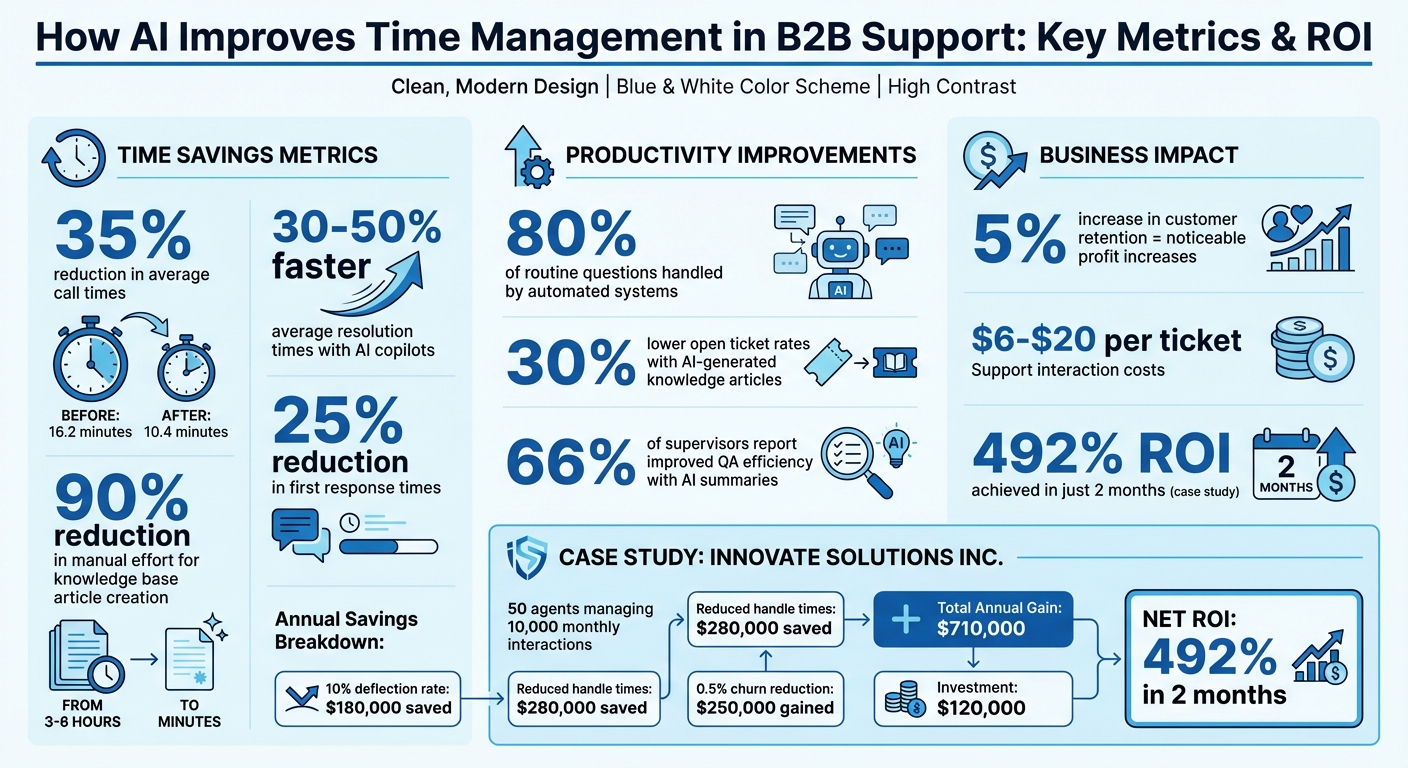
AI Impact on Support Team Time Management: Key Metrics and ROI
How AI Automates Ticket Management
Managing support tickets the old-fashioned way – manually sorting, routing, and reviewing cases – drains valuable time from agents who could be solving customer issues instead. AI-powered systems step in to remove these inefficiencies, automating the repetitive tasks that bog down traditional workflows. By moving from rule-based setups to AI-driven processes, support operations see a major upgrade in speed and accuracy, directly tackling the challenges of outdated methods.
AI-Powered Ticket Triage and Priority Assignment
Traditional systems rely on basic "IF-THEN" rules for ticket routing. For example, if a subject line includes the word "billing", the ticket might be sent to the finance team. But this approach is far from foolproof. A misspelled word, vague language, or a misleading subject line – like "Quick Question" for a critical system outage – can throw off the process entirely.
AI-powered triage, on the other hand, evaluates multiple factors at once to determine where a ticket should go and how urgent it is. It picks up on emotional cues like frustration or anger in a customer’s tone, flags urgent terms like "outage" or "system down", and pulls customer data – such as account value or service tier – from integrated CRM systems. It also spots patterns, like rapid follow-up messages, that might signal escalating issues [1].
By tapping into CRM data, AI sharpens its routing decisions and prioritizes critical cases. It doesn’t just funnel tickets into queues – it matches them with the best-suited agent, considering factors like expertise (e.g., API knowledge), language skills, workload, and availability [1][2]. This smarter routing reduces unnecessary hand-offs and ensures customers are connected to the right person faster. AI also auto-tags and categorizes tickets based on content analysis, making it easier to track trends and generate reports. For businesses handling premium accounts, AI can even prioritize tickets for high-value customers, ensuring top-tier service [1].
Automated Case Summaries
AI doesn’t stop at triage – it also simplifies how agents handle case histories. Digging through emails, chat logs, and notes to piece together a case’s background wastes time and delays resolutions. Support teams often call this the "context tax." AI-generated case summaries eliminate this hassle, offering instant, standardized overviews of a case’s history so agents can focus on solving problems instead of rehashing them [8][9][10].
For example, agents have cut their average call times from 16.2 minutes to 10.4 minutes – a 35% drop – by using AI to handle note-taking and after-call documentation [9]. This automation allows agents to move quickly to their next task without spending extra time on paperwork [9][10].
AI also creates "Current State" summaries, which highlight unresolved issues and the latest actions taken. This feature is especially helpful for agents or supervisors stepping into a case mid-stream, giving them a clear picture without needing to comb through previous interactions [8]. Supervisors benefit too – 66% report that AI-generated summaries improve quality assurance, as they can monitor cases more efficiently without reviewing every detail [9].
These summaries are generated at every stage – initial inquiry, post-interaction, real-time updates, and final closure – so agents always have the context they need at their fingertips. By handling this workload, AI ensures no time is wasted on tasks it can handle instantly, keeping teams focused on what really matters: solving customer issues [8].
sbb-itb-e60d259
How AI Improves Agent Productivity
AI doesn’t just automate ticket management; it actively boosts agent productivity by serving as a real-time assistant and knowledge manager. By cutting out the need to jump between systems or dig through outdated documentation, AI-powered copilots streamline support workflows. They instantly provide relevant information and turn resolved cases into reusable knowledge, improving both accuracy and speed in handling customer inquiries.
AI Agent Copilot and Response Suggestions
AI copilots analyze customer context, such as past interactions and CRM data, to suggest the next best response in real time. These suggestions come from an integrated knowledge repository, enabling even new agents to perform effectively with AI-guided responses, reducing their reliance on more experienced team members [2][4].
AI also takes charge of quality assurance, automatically reviewing interactions for empathy, accuracy, tone, and overall effectiveness [2]. This continuous feedback loop helps agents refine their skills without waiting for manual supervisor reviews. Nooshin Alibhai, Founder and CEO of Supportbench, highlights this capability:
"AI Copilots instantly surface existing knowledge, encouraging reuse. Furthermore, AI can assist in creating content – suggesting new articles based on resolved cases with a click, ensuring valuable solutions are captured fast, well-written, and documented to be published quickly internally and externally" [4].
In addition to real-time support, AI is transforming how solutions are documented and reused, making knowledge management more efficient.
Converting Cases into Knowledge Base Articles
Maintaining an up-to-date knowledge base is often a time-consuming task. Writing a single, detailed article can take anywhere from three to six hours [11]. AI changes the game by converting resolved cases into structured knowledge base articles, capturing solutions while the details are still fresh [2][4].
Using transcripts and logs from resolved tickets, AI identifies the steps taken to solve issues and drafts articles that meet Knowledge-Centered Service (KCS) standards [2][11]. This automation reduces manual effort by up to 90%, cutting production time from hours to just minutes [11]. Agents only need to review and approve the AI-generated drafts, ensuring accuracy without the usual workload.
AI also identifies knowledge gaps by analyzing patterns in support tickets. When recurring issues lack documentation, AI proactively drafts new articles. This approach has been shown to lower open ticket rates by 30% and reduce first response times by as much as 25% [12]. By automating the creation and maintenance of knowledge articles, AI ensures customers can self-serve, decreasing ticket volume and allowing agents to focus on more challenging problems.
Using Predictive Analytics to Allocate Time and Resources
Once ticket management and agent productivity are improved, predictive analytics takes things a step further by fine-tuning how resources are allocated. It shifts the focus from reacting to problems as they arise to proactively preventing them. Instead of waiting for issues to boil over or relying on surveys to uncover dissatisfaction, AI dives into patterns instantly, forecasting outcomes. This allows support teams to allocate resources more effectively, addressing potential problems early and ensuring the right people handle the right challenges at the right moment. Building on earlier automation efforts, predictive analytics sharpens resource allocation even further.
Here’s the kicker: boosting customer retention by just 5% can lead to noticeable profit increases. On top of that, efficiently managing support interactions that cost between $6 and $20 each directly impacts the bottom line. Predictive models analyze factors like sentiment, customer interaction trends, tier levels, and case complexity to replace guesswork with data-driven decisions.
Predicting CSAT, CES, and First Contact Resolution
AI has the power to predict Customer Satisfaction (CSAT) and Customer Effort Scores (CES) by analyzing elements like sentiment, tone, and interaction patterns during a case. It flags at-risk customers in real time[2][4]. Similarly, predictive scoring for First Contact Resolution (FCR) uses historical data to evaluate how likely a ticket is to be resolved in a single interaction[2]. When a case has a low predicted FCR score, it’s immediately routed to senior agents or specialists, cutting down on unnecessary back-and-forth and speeding up resolution times. This data also helps support leaders spot recurring issues that often fail to be resolved on the first contact, enabling targeted training or updates to documentation[4].
AI doesn’t just rely on keywords – it picks up on urgency and frustration through rapid follow-ups or emotional cues, even when customers don’t explicitly voice their concerns[1].
These predictions lay the foundation for more adaptive service standards.
Dynamic SLAs Based on AI Insights
Traditional Service Level Agreements (SLAs) treat every ticket the same, regardless of its importance or context. Dynamic SLAs, powered by AI, flip this approach on its head. They adjust in real time based on factors like case content, customer value, and sentiment[2][3]. By using Natural Language Processing (NLP), AI systems can automatically prioritize tickets. High-value accounts, critical issues, or emotionally charged cases are assigned tighter deadlines. For instance, if AI detects negative sentiment in a ticket from a customer nearing renewal, the system tightens the SLA and escalates the issue if it anticipates a breach[3]. This eliminates the need for manual reassessment, saving time and ensuring urgent matters are addressed promptly. As Supportbench puts it, "AI-based SLAs use NLP, predictive models, and customer context to prioritize B2B support tickets in real time, reduce breaches, and boost satisfaction"[3].
| Predictive Metric | Support Team Benefit | Resource Allocation Impact |
|---|---|---|
| Predictive CSAT/CES | Spots dissatisfied customers early | Focuses retention efforts and proactive outreach |
| Predictive FCR | Anticipates resolution challenges | Routes complex cases directly to senior agents |
| Sentiment Analysis | Identifies hidden urgency and frustration | Escalates tickets without relying on keywords |
| Dynamic SLAs | Adjusts to case context and customer value | Ensures critical cases meet strict deadlines |
This smarter triage approach moves beyond old-school, keyword-based rules to systems that truly grasp meaning and emotion[1]. The payoff? Faster resolutions, better customer experiences, and smarter use of your team’s time.
Measuring Time Management Improvements with AI
The real power of AI shines through when it delivers measurable results – quicker resolutions, fewer workflow bottlenecks, and increased efficiency. By using AI-driven metrics, assumptions are replaced with actionable insights that leadership can trust. These measurable outcomes provide the foundation for tracking Key Performance Indicators (KPIs) that highlight improvements in time management.
AI-Driven KPIs for Time Efficiency
Building on features like automated ticket routing and prioritization and dynamic SLAs, these KPIs demonstrate AI’s impact on operational efficiency. For instance, AI copilots can cut average resolution times by 30–50% by instantly surfacing relevant answers. Tools like Supportbench’s real-time dashboards make it easy to monitor these improvements. Automated systems that handle up to 80% of routine questions significantly reduce backlogs, allowing teams to close more tickets per hour[6][7].
First-contact resolution rates also see a boost when predictive routing ensures complex cases are assigned to the right specialists immediately, avoiding unnecessary back-and-forth communication. SLA compliance rates improve as well, with AI dynamically adjusting deadlines for critical or high-value cases, ensuring urgent issues are resolved promptly.
Dashboards that track real-time metrics – such as average handle time, backlog trends, agent utilization, deflection rates (AI-resolved vs. human-handled), and productivity scores – provide leadership with clear, actionable insights. Supportbench’s KPI scorecards offer detailed, up-to-the-minute data to help organizations stay on top of their performance metrics[2][5].
Case Study: Time Savings with AI-Driven Support
Take Innovate Solutions Inc., a B2B company with 50 agents managing 10,000 monthly interactions. Before introducing Supportbench AI, agents spent significant time searching for information, manually tagging tickets, and triaging cases. After implementing AI, handle times dropped by 1.5 minutes per complex case, while automated tagging saved an additional 0.5 minute per case.
These changes delivered major cost savings: a 10% deflection rate saved $180,000, shorter handle times saved $280,000, and a 0.5% churn reduction added $250,000. Altogether, the annual gain amounted to $710,000 against a $120,000 investment – an impressive 492% ROI in just two months[4].
"For organizations where support quality and accuracy are paramount, simply automating agents away isn’t the goal… The true ROI encompasses empowerment and intelligence."
- Nooshin Alibhai, Founder and CEO of Supportbench [4]
The objective isn’t to replace human agents but to provide them with tools that streamline repetitive tasks, enabling them to focus on solving meaningful problems. This kind of measurable ROI highlights how AI can revolutionize support operations, going far beyond the limitations of manual processes.
Conclusion
AI is reshaping the way support teams operate by saving time, improving satisfaction, and increasing efficiency – all of which contribute to better profitability. Tools like automated triage, intelligent routing, and AI copilots help slash average handle times, while predictive analytics pinpoint at-risk customers before they churn. These advancements enable B2B support teams to handle intricate, long-term cases without needing to grow their teams or rely heavily on IT for ongoing maintenance.
This evolution from reactive problem-solving to proactive customer care represents a major shift in how businesses safeguard retention and revenue. By automating repetitive tasks, AI allows agents to focus on solving complex, high-value challenges. Additionally, building a robust knowledge base transforms every resolved issue into a reusable resource.
"AI tools like Copilots, Bots, Predictive Analytics, and Automation aren’t just features; they are engines for transforming your support operation into a more efficient, consistent, proactive, and value-driven function."
- Nooshin Alibhai, Founder and CEO of Supportbench
Platforms that seamlessly integrate these AI-powered tools bring this vision to life.
Take Supportbench, for example. Designed specifically for B2B organizations, it delivers enterprise-grade features without the complications of outdated systems. By embedding AI directly into its platform, Supportbench eliminates inefficiencies and unifies fragmented tools into a single solution. The result? Tangible ROI – often within just two months – while maintaining the precision and reliability that B2B relationships require.
In an era where teams are expected to achieve more with fewer resources, AI serves as the cornerstone for scalable, sustainable support that fosters loyalty and drives growth.
FAQs
How does AI enhance ticket routing and prioritization in customer support?
AI is transforming how ticket routing and prioritization work by analyzing factors like the ticket’s content, customer history, sentiment, and potential business impact – all in real time. Unlike rigid, rule-based systems, AI takes a more flexible approach, dynamically assigning priority levels and directing tickets to the right team or agent. For example, it can instantly recognize urgent requests, flag unhappy or high-value customers, and adjust routing on the fly – something manual processes or basic automations often can’t handle effectively.
This smarter system streamlines operations by cutting down handling times, ensuring critical issues get addressed first, and removing the hassle of constant rule updates. Features like auto-tagging, priority detection, and dynamic SLA adjustments make it possible for support teams to manage more tickets, work more efficiently, and boost customer satisfaction – all without the need to expand the team.
How does AI enhance productivity and reduce response times in customer support?
AI has transformed productivity by taking over as much as 80% of repetitive tasks. This allows agents to dedicate their attention to more intricate and meaningful customer issues. By automating these processes, manual effort is reduced by 45–70%, freeing up significant time for tasks that require a human touch.
On top of that, AI slashes response times dramatically. What used to take an average of 15 minutes can now be accomplished in just seconds. By simplifying workflows and speeding up resolutions, AI empowers support teams to provide top-tier service – all without increasing their workload or needing additional staff.
How does predictive analytics improve resource management and customer satisfaction?
Predictive analytics empowers support teams to foresee ticket volumes and gauge customer sentiment. This foresight enables them to assign the most suitable agents, evenly distribute workloads, and adjust staffing levels ahead of time. The result? Shorter wait times, higher first-contact resolution rates, and a noticeable boost in customer satisfaction.
With the help of AI-driven insights, teams can make informed decisions about resource allocation. This ensures they’re ready to handle sudden demand surges while maintaining quick, efficient support – without overwhelming their staff.
Related Blog Posts
- 9 Tips for Scaling Support Without Hiring More Staff
- How AI Predicts Ticket Priority
- How to Manage Customer Support Across Multiple Products with Different Complexity Levels
- Dynamic Knowledge Delivery: AI in Customer Journeys
Evaluating help desks for a B2B team?
Supportbench is all-inclusive from $32 per agent per month, with migration and onboarding included. See pricing or book a 20-minute demo.