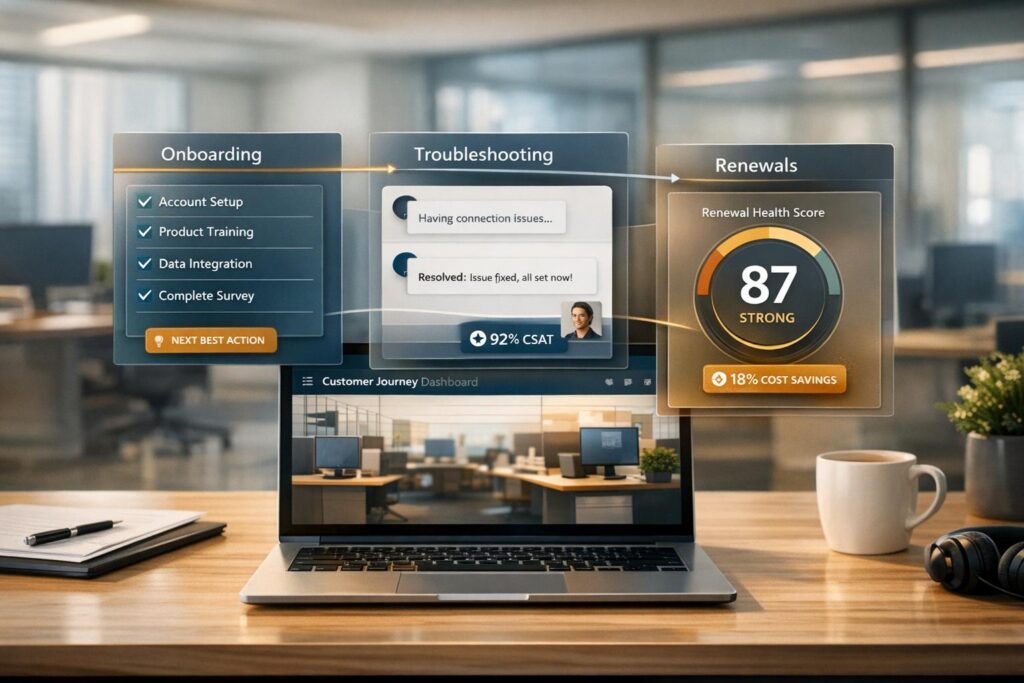
AI is transforming customer support in 2026. Businesses now use AI to deliver fast, personalized answers throughout the customer journey – cutting costs, improving accuracy, and boosting productivity by up to 45%. Whether it’s onboarding, troubleshooting, or renewals, AI ensures the right information is available instantly, eliminating the need for endless searches.
Key Takeaways:
- Onboarding: AI delivers role-specific guidance directly in tools like Slack or Teams.
- Troubleshooting: Real-time suggestions reduce errors by 20% and improve satisfaction by 30–50%.
- Renewals: Predictive analytics detect churn risks early, strengthening customer retention.
- Efficiency Gains: AI reduces support costs by 30% while creating knowledge articles in minutes.
This shift isn’t just about solving problems faster – it’s about smarter, data-driven support that anticipates customer needs and keeps teams efficient.
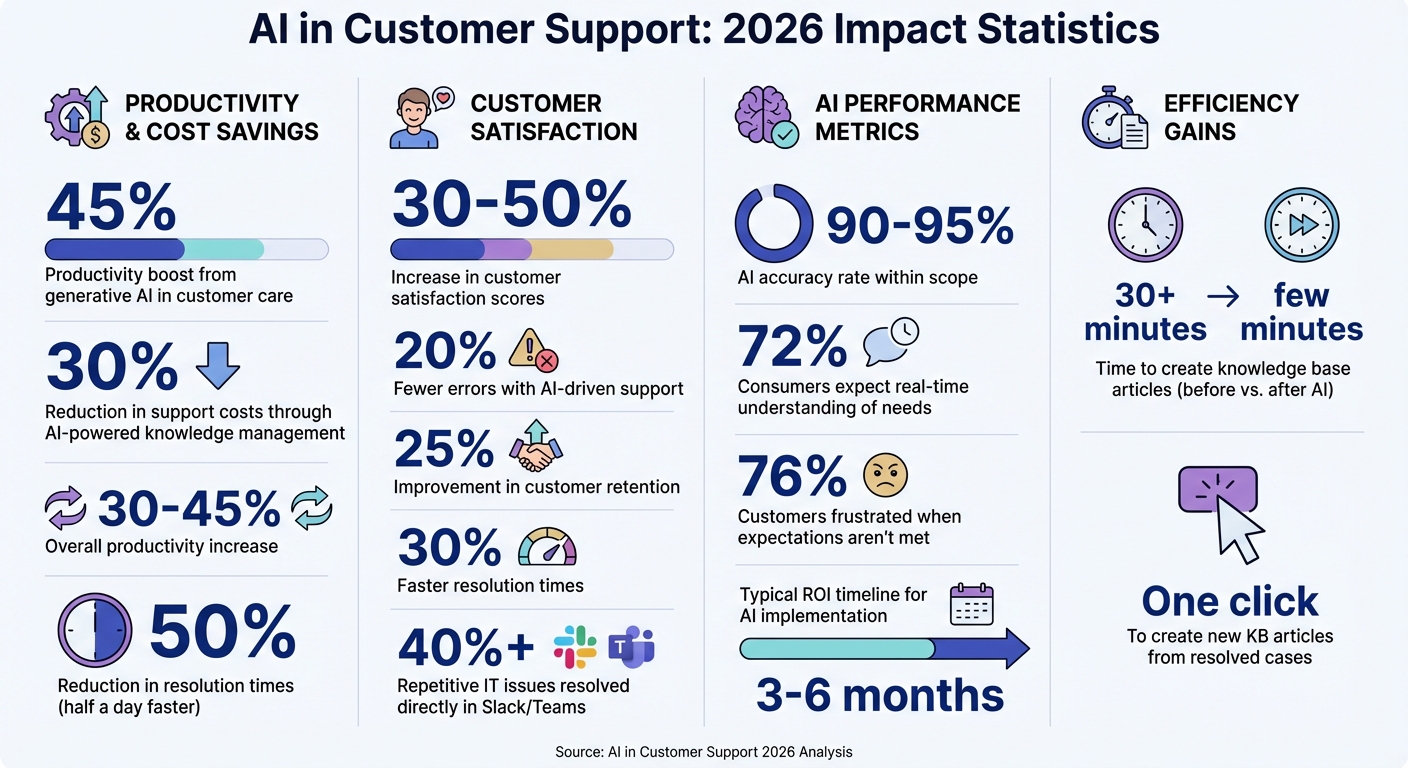
AI Impact on Customer Support: Key Metrics and Benefits in 2026
Easily Build an AI Customer Support Agent (That Gets Smarter Over Time)
Knowledge Needs at Each Stage of the Customer Journey
Every phase of the B2B customer lifecycle requires specific types of knowledge. Providing the wrong information at the wrong time can disrupt relationships. AI steps in to solve this by delivering the right content exactly when it’s needed – whether a customer is setting up their first integration or deciding whether to renew their contract.
Onboarding: Helping Customers Get Started Quickly
When onboarding, new customers require customized, role-specific guidance to get up and running. For example, an administrator configuring SAML authentication has very different needs compared to an end-user learning basic navigation. AI ensures this tailored assistance is delivered directly within platforms like Slack, Microsoft Teams, or embedded product interfaces, eliminating the hassle of searching through help centers [5].
Using Retrieval-Augmented Generation (RAG), AI pulls relevant content from tools like Confluence, SharePoint, and Notion, providing personalized answers instantly [5]. It can also create new knowledge base articles from resolved cases with just one click, ensuring documentation keeps pace with real-world challenges [2][3].
"The modern user does not navigate to a help center; they ask a question inside their workflow." – Enjo [5]
This approach to targeted knowledge delivery lays the groundwork for similar efficiency during troubleshooting.
Troubleshooting: Solving Problems Quickly and Effectively
When customers face issues, they need immediate access to relevant solutions and guidance tailored to their specific context. AI copilots provide this by surfacing answers from past cases and knowledge bases, adjusting responses based on the customer’s configuration and usage patterns [2][3]. For instance, developers may receive API documentation, while end-users get simplified tutorials [4].
AI also identifies gaps in existing knowledge by analyzing customer interactions, flagging topics that haven’t been adequately addressed [4]. The results speak for themselves: companies using AI-driven support have reported 30% to 50% increases in customer satisfaction and 20% fewer errors, thanks to consistent and accurate responses [4]. Additionally, AI can reduce the time needed to create a knowledge base article from over 30 minutes to just a few minutes of review [4].
This proactive, context-aware support ensures customers feel understood, which is critical for building loyalty as they approach renewal.
Renewal and Retention: Strengthening Customer Relationships
When it’s time for renewal, customers need proactive insights to address any concerns before they become bigger problems. AI can analyze sentiment and detect churn risks – sometimes even before a customer fills out a survey [6]. Predictive CSAT/CES scores and 360-degree account overviews make it easier to flag potential issues and evaluate account health [6]. Just like in onboarding and troubleshooting, AI ensures that knowledge delivery remains highly relevant throughout the customer journey.
Take Payfirma, for example. In February 2025, this fintech company used Supportbench’s analytics tools to manage support for nearly 10,000 customers with just four agents. By centralizing case monitoring and using push alerts, they reduced resolution times by half a day while handling 800–1,000 cases per month [6]. This data-driven approach not only improved customer satisfaction but also boosted operational efficiency during critical renewal periods.
"AI is no longer just a tool; it is a strategic partner in achieving superior customer satisfaction and operational excellence." – Nooshin Alibhai, Founder and CEO, Supportbench [6]
AI Techniques That Enable Dynamic Knowledge Delivery
AI-driven support relies on advanced methods to deliver quick answers and enhance team efficiency.
Predictive Analytics for Anticipating Customer Needs
Predictive analytics uses past interactions to anticipate what customers need – even before they ask. By analyzing case histories and resolved tickets, AI can suggest the "next best response" and pull up relevant knowledge base articles in real time [2][3]. For instance, during onboarding, a customer might automatically receive beginner tutorials, while experienced users are directed to advanced troubleshooting guides [4].
This technology also identifies gaps in the knowledge base by flagging topics not yet covered [4]. Teams can then create content based on actual customer needs rather than assumptions. Additionally, AI can calculate predictive CSAT and CES scores, helping identify potential churn risks or frustration early enough for proactive intervention [2][3].
| Feature | Source | Proactive Outcome |
|---|---|---|
| Knowledge Gap Detection | Customer conversations | Highlights missing documentation for immediate content creation [4] |
| Journey-Specific Support | User stage (Onboarding/Power User) | Automatically surfaces tailored tutorials or guides [4] |
| Predictive CSAT/CES | Interaction sentiment and effort | Flags at-risk customers before feedback is provided [2][3] |
| Dynamic SLAs | Case content and customer value | Prioritizes tickets in real time to avoid service breaches [2][1] |
The results are impressive. Companies leveraging AI for knowledge management have seen support costs drop by up to 30%, while generative AI in customer care has boosted productivity by 30–45% [4].
"What was once primarily a reactive function, focused on addressing issues as they arose, is transforming into a proactive, strategic powerhouse." – Supportbench [1]
These predictive tools enable real-time adjustments that keep support ahead of the curve.
Real-Time Behavioral Tracking and Analysis
Real-time tracking takes things further by analyzing current user behavior to refine knowledge delivery. AI models adapt instantly to user actions. For example, if someone shifts from casually browsing to actively searching for solutions, the system adjusts its suggestions immediately [7].
This capability shines when it comes to reducing friction. If a chatbot session shows signs of frustration – like repeated searches or abandoned queries – AI can escalate the issue to a live agent or suggest a troubleshooting guide before the customer gives up [9]. Businesses that use AI for customer journey analytics report up to a 25% improvement in retention and 30% faster resolution times [9].
AI also identifies "dead-end" queries – searches that yield no results or cause users to leave the site. These insights highlight areas where the knowledge base needs improvement. Unlike traditional systems that update periodically, AI-powered tools operate continuously, delivering updates almost instantly [7].
"Customer journey mapping is no longer about visualizing paths. It’s about predicting needs, eliminating friction, and responding in real time." – Jack Kosakowski, VP of GTM, Nextiva [9]
Sentiment and Intent Detection for Better Support
Sentiment and intent detection add another layer by analyzing customer emotions and goals. AI evaluates language and context to gauge emotional states, enabling empathetic responses for frustrated customers or efficient solutions for neutral inquiries [4].
Intent detection also tailors responses based on technical expertise. Developers might receive API documentation and code samples, while less technical users get simplified tutorials – all without any manual effort [4]. This level of personalization is crucial, as 72% of consumers expect companies to understand their needs in real time [4]. When businesses fail to meet this expectation, 76% of customers report feeling frustrated [8].
In B2B settings, sentiment analysis helps with intelligent routing. High-frustration cases are prioritized or sent to specialized agents, ensuring at-risk accounts are handled promptly [2][3]. AI also evaluates support interactions for tone, empathy, and effectiveness, providing agents with instant feedback to improve their approach [2][3].
The impact is clear. Well-implemented AI systems can achieve 90–95% accuracy within their scope, and companies using AI-driven support have seen customer satisfaction increase by 30–50% thanks to faster, more personalized responses [4].
"AI transforms knowledge management from a static process into a dynamic, continuously improving system." – Pylon [4]
These tools empower support teams to anticipate customer needs and respond with precision, creating a more seamless experience.
Building AI Into Knowledge Delivery Workflows
Support organizations have faced mounting challenges as ticket complexity grows and knowledge remains scattered across PDFs and chat logs [5].
Using AI to Improve Knowledge Base Management
By 2026, the concept of a knowledge base has transformed into an "enterprise brain" that drives support functions [5]. For AI agents to function effectively, they need structured data – content with clear headings, modular sections, and proper metadata. This shift requires businesses to audit their existing content and standardize article structures. Think short, digestible paragraphs (2–4 lines), scannable headings, and clear labels like "Admins only" to make retrieval seamless [5].
Modern tools now let teams integrate sources like Confluence, SharePoint, Notion, or Google Drive into a unified, permission-aware system. For one global enterprise, this strategy consolidated fragmented knowledge and resolved over 40% of repetitive IT issues directly within platforms like Slack and Teams [5]. Governance tools, including Role-Based Access Control (RBAC) and Single Sign-On (SSO), ensure AI provides only the information users are authorized to access.
"Automation is only as good as the knowledge it sits on." – Enjo.ai [5]
AI has also begun filling gaps in knowledge. It identifies unanswered queries and creates draft articles from resolved support cases, turning static knowledge bases into dynamic, ever-evolving systems [2][3][4]. This structured approach lays the groundwork for seamlessly integrating AI into daily support workflows.
Connecting AI with Support Operations
Once knowledge bases are optimized, the focus shifts to embedding AI directly into support operations. By integrating AI into case management systems, organizations can streamline workflows. A key goal for 2026 is achieving "zero-touch support", where user questions are resolved without needing to open a full article [5]. To make this happen, knowledge delivery must meet users where they work – whether that’s in Slack, Microsoft Teams, or directly within product interfaces.
AI Copilots now act as real-time assistants, drawing from the knowledge base to provide instant suggestions and reduce the need for context-switching. They summarize past interactions to give agents a complete customer history, cutting down ramp-up times. AI even adjusts Service Level Agreements (SLAs) dynamically based on case content and sentiment analysis [2][3].
Unified platforms also play a big role by reducing tool sprawl. With AI accessing a single source of truth, productivity improves [11]. Many organizations start small, using AI for tasks like summarizing and drafting responses. Over time, they move toward full automation. This gradual approach allows teams to focus on monitoring AI performance and tackling more complex challenges [4].
"In 2026, knowledge without automation is dead weight." – Enjo.ai [5]
sbb-itb-e60d259
Supportbench AI Features for Cost-Efficient Knowledge Delivery
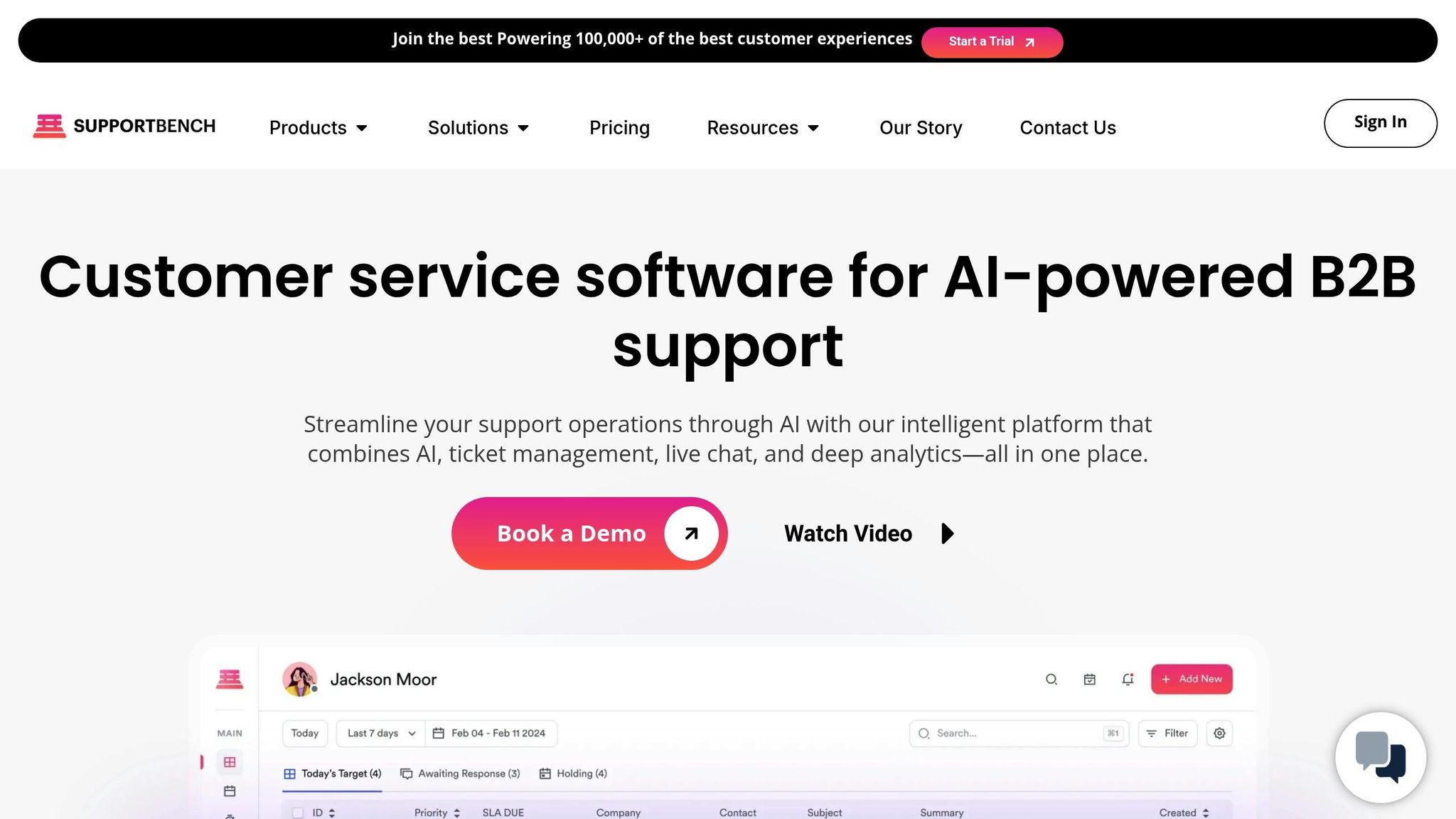
Supportbench takes advanced AI techniques and packages them into a platform designed for efficient, cost-effective knowledge delivery.
What sets Supportbench apart? AI capabilities are included across all pricing tiers. Features like predictive analytics, sentiment analysis, and automated knowledge creation come standard – no pricey add-ons required [10]. This approach minimizes the overall cost of ownership while empowering B2B teams to handle intricate, long-term customer relationships. It’s all about delivering proactive, personalized support without breaking the bank.
AI Agent-Copilot for Real-Time Suggestions
The AI Agent-Copilot is like having an extra set of hands (or brains) for your support team. It understands the context of each ticket and pulls up relevant information in real time [2] [3]. Forget about juggling multiple tabs – this tool auto-suggests replies based on case histories and provides quick summaries. The result? Faster responses and happier customers.
"For B2B SaaS companies, Supportbench’s AI capabilities are particularly valuable because they help manage complex, long-term customer relationships without adding heavy operational costs." – Nooshin Alibhai, Founder and CEO of Supportbench [10]
AI Knowledge Base Article Creation from Cases
Supportbench makes it ridiculously easy to turn resolved tickets into knowledge base articles [2] [3]. The AI organizes, summarizes, and tags content in a structure aligned with the Knowledge-Centered Service (KCS) methodology. This automation means no more manual processing by knowledge managers, cutting down on operational costs while ensuring documentation stays up to date. Plus, by integrating knowledge management directly into the support platform, companies can skip the expense of third-party tools. It’s a win-win: streamlined workflows and lower SaaS costs.
Predictive CSAT and CES for Measuring Outcomes
Supportbench’s AI doesn’t just react – it predicts. The platform can forecast Customer Satisfaction (CSAT) and Customer Effort Scores (CES) before a survey even goes out [2] [3]. By analyzing case content and sentiment in real time, it flags potential issues early, giving teams a chance to act before problems escalate. Visual dashboards and alerts keep everyone in the loop, while predictive metrics highlight when self-service articles need a refresh [4]. From onboarding to retention, these tools ensure customers get the support they need, when they need it.
Measuring the Impact of AI on Customer Satisfaction and Efficiency
Introducing AI into your operations is just the beginning; understanding its impact is where the real value lies. By focusing on the right metrics, AI provides insights into every customer interaction – tracking sentiment, accuracy, and resolution quality across all tickets [2][3]. This approach gives support leaders a much broader and more detailed perspective than traditional surveys, which often rely on small sample sizes.
AI shifts the game from reactive to proactive measurement. Instead of waiting for customers to complete surveys, AI predicts satisfaction scores in real time by analyzing case details, emotional tone, and the complexity of interactions [2][3]. Studies show that faster, more personalized responses powered by AI can increase customer satisfaction by 30%–50% [4]. On top of that, AI-driven knowledge management can cut support costs by up to 30%, with many organizations seeing a positive return on investment within just 3 to 6 months [4]. Below is a breakdown of key metrics that help measure AI’s impact.
Key Metrics and AI Measurement Approaches
The table below highlights the essential metrics for assessing AI-driven performance in customer support and the methods AI uses to evaluate them:
| Metric | AI-Driven Measurement Approach |
|---|---|
| Predictive CSAT & CES | AI evaluates sentiment, emotional cues, and interaction complexity to automatically assign satisfaction scores [2][3]. |
| First Contact Resolution (FCR) | AI predicts the likelihood of resolving an issue on the first attempt by analyzing intent and historical case data [2][3]. |
| Knowledge Deflection Rate | Tracks how often AI-suggested articles or automated responses prevent the need for human agent involvement [4]. |
| AI Resolution Rate | Measures the percentage of support issues fully resolved by AI without human assistance [4]. |
| Knowledge Base Coverage | Identifies gaps in documentation by flagging customer queries that lack matching resources [4]. |
| First Response Time (FRT) | AI dramatically reduces response times by instantly providing answers or drafting replies for agents [4]. |
| AI Accuracy | Tracks the percentage of AI-generated responses that are verified as correct and helpful through automated quality checks [4]. |
| Sentiment & Emotion Analysis | Monitors customer satisfaction or frustration in real time during interactions [2][4]. |
Escalation rates offer another critical layer of insight. When AI can’t resolve an issue and a human agent steps in, it highlights areas for improvement [4]. By analyzing which articles or responses successfully address customer concerns and which lead to escalations, support teams can fine-tune their knowledge base to ensure it remains effective throughout every stage of the customer journey.
Conclusion
AI-driven knowledge delivery is reshaping the way B2B companies approach customer support, creating a more proactive and efficient system.
With AI, resolved cases are transformed into updated knowledge base content, real-time guidance is provided, and customer satisfaction can even be predicted before surveys are sent [2][3]. This evolution allows support teams to address customer needs exactly when they arise – whether during onboarding, troubleshooting, or renewal discussions. It’s a shift from simply reacting to problems to anticipating them.
The financial benefits are clear too: AI-powered knowledge management can reduce support costs by as much as 30% [4].
"AI isn’t just a buzzword or future promise – it’s actively transforming how B2B companies deliver customer support." – Pylon Team [4]
For support teams under pressure to maximize efficiency, the solution lies in consolidating tools into a unified platform. A unified system ensures AI can access complete customer context, integrating insights across all support functions. This eliminates the inefficiencies and added costs of outdated, fragmented tools. Platforms like Supportbench offer enterprise-grade AI features – including predictive analytics, sentiment analysis, and automated knowledge creation – at accessible pricing, starting at $32 per agent per month [10].
FAQs
How does AI enhance the onboarding process for new customers?
AI has revolutionized the onboarding process, turning what was once a manual and time-heavy task into a streamlined, efficient experience. By automating steps like pulling data from forms, running instant compliance checks, and setting up accounts, AI can cut onboarding time by as much as 70%, all while reducing the chances of errors. Plus, real-time progress tracking keeps customers engaged and helps lower the likelihood of them dropping out midway.
In platforms like Supportbench, these AI-driven features are fully woven into the onboarding process. AI simplifies the experience by suggesting relevant knowledge-base articles, automatically creating onboarding documents, and directing cases to the right experts. It even uses predictive scoring to identify risks early, allowing teams to address potential issues before they escalate. This smoother process not only speeds up the journey to value but also boosts customer satisfaction and trims costs, making onboarding better for both customers and support teams alike.
How does AI help reduce customer churn during the renewal process?
AI has become a game-changer in spotting and tackling churn risks during the renewal phase. By analyzing case sentiment and forecasting crucial metrics like CSAT (Customer Satisfaction) and CES (Customer Effort Score) even before surveys are conducted, AI empowers support teams to take action ahead of time.
This proactive approach helps teams connect with customers who might be at risk, resolve their concerns, and build stronger relationships. The result? Better retention and lower churn rates. Armed with AI-driven insights, businesses can deliver personalized and timely support that keeps customers happy and committed.
How does AI-driven predictive analytics improve customer support efficiency?
AI-powered predictive analytics turns support data into practical insights, enabling B2B teams to work more efficiently. By examining ticket content, sentiment, customer value, and historical outcomes, it forecasts key metrics like First-Contact Resolution (FCR), CSAT, and CES – even before surveys are sent out. These insights help teams focus on high-priority cases, adjust SLAs in real time, and tackle potential churn risks early, reducing escalations and repeat issues.
This proactive strategy also optimizes workflows by automatically tagging and routing tickets based on predicted priority or complexity. Tickets are sent to the right agents or directed to self-service tools, ensuring faster resolutions. The impact? Agents spend less time hunting for information and more time solving problems, slashing average handling times and cutting per-ticket costs – from $22 to $11 – all while keeping satisfaction levels high. Predictive analytics ensures every interaction is quicker, more relevant, and cost-effective, safeguarding both customer relationships and revenue streams.