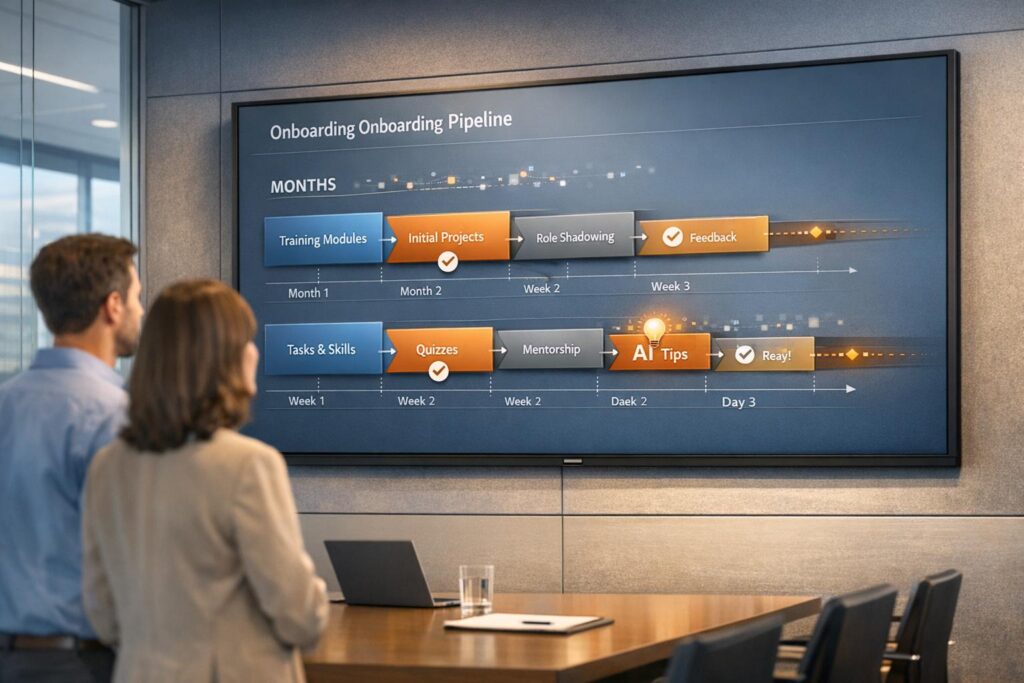
Onboarding new customer support agents is expensive and time-consuming – but AI can fix that. Companies are cutting onboarding time by up to 75%, slashing costs, and boosting agent performance with AI-powered tools. Instead of relying on outdated methods like static documents or manual coaching, AI integrates learning into daily workflows, providing real-time guidance and feedback.
Key Takeaways:
- Cost Savings: Training a single agent traditionally costs $115,200–$345,600. AI reduces these costs by automating training tasks and improving retention.
- Faster Ramp-Up: AI shortens onboarding from 4 months to 1 month by providing real-time knowledge and case summaries.
- Better Performance: AI reviews 100% of interactions for feedback, improving agent confidence and skill development.
- Efficiency Gains: Agents spend less time searching for information, cutting manual research by up to 75%.
By embedding AI into helpdesk systems, companies not only save time and money but also ensure agents are better equipped to handle customer needs from day one.
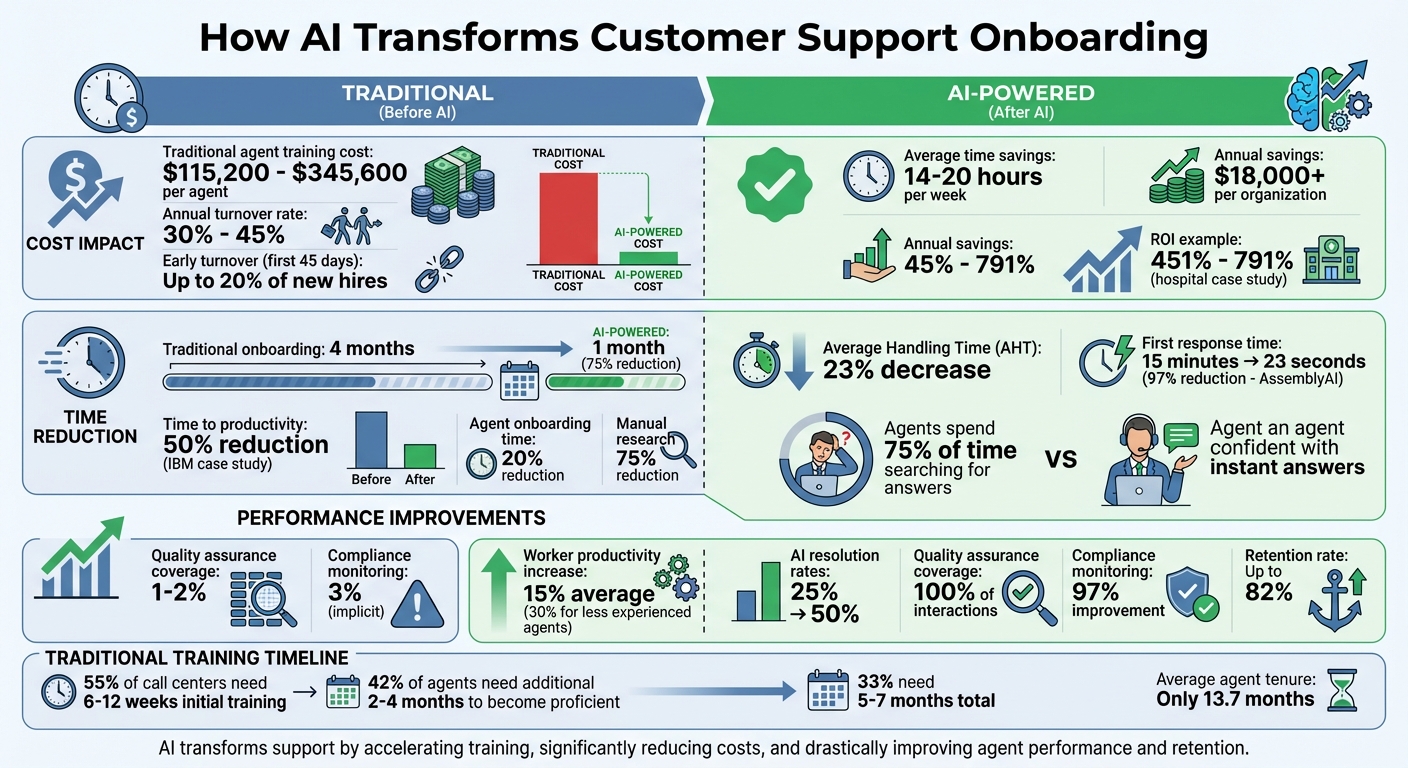
AI-Powered Onboarding: Cost Savings and Time Reduction Statistics
Why Traditional Onboarding Takes Too Long and Costs Too Much
The Real Cost of Long Onboarding Periods
Traditional onboarding can be a heavy financial strain. For instance, training a single call center agent using conventional methods can cost anywhere from $115,200 to $345,600. With annual turnover rates hovering between 30% and 45%, a significant chunk of these investments is lost before agents even reach their full potential [1][5][6].
The timeline only adds to the challenge. In 2021, 55% of call centers reported needing 6 to 12 weeks of training before agents felt ready to handle customer interactions [5]. But even after this initial phase, the learning curve remains steep – 42% of agents require an additional 2 to 4 months to become proficient, and over 33% need 5 to 7 months [5]. This means many teams operate with partially trained agents for a substantial part of the year. And considering the average customer service agent stays in their role for just 13.7 months, the onboarding cycle often starts again before teams can fully benefit from their training investments [6].
Problems With Static Documentation and Manual Coaching
Static training materials simply don’t prepare agents for the unpredictable challenges of modern customer service, particularly in B2B environments [6]. As Glean aptly puts it:
"Static training methods that rely on slide decks, scripts, and occasional workshops no longer equip agents for the unpredictable, nuanced conversations that define modern customer service." – Glean [6]
Shadowing senior agents, another common approach, has its own limitations. New hires might spend weeks observing experienced staff handle tickets, yet this doesn’t expose them to the full spectrum of complex scenarios they’ll face on the job [5]. Worse, manual coaching often disrupts senior agents, pulling them away from high-priority tasks to assist new hires [1][4].
Adding to this inefficiency, traditional quality assurance only reviews 1% to 2% of customer interactions. This fosters a "learn by failing" environment where mistakes are identified too late, and feedback is inconsistent [5]. These outdated methods not only slow down skill development but also exacerbate challenges when systems are fragmented.
How Disconnected Systems Make Scaling Harder
Fragmented systems are another major hurdle, forcing agents to spend up to 75% of their time searching for answers instead of resolving customer issues [4]. In B2B settings, this inefficiency becomes even more pronounced. Agents often juggle multiple tabs and integrations to locate critical details like renewal dates, entitlements, or asset configurations [7].
The problem compounds during onboarding. New hires must not only learn the product but also navigate a labyrinth of disconnected systems. As Nooshin Alibhai, Founder and CEO of Supportbench, explains:
"Zendesk’s reputation and feature depth once made it the natural choice for scaling teams, but growth has revealed its limits: higher costs, fragmented modules, and a steeper learning curve than most teams can justify." – Nooshin Alibhai, Supportbench [7]
When key knowledge resides in the heads of veteran agents rather than in accessible systems, scaling becomes an uphill battle. Each new hire requires the same time-intensive, manual effort, leaving no room for efficiency gains. This inefficiency not only drives up onboarding costs but also creates a barrier to growth, making it increasingly expensive to scale operations [8].
How AI Builds Learning Into Daily Work
AI weaves learning directly into everyday workflows, delivering the right knowledge at the right time. This seamless integration helps enhance agent performance by embedding powerful AI-driven tools into their daily tasks.
Real-Time Knowledge Suggestions and Case Summaries
Today’s AI tools are designed to work within helpdesk systems, instantly pulling up relevant documentation, past case histories, and actionable next steps [1].
Take AssemblyAI, for example. In June 2025, they adopted Pylon‘s AI-powered support platform to streamline developer inquiries. Under the leadership of Lee Vaughn, Manager of Support Engineering, AssemblyAI implemented AI agents and automated runbooks that guided their team through complex troubleshooting. These tools flagged incomplete requests and prompted agents to ask clarifying questions. The results? A staggering 97% reduction in first response time – from 15 minutes to just 23 seconds – and a jump in AI resolution rates from 25% to 50% [10].
"Our customers are developers who expect quick, actionable support. We needed a way to meet them where they work without slowing down." – Lee Vaughn, Manager of Support Engineering, AssemblyAI [10]
A key feature of these systems is their transparency. AI-generated responses often include source links, allowing agents to verify information on the spot. A fintech company, for instance, used Glean’s AI solution to unify its support data. This move slashed new agent ramp-up time by 75%, reducing a four-month training period to just one month. It also cut the time agents spent on manual research by up to 75% [1].
How AI Supports Agents Without Replacing Them
AI Copilots act as a safety net for agents, offering real-time guidance by surfacing relevant articles, summarizing past cases, and even suggesting draft responses [1].
"Instead of agents spending up 75% of their time doing manual research to find their customers’ answers… AI will significantly reduce the average handling time." – Deon Nicholas, President, Forethought [4]
This support allows new agents to jump into live customer interactions with confidence, knowing they have backup if needed. Features like one-click drafting generate context-specific response templates, reducing repetitive tasks and manual research. Automated runbooks also ensure consistency, even when agents handle unfamiliar or complex issues.
"Runbooks have helped us handle weird edge cases much more intelligently. Instead of failing the conversation, the agent now guides customers to the right resources automatically." – Lee Vaughn, Manager of Support Engineering, AssemblyAI [10]
Using Predictive Analytics to Identify Training Needs
AI doesn’t just assist in the moment – it also shapes long-term training strategies. By analyzing 100% of interactions, AI provides managers with an objective, data-driven view of agent performance [5]. This level of analysis helps identify struggling agents or risky interactions early, enabling targeted coaching before problems escalate.
AI tracks metrics like response times, tone, and problem-solving techniques to create detailed skill profiles. These profiles highlight areas where agents may need extra support, such as de-escalation or technical accuracy [6].
"AI feedback is based on 100% of agents’ interactions, offering an inherently objective view of their performance. Unlike human assessments that can be swayed by mood or bias, conversation intelligence is based solely on comprehensive data analysis." – Observe.AI [5]
Beyond identifying gaps, AI can dynamically adapt training modules to address specific needs. For instance, if an agent struggles with handling upset customers, the system could generate tailored de-escalation simulations. This personalized approach replaces the outdated one-size-fits-all training model.
Predictive performance modeling takes it a step further by forecasting agent readiness and identifying potential challenges before they arise. AI dashboards track knowledge gaps, helping managers determine when an agent is prepared for more advanced tasks. This proactive approach has led to a 20% reduction in onboarding time and a 23% decrease in average handling time [5].
How to Implement AI-Powered Onboarding
Start your AI-powered onboarding process with a knowledge audit. This means reviewing your help center articles, macros, SOPs, and policy guides to remove duplicates and outdated materials. The goal? A clean, up-to-date source of truth that prevents AI from delivering conflicting or obsolete information to new agents [3].
Next, identify your top 20-30 high-volume customer intents – common issues like password resets or billing disputes – and map out clear "happy paths" and escalation rules. For example, you might set a guideline like: "Never process refunds over $100; escalate with a summary instead" [3]. These boundaries ensure new agents operate within approved limits, even when AI tools suggest responses. Before going live, run your AI tools in shadow mode for 2-3 weeks. During this testing phase, the AI generates suggestions internally, allowing you to spot accuracy problems and policy gaps without impacting real interactions [3].
Creating Role-Based Learning Paths
AI can help tailor training for specific roles by generating customized scenarios for positions like technical support specialists, billing agents, or account managers [6][5]. Each role has unique requirements, from mastering payment systems and refund policies to troubleshooting product issues. AI platforms can adjust training content based on factors like an agent’s strengths, the products they’ll handle, or even geographic considerations [5].
Take it a step further with AI-powered role-play simulations. These virtual interactions mimic real customer conversations, complete with realistic emotional responses. New hires can practice handling tricky situations in a risk-free environment before addressing live tickets [6][9]. AI tracks their performance, pinpointing areas for improvement – whether it’s showing more empathy or delivering technically accurate solutions – and adjusts future training scenarios accordingly.
Automating Knowledge Creation and Tracking Progress
One standout capability of AI is its ability to turn resolved cases into training materials automatically. When an agent successfully handles a complex issue, the system can extract the key problem-solution details and create a knowledge base article, complete with a subject line, summary, and keywords [5][9]. This automation not only saves time but also keeps the learning process continuous, ensuring agents stay prepared for high-stakes support tasks.
For example, in 2025, Hitachi introduced a private AI system for its 300,000 employees worldwide. The result? Onboarding time was reduced by four days, and HR’s manual involvement dropped from 20 hours to just 12 hours per new hire [12]. The system handled documentation and tracked progress seamlessly.
To measure success, implement tiered KPIs. These metrics track not only completion rates but also "refusal accuracy" – how effectively the AI escalates complex issues [3]. This ensures agents learn both what actions to take and when to seek help.
"It’s great, because it’s work that people hated doing: activity logging, meeting notes, recaps to customers… we can now just totally automate today through AI." – Gillian Heltai, Chief Customer Officer, Haus [2]
With these foundational benefits in place, the next step is integrating AI directly into your workflows.
Adding AI Features to Current Workflows
Once your onboarding system is set up and tracking progress effectively, embed AI into your existing helpdesk systems to simplify operations even further. The most effective AI tools provide knowledge recommendations, case summaries, and suggested responses directly within the interfaces agents already use [1][4]. This seamless integration ensures minimal disruption to daily workflows.
For better results, start with Retrieval-Augmented Generation (RAG) instead of model fine-tuning. RAG keeps AI responses grounded in your current documentation, reducing errors and cutting down on maintenance [3][11]. As your knowledge base evolves, the AI automatically references updated materials without needing retraining.
To maintain control over high-risk actions or unfamiliar issues, implement Human-in-the-Loop (HITL) governance. Set confidence thresholds where the AI pauses and asks a human agent for input on complex tickets [3]. This approach safeguards both customer satisfaction and new agents as the system learns your organization’s specific needs. Companies using conversation intelligence have reported a 20% reduction in agent onboarding time with this method [5].
For instance, Novant Health adopted automated onboarding software tailored to roles and locations. This personalization cut their total hiring and onboarding time by 9%, all while integrating smoothly with their existing HR and training systems – no need for a platform overhaul [13].
sbb-itb-e60d259
Measuring the Results of AI-Powered Onboarding
Key Metrics to Track
AI-powered onboarding has transformed how organizations measure success, particularly by streamlining workflows and boosting efficiency. One of the most critical metrics to monitor is time-to-productivity – the time it takes for new hires to perform at the same level as their experienced peers. Traditionally, this process could take anywhere from four to eight months. With AI in the mix, that timeline has been slashed. For instance, a leading fintech company reported reducing ramp-up time from four months to just one – a 75% decrease [1]. Similarly, IBM achieved a 50% reduction in the time it takes new hires to hit peak productivity [6].
Another key metric is First Contact Resolution (FCR), which measures how often agents resolve customer issues during the first interaction without requiring follow-ups or escalation. AI tools make this possible by providing real-time suggestions and access to relevant knowledge. For example, Observe.AI’s platform helped over 350 enterprise contact centers achieve a 20% reduction in onboarding time and a 23% cut in Average Handling Time (AHT) [5].
AI also saves significant administrative time by automating tasks such as logging activities, creating meeting notes, and summarizing cases. This frees up managers to focus on coaching rather than paperwork. On average, organizations using AI-powered onboarding save 14 to 20 hours per week, which can translate to over $18,000 in annual savings per organization [14][16]. Additionally, monitoring agent retention is crucial, as early turnover can cost between 90% and 200% of an employee’s annual salary [14][16]. By reducing stress and building confidence through better tools, AI helps improve retention rates.
Maintaining Quality Across All Agents
While efficiency is essential, maintaining high-quality interactions during onboarding is equally important. AI-driven conversation intelligence stands out by automatically reviewing 100% of customer interactions, offering an objective, data-backed assessment of agent performance – whether they’re new hires or seasoned veterans. This is a significant leap from traditional quality assurance methods, which typically review only 1% to 2% of interactions. Implementing such tools has led to a 97% improvement in compliance monitoring [5], ensuring that new agents adhere to both regulatory and company-specific standards from day one.
"AI-recommendations are based on 100% of agents’ interactions, offering an inherently objective view of their performance. Unlike human assessments that can be swayed by mood or bias, conversation intelligence is based solely on comprehensive data analysis." – Observe.AI [5]
AI also tracks accuracy in denying disallowed actions, such as correctly refusing unauthorized refunds or escalating sensitive issues. This ensures compliance and builds judgment as agents gain experience. Predictive analytics further enhance the process by identifying skill gaps in training data before they affect customer interactions [6]. On average, AI assistance improves worker productivity by 15%, with less experienced employees seeing gains of up to 30% [6].
Reducing Costs While Scaling Operations
AI reduces costs by automating routine tasks, such as handling Tier 0/1 tickets, freeing new agents to focus on more complex challenges. Early turnover, which affects up to 20% of new hires within the first 45 days [14][16], can be costly. The financial impact can be calculated using this formula: (Number of New Hires) × (Early Attrition Rate %) × (Average Cost to Replace an Employee). However, effective AI-powered onboarding can significantly improve retention rates, reaching as high as 82% [14][16].
To measure the financial impact of AI-powered onboarding, organizations can calculate ROI using the formula: ROI (%) = ((Total Financial Gain − Total Investment Cost) / Total Investment Cost) × 100 [16]. For example, a U.S. hospital using an AI platform reported a 451% ROI over five years, which rose to 791% when factoring in radiologist time savings [15]. These results highlight how AI not only accelerates productivity but also substantially reduces operational costs, making it a game-changer for scaling operations efficiently.
Conclusion: Faster, Better Onboarding With AI
AI-driven onboarding has transformed the way B2B support teams train new agents. Companies are now slashing ramp-up times from four months to just one, all while boosting service quality and cutting costs [1]. This streamlined approach lays the groundwork for long-term operational success.
It’s not just about speed – AI significantly reduces expenses by automating repetitive tasks, offering real-time guidance during live interactions, and tailoring learning paths to individual needs. On average, this approach boosts worker productivity by 15%, with less experienced agents seeing improvements of up to 30% [6]. As agents gain confidence faster and avoid early-stage frustrations, retention naturally improves.
AI also ensures customer support remains focused on the human element. By taking over routine Tier 0/1 tickets and enabling instant access to knowledge, AI allows agents to dedicate their energy to more complex, emotionally nuanced issues that demand human judgment. Real-time AI copilots assist agents without overriding their decisions, striking the perfect balance between automation and human expertise.
For support leaders looking to scale quickly without sacrificing quality, AI-powered onboarding isn’t just a nice-to-have – it’s a must. Traditional training methods often waste resources, with around one-third of onboarding investments lost to high turnover and extended ramp-up periods [1]. AI replaces this inefficiency with adaptive, in-the-moment learning tailored to each agent’s needs.
The decision isn’t whether to adopt AI-powered onboarding – it’s how soon. Teams that embrace AI today are achieving faster resolutions, better customer interactions, and lower costs, all while building a future-ready support system.
FAQs
How can AI help speed up onboarding for new customer support agents?
AI streamlines the onboarding process by weaving learning into an agent’s day-to-day activities. With tools like real-time support, it can summarize case histories, suggest relevant knowledge articles, and provide guidance during live interactions. This means new agents can skip the drawn-out manual coaching or shadowing phase and become productive much faster.
By integrating training into routine tasks, AI helps agents confidently tackle complex products and challenging customer scenarios without compromising service quality. This method not only shortens the time it takes for new agents to get up to speed but also ensures a consistent standard of service across the entire team, whether they’re new or seasoned professionals.
What are the cost savings of using AI for onboarding new customer support agents?
AI-driven onboarding tools can dramatically lower costs by slashing training time by 50%, which directly decreases related expenses. These tools also help trim operational costs by reducing the number of unnecessary escalations and minimizing reliance on senior staff for coaching. On top of that, AI enhances agent retention by offering continuous support and guidance, helping new hires ramp up productivity more quickly – all while keeping training budgets steady.
How does AI help ensure consistent, high-quality customer support during onboarding?
AI-driven training takes the guesswork out of learning by integrating quality control into every interaction. For new agents, this means having instant access to crucial resources like case histories, product information, and SLA guidelines. The result? Responses that are accurate, consistent, and aligned with company standards. This not only boosts first-contact resolution rates but also helps avoid costly errors and unnecessary escalations.
During live interactions, AI steps in as a real-time assistant, analyzing calls or chats and providing corrective suggestions or best-practice tips before mistakes can impact the customer. It also ensures compliance by embedding essential prompts – such as escalation protocols or privacy guidelines – directly into workflows. These tools empower new agents to deliver excellent support while learning on the job, keeping their performance in line with seasoned team members and shortening the onboarding process.
Related Blog Posts
- Support Team Onboarding Checklist: 15 Essential Steps
- AI vs. Legacy Tools for Account Management
- How AI Simplifies Multi-Channel Support Integration
- Top 7 AI Tools for Tracking Support Agent Performance and Competency
Evaluating help desks for a B2B team?
Supportbench is all-inclusive from $32 per agent per month, with migration and onboarding included. See pricing or book a 20-minute demo.