Voice of the Customer (VoC) is the process of collecting and acting on customer feedback to improve products, services, and overall experiences. While most companies gather customer data, only 10% use it effectively to enhance customer satisfaction. A well-structured VoC program can increase retention by 55% and revenue by over 40%.
Key Steps to Building a VoC Program:
- Set Clear Goals: Define measurable objectives (e.g., reduce churn by 5% or improve NPS by 5 points).
- Map Customer Touchpoints: Identify where feedback matters most (e.g., onboarding, support, or renewals).
- Collect Feedback: Use surveys, support interactions, and AI-powered tools for real-time insights.
- Analyze Data: Leverage AI to uncover patterns, detect sentiment, and prioritize critical issues.
- Act on Insights: Address pain points, share improvements, and close the feedback loop.
- Scale and Optimize: Use AI to manage growing data and continuously refine the program.
Why It Matters:
- AI tools like sentiment analysis and predictive analytics help identify trends and risks faster.
- Companies using VoC programs reduce churn by up to 7x and increase customer lifetime value by 25%.
- Transparent action on feedback builds trust and loyalty, with 85% of customers more likely to engage when they see results.
A VoC program isn’t just about gathering feedback – it’s about turning insights into meaningful improvements that drive retention and growth.
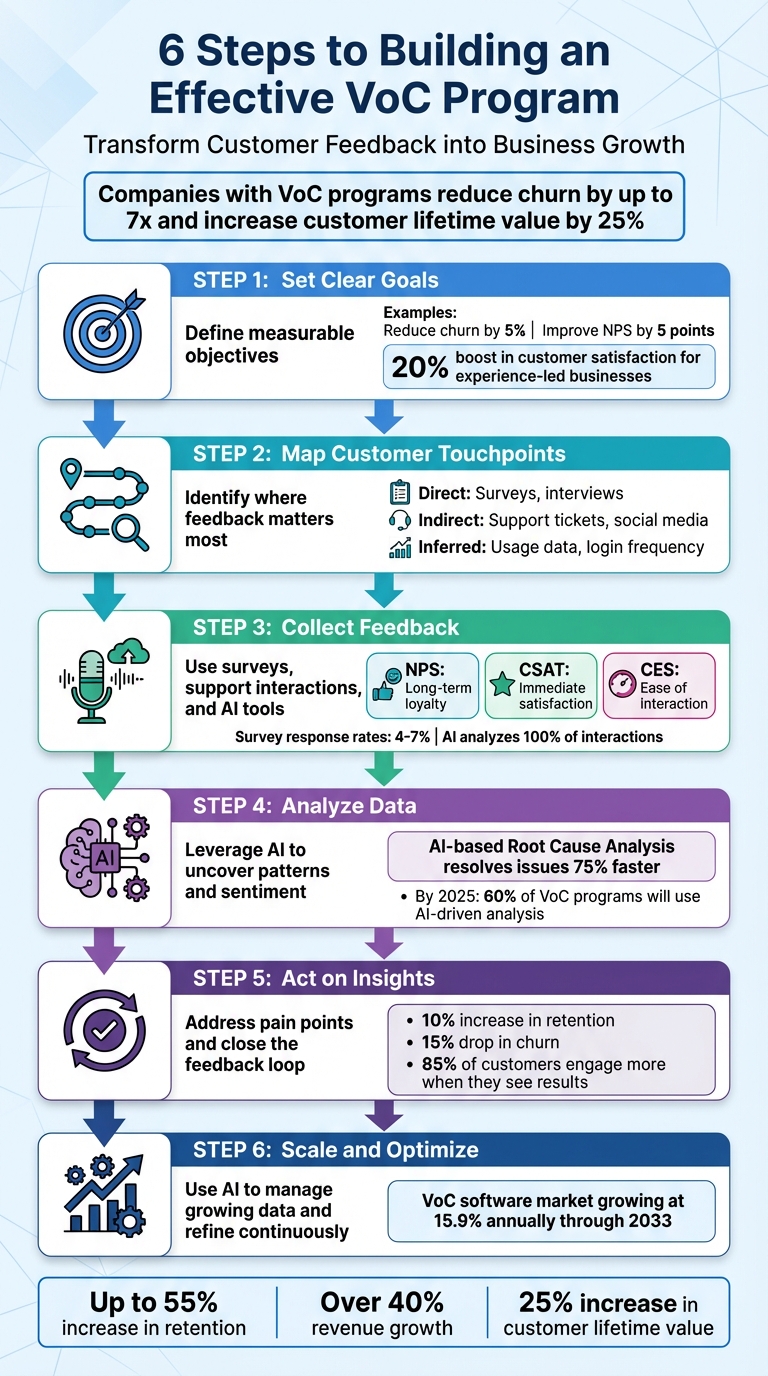
6-Step Voice of Customer Program Implementation Framework
5 Steps To Take Before Creating a Voice of the Customer Program
Step 1: Set VoC Goals and Map Customer Touchpoints
Before diving into feedback collection, it’s critical to define what you want to achieve and where you should be listening. Without clear objectives, you risk gathering a flood of unstructured data with no clear direction. Start by setting your goals and aligning them with business outcomes, then pinpoint the key customer touchpoints where feedback matters most.
Align VoC Goals with Business Objectives
Begin by establishing specific, measurable goals that directly connect to your business priorities. Avoid vague aspirations – focus on concrete targets like reducing churn by 5% in six months, improving first-contact resolution rates by 10% this quarter, or boosting your Net Promoter Score (NPS) by 5 points within a year. Using the SMART framework (Specific, Measurable, Achievable, Relevant, Time-bound) ensures clarity and accountability for these objectives.
Collaboration is key here. A successful VoC program can’t operate in isolation. Bring together leaders from Sales, Marketing, Product, and Customer Success to create objectives that span the entire customer journey. For example, start with a shared company-wide goal, such as "improving overall customer satisfaction by 10%." From there, individual teams can set specific sub-goals tailored to their focus areas. This approach keeps everyone aligned while ensuring each team contributes to the bigger picture.
Companies that adopt this strategy often see impressive results. For instance, experience-led businesses report a 20% boost in customer satisfaction and up to a 30% reduction in service costs. Greyhound is a great example – they implemented a VoC program that acted on survey insights, improving a key loyalty metric by 15 points while driving profitability gains.
Once your goals are in place, the next step is identifying where customer interactions provide the most actionable feedback.
Map Key Customer Touchpoints
Pinpoint when and where to gather feedback throughout the customer lifecycle. Focus on critical stages like onboarding, support interactions, mid-cycle check-ins, and renewal discussions. Each of these moments offers unique insights – onboarding highlights friction in time-to-value, support tickets reveal recurring pain points, and renewal conversations shed light on churn risks or upsell opportunities.
Organize touchpoints into three categories:
- Direct: Surveys, interviews, and advisory boards that capture explicit feedback.
- Indirect: Support tickets, sales calls, and social media interactions that reveal unfiltered sentiment.
- Inferred: Data like feature adoption, login frequency, and usage metrics that provide objective insights.
Modern VoC programs are moving beyond surveys, which often only achieve response rates of 4–7%. Instead, organizations are analyzing 100% of customer interactions using AI. By 2025, 60% of companies with VoC programs are expected to combine traditional surveys with AI-driven analysis of voice and text interactions.
A real-world example: Adobe introduced a three-step VoC framework using Gainsight to automate their onboarding process. They sent automated CSAT surveys after onboarding, but discovered long surveys were discouraging responses. By reducing their questionnaire from six questions to four, they scaled their onboarding process for small business customers while maintaining high satisfaction levels. The takeaway? Trigger surveys based on behavior – like feature activation or usage drop-offs – rather than sending generic mass surveys that lead to fatigue.
| Feedback Category | Examples of Touchpoints | Best Use Case |
|---|---|---|
| Direct | Surveys (NPS/CSAT), Interviews, Beta Tests | Measuring satisfaction and exploring the "why." |
| Indirect | Support Tickets, Sales Calls, Social Media | Capturing unfiltered sentiment and friction. |
| Inferred | Product Usage, Login Frequency, Clicks | Gaining objective insights into user behavior. |
Step 2: Select Feedback Collection Methods
Once you’ve mapped out your customer touchpoints, the next step is deciding how to gather feedback effectively. A well-rounded Voice of the Customer (VoC) program blends active, passive, and AI-driven methods to ensure you’re capturing the full spectrum of customer input.
Active Feedback: Surveys and Direct Input
Active feedback involves directly asking customers for their thoughts, typically through surveys. The most common metrics include:
- Net Promoter Score (NPS): Measures long-term loyalty. Use it periodically or after major milestones.
- Customer Satisfaction Score (CSAT): Tracks satisfaction with specific interactions. Deploy this immediately after support interactions.
- Customer Effort Score (CES): Evaluates how easy it was for customers to get their issue resolved. Trigger this after key tasks or resolutions.
Surveys can be tricky, though. Completion rates often hover between 4–7%, and customers tend to abandon surveys longer than 7–8 minutes. To keep them engaged, keep questions short (aim for an eighth-grade reading level) and limit the number of questions to four or fewer. For example, Slack makes it easy for users to provide feedback directly within their platform, which has helped them maintain a near-perfect CSAT score.
Timing is also crucial. Instead of sticking to fixed schedules, trigger surveys based on customer actions. For instance, send a CSAT survey right after a support ticket is resolved or an NPS survey when a customer activates a key feature. Personalizing the timing and context of your surveys can significantly improve the quality of responses.
Passive Feedback: Analyze Support Interactions
Passive feedback taps into the natural data customers generate during their interactions with your business. This includes support tickets, chat logs, email threads, recorded calls, social media mentions, and online reviews. Unlike surveys, this method doesn’t require customers to take any extra steps, making it a great way to gather insights from those who might not respond to direct inquiries.
The real goldmine here is unstructured text and voice data. Modern AI tools, powered by Natural Language Processing (NLP), can analyze every single customer interaction, not just the few responses collected through surveys. Take Homebridge, for example. They use NLP to turn negative Trustpilot reviews into support tickets, which are then escalated through their agent workflows. This proactive approach, led by Ben Chapman, Director of Client-Facing Experience and Analytics, has helped them address customer dissatisfaction head-on. In fact, 89% of consumers are more likely to stick with a business that responds to all its online reviews.
Combining direct surveys with passive data analysis creates a strong foundation for leveraging AI to further enhance feedback collection.
AI-Driven Feedback Collection
AI takes feedback collection and analysis to the next level. It can automatically score sentiment, detect urgency, identify intent, and route feedback to the right team – no manual effort required. By 2025, it’s expected that 60% of organizations with VoC programs will integrate voice and text analysis alongside traditional surveys.
For example, AI-powered chatbots can gather feedback through conversational interactions instead of rigid forms. Using NLP, these bots engage customers in real time, collecting valuable insights while reducing survey fatigue.
AI also offers predictive insights. Modern VoC platforms can spot early warning signs of churn – like negative sentiment trends or decreased product usage – before customers even voice their concerns. Additionally, businesses that use AI for root cause analysis resolve issues 75% faster than those relying on manual methods.
| Metric | What It Measures | Best Time to Use |
|---|---|---|
| Net Promoter Score (NPS) | Long-term loyalty and advocacy | Periodically or after major milestones |
| Customer Satisfaction (CSAT) | Immediate satisfaction with an interaction | After support tickets or transactions |
| Customer Effort Score (CES) | Ease of interaction and resolution | After task completion or support resolution |
Step 3: Analyze Feedback and Share Insights
Collecting feedback is just the beginning – it’s what you do with that data that truly matters. By turning raw feedback into actionable insights, you can make decisions that drive real change. Modern AI tools make this process faster, more efficient, and far more precise than manual methods ever could.
Use AI for Feedback Analysis
AI tools go beyond simple sentiment analysis. Natural Language Processing (NLP), for instance, can automatically uncover patterns and trends in feedback, even when you don’t know what to look for. This means AI can reveal issues you might have otherwise overlooked.
Advanced models can also detect emotions and urgency in feedback, helping support teams prioritize critical issues immediately. Through entity recognition, AI links unstructured feedback – like survey responses or social media comments – to specific products, features, or locations. This makes it easier to identify areas that need improvement.
A great example of this in action is eBay’s transformation of their Voice of Customer (VoC) process. By using AI-driven analysis, they reduced categorization time from weeks to real-time. Angela Yanes, eBay’s Director of Operations, shared how they processed multilingual feedback (including Chinese, Russian, and German) and automated Jira ticket creation for engineering teams. What once took months now happens in real time, saving countless hours of manual work.
"You set this aspiration of ‘let’s make a delightful experience,’ and you have to ask the question, ‘well, for who, and what would they find delightful?’" – Angela Yanes, Director of Operations, eBay
AI also excels with predictive analytics, using historical data to forecast customer behavior. Whether it’s identifying churn risks or spotting potential reputational issues, these tools can help address problems before they escalate. Companies using AI-based Root Cause Analysis (RCA) resolve recurring issues 75% faster than those relying solely on manual processes. The key is integrating these insights directly into your systems to enable immediate action.
Share Insights Across Teams
Once you’ve refined your insights, it’s crucial to ensure they lead to action. Insights locked away in spreadsheets or reports don’t help anyone. Start by centralizing your data into a single, unified platform that combines feedback from surveys, support tickets, social media, and call transcripts. This prevents teams from working with incomplete or conflicting information.
Tailor dashboards for different teams. Executives can track high-level trends and revenue impact, product managers can focus on feature requests and bug reports, and frontline agents can monitor real-time sentiment alerts. For example, Adobe revamped its onboarding process in 2024 by using Gainsight’s framework. They equipped executives with dashboards showing CSAT scores in real time. Low scores triggered automated workflows, enabling teams to re-engage customers before they churned.
To prove the value of your VoC program, tie feedback metrics like NPS or CES directly to business outcomes. For instance, Harbor Path, a nonprofit in healthcare, used VoC analysis to identify a growing need for Naloxone in a specific state. By presenting this data to donors and state officials, they secured immediate funding to provide life-saving medication.
Make sure these insights are embedded into the tools teams already use. Set up Slack alerts for spikes in negative sentiment, sync feedback into your CRM for account reviews, or route feature requests directly into your product backlog in Jira. This integration ensures that insights don’t just sit in reports – they lead to real action.
| AI Technique | Function | Value |
|---|---|---|
| Thematic Analysis | Identifies recurring patterns | Highlights emerging priorities early |
| Sentiment Analysis | Detects emotional tone in real-time | Flags detractors for immediate follow-up |
| Entity Recognition | Links feedback to specific products/features | Pinpoints exact sources of dissatisfaction |
| Predictive Analytics | Forecasts churn based on historical data | Enables proactive retention for key accounts |
sbb-itb-e60d259
Step 4: Act on Insights and Close the Feedback Loop
Gathering feedback is only the first step – what truly matters is turning those insights into action. Customers want to see that their input leads to real, measurable changes.
Prioritize and Address Pain Points
Not every piece of feedback carries the same weight. Start by ranking issues based on factors like the number of customers affected, potential business risks, revenue impact, and how easily the problem can be resolved. Once you’ve identified the most pressing concerns, assign ownership using a RACI model. This ensures everyone involved – whether it’s Product, Support, or Engineering – knows their role in addressing the issue. Without clear accountability, feedback often gets lost in the shuffle.
Translate these priorities into concrete actions. For example, if customers find your onboarding process confusing, update the process and provide additional training for your team. Greyhound offers a great example of success: by using a structured Voice of the Customer (VoC) program and acting on survey results, they boosted a key customer loyalty metric by 15 points and achieved noticeable profitability gains.
Leverage tools like AI-powered Root Cause Analysis to tackle recurring problems. This approach can resolve issues 75% faster than traditional methods, allowing you to address root causes instead of just patching symptoms.
Once changes are implemented, track their effectiveness to ensure they’re making a difference.
Measure the Impact of VoC Actions
Using AI insights can help validate the effectiveness of your VoC efforts. Monitor key performance indicators (KPIs) like First Contact Resolution (FCR), Customer Effort Score (CES), CSAT, and Churn Rate to determine whether your actions are delivering results. Companies that act on customer feedback often see a 10% increase in customer retention and a 15% drop in churn. AI-driven VoC programs, in particular, can reduce churn by 5–7x and increase customer lifetime value by 25%. Businesses with strong feedback management processes also report being 21% more profitable.
Tie these metrics directly to business outcomes. For instance, if you’ve addressed complaints about slow response times, track improvements in FCR and analyze shifts in customer sentiment from negative to positive.
| Metric | What It Measures | Impact of VoC Action |
|---|---|---|
| First Contact Resolution (FCR) | Efficiency in resolving issues on the first try | Boosts satisfaction and lowers operational costs |
| Customer Effort Score (CES) | Ease of resolving issues | Indicates likelihood of repeat business and loyalty |
| Sentiment Score | Emotional tone of feedback | Identifies negative emotions for faster resolution |
| Churn Rate | Customer attrition | Validates whether improvements are reducing customer loss |
Maintain Continuous Improvement
Building on your prioritized actions and measurable results, keep refining your VoC program. Treat it as an ongoing process rather than a one-time initiative. The most successful programs use continuous feedback loops to adapt as customer needs evolve. Assign roles like "insights stewards" to regularly audit AI-generated feedback and ensure accuracy.
Communicate changes to customers directly with messages like, "You told us, so we did." When customers see their feedback leading to real improvements, they’re more likely to stay engaged. In fact, 85% of customers are more inclined to provide feedback if they know it results in action. Consider publishing a monthly update to highlight these improvements and show how customer input drives change.
For negative feedback, take a personal approach. Follow up with the customer, explain the changes made, and consider offering a goodwill gesture like a discount or gift. This can go a long way in preventing churn. Statistics back this up: 74% of shoppers are willing to forgive a mistake if they receive excellent service, and 89% are more likely to make another purchase after a positive support experience.
Finally, integrate VoC data into your CRM to streamline follow-ups and maintain a unified system across departments. Automated workflows can ensure high-priority issues are flagged and routed to the right team – whether it’s Product, Engineering, or Support – without delay.
Step 5: Monitor, Scale, and Optimize Your VoC Program
A Voice of the Customer (VoC) program isn’t a one-and-done project. As your customer base grows and their expectations shift, your program needs to evolve – without ballooning costs or requiring extra data science resources. The secret lies in building monitoring into your workflow from the start and using AI-powered tools to handle the complexity as you expand. This approach allows you to scale and fine-tune your VoC program effectively.
Scale VoC with AI-Powered Tools
Traditional VoC programs often hit a wall when it comes to scaling. Manual tagging and disconnected feedback channels slow down insights and drive up costs. AI-powered platforms change the game by analyzing all customer interactions – not just the small percentage of users who respond to surveys. This means every support ticket, chat, email, and call becomes a treasure trove of data for understanding customer needs.
Take Gousto, a meal kit company, as an example. They consolidated feedback from nine different channels, including AWS voice calls and live chat, into one platform. This integration reduced the time it took to gain insights from days to mere minutes, giving their product and operations teams access to real-time data. Similarly, Butternut Box, a fresh dog food brand, used AI-driven tagging to simplify over 200 manual tags into actionable categories linked to Net Promoter Score (NPS) outcomes. They identified key drivers like "value for money" and "delivery speed", which provided a clearer picture of customer satisfaction.
When scaling, focus on tools that don’t demand heavy IT involvement. AI-native platforms like Supportbench offer plug-and-play omnichannel insights, cutting down on the costs associated with manual data handling. Start with impactful channels – such as post-support surveys or online reviews – before expanding to more complex, omnichannel setups. Automate workflows to route feedback to the right teams, whether it’s product issues to developers or churn risks to account managers.
To keep your program running smoothly, set operational Service Level Objectives (SLOs). For example, aim to triage 90% of feedback within 24 hours and assign ownership within 72 hours. Track your "closed-loop rate" – the percentage of customers who receive a follow-up after providing feedback – to ensure your program delivers meaningful results, not just data.
Refine the Program with AI-Driven Insights
Once you’ve scaled your VoC program, the next step is to refine it using advanced AI insights. AI doesn’t just help you grow; it makes your program smarter over time. Unlike traditional keyword-based methods, AI employs unsupervised learning to uncover new patterns and trends without manual input. This allows you to address issues before they escalate.
Lakrids by Bülow, a premium confectionery brand, used AI-driven topic detection to pinpoint recurring customer pain points. By addressing packaging-related concerns, they cut complaints by 26% and boosted their Customer Satisfaction (CSAT) score by 9 points. Similarly, Verizon leveraged Generative AI to predict the reasons behind 80% of incoming calls, improving call routing and reducing churn for over 100,000 customers.
Set up real-time alerts for shifts in sentiment or spikes in feedback volume, and use predictive churn modeling to identify risks early – whether it’s declining product usage or negative sentiment. Tie VoC metrics like NPS, CSAT, and Customer Effort Score directly to business outcomes such as retention and revenue. Companies that act on customer feedback have reported a 10% boost in retention and a 15% drop in churn.
"AI-native VoC platforms offer a proactive, continuous view of customer sentiment – making feedback a strategic asset, not a retrospective report." – Stephen Christou, Marketing Director, SentiSum
To maintain accuracy, assign an "insights steward" to validate AI-generated tags and keep false positives below 10%. Share a monthly "What We Changed" update to show customers how their feedback is driving improvements. This transparency encourages engagement – 85% of customers are more likely to provide feedback when they see it leads to action. By refining your program continuously, you ensure it remains a powerful tool for improving customer support operations.
Conclusion: Building a VoC Program That Drives B2B Success
A Voice of the Customer (VoC) program can turn every customer interaction into actionable insights that help reduce costs and improve retention. By integrating AI-powered platforms, your VoC program shifts from being a reactive tool to a proactive driver of efficiency and customer loyalty. The five steps outlined – setting strategic goals, selecting effective collection methods, analyzing feedback with AI, acting on insights, and refining the program – provide a clear roadmap for success. When executed well, these steps transform a VoC initiative into a powerful revenue-generating tool.
AI has reshaped how VoC programs operate. Traditional surveys often miss the bigger picture by capturing feedback from only a fraction of customers. AI-powered platforms, on the other hand, analyze all customer interactions – support tickets, chats, emails, and calls – eliminating manual bottlenecks. For instance, companies using AI for root cause analysis resolve issues 75% faster and reduce churn rates by 5–7 times compared to manual methods. Automated multilingual processing and ticket generation have also enabled leading organizations to categorize feedback in real time instead of waiting weeks.
The advantages are clear. AI-driven VoC programs can increase customer lifetime value by 25% while reducing operational costs through streamlined data processing. By 2025, 60% of organizations are expected to adopt AI to tap into the value of unstructured customer data. With the VoC software market projected to grow at an annual rate of 15.9% from 2025 to 2033, platforms like Supportbench offer B2B teams a scalable way to gain insights without adding to headcount. These insights provide a roadmap for B2B leaders to achieve strategic success.
Key Takeaways for B2B Leaders
Here are the critical strategies B2B leaders should focus on:
- Prioritize business outcomes over data collection.
Align your VoC goals with measurable KPIs like reducing churn, improving product adoption, or boosting renewal rates. Map the customer journey to identify key moments for collecting feedback – such as onboarding, support escalations, or renewal discussions – and focus your efforts there. AI tools can handle tasks like categorization, sentiment analysis, and routing, freeing your team to focus on solving real problems. - Close the feedback loop and prove ROI.
Transparency builds trust. When customers see their feedback leading to meaningful changes – like fixing a bug, introducing a new feature, or improving processes – they feel valued. By linking VoC metrics such as NPS, CSAT, and Customer Effort Score to revenue and retention, you can transform your VoC program into a strategic asset that enhances operational efficiency.
Organizations that thrive are those that treat customer feedback as a continuous stream of intelligence, not just a backward-looking report.
FAQs
How does AI enhance a Voice of the Customer (VoC) program?
AI brings a new level of efficiency to a Voice of the Customer (VoC) program by automating how businesses gather, analyze, and interpret customer feedback. This makes understanding customer needs and emotions faster and more precise. With tools like natural language processing (NLP), AI can sift through unstructured data from sources like surveys, support tickets, social media posts, and reviews. It identifies patterns, recurring issues, and customer sentiment – without requiring extensive manual work.
What’s more, AI provides real-time insights and predictive analytics, enabling support teams to tackle potential problems before they grow. It can categorize feedback by behavior, demographics, or sentiment, making it easier to craft personalized responses and offer proactive support. By pulling feedback from multiple channels and analyzing it as a whole, AI empowers businesses to make smarter decisions based on data. This not only boosts operational efficiency and cuts costs but also strengthens customer satisfaction and loyalty – key ingredients for success in today’s AI-powered support landscape.
What are the most effective ways to gather customer feedback for a VoC program?
To effectively gather customer feedback in a Voice of the Customer (VoC) program, it’s essential to use multiple methods across various channels. Some popular options include surveys (conducted before or after a purchase), customer reviews, and analyzing support tickets. For more in-depth insights, direct interviews or focus groups can be incredibly useful. Additionally, tools like social media sentiment analysis and in-app feedback capture real-time, unfiltered opinions.
An omnichannel approach is key to covering the entire customer journey. This means collecting both explicit feedback, such as survey responses and reviews, and indirect feedback, like insights from social media or customer support interactions. These indirect sources often reveal hidden concerns or unmet needs. To streamline the process, AI-powered tools can automate data collection and analysis, making it easier for teams to act on findings quickly. By combining these methods, you’ll gain a comprehensive view of customer expectations and experiences.
How does using VoC insights help improve customer retention?
Using Voice of the Customer (VoC) insights can significantly boost customer retention by helping businesses address what their customers truly need, want, and find frustrating. When customers notice that their feedback leads to real improvements, they feel valued – and that sense of being heard often translates into loyalty.
By leveraging VoC data, businesses can fine-tune customer experiences, tackle ongoing issues, and strengthen relationships. This approach not only enhances satisfaction but also builds trust, encouraging customers to stick with your brand rather than turning to competitors.