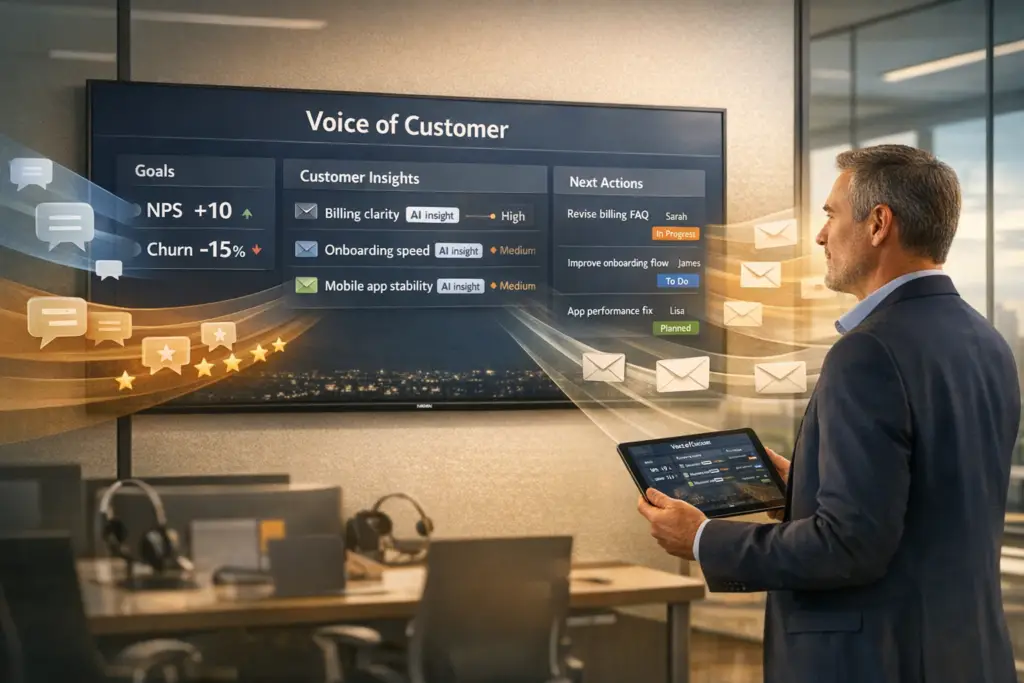
Voice of Customer (VoC) programs often fail because feedback gets stuck in silos, buried in spreadsheets, or disconnected from actionable outcomes. To avoid this, focus on these key steps:
- Set Clear Goals: Tie VoC objectives to business metrics like retention, churn reduction, or revenue growth.
- Centralize Feedback: Collect data across all channels (surveys, tickets, social media) in one system.
- Use AI for Analysis: Leverage AI to process feedback in real-time, prioritize issues, and identify patterns.
- Act on Feedback: Assign ownership, integrate into workflows, and follow up with customers to show changes made.
Companies that take action on VoC insights see up to a 10% boost in retention and 21% higher profitability. By centralizing data, automating analysis, and closing the feedback loop, you can transform your VoC program into a powerful driver of business results.
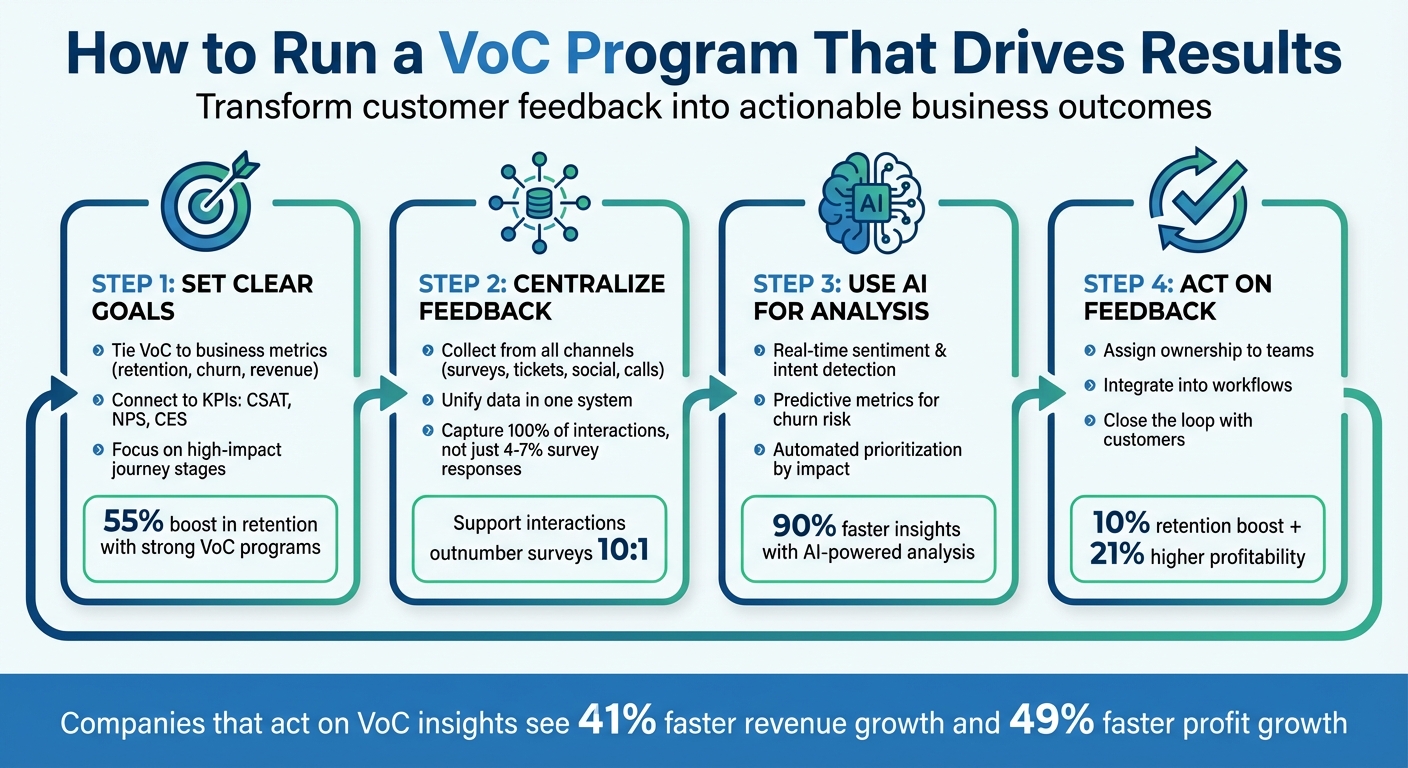
4-Step Framework for Running an Effective Voice of Customer Program
How to Run a VOICE of CUSTOMER (VoC) Program
sbb-itb-e60d259
Set Clear Goals for Your Voice of Customer Program
Before diving into surveys or feedback collection, ask yourself: what problem are you trying to solve? Without a clear objective tied to key outcomes, your Voice of Customer (VoC) data risks becoming just noise – lots of responses but no actionable direction.
The secret to success lies in alignment. Your VoC goals should directly tie to metrics your leadership team already values, like retention rates, churn reduction, renewal percentages, or support costs. Take Adobe, for example. When they revamped their onboarding process with VoC insights, they didn’t just aim to "improve customer satisfaction." They reduced survey questions from six to four and introduced automated playbooks to re-engage customers with low CSAT scores. This approach provided real-time insights and even justified automating processes for small business customers.
And the results? Strong VoC programs can boost retention by up to 55%, while customer-focused companies report 41% faster revenue growth and 49% faster profit growth compared to their competitors. But achieving these outcomes requires setting measurable goals tied to business priorities – not just vanity metrics that look good in presentations. This foundation ensures your VoC program delivers actionable insights.
Connect VoC Goals to Business Results
To make your VoC program effective, link its goals to your business’s existing KPIs. For instance, if your focus is on operational efficiency, track how feedback impacts repeat tickets or improves First Contact Resolution (FCR). If your aim is customer growth, align your objectives with metrics like Monthly Recurring Revenue (MRR) or renewal rates.
Here’s the impact of getting it right: managing feedback well can reduce churn by 15% and increase retention by 10%. These aren’t just abstract numbers – they translate into real revenue. For example, improving customer retention by just 5% can boost profits by 25% to 95%. That’s the kind of result that gets executive approval and secures budgets.
To prove ROI, focus on metrics that matter. For B2B support teams, this often includes:
- Customer Satisfaction (CSAT): Measures service quality and helps lower support costs.
- Customer Effort Score (CES): Highlights friction points leading to churn.
- Net Promoter Score (NPS): Predicts renewal likelihood and referral potential.
Each metric should connect back to a specific business goal. For instance, improving CSAT can lower ticket recurrence, CES can enhance product usability, and NPS can drive loyalty and advocacy.
| B2B Support Metric | Business Priority Alignment | Impact on Outcomes |
|---|---|---|
| CSAT (Post-Interaction) | Service Quality & Efficiency | Reduces ticket recurrence and costs |
| NPS (Relational) | Brand Loyalty & Advocacy | Predicts renewals and referrals |
| CES (Customer Effort) | Product Usability | Identifies friction points that lead to churn |
| Time-to-Value | Onboarding Success | Ensures early retention and faster expansion |
| Churn Rate | Revenue Stability | Directly affects growth and profitability |
Keep an eye on how these metrics interconnect. For example, if NPS is rising but renewals aren’t, it signals a disconnect. Use VoC data to bridge the gap between customer sentiment and revenue performance.
Target High-Impact Customer Journey Stages
Once you’ve aligned your VoC goals with business outcomes, focus on gathering feedback where it counts the most. Not all feedback is equally valuable. A complaint during onboarding is far more critical than a feature request from a long-term, loyal customer. To cut through the noise, zero in on the stages that have the greatest impact: onboarding, support interactions, mid-cycle adoption, and renewals.
- Onboarding: This is where you measure time-to-value and ensure customers experience early success. Struggles here often lead to early churn.
- Support Interactions: These highlight service quality issues that can cause frustration and repeat tickets.
- Mid-Cycle Adoption: Feedback here uncovers gaps in training or feature understanding that might prevent customers from seeing full value.
- Renewals: This is your last opportunity to identify and address churn risks.
For example, Harbor Path, a healthcare nonprofit, analyzed thousands of patient applications and found a growing need for Naloxone. By presenting this specific VoC data to state donors, they secured immediate funding to distribute the life-saving medication.
This case shows the power of acting on feedback at the right moment. Instead of waiting for annual surveys, they captured insights when it mattered most.
To make feedback actionable, use behavior-based triggers rather than mass surveys. For instance, send a CSAT survey after a support ticket closes, trigger an NPS survey 90 days before renewal, or request feedback when a customer activates a new feature. This approach keeps response rates high and ensures feedback is relevant to the customer’s experience.
Don’t forget to segment your feedback by persona. Executives care about ROI and strategy, while end users focus on usability and efficiency. A one-size-fits-all survey will only give you generic responses that don’t lead to meaningful action.
Collect Feedback Efficiently Across Channels
Many Voice of Customer (VoC) programs stumble because they depend on manual data entry across disconnected systems. Feedback often gets stuck in emails, surveys, tickets, and social media, forcing teams to spend more time on data entry than meaningful analysis. With traditional survey response rates averaging just 4% to 7%, decisions are often based on a small, skewed sample. To address this, a unified, real-time approach is critical.
The solution? Collect feedback from every customer channel and centralize it automatically. Modern B2B support teams are shifting to what some call "VoC 2.0", which involves analyzing 100% of customer interactions in real time. This includes everything from support calls and chat logs to social media activity and product usage patterns. By doing so, teams can uncover the real reasons behind customer behavior – not just a numerical score.
Capture Feedback at Key Touchpoints
Support interactions are a goldmine for VoC data. Support calls, chats, and emails often outnumber survey responses by as much as 10:1. These interactions reveal friction points, product bugs, and feature requests without needing to ask customers directly.
To get started, map out your customer journey and identify the moments where feedback naturally occurs. For B2B support teams, these moments typically include post-ticket resolution, after onboarding milestones, during product adoption phases, and before renewal cycles. Event-triggered surveys at these key points – like after resolving a ticket or when a customer uses a new feature – can provide valuable insights.
But surveys aren’t the only way to gather feedback. Many companies are now using voice and text analysis of support call transcripts, chat logs, and social media mentions to capture unfiltered customer sentiment. AI voice agents can transcribe calls, analyze sentiment, and flag high-priority issues directly in your ticketing system – cutting triage times from days to just hours.
Take Homebridge as an example – they integrated customer reviews directly into their support workflows, allowing for proactive outreach. Similarly, Slack made feedback collection seamless by incorporating a feedback command directly into their platform. Users could report bugs or issues in-app, automatically generating tickets for engineers and product managers. This eliminated the need for separate survey tools and helped maintain a high CSAT, CES, and NPS scores.
"We just ask our customers to tell us what their problem is, and then we’ve learned to interpret that."
- Lindsay Schaur, Director of Customer Experience Operations, Slack
Centralizing these diverse data points is key to unlocking the full potential of your VoC program.
Use Centralized Tools for Feedback Collection
Fragmented data across multiple tools leads to inefficiencies. When it’s time to analyze trends, teams often end up manually exporting and merging data into spreadsheets – only for the information to become outdated almost immediately.
AI-native platforms solve this issue by bringing together feedback from multiple sources – email, SMS, WhatsApp, in-app surveys, social media, and support tickets – into a single, unified format. Instead of manually tagging themes or analyzing sentiment, automated Natural Language Processing (NLP) can process thousands of interactions in real time. This allows teams to evaluate all customer conversations, not just the small percentage that responds to surveys.
When choosing centralized tools, look for platforms that integrate seamlessly with your existing CRM and helpdesk systems. This ensures that feedback triggers automated workflows rather than sitting idle in a dashboard. For instance, if a high-value account submits negative feedback, the system can automatically create a ticket, assign it to the appropriate account manager, and flag it for executive review.
Use AI to Analyze and Prioritize Feedback
Centralizing feedback is just the start – AI takes it a step further by turning that mountain of raw data into clear, actionable insights. Instead of relying on manual tagging, which often results in spreadsheets full of unused information, AI processes every interaction automatically. This eliminates the guesswork and ensures valuable data doesn’t get buried.
AI tools, powered by Natural Language Processing (NLP), can interpret customer feedback regardless of whether it’s a feature request, a bug report, or filled with industry-specific jargon. Beyond basic sentiment analysis, emotional AI can detect emotions like frustration or urgency, helping teams prioritize critical issues. For example, in 2024, Lakrids by Bülow, a premium confectionery brand, used AI to identify recurring customer pain points, cutting related complaints by 26% and improving its CSAT score by 9 points.
With AI-powered conversation analytics, businesses can gain insights up to 90% faster than traditional methods. Real-time alerts flag sentiment shifts or spikes in complaints, enabling swift action. Companies adopting AI for feedback analysis often see CSAT scores rise by 30–50% and resolve issues 75% faster, thanks to automated root cause analysis.
Automate Sentiment and Intent Detection
AI doesn’t just analyze what customers are saying – it helps uncover why they’re saying it and how urgent their concerns are. Sentiment analysis goes beyond labeling feedback as positive or negative. It identifies emotional states and intent, such as whether a customer is considering canceling, is open to an upsell, or is making a feature request.
Take Motel Rocks, an online fashion retailer, as an example. In 2024, they implemented AI-driven sentiment analysis to better understand customer intent. The result? A 9.44% increase in CSAT and a 50% reduction in support tickets. The system automatically routed negative feedback to the right team members, equipping agents with context before they even opened a case.
AI also uses unsupervised learning to identify patterns in feedback, even as customer language evolves with new products and market changes. For instance, Butternut Box, a dog food subscription service, replaced over 200 manual tags with actionable AI-driven categories tied to NPS. This helped them zero in on key drivers like "value for money" and "delivery speed" without the need for tedious manual sorting.
When selecting AI tools for sentiment and intent detection, it’s essential to choose platforms that support domain-specific training. Generic models often struggle with industry jargon or company-specific terms. However, with proper tuning, AI models can achieve up to 90% accuracy in sentiment analysis and 85% precision in categorization.
Once sentiment and intent are identified, predictive metrics can take over to guide decision-making.
Apply Predictive Metrics to Guide Decisions
AI-powered Voice of the Customer (VoC) programs do more than just listen – they predict future outcomes. By monitoring signals like declining usage, negative sentiment, or rising ticket volumes, AI can forecast churn risks and revenue threats before they’re reflected in traditional surveys. This shifts VoC from a reactive process to a proactive one.
For example, platforms like Supportbench use AI to predict metrics like CSAT, CES, and FCR based on interaction patterns – even for customers who don’t fill out surveys. This allows businesses to assess customer sentiment across all interactions, not just the ones captured in surveys.
"AI transforms VoC programs from reactive listening to proactive intelligence… uncovering patterns and customer insights that humans would miss." – Swati Sharma, Zonka Feedback
Verizon offers a compelling example of this in action. Their GenAI system predicts the reasons behind 80% of incoming calls, improving routing and reducing churn for over 100,000 customers. By analyzing conversation patterns and behavioral data, the AI flags at-risk accounts and initiates workflows, such as alerting a Customer Success Manager when a high-value client shows dissatisfaction.
AI also helps prioritize feedback by ranking themes based on four key factors: severity, volume, urgency, and revenue impact. This ensures that high-impact issues – like complaints from major enterprise clients – are addressed immediately, while less critical suggestions can be reviewed later.
The results speak for themselves. AI-driven VoC programs can reduce customer churn by 5–7x and increase customer lifetime value by 25%. Companies leveraging predictive intelligence report 41% faster revenue growth and 49% faster profit growth compared to those sticking with traditional feedback methods.
Convert Insights Into Operational Changes
Feedback is only as good as the action it inspires. Without follow-through, even the best insights risk becoming just another forgotten spreadsheet. Companies that actively respond to customer feedback see retention rise by 10%, while those that merely collect data without acting let valuable opportunities slip away. The goal is clear: transform insights into actionable workflows, not just reports.
Prioritize Feedback by Business Impact
Not all feedback carries the same weight. Use a scoring system to prioritize effectively: assign greater importance to impact (3x), followed by prevalence (2x), and then customer lifetime value (CLV) (1x). This ensures that your team addresses the feedback that matters most to revenue and retention, rather than just reacting to the loudest voices.
Keep weekly actions focused on the top six high-impact items. This approach minimizes distractions and keeps teams from getting overwhelmed by endless backlogs. For instance, if enterprise clients highlight slow response times while individual users request minor UI updates, prioritize the enterprise issue – it has a bigger effect on your bottom line.
Set clear service-level agreements (SLAs) to maintain momentum: acknowledge feedback within 24 hours, assign tasks within 72 hours, and follow up within 10 business days. These timelines create accountability and ensure insights don’t get lost in the shuffle.
Assign Ownership and Build Into Workflows
Feedback without a clear owner is just noise. Assign specific teams to handle different types of feedback: the Product team for roadmap suggestions, Customer Success for relationship-building, and Support for technical concerns. This eliminates gaps in responsibility.
Integrate feedback into your existing tools, like CRM, engineering, and support systems, to ensure it’s acted on quickly. A great example comes from 2025, when Jackson Hewitt centralized responses to Google reviews from over 5,200 locations into a single dashboard. By leveraging AI and pre-approved templates, they reduced average case-handling time by 80% while maintaining a consistent brand voice. Automation played a key role – negative reviews were automatically converted into support tickets with assigned owners and deadlines.
Use role-specific dashboards to deliver relevant insights to the right people. For instance, product managers could receive weekly summaries of recurring issues, while contact center agents might see sentiment trends before starting their shifts. This approach ensures feedback becomes part of daily workflows rather than an afterthought during quarterly reviews.
Adopt a two-tiered system to close the loop: resolve individual complaints quickly while addressing broader, systemic issues. This way, you’re not just putting out fires – you’re preventing them. Be sure to confirm changes with customers to complete the feedback cycle.
Follow Up With Customers on Changes Made
Once feedback is addressed, let customers know. Surprisingly, only 5% of companies follow up directly with customers after receiving their input. Yet, 72% of customers feel more positively about brands that not only solicit feedback but act on it. Following up isn’t just polite – it’s a powerful retention strategy.
Use messaging like "You asked, we delivered" across multiple platforms, such as in-app notifications, emails, or community forums. In 2025, Slack introduced a feedback command within its platform, allowing users to report bugs or suggest features without leaving the app. This streamlined process automatically generated tickets for engineers and designers, enabling rapid fixes and keeping their CSAT score near 100%.
For detractors or high-value accounts, establish strict timelines for direct outreach – respond within 24–48 hours. Research shows that 70% of dissatisfied customers will stay if their issues are resolved, and that number jumps to 96% with prompt resolutions. A simple, two-sentence reply acknowledging the feedback, explaining the change, and inviting further input can turn unhappy customers into loyal advocates.
Consider publishing a monthly "What we changed because of you" bulletin highlighting three visible improvements driven by customer feedback. This demonstrates that your company is listening and fosters transparency. When customers see their input lead to real changes, they’re 85% more likely to provide feedback again, creating a positive feedback loop that keeps your program thriving.
Conclusion: Build a VoC Program That Delivers Results
A Voice of Customer (VoC) program only works when it sparks real change, not when it’s stuck in a cycle of unused data. To make it impactful, focus on four key elements: setting clear objectives tied to business goals, centralizing feedback collection, leveraging AI for analysis, and ensuring consistent action.
Well-executed VoC programs can increase retention by as much as 55% when feedback aligns with financial goals. For example, Apollo.io streamlined its VoC data and pinpointed the top four drivers of customer inquiries. By addressing these issues, they cut inquiries by 40% and achieved 9x growth in their business.
Once you’ve locked in your goals, the next step is to integrate your feedback channels. Consolidate data from surveys, support tickets, social media, and call logs into a single platform. Traditional surveys capture only 4–7% of customer feedback, but AI tools can analyze every interaction. This shift keeps your VoC program manageable and actionable.
"Design your VoC program as a scalable platform that serves the entire organization, rather than a bottleneck or a function limited to one department."
- Michael Nguyen, Head of Voice of Customer, Figma
A scalable platform ensures your VoC program stays flexible and impactful. The final step? Closing the feedback loop. Greyhound used customer insights to improve a loyalty metric by 15 points, which also boosted profitability. Following up with customers to show how their feedback drives change builds trust and encourages them to keep sharing. This turns your VoC program into a tool for driving measurable results rather than just collecting data.
FAQs
How can AI make a Voice of Customer program more effective?
AI can supercharge a Voice of Customer (VoC) program by transforming massive amounts of feedback into practical insights – fast and with precision. Using tools like sentiment analysis and pattern detection, AI helps pinpoint customer frustrations, spot emerging trends, and flag potential risks in real time. This means teams can tackle issues head-on instead of waiting for the next survey cycle.
Another advantage? AI streamlines data collection and analysis across multiple channels – think surveys, support calls, and chat logs. It can even process unstructured data, like open-ended survey responses or call transcripts, to paint a fuller picture of customer needs. This prevents valuable feedback from vanishing into a "spreadsheet graveyard" and ensures it drives real improvements in satisfaction, loyalty, and efficiency.
How can I effectively gather and centralize customer feedback from multiple channels?
To gather and centralize customer feedback effectively, start by setting up a system that pulls data from all your communication channels. This includes surveys, support calls, social media, emails, and chat interactions. Using AI-powered tools can simplify this process by collecting feedback in real-time while adapting to the customer’s preferred language and tone. Features like conversational surveys and automation can make the experience feel more natural for users.
Bringing all this information into one centralized platform creates a dependable "source of truth" for your team. With AI-driven analytics, such as sentiment analysis and workflow automation, you can spot trends, address pressing issues, and act quickly. By integrating feedback across departments and automating follow-ups, you can turn scattered data into clear, actionable insights that enhance both the customer journey and your internal processes.
How can I make sure my Voice of Customer program leads to real improvements?
To make your Voice of Customer (VoC) program truly effective, focus on three key steps: gathering meaningful feedback, analyzing it thoroughly, and taking decisive action. Start by collecting input from a variety of sources, including surveys, support interactions, and real-time conversations. Make sure the feedback you gather reflects your customers’ context and preferences to ensure it’s relevant and actionable.
Leverage AI-powered tools to process and analyze the data quickly and accurately. Tools like sentiment analysis and trend detection can highlight major pain points and help you prioritize what matters most to your customers. Once you have these insights, set up workflows to share them with the right teams and automate follow-ups to ensure timely responses.
Lastly, implement a closed-loop feedback process. This means acknowledging customer input, making the necessary changes, and keeping your customers informed about the improvements you’ve made. This cycle not only builds trust but also strengthens loyalty, ensuring your VoC program delivers tangible results.