Quick answer: The best ServiceNow alternatives for B2B customer support teams in 2026 are Supportbench (best overall for account-based B2B support), Zendesk (broadest ecosystem), Freshdesk (best entry price), Salesforce Service Cloud (best if you live in Salesforce CRM), Jira Service Management (best for dev-adjacent teams), Zoho Desk (best value inside the Zoho suite), Pylon (modern Slack-first entrant), and Freshservice (best if what you actually need is lighter ITSM). Which one is right depends on a question most roundups skip: are you replacing ServiceNow for IT service management, or for customer support? They are different problems with different winners.
After a decade in this market, we’ve watched the same pattern repeat: a company adopts ServiceNow for IT, customer support gets folded into it, and two years later the support team is running B2B accounts through incident-management machinery. You can see queues, but not accounts. Every workflow change goes through an admin. The renewal quote keeps climbing. This guide ranks the best ServiceNow alternatives for that team — with honest assessments of where each one wins and where it falls short, including our own platform.
First, Decide Which ServiceNow You’re Replacing
Most “ServiceNow alternatives” lists assume you’re an IT team shopping for ITSM — CMDB, change management, ITIL workflows. If that’s you, the honest answer is that Freshservice, Jira Service Management, or SysAid will serve you well, and you can stop reading here.
But a large share of teams searching for ServiceNow alternatives are customer support teams — usually B2B — who inherited the platform because IT already owned it. For them, the problem isn’t that ServiceNow is a bad ITSM. It’s that B2B customer service runs on accounts, contractual SLAs, and relationships — not incidents. If a $200K/year customer has twelve open cases, an incident queue shows you twelve rows; it doesn’t show you a customer at risk. We’ve written more about that distinction in ServiceNow vs Supportbench: do you need ITSM for customer support?
What ServiceNow Actually Costs a Support Team
ServiceNow does not publish pricing — every deal is quote-based, which is itself worth noticing: platforms with transparent pricing don’t make you call sales to learn what you’ll pay at renewal. The sticker license is only the start, which is why any honest comparison of ServiceNow alternatives has to begin with cost structure, not features. The true cost formula looks like this:
TRUE ANNUAL COST OF SERVICENOW FOR SUPPORT
True cost = Licenses + Implementation (yr 1) + Admin overhead + Upgrade cycles
where Admin overhead = dedicated admin FTEs × loaded salary
Worked example — 15-agent B2B support team (illustrative figures; ServiceNow quotes vary widely, which is the point):
- Licenses at a typical mid-market quote of ~$100/agent/month → ~$18,000/year
- Partner-led implementation and configuration, year one → $40,000–$80,000 (ServiceNow deployments are measured in months, not days)
- Half a dedicated platform admin (a common real-world ratio) → ~$55,000/year loaded
- Year-one total: roughly $113,000–$153,000 — before a single integration or the twice-yearly upgrade testing cycles
- A purpose-built B2B support platform typically lands at $40–$80/agent/month all-in, with setup measured in days — for this team, $7,200–$14,400/year and no dedicated admin
That gap isn’t a discount conversation. It’s a structural difference: you’re paying for an enterprise workflow engine your support team uses 10% of.
The 8 Best ServiceNow Alternatives, Honestly Assessed
1. Supportbench — Best for B2B Customer Support Teams

Supportbench is built around the thing ServiceNow structurally lacks for customer support: the account. Cases, emails, chats, health scores, and contractual SLAs all roll up to the customer relationship, so an agent opening any case sees the whole account — history, sentiment trajectory, open commitments — not an isolated incident. Dynamic per-account SLAs, AI-driven routing and escalation, KPI scorecards, and native NPS/CSAT run without a platform admin. Of all the ServiceNow alternatives on this list, it’s the only one designed exclusively for B2B customer support. Deployment is days to weeks, not quarters, and pricing is published — no quote theater.
Where it falls short: Supportbench is not an ITSM — there’s no CMDB, change management, or ITIL certification path, so if IT is keeping ServiceNow for those, you’ll run two systems (which is often the right answer). It’s also a smaller vendor than the giants on this list; you trade brand-name procurement comfort for a platform that does one job extremely well.
2. Zendesk — Broadest Ecosystem and App Marketplace
Zendesk is the default name in customer service software for a reason: mature omnichannel support, a huge app marketplace, and enough ITSM-lite coverage (ticketing, incident tracking, asset visibility) to satisfy teams leaving ServiceNow who don’t need ITIL depth.
Where it falls short: Zendesk is ticket-centric, not account-centric — the same structural gap you’re leaving, in friendlier packaging. And the sticker price is not the real price: AI add-ons, QA, and workforce management stack on per-agent fees fast. We’ve broken down how Zendesk pricing really works, and if you’re comparing the field, see our full guide to Zendesk alternatives.
3. Freshdesk — Best Entry Price for Straightforward Support
Freshdesk (from Freshworks) offers genuinely usable multi-channel support from $19/agent/month, with the Freddy AI assistant available on higher tiers. For a small team leaving ServiceNow purely on cost, it’s the fastest way down.
Where it falls short: the pricing ladder is steep in practice — multiple SLA policies (table stakes for B2B contracts) are gated to the Pro tier at $55/agent/month, and Freddy AI Copilot is another $29/agent on top. A B2B team that evaluates on the $19 Growth tier rarely stays there. Its DNA is high-volume B2C ticketing, not account management. Full comparison: the best Freshdesk alternatives for B2B teams.
4. Salesforce Service Cloud — Best If You Live in Salesforce CRM
If your company runs on Salesforce, Service Cloud puts cases next to opportunities and gives leadership one reporting surface. Einstein AI, omnichannel routing, and enterprise-grade scale are all real.
Where it falls short: you’d be trading one admin-heavy enterprise platform for another — Service Cloud has the same gravitational pull toward dedicated admins, paid add-ons, and consultant-led changes that pushed you off ServiceNow. Budget honestly using our breakdown of how Salesforce Service Cloud pricing works before assuming the CRM bundle makes it cheap.
5. Jira Service Management — Best for Dev-Adjacent Support
For support teams that escalate half their tickets to engineering, Jira Service Management’s native link to Jira Software is a genuine advantage — one backlog, shared visibility, ITIL-compliant workflows when you need them, at a fraction of ServiceNow’s cost.
Where it falls short: customer support is a workflow bolted onto developer tooling. The agent experience, customer portal, and account-level view all show it — B2B support teams tend to outgrow it the moment support stops being a queue and starts being a revenue function. We’ve compared them directly in Supportbench vs Jira Service Management.
6. Zoho Desk — Best Value Inside the Zoho Suite
Zoho Desk delivers an honest amount of help desk — multi-channel, SLA management, the Zia AI assistant — at some of the lowest per-agent prices in the category, and it clicks neatly into Zoho CRM and the rest of the suite.
Where it falls short: the value case weakens outside the Zoho ecosystem, and enterprise B2B mechanics — complex multi-account SLAs, deep escalation logic, account health — are thinner than what mid-market teams end up needing. It’s a strong small-business pick, not usually the landing spot for a team leaving an enterprise platform.
7. Pylon — Modern Slack-First Entrant for B2B
Pylon is the most visible of the new B2B-native support platforms, built for teams whose customers live in shared Slack channels. It gets the core B2B insight right — support is account-based — and moves fast on product.
Where it falls short: it’s a young platform with chat-first DNA. Teams with heavy email volume, formal contractual SLA portfolios, or compliance-driven workflows will find the operational depth still maturing. If you’re evaluating it, our guide to Pylon alternatives for B2B support at scale covers the tradeoffs.
8. Freshservice — Best If You Actually Need ITSM
The honest inclusion: most roundups of ServiceNow alternatives are really ITSM lists in disguise, and if your exit is driven by IT — not customer support — Freshservice gives you asset management, change management, and ITIL workflows with radically simpler administration and published pricing. SysAid and Jira Service Management compete credibly here too.
Where it falls short: it’s an ITSM for employees, not a customer support platform. Routing external B2B customers through it recreates the exact mismatch this article exists to solve.
Comparison: ServiceNow Alternatives at a Glance
| Platform | Best for | Pricing transparency | Biggest tradeoff |
| Supportbench | B2B customer support run on accounts & SLAs | Published, all-inclusive | Not an ITSM (no CMDB/change mgmt) |
| Zendesk | Omnichannel breadth, app ecosystem | Published, add-ons stack | Ticket-centric; real cost ≫ sticker |
| Freshdesk | Small teams, lowest entry price | Published, tier-gated | B2B features force Pro tier |
| Salesforce Service Cloud | Salesforce-native enterprises | Published, complex | Same admin burden you’re leaving |
| Jira Service Management | Dev-adjacent support, ITSM-lite | Published | Support bolted onto dev tooling |
| Zoho Desk | Budget pick inside Zoho suite | Published | Thin enterprise B2B mechanics |
| Pylon | Slack-first B2B startups | Published | Young platform, chat-first DNA |
| Freshservice | Teams that genuinely need ITSM | Published | It’s for employees, not customers |
How to Choose: A 5-Step Evaluation Framework
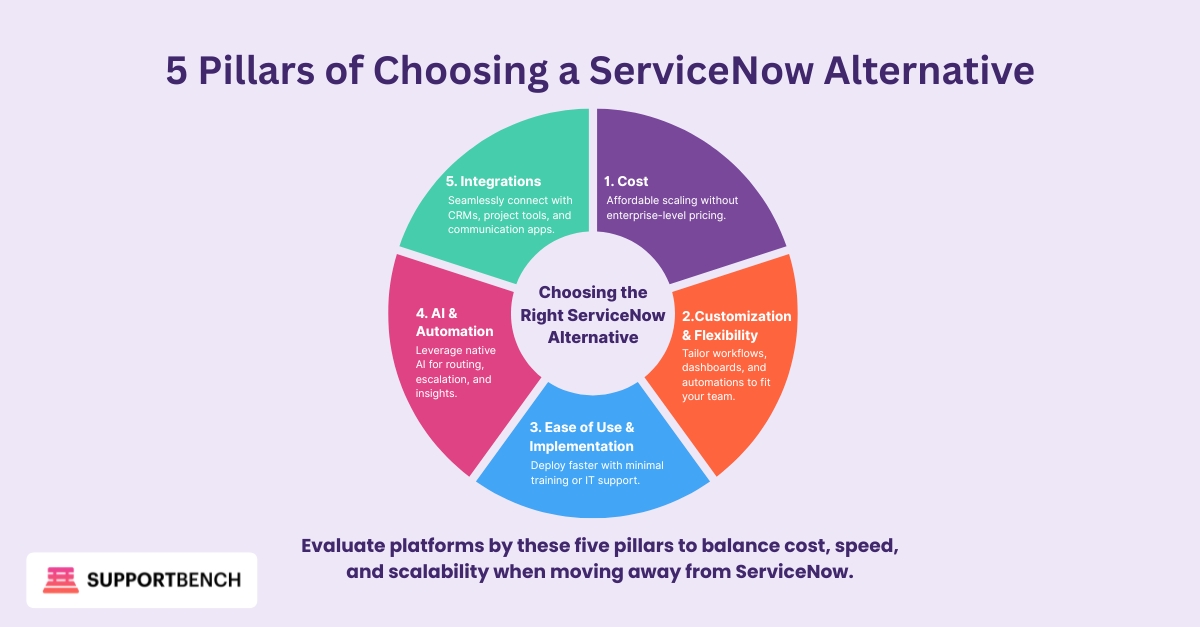
Here’s how to narrow the ServiceNow alternatives above to a shortlist of two:
- Name the job. ITSM replacement, customer support replacement, or both? If both, plan for two right-sized tools — it’s usually cheaper than one wrong-sized platform.
- Price the true cost, not the license. Run the formula above for every finalist: licenses + implementation + admin FTEs + add-ons at the tier you’ll actually need (multiple SLA policies, AI, analytics).
- Demand account-level context in the demo. Ask to see one screen showing a customer’s full history, SLA status, and health. If the answer involves a custom report, that’s your answer.
- Test with your three ugliest real tickets. Not the vendor’s demo data. A multi-contact escalation with an SLA breach and an angry CC’d executive tells you more than any feature grid.
- Plan the migration before you sign. Ticket history, attachments, and account data need a landing plan — our help desk migration guide covers the export/import mechanics platform by platform.
The Bottom Line
If you need ITSM, take Freshservice or Jira Service Management and enjoy the savings. But if you’re a B2B support team that’s been running customer relationships through incident queues, don’t replace ServiceNow with a smaller version of the same mismatch. The best ServiceNow alternatives for B2B support are the ones built on accounts, not incidents. You’ve outgrown your help desk — you don’t need enterprise bloat to prove it. Supportbench gives you the dynamic SLAs, escalation workflows, account-level visibility, and native AI that B2B support actually runs on, at a published price and a setup measured in days.
Don’t take our word for it — see it on your own workflows. Book a demo and bring your ugliest escalation scenario.
Evaluating help desks for a B2B team?
Supportbench is all-inclusive from $32 per agent per month, with migration and onboarding included. See pricing or book a 20-minute demo.