Sentiment analysis helps predict churn by analyzing customer interactions in real time using AI and Natural Language Processing (NLP). It identifies early signs of dissatisfaction, enabling businesses to act before customers leave. Traditional metrics like CSAT and NPS fall short because they only reflect past interactions, while sentiment analysis focuses on future risks. Companies like Fivetran and Qlik have reduced churn by up to 25% using this approach.
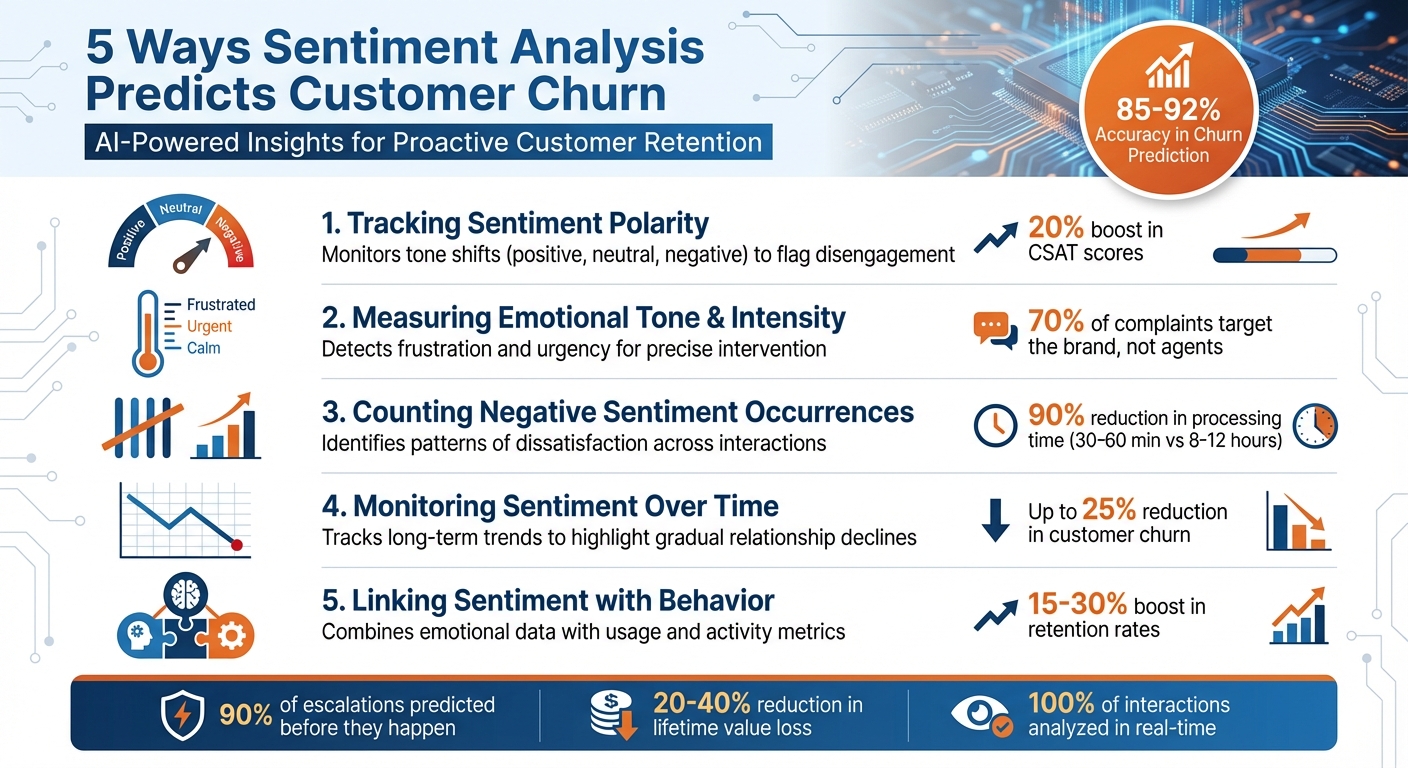
Here are five ways sentiment analysis predicts churn:
- Tracking Sentiment Polarity: Monitors shifts in tone (positive, neutral, negative) to flag disengagement early.
- Measuring Emotional Tone and Intensity: Detects frustration or urgency for more precise intervention.
- Counting Negative Sentiment Occurrences: Identifies patterns of dissatisfaction across interactions.
- Monitoring Sentiment Over Time: Tracks long-term trends to highlight gradual declines in customer relationships.
- Linking Sentiment with Behavior: Combines emotional data with usage and activity metrics for accurate churn prediction.
Sentiment analysis offers 85–92% accuracy in predicting churn when combined with behavioral data, saving time and helping teams act faster. Automated tools like Supportbench integrate these insights into workflows, ensuring businesses can protect key accounts effectively.
5 Ways Sentiment Analysis Predicts Customer Churn
Predict Customer Churn with Oracle AI Data Platform: Demo
1. Tracking Changes in Sentiment Polarity
Sentiment polarity labels every customer message as positive, negative, or neutral – a simple yet powerful way to gauge customer satisfaction. Watching how these labels evolve over time can uncover early warning signs of churn. For instance, if a customer who usually sends neutral or positive messages suddenly begins using negative language, it’s a clear signal that action is needed.
AI tools take this a step further by assigning numerical sentiment scores to each interaction. A steady decline in these scores across multiple touchpoints often indicates quiet disengagement. This is especially critical in B2B settings, where multiple stakeholders within a single account are involved. One frustrated individual might not be alarming, but when discontent spreads across departments, it’s a red flag that demands attention. This kind of nuanced evaluation is crucial for managing complex B2B relationships.
Real-time monitoring transforms these insights into immediate action. Instead of waiting for periodic reviews, AI systems can flag shifts in sentiment as they happen. This allows support managers to step in within minutes, not weeks. For example, Databricks leveraged real-time sentiment tracking in 2022 to achieve a 20% boost in CSAT scores and a 40% drop in SLA misses under the leadership of Tanvir Kherada, Senior Director of Technical Solutions. These real-time alerts empower teams to tackle issues before they snowball into major problems.
When combined with customer history, sentiment analysis becomes even more accurate. By pairing sentiment polarity with behavioral data – like product usage patterns, support ticket trends, and renewal timelines – AI can differentiate between isolated frustrations and recurring issues that signal a genuine risk of churn. Companies using this method often reach 85–92% accuracy in predicting churn.
"By analyzing customer sentiment, support teams, who are on the frontlines each day with customers, can intervene at key moments." – Ryan Radcliff, Director of Product Marketing, SupportLogic
To act on these insights effectively, set up automated workflows. For instance, route tickets showing negative sentiment shifts directly to senior agents or account managers. For high-value accounts, real-time alerts can ensure issues are addressed promptly, preventing escalation.
2. Measuring Emotional Tone and Intensity
Polarity gives you a sense of whether a customer is happy or unhappy, but emotional tone and intensity take it a step further by showing just how strongly they feel. AI systems can pick up on specific emotions like frustration, anger, or urgency, making it easier to identify customers who might be on the verge of disengaging.
Building on polarity data, emotional tone and intensity provide a more nuanced picture of customer sentiment. Platforms often use scales (like –2 to +2) to map out emotional trends, creating a Sentiment Score to reflect the overall mood and an Attention Score to flag urgency. For example, if sentiment starts to decline while the attention score rises, it’s a red flag that the situation might need management involvement to prevent it from escalating further.
"There’s a certain trajectory that most conversations go through. The customer comes in, they’re usually dissatisfied. [Agents can] bring it up to neutral or a slightly satisfied level."
– Seth Levine, Lead Machine Learning Scientist, Loris
Natural Language Processing (NLP) plays a key role here, identifying signs of escalation, mentions of feature gaps, or unresolved issues that indicate growing frustration. Crucially, AI can also determine whether a customer’s anger is directed at the brand or product itself, rather than at a specific support agent. Interestingly, data shows that 70% of customer complaints are aimed at the brand, meaning most negative feedback stems from product or service issues rather than individual interactions.
To act on these insights, companies can set up automated processes. For example, tickets marked with high frustration or anger can be routed directly to senior agents or Tier 2 support. Additionally, alerts can be triggered for Customer Success Managers if an account’s average sentiment score drops by 20% within a month. These measures ensure that important accounts get prompt attention, reducing the risk of frustration leading to churn.
3. Counting Negative Sentiment Occurrences
Tracking how often negative sentiment appears in customer interactions is key to spotting patterns that single incidents might not reveal. This approach helps differentiate between one-off frustrations and growing trends. By monitoring this data, businesses can catch early warning signs like increasing complaints or frequent mentions of competitors – clues that a customer might be on the verge of leaving.
Building on measures like emotional tone and polarity, frequency analysis adds another layer to churn prediction. The real advantage? Scale and precision. AI-powered tools can process every interaction – emails, chats, and call transcripts – in real time. This is a game-changer compared to manual sampling, which often reviews only a small portion of support tickets and can miss critical insights or introduce biases. Advanced AI even picks up subtle differences in phrasing, such as distinguishing between "I’m not happy" and "I’m not unhappy", to provide more accurate predictions.
When you combine repeated instances of negative sentiment with historical customer behavior, the predictive power grows significantly. Pairing this frequency data with metrics like product usage and renewal history creates a unified churn risk score that flags accounts in danger of leaving. This comprehensive view highlights how repeated negative feedback, coupled with declining engagement, can sharply increase the likelihood of churn.
Automation takes these insights to the next level. Instead of combing through dashboards manually, teams can set up real-time alerts through platforms like Slack or CRM systems. These alerts notify teams when high-value accounts show repeated signs of dissatisfaction.
The efficiency gains are striking. AI-driven sentiment tracking can complete in just 30–60 minutes what might take a support team 8–12 hours to do manually – cutting processing time by over 90%. This speed frees up teams to focus less on reacting to problems and more on preventing them.
Platforms like Supportbench integrate these advanced sentiment analysis tools directly into their case management systems. This integration allows support teams to address customer dissatisfaction proactively, reducing churn risk. By combining sentiment data with customer behavior, businesses can achieve even sharper and more actionable churn predictions.
sbb-itb-e60d259
4. Monitoring Sentiment Patterns Over Time
One negative interaction doesn’t paint the whole picture. What really matters is the bigger story – how a customer’s feelings change over time. By observing how sentiment shifts over weeks or months, businesses can uncover gradual declines in relationships that quick surveys like CSAT or NPS might miss entirely. This long-term tracking helps identify patterns and opens the door to combining multiple data signals for deeper insights later on.
The benefits of this approach are hard to ignore. Traditional metrics only capture isolated moments, but tracking sentiment trends reveals subtle warning signs of churn that might otherwise fly under the radar. Companies using AI to monitor these trends often achieve 85–92% accuracy in predicting churn by focusing on patterns instead of one-off data points. When combined with other information – like product usage, renewal timelines, and historical CRM data – these trends generate a churn risk score to highlight customers who may be quietly disengaging.
AI makes scaling this type of analysis possible. Automated platforms can review 100% of interactions across an entire customer base in real time, something manual teams could never achieve. For example, 8×8, a cloud communications provider, uses AI to predict 90% of potential escalations before they happen. The payoff? Businesses using proactive sentiment tracking have seen customer churn drop by as much as 25%.
Modern tools like Supportbench take this even further by embedding sentiment tracking directly into workflows. If a high-value account’s sentiment dips below a set threshold, the system sends automated alerts, prompting executives to intervene or deploy tailored retention strategies via platforms like Slack or Microsoft Teams. This proactive approach ensures teams can address issues early, protecting relationships and revenue before they’re at risk.
5. Linking Sentiment Data with Customer Behavior
Sentiment scores alone provide a glimpse into customer emotions, but their real power emerges when paired with behavioral data. By combining sentiment insights – positive, negative, or neutral – with metrics like product usage, support ticket volume, and account activity, B2B teams can paint a clearer picture of churn risk. This approach helps distinguish between customers who are slowly disengaging and those who are actively dissatisfied, creating a detailed risk profile that captures both actions and emotions.
When sentiment data is integrated with customer behavior, churn prediction accuracy improves significantly. While sentiment analysis alone can predict churn with 85–92% accuracy, adding data like usage patterns and renewal history uncovers risk signals that might otherwise go unnoticed. For example, blending these data points has been shown to reduce churn and resolve escalations more effectively.
"By the time you wait for CSAT to be the deterministic factor to understand what the customer experience was like, it’s too late." – Tanvir Kherada, Senior Director of Technical Solutions, Databricks
Scalability becomes a key advantage with automated scoring tools. Modern platforms can consolidate sentiment data from various sources – emails, calls, chats, and QBR notes – into a single, comprehensive view of account health. If both sentiment and usage metrics decline in a high-value account, the system can immediately escalate the issue to senior agents or executive sponsors for quick action. This automation streamlines prioritization, ensuring that teams focus their resources on accounts most at risk of churning instead of spreading their efforts too thin.
AI-powered sentiment monitoring also slashes the time spent on manual analysis. Tasks that once took 8–12 hours can now be completed in just 30–60 minutes. Platforms like Supportbench integrate these capabilities directly into workflows, linking sentiment tracking with CRM systems and sending real-time alerts through tools like Slack or Microsoft Teams when VIP accounts show warning signs. This proactive strategy shifts support teams from a reactive mode to one that actively protects revenue, addressing risks before customers consider leaving. It’s a powerful shift that turns customer support into a driving force for retention.
Conclusion
Anticipating churn before it happens takes more than just tracking a single metric. It involves combining sentiment polarity, emotional intensity, trend patterns, and key contextual signals to create a comprehensive churn risk score. This shifts support teams from merely reacting to problems to proactively safeguarding revenue streams.
By connecting sentiment analysis, emotional trends, and behavior data, this approach not only identifies when customers might churn but also explains why. This enables teams to act strategically, deploying targeted retention efforts before customers fully disengage. For B2B companies, where a single account might represent millions of dollars, this kind of insight addresses the "satisfaction gap" – those moments when customers silently lose interest without voicing complaints. It’s a game-changer, paving the way for automated, AI-driven solutions.
Platforms like Supportbench seamlessly integrate these advanced methods into existing workflows. For instance, high-risk tickets are automatically routed to senior agents, and tools like Slack or Microsoft Teams issue real-time alerts when VIP accounts show signs of trouble. This automation drastically reduces manual analysis time – tasks that previously took 8–12 hours are now completed in just 30–60 minutes. The results? Churn predictions with 85–92% accuracy, a 15–30% boost in retention rates, and a 20–40% reduction in the lifetime value loss of at-risk customers.
FAQs
How is sentiment analysis more effective than CSAT and NPS in predicting churn?
Sentiment analysis takes customer feedback to the next level by diving into emotional cues found in interactions like tickets, emails, or chats. It can spot subtle signs of frustration or unhappiness early on, offering actionable insights that help address issues before they escalate into customer churn.
On the other hand, traditional metrics like CSAT and NPS rely on post-interaction surveys to measure overall satisfaction. While these can be useful, they often overlook the real-time emotional signals that sentiment analysis picks up. This makes sentiment analysis a more proactive approach to keeping customers happy and engaged.
How does emotional tone and intensity help predict customer churn?
Emotional tone – whether it’s positive, neutral, or negative – can reveal a lot about a customer’s likelihood to stick around. When those emotions are both strongly negative and highly intense, the risk of churn skyrockets.
By examining the sentiment behind customer interactions, support teams can take proactive steps to address issues, boost satisfaction, and ultimately keep more customers on board. Tools like Supportbench, which seamlessly incorporates AI-powered sentiment analysis into existing workflows, make it simpler to spot these warning signs and respond effectively.
How can businesses use sentiment analysis and behavioral data to predict customer churn more effectively?
Combining sentiment analysis with behavioral data offers a robust way to predict customer churn. Start by examining customer interactions – think support tickets, chat logs, call transcripts, and survey feedback – using AI-powered sentiment models to track emotional trends over time. Then, pair this sentiment data with behavioral metrics like login frequency, feature usage patterns, ticket volumes, SLA breaches, and renewal schedules. Together, these elements create a well-rounded risk score that captures both how customers feel and how they act.
Platforms like Supportbench simplify this process by integrating sentiment analysis and behavioral data into one system. This makes it easier for teams to spot at-risk customers, trigger alerts, and prioritize follow-ups. Embedding these insights into daily workflows empowers businesses to take proactive measures, such as assigning high-risk cases to experienced agents or tweaking SLAs, to boost retention and build stronger customer relationships – all without relying on expensive third-party tools.