When it comes to multi-tier support and escalations, choosing the right helpdesk is critical for managing complex workflows, maintaining SLAs, and improving customer satisfaction. This guide compares six non-US providers based on their features, AI capabilities, pricing, and scalability to help you find the best fit for your business.
Key Takeaways:
- Supportbench: Best for B2B teams needing advanced AI tools, SLA tracking, and scalability (10–1,000 agents). Pricing starts at $32/agent/month.
- Deskpro: Offers flexible hosting (cloud, on-premise) and solid AI features for mid-sized teams. Pricing starts at £39/agent/month.
- ScienceSoft: Custom-built tiered support with a per-ticket pricing model ($6–$28 per ticket). Ideal for businesses needing tailored solutions.
- Magellan Solutions: Affordable BPO service for SMEs with structured Tier 0–3 workflows. Hourly rate: $4.83; annual seat cost: ~$18,086.
- Aeologic: AI-driven ticket triaging and escalation workflows. Custom pricing based on development needs.
- Support Adventure: Outsourced helpdesk services with volume-based pricing. Limited public details on features.
Quick Comparison:
| Provider | Escalation Management | AI Features | Pricing | Scalability |
|---|---|---|---|---|
| Supportbench | Dynamic SLAs, multi-level escalation | AI Co-Pilot, predictive analytics | $32/agent/month | 10–1,000 agents |
| Deskpro | Rule-based automation | Sentiment analysis, AI chatbots | £39+/agent/month | Mid-sized teams |
| ScienceSoft | Tiered L1–L4 model | AI-powered assistants | $6–$28 per ticket | Flexible with custom dev |
| Magellan Solutions | BPO-managed tiers | Basic AI tools | $4.83/hour | Scales via staffing |
| Aeologic | Custom workflows | NLP, sentiment analysis | Custom project rates | Depends on development scope |
| Support Adventure | Standard BPO structure | Not specified | Volume-based pricing | Scales with external team |
Each provider targets specific needs, from AI-powered automation to cost-effective outsourcing. For B2B operations, Supportbench stands out for its advanced features and scalability, while Magellan Solutions is a budget-friendly option for SMEs. Choose based on your team’s size, complexity of support needs, and budget.
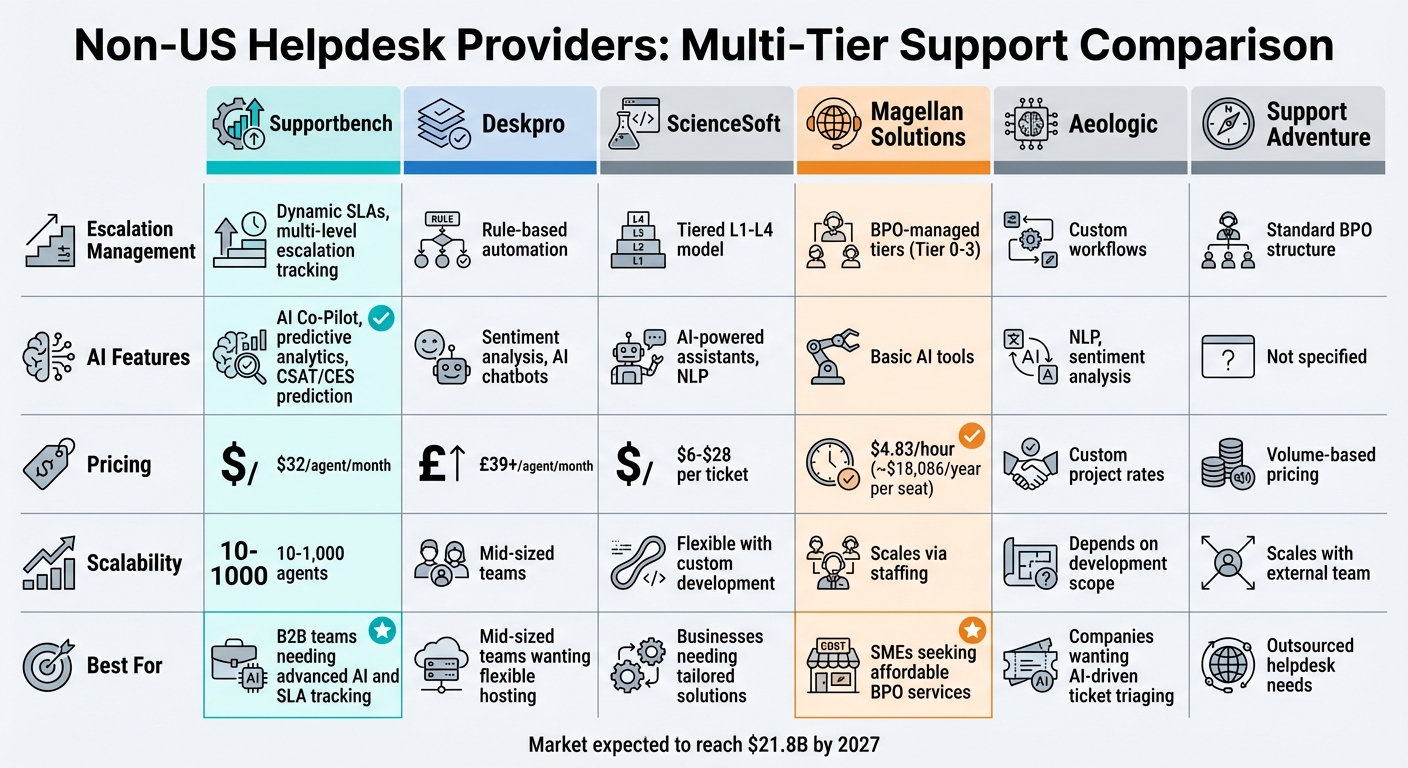
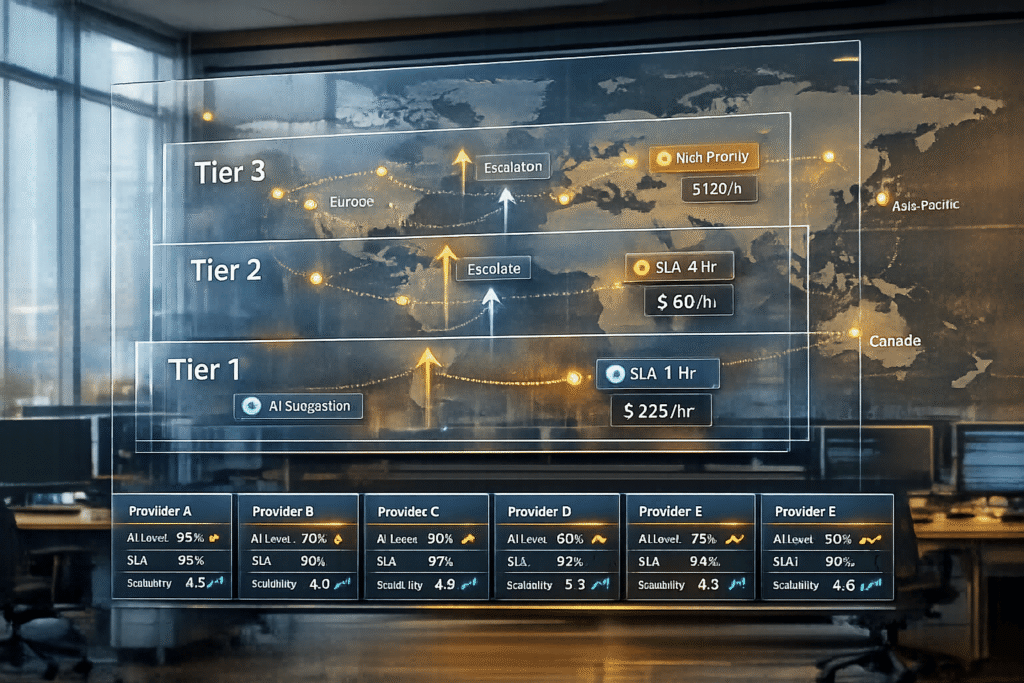
Non-US Helpdesk Providers Comparison: Features, Pricing, and Scalability
The 5 Levels of Help Desk Support (And Why You Need Them)
1. Supportbench
Supportbench is tailored for B2B teams that handle intricate, multi-tier support across global time zones. It can scale effortlessly from 10 to 1,000 agents without needing a system overhaul.
Escalation Management
The platform simplifies escalation processes with automated multi-step paths triggered by urgency, complexity, or customer sentiment. It uses dynamic SLA monitoring to escalate tickets as deadlines approach, while real-time dashboards highlight escalation rates and bottlenecks. By analyzing email content, Supportbench identifies customer sentiment, ensuring frustrated or high-value customers receive quicker attention. Seamless integrations with tools like JIRA and Salesforce allow smooth transitions between support, product, and engineering teams, ensuring context remains intact throughout the escalation process.
These features work hand-in-hand with the platform’s AI tools to enhance efficiency.
AI Capabilities
Supportbench’s AI Co-Pilot assists agents by summarizing past interactions and pulling relevant knowledge base answers during escalations. It predicts CSAT and CES scores even before surveys are completed, helping managers identify potential escalation risks early. The built-in AI Quality Assurance evaluates tickets for empathy, tone, and overall effectiveness, offering instant feedback to agents. Additionally, AI-driven classification and assignment eliminate manual sorting delays, and the platform can transform resolved tickets into well-organized, tagged knowledge base articles with just one click.
These AI tools help refine workflows, especially in tiered support environments.
Tiered Support Workflow
The platform supports customized policies for different service levels, guiding front-line agents on when and how to escalate cases.
"Supportbench is purpose-built for complex B2B support environments where depth and flexibility matter." – Nooshin Alibhai, Founder and CEO of Supportbench
Cost Efficiency
Supportbench offers straightforward, all-inclusive pricing that covers automation, analytics, and reporting from the start. This eliminates the hidden costs often associated with legacy platforms where adding new channels or features increases expenses. Trusted by 9,000 businesses worldwide, Supportbench has earned recognition from G2, Gartner, Capterra, and Software Advice.
Scalability
The platform is built to grow alongside your team without requiring major changes or migrations. It handles higher ticket volumes and expanding agent teams while maintaining performance. For businesses with strict data regulations, Supportbench offers options like dedicated hosting in regions such as Canada, ensuring compliance with international data location requirements.
2. Deskpro
Deskpro, a UK-based platform, offers a versatile range of hosting options, including cloud, private cloud, on-premise, and sovereign data center hosting. It supports over 1,000 integrations and provides hosting services in the UK and EU [19,20].
Escalation Management
Deskpro allows admins to configure time-based escalation rules that activate automatically if a ticket remains unresolved for too long. These rules can escalate urgency, reassign tickets to higher-tier agents, or notify managers. The platform also includes Approvals workflows for internal authorization requests and enables agents to link multiple incidents to a single issue, ensuring a coordinated resolution process. Additionally, these escalation features integrate with AI tools, simplifying ticket routing even further.
"We have 734 new ticket triggers, 850 departments, and over 650 unique outgoing email addresses. Once we had set them up, it saved us countless hours by automating many of the complexities of routing, mapping, and responding." – Chris Evans, VP of IT Operations, FROSCH
AI Capabilities
Deskpro AI leverages intent and sentiment analysis to automatically categorize and route tickets. Its AI Agent Assist feature drafts responses, summarizes lengthy ticket threads, and standardizes replies. AI-powered chatbots handle routine Tier 1 queries, escalating more complex issues to human agents when needed. The platform’s model-agnostic design supports multiple AI providers, including Anthropic Claude, Google Gemini, Mistral AI, and AWS Bedrock. For industries with strict regulations, Deskpro also offers Private AI deployment within an Amazon VPC via AWS PrivateLink [18,20,21].
Tiered Support Workflow
Deskpro uses "Triggers" to assign tickets to specific departments or agents based on flexible rules. The "Lite Agents" feature allows non-support staff, such as engineers or product specialists, to contribute to ticket resolution. Professional plans include 50 Lite Agents, while Enterprise plans support up to 1,000 Lite Agents, making it easier to manage cross-departmental collaboration and reduce costs. Additionally, Round Robin routing ensures workloads are evenly distributed among agents [22,23].
Cost Efficiency
Deskpro pricing starts at £39 per agent per month for the Team plan (minimum 5 agents), £59 per agent per month for the Professional plan (minimum 10 agents), and £99 per agent per month for the Enterprise plan (minimum 25 agents). The Professional tier includes Deskpro AI and 50 Lite Agents, while the Enterprise tier supports up to 1,000 Lite Agents and guarantees a 99.99% uptime SLA. Organizations can choose between Deskpro’s Managed AI or integrating their own AI providers, offering flexibility in cost management and customization.
Scalability
Deskpro is designed to support multi-brand operations, with unlimited brands available on the Enterprise tier. It holds certifications such as SOC II, ISO 27001, and HIPAA, making it suitable for industries with strict compliance requirements. With hosting options in the US, UK, and EU, Deskpro ensures reliable support for organizations operating across different regions [20,23].
3. ScienceSoft
ScienceSoft, with its 36 years of expertise, employs a tiered L1–L4 escalation model to handle complex, multi-level support operations. In this system, L1 agents resolve straightforward issues, escalating more intricate problems to L2 for deeper troubleshooting. L3 addresses code-level fixes and infrastructure updates, while L4 collaborates with external vendors like Microsoft or Salesforce when necessary. This method ensures efficient and tiered problem resolution, meeting the demands of global support environments.
Escalation Management
The escalation process begins with Tier 0 self-service options, followed by Tier 1 scripted solutions, Tier 2 technical log analyses, and Tier 3 infrastructure-level fixes. Automated notifications enhance responsiveness; for example, if a ticket is marked "urgent" after submission, the system immediately alerts the L2 or L3 teams rather than leaving it in a general queue. This approach has proven effective – for instance, at fintech company BPC, ScienceSoft’s Tier 2–3 team cut IT support costs by over 10% through targeted infrastructure improvements.
AI Capabilities
ScienceSoft integrates AI to streamline its tiered support. AI-powered assistants handle first-contact tasks like password resets and routine inquiries, using natural language processing to understand variations in phrasing, typos, and multiple languages. When issues become more complex, the AI seamlessly escalates them to human agents.
"Gartner expects [agentic AI] to autonomously resolve ~80% of common service issues by 2029 and cut costs by ~30%" – Veranika Kavaliova, Help Desk Department Manager at ScienceSoft
An AI-enhanced knowledge base supports virtual agents, helping maintain a user satisfaction rate of at least 97%.
Tiered Support Workflow
ScienceSoft’s team of over 750 IT professionals provides flexible support with options like 24/7, 12/7, and 8/5 coverage across various time zones. This setup ensures quick responses, regardless of location. For instance, ScribeAmerica, a medical scribe company with over 25,000 employees, benefits from 12/5 L1 support that manages approximately 900 tickets monthly, achieving an average first response time of 7 minutes. ScienceSoft sets ambitious targets, such as first responses within 30 minutes for emails and 40 seconds for calls, while maintaining a resolution rate of at least 70%.
Cost Efficiency
ScienceSoft uses a per-ticket pricing model to reduce help desk expenses by up to 40% compared to in-house operations. L1 tickets cost between $6 and $14, while L2 tickets range from $22 to $28. For example, managing 1,000 tickets costs up to $10,000, whereas 2,000 tickets cost up to $16,000. In its partnership with Lolli & Pops, a retail chain with 70 stores, ScienceSoft handled 400 cases monthly, achieving a 30-minute first response time and a 100% employee satisfaction rate.
Scalability
ScienceSoft offers flexible scalability to handle fluctuating ticket volumes. Support is available in multiple languages, including English, Spanish, German, French, Polish, Czech, and Turkish. For Qventive Healthcare, ScienceSoft’s 24/7 L1 support manages about 100 tickets monthly, delivering first responses within 30 minutes for emails and 20 seconds for calls, with a resolution rate exceeding 90%. Certifications like SOC II and ISO 27001 further position ScienceSoft as a trusted partner for organizations with strict compliance needs.
4. Magellan Solutions
Magellan Solutions, headquartered in the Philippines, has nearly two decades of experience and a workforce of 1,248 employees. The company operates a structured four-tier support system (Tier 0 to Tier 3) tailored for small and medium-sized enterprises (SMEs). Each tier has a specific focus: Tier 0 handles self-service tasks like password resets, Tier 1 agents address basic issues using a technical knowledge base, Tier 2 specialists manage more complex problems with deeper product expertise, and Tier 3 experts conduct root cause analysis involving product codes and specifications. This well-organized system ensures efficient issue resolution and seamless integration with advanced AI technologies.
Escalation Management
Magellan’s escalation process is designed to prevent service disruptions and ensure timely resolutions. The system includes a "Monitor and Escalate" phase that tracks incidents and initiates countermeasures to avoid breaches of service level agreements (SLAs). If Tier 1 agents are unable to resolve an issue, it is escalated to Tier 2 analysts, who have a more comprehensive understanding of the product. Resolutions from Tier 2 and Tier 3 are then added to the Support Knowledge Base, enabling lower-tier agents to handle similar issues more effectively in the future.
"This process continuously monitors the status of outstanding incidents. This is to introduce countermeasures as soon as possible if service levels are likely to be breached." – Magellan Solutions
This proactive approach is further enhanced with AI tools, making the escalation process even more efficient.
AI Capabilities
Magellan leverages AI at Tier 0 for automating routine tasks, directing tickets to the most qualified agents, and monitoring SLAs to trigger timely countermeasures. The company also employs technologies like Interactive Voice Response (IVR) and speech recognition – adopted by 40% and 27% of Philippine contact centers, respectively – in line with global B2B support trends.
Cost Efficiency
Magellan’s pricing model is designed to be budget-friendly for SMEs. With an annual seat cost of about $18,086, an hourly rate of $4.83, and a transaction cost of $0.40, the company keeps expenses manageable. Labor accounts for 46% of the total contact center budget, and basic service packages typically range from $100 to $400 per device each month, depending on contract length and expertise required. A 1:8 supervisor-to-agent ratio ensures high-quality service while maintaining cost control, supporting scalable and efficient operations.
Scalability
Magellan offers 24/7 support across multiple time zones, including the United States, Australia, Europe, and Asia, with pricing designed to accommodate SMEs. The company’s ISO and HIPAA certifications guarantee high security standards, making it a reliable partner for businesses looking to grow. With an average attrition rate of 18% for full-time agents and 66% of calls being inbound, Magellan delivers consistent performance. Its scalable solutions allow businesses to expand without the need for building and maintaining internal support teams.
sbb-itb-e60d259
5. Aeologic
Aeologic Technologies provides AI-powered helpdesk solutions designed to streamline multi-tier support systems. By leveraging Natural Language Processing (NLP), the company automates the initial stages of support, focusing on intelligent ticket triaging. Their AI analyzes the intent and sentiment behind customer queries, automatically sorting them into the right support tier – whether it’s Tier 1, Tier 2, or Tier 3. This automated process ensures quicker ticket categorization, setting the stage for faster resolutions and more efficient workflows.
AI Capabilities
Aeologic’s AI tools are designed to identify critical issues through sentiment analysis and trigger words. For example, when customer dissatisfaction or urgent concerns are detected, the system escalates these issues immediately, ensuring they’re addressed without delay. This proactive approach minimizes the risk of unresolved escalations slipping through the cracks.
Tiered Support Workflow
The platform efficiently transitions issues across various support levels. It starts with self-service options (Tier 0) and moves through frontline agents (Tier 1) to specialists (Tier 2). For highly technical problems or deep product expertise, tickets are escalated to developers (Tier 3). Aeologic’s precise triaging ensures tickets are routed to the correct tier from the start, reducing unnecessary handoffs and speeding up resolution times.
Scalability
While specific pricing details aren’t disclosed, Aeologic offers a flexible, custom AI approach tailored to meet unique support requirements. By automating the triage process, the platform handles increasing ticket volumes without the need for additional staff. This allows businesses to scale their support operations efficiently, keeping costs in check while maintaining high service standards.
6. Support Adventure
Support Adventure is a business process outsourcing (BPO) provider that takes over customer support tasks, operating as an external helpdesk solution. Unlike the in-house options mentioned earlier, this outsourced model shifts the day-to-day management of support services to an external team.
Details about its multi-tier support and escalation processes are limited in public documentation. Typically, BPO providers rely on standard tiered structures: simpler issues are addressed first, while more complex problems are escalated to specialized teams. Their pricing model is labor-based, calculated by service volume rather than a per-user fee structure.
If you’re considering Support Adventure, it’s important to ask for specific performance metrics – such as response times, escalation procedures, and scalability capabilities – to ensure it aligns with your organization’s needs. This wraps up the overview of non-US helpdesk providers, setting the stage for a comparison of their strengths and weaknesses in the next section.
Strengths and Weaknesses by Provider
Choosing the right multi-tier helpdesk means weighing factors like escalation management, AI integration, workflow design, pricing, and scalability. Each provider approaches these challenges differently, as shown in the comparison below.
| Provider | Escalation Management | AI Features | Workflow Design | Pricing Model | Scalability |
|---|---|---|---|---|---|
| Supportbench | Triggered SLAs at any lifecycle point with multi-level escalation tracking and de-escalation | AI Co-Pilot, triage, predictive CSAT/CES, auto-responses, and case summaries | No-code configuration | From $32/agent/month, all features included | Scales from 10 to 1,000 agents without retooling |
| Deskpro | Standard tiered escalation | Rule-based automation with basic AI integrations | Customizable configuration | Varies by deployment (cloud or on-premise) | Best suited for mid-sized teams |
| ScienceSoft | Custom escalation paths tailored to client needs | AI capabilities vary with implementation | Fully custom development | Project-based consulting fees | High scalability potential with additional development |
| Magellan Solutions | BPO-managed escalation protocols | Traditional call center approach with minimal AI | Predefined BPO workflows | Labor-based, volume-dependent pricing | Scales with staffing |
| Aeologic | Custom escalation workflows via development services | Dependent on third-party integrations | Requires custom development | Project and hourly rates | Scalability depends on development scope |
| Support Adventure | Standard BPO tiered structure | Details not specified | Managed by an outsourced team | Volume-based service pricing | Scales through external staffing |
This table underscores the unique strengths each provider offers for multi-tier support. Supportbench stands out with its AI-powered features, transparent pricing, and dynamic SLA capabilities, making it a strong choice for B2B teams handling complex, long-term cases where maintaining context is essential.
Other providers rely on traditional tiered escalation, rule-based AI, or customizable BPO-driven solutions. To ensure smooth and effective operations, organizations should align their support strategy with the provider’s pricing, integration options, and scalability potential.
Conclusion
Selecting the right non-US helpdesk for multi-tier support hinges on aligning your operational priorities with the strengths of each provider. For extended cases, Supportbench stands out with its AI Co-Pilot, predictive CSAT/CES features, and dynamic SLA workflows, enabling quicker resolutions without needing to expand your team.
If cutting costs through self-service is your focus, implementing Level 0 self-service with AI chatbots and a robust knowledge base can handle up to 70% of interactions independently. This approach not only reduces expenses but also ensures that complex cases are smoothly escalated to the right teams. For mid-sized teams, balancing adaptability with data control is key.
For those mid-sized teams, Deskpro offers customizable, ready-to-deploy solutions, including tiered escalation management and on-premise deployment for organizations with strict data control needs. On the other hand, BPO providers like Magellan Solutions and Support Adventure cater to varying support models with scalable, volume-based pricing for external staffing.
With the helpdesk software market expected to hit $21.8 billion by 2027, and IT downtime potentially costing up to $9,000 per minute, the importance of speed and efficiency cannot be overstated. Small teams with fewer than 10 agents benefit from low-overhead tools, while larger enterprises need features like advanced escalation workflows and CRM integrations.
To keep pace with AI-driven support trends, the ideal helpdesk should integrate AI directly into case management, ensure seamless context transfer during escalations, and grow effortlessly alongside your team.
FAQs
What should I look for in a non-US helpdesk to handle multi-tier support effectively?
When selecting a non-US helpdesk for multi-tier support, it’s essential to focus on tools that simplify ticket routing, escalation workflows, and context preservation. These features help ensure smooth handoffs between support tiers and eliminate the frustration of customers needing to repeat their issues.
Seek out platforms with smart routing capabilities that assign tickets based on factors like agent expertise, urgency, or workload. This can greatly boost efficiency. Additionally, features such as SLA management to monitor response and resolution times, collaboration tools for seamless team communication, and knowledge base integration to empower agents with quick access to solutions are critical.
Platforms equipped with AI-driven tools, like predictive escalations or intelligent triage, can also play a big role in speeding up resolutions and improving accuracy. By prioritizing these elements, you can build a support system that’s scalable, efficient, and designed to handle complex workflows with ease.
How does AI improve the efficiency of multi-tier support systems?
AI plays a crucial role in transforming multi-tier support systems by streamlining processes, speeding up resolutions, and improving customer experiences. One standout feature is intelligent triage, which examines tickets for factors like intent, sentiment, and language. This ensures tickets are routed to the right support tier or specialist automatically, cutting out manual effort. As a result, urgent or complex cases get prioritized more effectively, reducing delays across the board.
Another key capability is smart escalation workflows. These workflows automatically respond to specific conditions, such as detecting negative sentiment or identifying high-priority issues, by escalating tickets to the appropriate team without delay. This approach helps eliminate bottlenecks and ensures critical problems are addressed promptly. By automating repetitive tasks, improving ticket accuracy, and enabling proactive resolutions, AI not only simplifies operations but also elevates customer satisfaction.
What are the costs and benefits of using AI in a tiered support model?
Bringing AI into a tiered support model can change the cost landscape in several ways. On one hand, features like predictive analytics, intelligent triage, and automated escalations may lead to higher upfront expenses. These costs could come from platform subscription fees or as additional charges for advanced tools. But on the other hand, these AI-driven capabilities can significantly boost efficiency.
For example, AI can streamline ticket processing, speed up resolution times, and handle routine issues without requiring human involvement. Over time, this can lead to noticeable reductions in operational costs.
That said, there are initial hurdles to factor in. Investments are needed for deploying the AI technology, training teams to use it effectively, and reworking workflows to align with a multi-tier structure. While these setup costs may seem daunting, the long-term benefits – like lower operational expenses and happier customers – often make the investment worthwhile. The challenge lies in striking the right balance between upfront costs and the scalability and efficiency gains AI solutions can deliver.