
EdTech support teams face a unique and complex challenge: managing the needs of districts, schools, and users with varying technical requirements. The stakes are high, with over 60% of students experiencing academic delays due to tech issues and 65% of IT teams reporting high stress levels. Traditional support systems often fall short, leading schools to adopt AI-driven solutions to streamline workflows and reduce inefficiencies. Key takeaways include:
- High Volume: Some platforms handle 165,000 contacts annually across 2,000+ schools, with daily calls ranging from 800 to 1,900.
- Layered Needs: Administrators demand compliance tracking, teachers need quick fixes, and students expect 24/7 device support.
- AI Impact: AI systems reduce ticket resolution times from 5 days to 1 day, automate ticket routing, and improve self-service options.
- Cost Efficiency: AI tools help districts avoid hiring more staff by automating repetitive tasks, saving time and money.
AI-powered platforms are transforming EdTech support by simplifying processes, reducing resolution times, and allowing IT teams to focus on more complex issues.
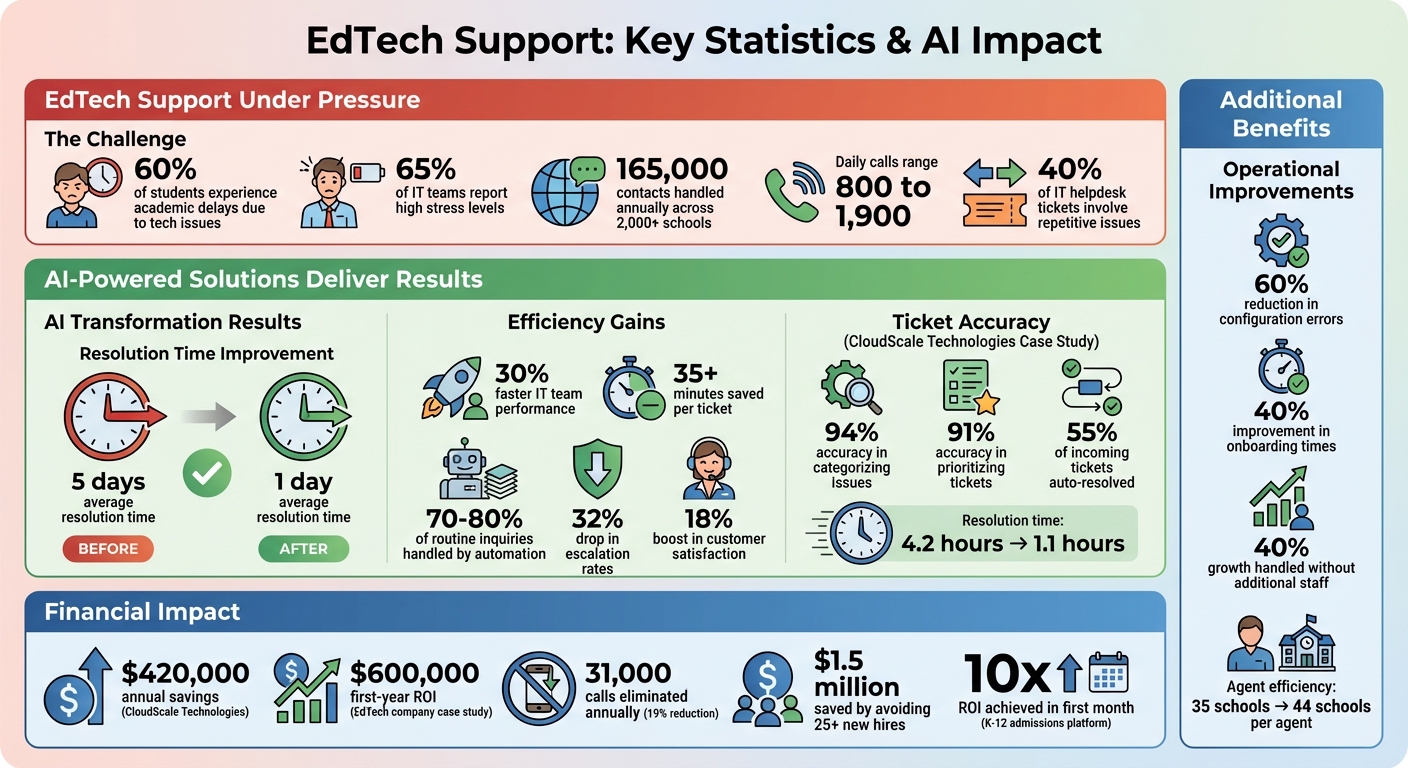
EdTech Support Statistics: AI Impact on Resolution Times and Cost Savings
Smart care with AI and Infrastructure solutions in Education
sbb-itb-e60d259
EdTech Support Challenges: Districts, Schools, and Users
Navigating EdTech support is no easy task. It involves juggling the needs of district administrators, individual schools, and countless end users – all of whom have varying priorities, technical know-how, and expectations for response times.
Ticket Routing Across Multiple Levels
Traditional help desks often fall short in education’s layered structure. They require districts to create separate accounts for each campus, leading to fragmented workflows and a lack of overall visibility [2]. Tickets frequently end up in general inboxes rather than reaching the right experts, delaying resolutions. Technicians waste valuable time hunting down basic details like device location, repair history, or user information.
Take Simsbury Public Schools, for example. Their Director of IT, Maggie Siedel, shared:
"We’ve noticed how getting better information [from initial help ticket submission] enables us to respond more efficiently and get the problem fixed" [1].
Automation can make a big difference. When a student is added to PowerSchool, automatic triggers can ensure accounts and hardware are assigned without delay [1]. Similarly, Venus ISD integrated their ticketing system with tools like SCCM, Active Directory, Google, and Skyward. Technology Director Daniel Domain praised the integration:
"Incident IQ integrates so well with just about everything that we have, so we’re able to pull in information from SCCM, our Active Directory, Google, Skyward – just about anything. Being able to pull all that information in is invaluable" [1].
These examples underline the importance of tailored support systems that cater to the specific needs of education environments.
Managing Different Stakeholder Needs
EdTech support isn’t one-size-fits-all. Administrators, teachers, students, and IT staff each have distinct needs. Administrators rely on district-wide reporting and compliance tools, while teachers need quick fixes to prevent disruptions during lessons. Students expect fast device repairs and easy-to-use self-service options.
Role-specific portals simplify these processes. Joe Runciman, an Online Course Developer, noted:
"HappyFox added a level of clarity and convenience to an otherwise overwhelming support load" [6].
Teachers can access classroom tech guides, students find troubleshooting steps, and parents get clear instructions for account access – all through customized tools. AI-powered ticket assistants further streamline the process by escalating critical issues, like classroom-wide outages, while routing less urgent tasks to campus-level technicians. This efficiency can cut resolution times from 5 days to just 1 day [7].
Incident IQ CEO R.T. Collins explained the value of such tools:
"AI Ticket Assistant is designed to elevate, not replace, the work of K–12 IT teams. Teachers need to submit tickets quickly to keep classrooms running, and techs need the details to resolve them" [7].
| Stakeholder | Primary Support Need | Recommended Solution |
|---|---|---|
| Administrators | Real-time reporting, budget tracking, and compliance | Dashboards and automated ROI/SLA tracking [8][6] |
| Educators | Immediate classroom tech fixes | AI-assisted submissions and automated workflows [7][8] |
| Students | Quick device repairs and learning access | Smart lockers and mobile-friendly self-service portals [6][5] |
| IT Staff | Reduced manual workload and asset visibility | SIS/MDM integrations and automated ticket routing [1][8] |
By addressing these specific needs, role-based systems supported by AI can drastically improve efficiency and satisfaction.
Disconnected Tools and Data Silos
Another challenge is the reliance on disjointed tools, which often trap information in isolated systems. Technicians are forced to jump between Student Information Systems, Mobile Device Management consoles, and spreadsheets just to gather basic information about a device [1][2]. This "data gravity" slows down processes and limits productivity.
Ithaca City School District tackled this issue in 2025 by consolidating IT, HR, and enrollment services into a single platform. Despite a staggering 500% increase in ticket volume – from 2,495 in 2021 to 16,372 in 2024 – they maintained an impressive 9.5/10 customer experience score [9]. Superintendent Dr. Luvelle Brown emphasized:
"It’s not just about test scores. With Onflo, we track customer service every day. That data has changed how we lead" [9].
AI integration plays a crucial role in breaking down these silos. Wade Grant, Director of Educational Technology at Vicksburg Warren School District, described the financial benefits:
"Technology spending is like a big salami, and we’re always looking to shave off another slice. With strategic investments to improve efficiency… those little slices add up to something much bigger" [1].
AI Solutions for EdTech Support
AI-powered platforms are transforming how EdTech support operates, taking over repetitive tasks that often weigh down IT teams. Instead of manually handling countless tickets or figuring out which technician should address a classroom issue, AI steps in to classify, route, and even resolve problems automatically. Let’s dive into how AI enhances ticket triage, predicts escalations, and improves knowledge bases for self-service.
Automated Ticket Triage and Assignment
One of AI’s key strengths is its ability to standardize and categorize tickets, no matter how they come in – whether via email, Slack, or parent portals. It doesn’t rely on users to describe issues perfectly. For example, a vague request like “laptop won’t connect” can be accurately matched to a “Wireless Configuration Reset” task without needing exact keywords [11].
A great case study comes from CloudScale Technologies, a company with 1,200 employees. In early 2026, they trained an AI model on 86,000 historical tickets over eight weeks. The results? 94% accuracy in categorizing issues and 91% accuracy in prioritizing them. Within a month, 55% of incoming tickets were auto-resolved, cutting the average resolution time from 4.2 hours to just 1.1 hours. This efficiency saved them an estimated $420,000 annually [11]. When AI couldn’t resolve a ticket, it still added value by compiling a detailed context package, including classification reasoning, relevant articles, diagnostic results, and examples of similar past issues [11]. On average, districts using AI workflows save 35+ minutes per ticket [8].
Once tickets are sorted efficiently, predictive tools take support to the next level.
Predictive Escalations and Dynamic SLAs
Predictive escalation tools don’t just route tickets – they analyze them in real time to assess risks. Factors like sentiment changes, delays in responses, past severity levels, and user history are all considered [13]. For instance, while a single password reset might stay in the normal queue, a network outage affecting an entire classroom would be flagged and sent directly to senior technicians.
In February 2026, Incident IQ introduced its AI Ticket Assistant for K-12 school districts, serving over 14 million students across 2,000 districts. This tool, led by CEO R.T. Collins and VP of Product Marcia Natal, was designed to handle rising ticket volumes without increasing staff. The results? Resolution times dropped from 5 days to just 1 day, and IT teams worked up to 30% faster [7]. Marcia Natal explained:
"By capturing better information upfront, reducing back-and-forth to gather details, and recommending relevant solutions, we’re helping IT teams resolve issues faster, scale their impact, and keep teachers focused on teaching – not troubleshooting" [7].
Dynamic SLAs (Service Level Agreements) also adapt based on ticket context. For instance, if a renewal deadline is near or multiple users are involved, resolution timelines are tightened to minimize disruptions. Organizations using AI for escalation prediction have seen a 32% drop in escalation rates and an 18% boost in customer satisfaction scores for high-priority issues [13].
But AI’s impact doesn’t stop there – it also transforms self-service support.
Building a Knowledge Base for Self-Service
Self-service tools shine when users can solve their own problems without submitting tickets. AI-driven knowledge bases make this possible by using semantic search to match user queries with the right solutions, even when the language isn’t precise [11]. For example, users don’t need to know technical jargon to find the help they need.
Take the case of an EdTech company serving over 2,000 schools. In 2025, they adopted MatrixFlows’ self-service platform to manage 165,000 annual support calls. By offering tailored guidance during enrollment and school-specific help, they eliminated 31,000 calls annually – a 19% reduction – and achieved a $600,000 ROI in the first year. This allowed their 45 agents to handle 40% year-over-year growth without hiring additional staff [3]. As their VP of Customer Success put it:
"Instead of just answering questions faster, we could eliminate most questions entirely by providing the guidance people actually needed to succeed independently" [3].
AI also keeps these knowledge bases up-to-date. By analyzing ticket trends, it suggests new FAQs, drafts articles based on common resolutions, and flags outdated content for updates [11]. Since 40% of IT helpdesk tickets involve repetitive issues like password resets or software requests [11], self-service platforms are ideal for handling these tasks. Districts using AI-driven self-service tools report that automated workflows and chatbots can manage 70% to 80% of routine inquiries [10][12]. This makes self-service a powerful complement to AI-powered ticketing and escalation systems, creating a streamlined support ecosystem.
Cost-Efficient AI Platforms for EdTech Support
AI-native platforms are reshaping how EdTech teams scale their support operations. Instead of hiring more staff as user numbers grow, these platforms allow teams to handle increased demand without proportional headcount expansion. The result? Lower costs, faster resolutions, and the ability to focus on complex challenges rather than repetitive tasks. By streamlining ticket management and reducing overhead, these platforms also enhance flexibility and efficiency.
Reducing IT Dependencies
Traditional support systems often rely heavily on IT teams to handle tasks like configuring workflows or updating knowledge bases. This dependency can slow down response times and frustrate managers who need quick adjustments. AI-native platforms change the game by giving non-technical teams the tools to manage operations independently.
Take one EdTech provider as an example. They empowered their non-technical teams to tweak support workflows instantly. Their Director of Customer Operations explained how this transformed their processes:
"The ability to iterate quickly based on what we learned from support interactions was game-changing. We could spot patterns in calls, update the guidance, and prevent future inquiries – all without opening IT tickets." – Director of Customer Operations, unnamed EdTech SaaS company [3]
This approach allowed them to manage a 40% growth in demand without hiring additional staff. By rolling out contextual self-service in just 30 days, they reduced annual call volume by 31,000 (a 19% drop) and avoided hiring 25+ agents, saving around $1.5 million annually [3]. Their VP of Customer Success broke it down:
"The math was simple – we could either hire 25 more agents at $60,000 each plus benefits and office space, or we could invest in self-service that scales automatically with growth." – VP of Customer Success, unnamed EdTech SaaS company [3]
AI platforms also simplify scaling across multiple schools and districts. Multi-tenant architectures allow support teams to customize experiences for different user groups – like parents, students, and administrators – without duplicating infrastructure. This reduces setup time and maintenance costs, making large-scale rollouts more efficient [15].
Improving Agent Productivity and User Experience
AI tools don’t just lighten the workload – they make agents more effective when handling complex issues. Features like conversation summaries, solution suggestions, and contextual recommendations help agents resolve tickets faster without compromising quality. Studies show that AI chatbots can boost worker productivity by up to 14% [15]. But the real advantage lies in combining automation with human expertise.
In February 2026, Incident IQ introduced an AI Ticket Assistant for K-12 districts. Serving over 14 million students across 2,000 districts, the tool allowed teachers to describe issues in plain language while AI handled classification and routing. The results were impressive: ticket resolution times dropped from 5 days to just 1 day, and IT teams became 30% more efficient [7]. CEO R.T. Collins captured the platform’s purpose:
"AI Ticket Assistant is designed to elevate, not replace, the work of K–12 IT teams… schools and districts can protect instructional time by reducing repetitive tasks and resolving issues faster." – CEO R.T. Collins, Incident IQ [7]
Additionally, configuration errors among administrators decreased by 60%, and onboarding times for new schools improved by 40% with AI-driven guidance during critical workflows [16]. This freed up support teams to focus on strategic tasks rather than repetitive questions.
The productivity gains also translate into measurable returns, as AI tools provide real-time metrics to track performance and impact.
Tracking ROI with AI Metrics
To measure ROI effectively, EdTech teams need to go beyond traditional metrics like Average Handle Time (AHT). Instead, they should focus on outcome-based metrics such as First Contact Resolution (FCR), Time to Resolution (TTR), and Customer Satisfaction (CSAT) [14]. AI-native platforms make this easier by automatically logging resolution trends, identifying knowledge gaps, and surfacing actionable insights.
For example, a K-12 admissions platform used AI to build a unified knowledge base. Within 30 days, they cut support contacts by 70% and achieved a 10x ROI in the first month by deflecting up to 80% of routine inquiries [16]. The AI also flagged outdated knowledge base articles and suggested new FAQs, ensuring self-service resources remained accurate [14][4].
Another critical metric is cost-to-serve. By analyzing the cost of resolving tickets across different user groups – such as parents versus administrators – support teams can pinpoint where automation delivers the best results [14]. AI platforms provide these insights automatically, enabling managers to allocate resources effectively.
The transition from hiring-based scaling to AI-driven efficiency is clear. One EdTech company increased agent efficiency from managing 35 schools per agent to over 44 schools per agent using AI self-service [3]. Another avoided relocation and equipment costs by slowing headcount growth while still supporting rapid expansion. As their VP of Customer Success put it:
"Instead of just answering questions faster, we could eliminate most questions entirely by providing the guidance people actually needed to succeed independently." – VP of Customer Success, unnamed EdTech SaaS company [3]
Platforms like Supportbench integrate these capabilities – automated triage, contextual self-service, agent assistance tools, and real-time ROI tracking – into one system. For EdTech teams navigating the complexities of districts, schools, and diverse user needs, this approach offers a practical way to scale support operations while keeping costs under control.
Conclusion
Managing EdTech support across districts, schools, and various user groups doesn’t have to mean higher costs or a bigger team. AI-native platforms are changing the game by breaking the old pattern of growth requiring more staff. Instead of adding headcount, teams can rely on smart systems that handle ticket triage, offer contextual self-service, and predict escalations – all while staying compliant with FERPA and other K–12 privacy standards [7].
The benefits are clear. Districts using AI-driven ticketing systems have slashed resolution times from 5 days to just 1 day [7]. EdTech companies have also seen massive gains, eliminating over 31,000 annual support calls and achieving a first-year ROI of more than $600,000 [3]. These advancements shift the focus from reactive troubleshooting to proactive solutions, preventing problems before they even become tickets. This approach not only improves satisfaction for all stakeholders but also strengthens operational efficiency across every level of support.
Robert Armstrong, Director of Customer Support at Frontline Education, emphasizes this point:
"AI is an amplifier… if your support operations are flawed, AI will simply magnify those issues" [17].
This highlights why a strong support foundation is critical. Start by organizing your knowledge base, solving the biggest pain points in your user journey, and selecting platforms that allow non-technical teams to innovate without relying on IT.
For EdTech teams managing complex environments, platforms like Supportbench bring everything together in one system. They eliminate the need for costly add-ons and empower lean teams to scale effectively. With unified workflows tailored to the unique needs of districts, schools, and users, these platforms help teams stay efficient and control costs while meeting the demands of modern education support.
FAQs
What should we automate first in EdTech support?
The first step toward streamlining EdTech support is setting up automated triage systems. These systems use keywords or AI to analyze incoming tickets and direct them to the appropriate support teams. By doing this, they cut down on manual work, speed up response times, and ensure tickets are handled more accurately. It’s a practical and efficient way to kick off automation efforts in this space.
How do we set up ticket routing for districts and schools?
To streamline ticket routing for districts and schools, consider using automated systems like AI or keyword-based triage. Begin by evaluating your current workflows to identify areas for improvement. Define keyword rules – such as terms like "network" or "technology" – to help categorize and direct tickets to the appropriate teams. For more intricate setups, AI can analyze ticket content in greater detail, boosting routing accuracy.
To maintain efficiency, regularly update your system and ensure it integrates smoothly with your existing tools. This keeps the process adaptable as requirements change over time.
How can we measure AI support ROI in K–12?
Measuring the return on investment (ROI) of AI support in K–12 education means looking at both the measurable and less obvious benefits. Key metrics to consider include cost savings, increased staff productivity, and better student outcomes – think higher literacy rates or improved graduation numbers.
AI can also boost operational efficiency by cutting down on things like ticket resolution times or overall support volume, translating into saved time and resources. A thorough evaluation connects these metrics to the district’s broader objectives, showing how AI can improve both educational quality and administrative processes.