
Great customer service is more important than ever. In 2026, with AI automating 80% of routine tasks, support agents are focusing on complex, high-stakes issues that require both technical expertise and strong interpersonal abilities. The stakes are high: U.S. companies lose over $62 billion annually due to poor service, and 60% of customers switch to competitors after just 2-3 negative experiences.
Here’s what matters most:
- Communication: Active listening, writing clarity, and tone consistency build trust.
- Problem-Solving: Root-cause analysis, resourcefulness, and strategic escalation ensure faster resolutions.
- Emotional Intelligence: Empathy, patience, and social awareness strengthen customer relationships.
- Flexibility: Agents must adapt to new tools, workflows, and customer needs.
The takeaway? Strong customer service isn’t just about solving problems – it’s about creating lasting relationships that drive loyalty and revenue growth. With the right skills, your team can handle challenges that AI can’t, making customer support a key driver of success.
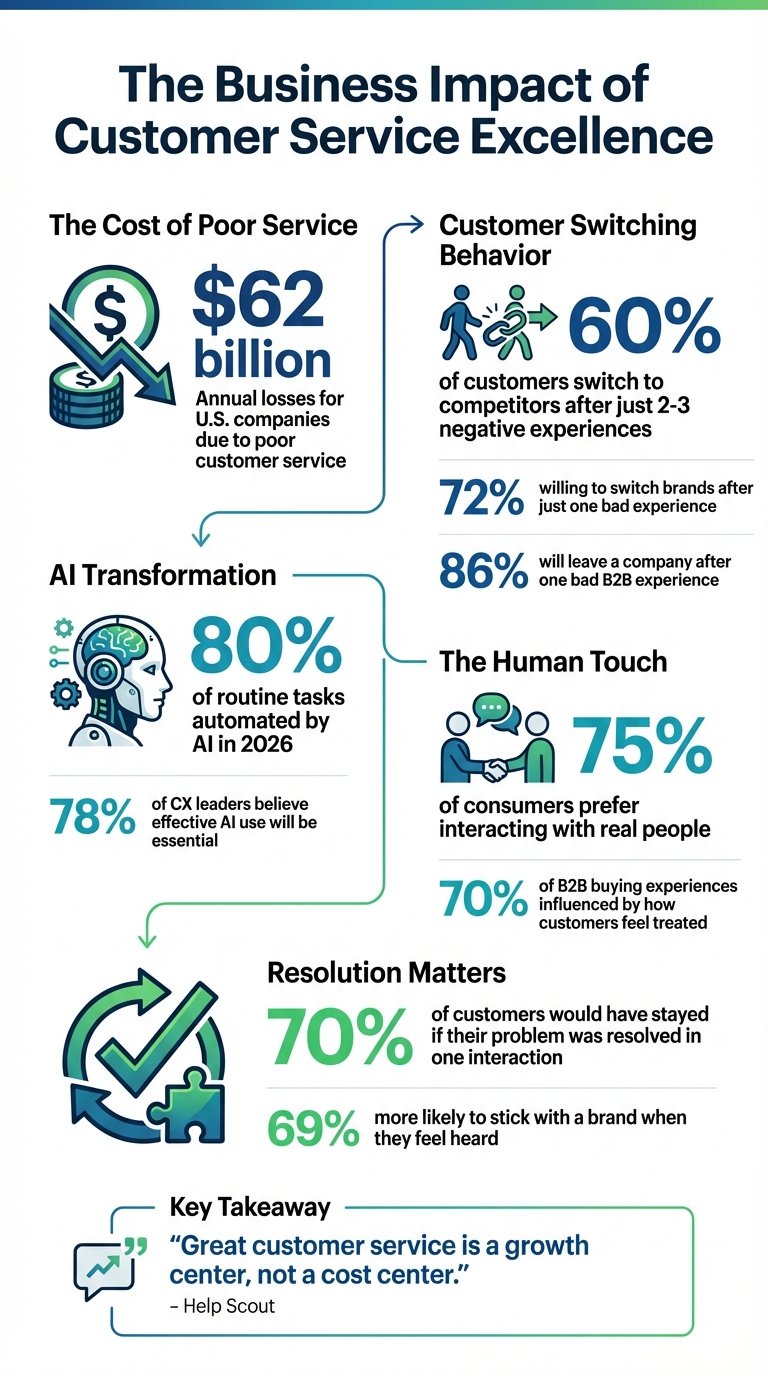
Customer Service Skills: Key Statistics and Impact on Business Growth
6 Tips For Improving Your Customer Service Skills | Indeed Career Tips

1. Communication
At the heart of every customer interaction lies communication. It’s not just about exchanging words – it’s about understanding, clarity, and connection. In today’s AI-driven support landscape, mastering six key communication skills can turn challenging situations into trust-building opportunities. Let’s start with one of the most essential: Active Listening.
Active Listening involves digging deeper to uncover the real issues behind a customer’s words. Rather than rushing to offer solutions, agents should paraphrase what they’ve heard and ask clarifying questions. A helpful framework for this is the RASA method: Receive (give your full attention), Appreciate (use affirmations like "I see" or "okay"), Summarize (recap with phrases like "So, what I’m hearing is…"), and Ask (follow up with thoughtful questions). This method not only helps avoid misunderstandings but also reduces unnecessary back-and-forth communication.
Writing Proficiency is equally critical in a world dominated by digital communication. Whether through chat, email, or SMS, agents must express empathy and precision. Proper grammar, complete sentences, and an appropriate tone are key to building trust. Every written message reflects your company’s professionalism, especially in B2B environments, where maintaining a polished image is non-negotiable.
Clarity and Simplicity are what set exceptional agents apart. Tackling complex technical issues? Break them down into plain, straightforward language. As Einstein famously said, simplicity demonstrates true understanding. One practical tip: create cheat sheets that translate 10–15 tricky technical terms into everyday language. This small step can prevent confusion and make sure everyone’s on the same page.
Positive Language helps agents turn roadblocks into opportunities. For example, instead of saying, "I can’t get you that product", an agent might say, "That product will be available next month; I can place the order for you now". This shift in tone makes a big difference, especially when you consider that 60% of customers are likely to switch to a competitor after just two or three negative experiences.
Finally, a well-rounded communicator needs Digital Literacy and the ability to read subtle customer cues. Agents must juggle multiple platforms while maintaining a consistent, conversational tone across all channels. They should also pick up on subtle hints about a customer’s mood, patience, or personality. For instance, if a customer signs off with "PhD", it’s a good idea to match that professionalism by skipping casual touches like emojis. These small adjustments can make a big impact in creating a positive customer experience.
2. Problem-Solving
While strong communication skills lay the groundwork, problem-solving takes customer support to the next level. With AI now managing up to 80% of routine inquiries, human agents are left to handle the more intricate and high-stakes issues. These situations demand sharp critical thinking and a knack for resourcefulness. Let’s explore some key techniques that define expert problem-solving.
Root-Cause Questioning is what sets top-tier agents apart. Instead of addressing surface symptoms, skilled agents dig deeper with follow-up questions to uncover the actual issue. This approach not only prevents repeat tickets but also saves time for both the customer and the team. For instance, when a customer reports a login error, the underlying cause might not be a forgotten password but rather a conflict with the password policy or browser compatibility.
Intuitive Goal Identification focuses on understanding the bigger picture behind a customer’s request. A password reset isn’t just about resetting the password – it’s about enabling the customer to log in and complete their task. By anticipating the next barrier, agents can address potential issues before they arise, creating a smoother experience.
Strategic Escalation is just as critical as solving problems independently. The best agents know when to escalate an issue to a specialist without delay. This is vital because 70% of customers who leave a company say they would have stayed if their problem had been resolved in a single interaction.
Resourcefulness is about finding solutions, even in unfamiliar territory. This involves navigating CRMs, knowledge bases, and internal documentation efficiently. In AI-driven workflows, it also means leveraging tools like AI-generated ticket summaries and sentiment analysis to quickly understand the context without sifting through lengthy email threads. The combination of human judgment and AI tools leads to faster resolutions.
Reproducible Debugging eliminates guesswork by verifying the issue firsthand before providing a solution. This method is especially crucial in B2B settings, where a single poor experience can have significant consequences – 86% of customers say they’d stop doing business with a company after just one bad interaction. Ensuring accuracy through testing builds trust and prevents costly errors.
sbb-itb-e60d259
3. Emotional Intelligence
Solving problems is a big part of customer support, but emotional intelligence is what makes customers feel genuinely valued. In fact, 70% of buying experiences in B2B support are influenced by how customers feel they are treated. This skill is what keeps technical issues from damaging customer relationships – especially since 75% of consumers say they’ll still prefer interacting with real people as technology continues to evolve. Key emotional intelligence traits include empathy, active listening, patience and composure, conflict resolution, resiliency, and social awareness. Together, these traits complement problem-solving skills, ensuring every interaction strengthens the bond with the customer.
Among these traits, empathy is the cornerstone. It allows agents to acknowledge and validate a customer’s frustration before jumping into solutions. In AI-driven workflows, tools like sentiment analysis can even gauge frustration levels and direct more sensitive cases to agents skilled in empathy.
Active listening sharpens an agent’s ability to pick up on tone and subtle cues. A great way to show active listening is by paraphrasing the customer’s issue to confirm understanding. AI tools can also help by summarizing emotional context, cutting down on the need for customers to repeat themselves – a relief for the 35% of customers who dread having to explain their issue multiple times.
Patience and composure are vital when dealing with stressed or upset customers. The best agents remain calm and act as a steady presence during a crisis. To ensure new hires have this ability, companies can use role-playing scenarios with simulated angry or irrational customers. This is critical, as 86% of customers will leave a company after just one bad experience.
Conflict resolution helps agents position themselves as allies rather than obstacles. When customers feel heard, 69% are more likely to stick with a brand. Mirroring a customer’s tone and language can build rapport, and AI tools that suggest empathetic phrases in real time can help agents navigate tense situations while staying professional.
Resiliency is just as important. It allows agents to handle tough feedback without burning out.
Finally, social awareness enables agents to pick up on cues like mood, patience level, and communication style, adjusting their approach to meet the customer where they are. When these emotional intelligence skills are integrated into AI-supported workflows, they can significantly improve customer retention and drive revenue growth.
4. Adaptability
Agents who can adapt thrive when the unexpected happens. As AI continues to transform support operations, the ability to quickly learn new tools, workflows, and communication channels has never been more important. This skill requires not just rapid learning but also the ability to adjust effectively as customer needs, technologies, or priorities evolve.
To identify adaptability during hiring, create scenarios that mimic real-world challenges. Use tests that introduce sudden changes or technical glitches to see how candidates think on their feet. Evaluate their learning agility by observing how they approach using a new technology for the first time – pay attention to their self-motivation and curiosity. You can also conduct channel-switching simulations, where candidates rotate between tasks like responding to emails, managing live chats, and engaging on social media. These exercises reveal how well they adjust their tone and pacing across different platforms.
"Skills can be trained, knowledge fostered…but motivation is what leads to exceptional experiences." – Nate Brown, Co-Founder, CX Accelerator
Look for candidates who demonstrate an ability to prioritize project urgency and provide real examples of resolving conflicts. Be cautious of those who avoid taking responsibility or cannot share any conflict resolution experiences. Live writing tasks can also be helpful, as they simulate the day-to-day demands of the role. For an even deeper assessment, involve your top-performing agents in the interview process – they often have the best sense of the flexibility required for success.
This focus on adaptability pays off in daily operations. Flexible agents handle multiple communication channels with ease, quickly learn how to use new AI tools, and apply AI-generated feedback to refine their approach. Considering that 72% of customers are willing to switch brands after just one bad experience, having adaptable agents on your team is crucial to staying competitive in a fast-changing support environment.
Conclusion
Creating a top-notch support team starts with hiring individuals who bring a blend of technical expertise and strong interpersonal abilities, then continuously helping them grow. The 25 skills discussed in this article form the backbone of what sets outstanding support teams apart from those that just handle tickets. With automation managing routine tasks, your human agents are left to tackle the more complex, sensitive cases that call for empathy, innovative thinking, and relationship-building.
The numbers make it clear: excellent customer service leads to repeat business and increased spending. On the other hand, poor service costs U.S. companies billions each year, and many customers won’t give a brand a second chance after a single bad experience. This highlights a crucial point: customer service isn’t just a cost – it’s a driver of growth.
"Great customer service is a growth center, not a cost center. It’s really that simple." – Help Scout
These statistics emphasize the importance of enhancing your team’s skill set. Start by analyzing your team’s performance using data from analytics and satisfaction surveys to identify areas for improvement. From there, provide targeted coaching to address those gaps. When hiring, prioritize traits like warmth, curiosity, and adaptability – qualities that are much harder to teach than product knowledge. Build a skills rubric based on these competencies for use in performance evaluations, and during the hiring process, assess candidates with real-world scenarios to see how they handle both positive interactions and challenging situations.
It’s also worth noting that 78% of customer experience leaders believe effective use of AI will be essential in the years ahead. The best agents will be those who can seamlessly collaborate with AI tools, leverage data insights, and deliver the kind of personalized, relationship-driven service that automation simply can’t replicate. By focusing on these 25 critical skills now, you’ll not only build a team that resolves problems effectively but also one that inspires loyalty, reduces churn, and drives revenue growth.
FAQs
How does AI improve customer service while keeping the human touch?
AI plays a crucial role in transforming customer service by managing routine tasks such as answering frequently asked questions and directing more complex issues to human agents. This frees up support teams to concentrate on higher-level interactions that demand empathy, critical thinking, and creativity – qualities that AI hasn’t mastered.
It also enhances efficiency by equipping agents with real-time data, tailored suggestions, and actionable insights, enabling them to respond faster and more accurately. Instead of replacing human agents, AI works alongside them to streamline the customer experience, reduce burnout within teams, and ensure that the human touch remains an essential part of customer support.
What emotional intelligence traits are essential for great customer support?
Effective customer support thrives on a foundation of emotional intelligence, with traits like self-awareness, empathy, emotional self-control, and strong social skills playing a central role. These qualities allow support agents to remain attuned to their own emotions while thoughtfully addressing the needs and feelings of customers.
When support teams excel in these areas, they can build trust, navigate difficult situations, and leave customers with a positive impression – even during tough conversations. Focusing on emotional intelligence leads to better communication and fosters stronger, more meaningful connections with customers.
Why is adaptability so important for customer service teams today?
Adaptability plays a key role in customer service, enabling teams to keep up with the constantly shifting demands of customers and navigate challenges in a fast-paced support environment. With interactions spanning multiple channels – like phone, email, live chat, and social media – flexibility is crucial for crafting responses that suit each customer’s unique preferences and situation.
As AI and automation tools become more common in support workflows, the ability to adapt helps team members quickly get up to speed with new technologies and processes. This agility not only streamlines problem-solving but also boosts customer satisfaction and fosters trust by providing consistent, tailored support. In the end, teams that can pivot effectively are better equipped to manage surprises, remain competitive, and nurture strong, lasting relationships with their customers.