Customer service is the process of supporting customers before, during, and after they purchase a product or service. In B2B settings, it focuses on building long-term relationships with multiple stakeholders, such as procurement teams and executives, rather than individual transactions. Effective customer service reduces churn, strengthens trust, and drives revenue growth.
Key Takeaways:
- Definition: Customer service addresses customer needs, resolves issues, and ensures satisfaction.
- B2B vs. B2C: B2B involves managing complex, multi-stakeholder relationships with higher revenue stakes, while B2C focuses on individual consumers.
- Core Principles: Responsiveness, empathy, and problem-solving are essential for success.
- Modern Trends: AI tools now streamline tasks, improve self-service, and enhance decision-making in B2B environments.
- Examples: Companies like Zoom and Black Duck use AI to boost efficiency, deflect tickets, and improve customer satisfaction.
Quick Overview:
- Challenges: B2B service failures can cause lost contracts and revenue.
- Solutions: Use AI for automation, equip teams with tools, and track key metrics like FCR and CSAT.
- Best Practices: Automate repetitive tasks, centralize knowledge, and act on customer feedback.
Customer service is more than resolving issues – it’s about creating partnerships that ensure long-term growth and client satisfaction.
Marty Kausas, Pylon CEO on Modern B2B Support, AI KB & Post‑Sales Tools
What Is Customer Service?
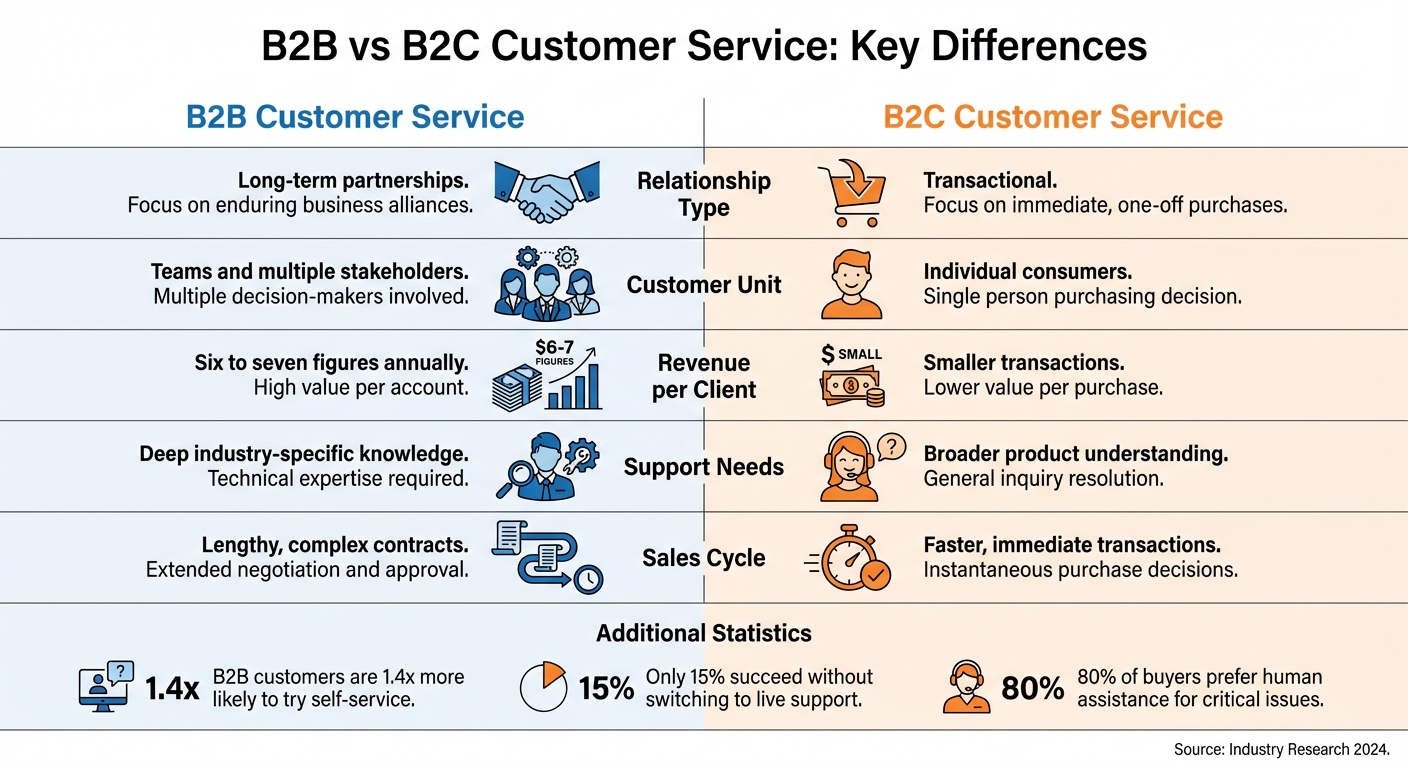
B2B vs B2C Customer Service: Key Differences Comparison
Customer service is all about providing support to customers at every stage of their journey – before, during, and after they purchase your product or service. It includes answering questions, resolving issues, simplifying onboarding, and helping customers meet their goals. In a B2B environment, customer service isn’t just about transactions; it’s about forming long-term partnerships that secure revenue and drive consistent growth. This approach lays the groundwork for understanding what defines outstanding service.
The stakes are much higher in B2B settings. One client can account for six or seven figures in annual revenue [3]. If service falls short, the impact isn’t just losing a single sale – it could mean losing a critical contract, damaging relationships, and tarnishing your reputation. As highlighted in the Coveo B2B Service Guide, "B2B relationships are built for the long run. Business leaders want partners, not just vendors" [3].
Strong customer service builds trust and loyalty, showing operational reliability while reducing friction in every interaction. Providing consistently excellent support doesn’t just solve today’s challenges – it strengthens the partnership, encouraging clients to renew contracts and increase their investment in your solutions.
Core Principles of Customer Service
Three key principles form the backbone of great customer service: responsiveness, which involves addressing customer needs promptly; empathy, which means understanding the customer’s perspective and the impact on their business; and problem-solving, which requires technical know-how and creative thinking to tackle challenges [4][2].
These principles are even more critical in B2B settings. Giving support teams the authority to make decisions and resolve issues quickly leads to better outcomes [2][1]. AI-powered tools can further enhance problem-solving by bringing up relevant information and automating routine tasks, freeing up teams to handle more complex, high-stakes scenarios. As Eric Klimuk points out, consistency builds trust and simplifies interactions [1].
How B2B Customer Service Differs from B2C
B2B and B2C customer service operate in entirely different worlds. Here’s how they compare:
- Relationship Type: B2B is about long-term partnerships; B2C is more transactional.
- Customer Unit: B2B serves teams and multiple stakeholders, while B2C focuses on individual consumers.
- Revenue per Client: B2B clients can bring in six or seven figures, whereas B2C transactions are generally smaller.
- Support Needs: B2B often requires deep industry-specific knowledge, while B2C needs broader product understanding.
- Sales Cycle: B2B deals with lengthy, complex contracts, while B2C transactions are faster and more immediate.
Source: [3]
These differences highlight the need for a tailored, hybrid approach that blends AI and human expertise in B2B support. Instead of assisting just one user, you’re often managing entire teams across various departments, each with unique priorities and challenges. Interestingly, B2B customers are 1.4 times more likely to try self-service compared to B2C consumers, but only 15% succeed without switching to live support [3]. Moreover, 80% of buyers still prefer human assistance for critical issues [3]. This underscores the importance of combining AI efficiency with the personal touch of human support in B2B environments.
Examples of Effective Customer Service
Effective customer service in the B2B world isn’t just about resolving issues – it’s about creating meaningful partnerships, cutting costs, and delivering faster solutions. The examples below highlight how AI and proactive strategies are reshaping B2B support to achieve measurable results.
Proactive Customer Support
Proactive support is all about staying ahead of the curve. Instead of waiting for problems to land in the inbox, teams anticipate potential issues and address them before they escalate. This approach not only reduces the number of escalations but also builds trust, positioning your organization as a strategic ally rather than just another service provider.
Take Spoonflower, for example. This B2B marketplace implemented AI-driven ticket routing to streamline customer inquiries. The result? A 45% ticket deflection rate[3]. By directing questions to the right resources – whether through self-service tools or specialized agents – they managed to improve efficiency while keeping customers satisfied.
AI-Enhanced Problem Solving
AI has moved far beyond basic chatbots. Today’s advanced systems can analyze problems, design solutions, and execute tasks across platforms, making them indispensable for handling complex support scenarios.
Here are a few standout examples:
- Zoom, faced with skyrocketing demand across 17 languages, introduced generative AI in 2024. Instead of offering a list of search results, their system provided direct, cited answers tailored to each query. The impact? A 2.3x increase in case deflection, an 89% reduction in content gaps, and a 20% rise in self-service success[3].
- Black Duck took a creative approach by integrating AI with its Knowledge-Centered Service (KCS) documentation. This turned static help articles into dynamic, context-aware responses during case submissions. The result was a 268% increase in case deflection and a 43% boost in self-service success[3].
- Tyler Technologies used AI-powered search tools to unify access to siloed information for 1,400 agents. With instant access to customer history and context, first-call resolution rates improved by 23%, benefiting their 126,000 customers[3].
Personalized Customer Interactions
Automation is powerful, but personalization takes customer service to the next level. In B2B support, personalization means understanding each client’s unique needs – whether it’s their industry challenges, how they use your product, or their broader business objectives. Tailored solutions not only improve engagement but also strengthen long-term customer relationships.
For instance, Informatica, under the leadership of Pattabhi Raman, VP of Digital Experience, used AI to recommend paid educational resources to customers who completed free micro-learning paths. This personalized strategy generated a $1M pipeline within the first year, with nearly 90% of customers finding the suggestions helpful and reporting that the targeted content enabled them to use the product more independently[3].
"After customers have finished the learning path, we ask if the course was useful. Close to 90% of customers come back and told us yes. This results in them using the product more independently, exploring these features and capabilities."
- Pattabhi Raman, VP Digital Experience, Informatica[3]
Similarly, Xero, a cloud-based accounting provider, implemented generative AI into its search system. Within just six weeks, they achieved a 20% increase in self-service success[3].
These examples underscore how blending technology with a personal touch can transform customer service into a competitive advantage.
sbb-itb-e60d259
Best Practices for Scaling Customer Service
Scaling B2B customer service requires balancing efficiency, cost management, and quality while navigating the intricacies of multi-stakeholder accounts. The secret lies in combining AI’s capabilities with equipping your team with the right tools and insights to deliver outstanding support.
Use AI to Automate Repetitive Tasks
Tasks like ticket categorization, labeling, and routing often eat up valuable time that could be better spent solving complex customer issues. AI can handle these repetitive processes with impressive results, achieving 90% accuracy in ticket classification and cutting resolution times by 50%[5]. By 2026, 80% of customer service organizations are expected to incorporate generative AI into their operations[6].
The real game-changer is how AI frees up your team to focus on higher-value tasks, such as resolving intricate problems and strengthening customer relationships. AI can prioritize cases based on urgency, assign issue types, and tag tickets automatically, reducing the need for manual intervention.
To get started, create a searchable knowledge base that allows AI to identify gaps and generate content efficiently. This forms a self-improving cycle: AI agents use these articles to deliver instant responses, while human agents refine and expand the knowledge base based on real-world interactions. Over time, this system evolves and improves without requiring constant manual updates.
Equip Teams with Knowledge and Tools
While AI handles routine tasks, empowering your team with the right tools and resources is equally important. In B2B support, speed matters, but speed without the proper support can lead to frustration. Your agents need centralized access to information, clear decision-making frameworks, and tools that enhance their productivity.
A good example is the Knowledge-Centered Service (KCS) framework, where agents create and update knowledge base articles in real time as they resolve cases. This ensures that your documentation stays current and relevant alongside your product’s evolution. To support KCS, establish clear standard operating procedures (SOPs) for escalations and communication tone. As Geronimo Chala, Chief Consumer Officer at Rebag, explains:
"When you want to provide every customer with a luxurious, best-in-class experience, efficiency and speed are critical. And they’re not only critical for our customers but also for our employees." [7]
AI copilots can further enhance this process by analyzing past cases and suggesting relevant answers in real time. This allows agents to resolve issues more quickly without needing to escalate to senior team members constantly. Additionally, regular feedback loops – via tools like CSAT and NPS surveys – help refine training and update SOPs to reflect what works best in real-world scenarios[1][7].
Measure and Act on Performance Metrics
Automation and tools are vital, but tracking performance metrics is what ensures consistent improvement. Monitoring the right metrics provides clarity on what’s working and what needs adjustment. Focus on key indicators like first-contact resolution (FCR), customer effort score (CES), and customer satisfaction (CSAT) to build a scalable customer service operation.
- FCR measures how often issues are resolved in the first interaction, reflecting both efficiency and customer experience.
- CES gauges how easy it is for customers to resolve their issues.
- CSAT captures overall satisfaction levels.
Predictive tools can even forecast CSAT and customer sentiment before surveys are completed[8], allowing you to address potential problems proactively.
Don’t forget to include employee-focused metrics like agent satisfaction and turnover rates. As Eric Klimuk, Founder and CTO of Supportbench, emphasizes:
"Customer service is the backbone of any thriving business. It’s not just about solving problems – it’s about fostering lasting relationships with customers." [9]
Happy, well-supported agents naturally provide better service. Regularly tracking and acting on these metrics not only sharpens internal processes but also strengthens bonds with customers. Use data to drive meaningful improvements and create a culture where feedback and metrics lead the way.
How to Evaluate and Improve Customer Service Performance
Assessing B2B customer service effectively goes beyond just tallying up closed tickets. In an AI-driven support environment, thorough performance evaluation is crucial to strike the right balance between automation and meaningful customer engagement. Eric Klimuk, Founder and CTO of Supportbench, explains it well:
"If you’re only tracking how many tickets your team closed last week, you’re flying blind. High-performing support managers don’t focus on volume alone; they pay attention to the signals that move satisfaction, efficiency, and team health." [10]
To get a clear picture of your team’s performance, focus on five key areas: Efficiency, Quality, Productivity, Compliance, and Cost [10]. This approach helps pinpoint strengths and identify where changes will make the most impact. In B2B support, where a single client can represent a significant portion of revenue, these metrics are critical for maintaining strong relationships and ensuring retention.
Define and Monitor Key Metrics
Aligning metrics with your business goals is essential. Here are some of the most critical ones to monitor:
- First Contact Resolution (FCR): This measures how often issues are resolved during the first interaction. For B2B, FCR benchmarks typically range from 70% to 79%, reflecting the complexity of technical issues [10][11].
- SLA Compliance Rate: Meeting service-level agreements is vital in B2B settings with strict contractual obligations. Top-performing teams achieve compliance rates between 75% and 100% [10].
- Escalation Rate: This tracks how often issues are escalated. A rate below 5% is excellent, while anything above 20% highlights potential problems [10].
- Cost per Ticket (CPT): In technology industries, CPT usually falls between $25 and $35 [10].
- Support Spend as a Percentage of Revenue: This metric positions your support team as a value contributor rather than a cost center [10].
Real-time dashboards are a game-changer for tracking these metrics. Unlike static weekly reports, dashboards provide instant alerts for SLA breaches or a sudden rise in escalations [10]. Segmenting metrics by customer type also helps with resource planning and hiring forecasts [11].
As Klimuk notes:
"Metrics should be signals, not goals. Low First Contact Resolution (FCR) might point to onboarding problems, while rising backlog often signals documentation gaps." [10]
Here’s a snapshot of some key metrics and their benchmarks:
| Metric | Formula | B2B/Tech Benchmark |
|---|---|---|
| First Contact Resolution (FCR) | (Tickets Resolved on First Contact ÷ Total Tickets) × 100 | 70–79% (Lower for complex B2B) [10][11] |
| Average Resolution Time (ART) | Total Time to Resolution ÷ Total Resolved Tickets | ~24 hours (Email) [10] |
| SLA Compliance | (Tickets Handled Within SLA ÷ Total SLA Tickets) × 100 | 75–100% [10] |
| Cost per Ticket (CPT) | Total Support Cost ÷ Total Resolved Tickets | $25–$35 (Technology) [10] |
| Net Promoter Score (NPS) | % Promoters – % Detractors | >50 is Excellent [10] |
| Escalation Rate | (Escalated Tickets ÷ Total Tickets) × 100 | <5% (Excellent) [10] |
Gather and Act on Customer Feedback
Collecting feedback is only the first step – it’s what you do with it that counts. The ACAF Feedback Loop is a simple yet effective process: Ask for feedback, Categorize it by department (product, sales, support), Act on it by sharing insights with relevant teams, and Follow up with customers to show how their input has been used [12]. This not only builds trust but also demonstrates that you value their opinions.
Timing is everything when it comes to feedback. In B2B, where 80% of customers rate the overall experience as important as the product itself [14], ask for feedback right after a purchase or support interaction to capture accurate insights [12][13]. Keep surveys straightforward – use star ratings, emojis, or color-coded answers to make it quick and easy for customers to respond [12].
Real-world examples show the power of feedback-driven improvements:
- Mailchimp analyzed support tickets to identify common feature requests. By automating follow-ups and check-ins, they saved 48,000 agent replies in a year [12].
- Tyler Technologies unified data across teams and equipped 1,400 agents with AI-powered search tools. This boosted their first-call resolution rate by 23% across 126,000 customers [3].
To ensure feedback leads to actionable results, use a customer needs matrix to align insights across product, marketing, and sales teams [12]. Always close the loop by informing respondents about the changes made based on their input – this strengthens loyalty and trust [12][13].
Choose Scalable and Cost-Effective Solutions
Your choice of platform plays a huge role in scaling operations effectively. Legacy systems often require costly add-ons for AI capabilities, which can lead to fragmented tools and higher expenses. Instead, opt for platforms with built-in AI features that handle tasks like ticket classification, prioritization, and knowledge base creation without extra fees.
Take Black Duck, for example. They integrated Knowledge-Centered Service (KCS) content into their case submission workflow and paired it with generative answering. This resulted in a 268% increase in case deflection and a 43% rise in self-service success [3]. Similarly, Xero adopted generative answering in their search infrastructure, achieving a 20% boost in self-service success within just six weeks [3].
Scalable platforms simplify case management and knowledge creation, reducing costs per ticket while improving performance metrics. Look for solutions that embed AI within the software interface, enabling users to find answers without leaving the platform [3]. This reduces customer effort and frees up your team to focus on complex, high-value issues that solidify long-term partnerships.
Conclusion
B2B customer service goes far beyond simply resolving tickets – it’s about showcasing reliability, strengthening stakeholder trust, and driving consistent revenue growth. Providing dependable, top-notch support demonstrates to investors that your business can retain its existing customers. And that matters because keeping one customer is far more cost-effective than acquiring three new ones[2].
To achieve this, empower your frontline teams to make meaningful decisions, use AI-powered platforms to handle repetitive tasks, and prioritize metrics that reflect real business impact – not just the number of tickets resolved. Take Payfirma as an example: this fintech company, serving nearly 10,000 customers with just four team members, managed to handle 800–1,000 cases each month and cut their average resolution time by half a day. They accomplished this by integrating analytics and automation into their case routing and real-time monitoring systems[15].
Modern customer support thrives on platforms that seamlessly integrate AI into daily workflows. The most successful teams treat support as a growth driver rather than a cost burden, investing in tools that boost agent productivity while keeping expenses manageable.
FAQs
How does AI enhance efficiency in B2B customer service?
AI helps make B2B customer service more efficient by taking over repetitive tasks like routing inquiries and addressing common questions. It provides real-time suggestions to agents, allowing them to respond quicker and with greater accuracy. Additionally, AI automates workflows, simplifying processes, cutting down handling times, and boosting overall productivity.
With AI managing routine support tasks, businesses can dedicate more attention to complex, high-priority interactions. This not only enhances customer satisfaction but also helps save on costs.
What are the main differences between B2B and B2C customer service?
When it comes to customer service, B2B and B2C operate on entirely different playing fields, shaped by their unique demands and goals.
B2B customer service often deals with a smaller number of high-value accounts. These accounts typically involve long-term contracts and multiple stakeholders, such as procurement teams or IT departments. Because of this, B2B support requires a tailored, proactive approach that seamlessly integrates with a client’s operations. Even minor hiccups can lead to significant financial or reputational risks, so precision and technical expertise are critical.
In contrast, B2C customer service is all about scale. It focuses on managing large volumes of individual customers, where speed and convenience are paramount. Building an emotional connection with the brand also plays a key role in creating customer loyalty.
Metrics and Tools: A Tale of Two Strategies
- B2B Teams: These teams zero in on metrics like churn rate, SLA compliance, and renewal velocity. To maintain strong client relationships, they often assign dedicated account managers or specialists who guide clients through every step of their journey.
- B2C Operations: Here, the focus shifts to efficiency and satisfaction. Metrics like first-contact resolution, response time, and customer satisfaction scores take center stage. To handle the sheer volume of inquiries, B2C teams rely heavily on standardized processes, AI-driven tools, and self-service options.
At its core, B2B customer service is designed to drive revenue growth and nurture long-term partnerships. Meanwhile, B2C service is all about strengthening brand loyalty and encouraging repeat purchases.
Why is personalization crucial in B2B customer support?
Personalization plays a crucial role in B2B customer support by demonstrating to clients that their specific needs and history matter. When support teams acknowledge past interactions or deliver tailored solutions, it creates a sense of value and understanding. This approach not only builds trust but also strengthens long-term relationships with clients.
But it’s not just about trust – personalization also boosts efficiency. With the help of AI-powered tools, support agents can quickly access relevant account information, enabling them to resolve issues faster while aligning solutions with the client’s objectives. Businesses that emphasize personalized support often experience higher customer satisfaction, increased revenue, and stronger client loyalty. In today’s competitive landscape, personalization has become a non-negotiable factor for success.