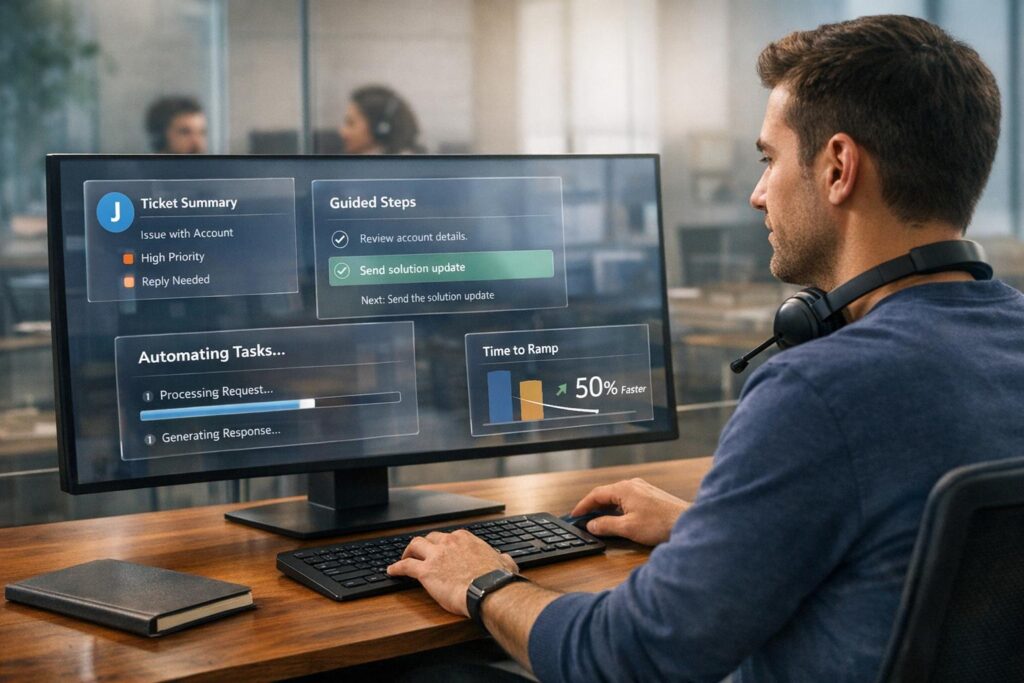
AI agent copilots can cut onboarding time by 50% by providing real-time guidance, automating repetitive tasks, and streamlining access to essential knowledge. Traditional onboarding often wastes time with scattered resources and manual processes. Copilots solve this by integrating into existing workflows, offering instant answers, step-by-step guidance, and automated coaching.
Key Insights:
- 75% of new agents’ time is spent searching for information. AI copilots eliminate this with real-time retrieval.
- Companies using AI report 40% faster training completion and reduce onboarding time by up to 5 days.
- Features like auto-assist, ticket summaries, and live feedback help agents become independent faster.
Example Results:
- An e-commerce company reduced ramp-up time from 21 days to 11 days using AI tools.
- AI copilots can cut escalations by 50% and improve resolution times significantly.
By automating learning, providing instant feedback, and reducing reliance on senior staff, AI copilots transform onboarding into a faster, more efficient process.
What AI Agent Copilots Do
Definition of AI Agent Copilots
AI agent copilots act as behind-the-scenes assistants, seamlessly integrated into your support platform. Unlike customer-facing chatbots that aim to resolve issues directly, copilots assist human agents by simplifying the handling of complex tickets. They remain invisible to customers while equipping agents with instant access to knowledge, suggested responses, and step-by-step guidance – all within the workspace.
"The AI handles the heavy lifting of searching internal databases, analyzing customer history, and suggesting perfect responses. But the human agent remains in complete control." – Ryan Smith, Decagon [4]
The role of copilots is to enhance an agent’s expertise, delivering timely and relevant information without taking over the decision-making process.
Core Features of AI Agent Copilots
AI agent copilots are particularly suited for B2B support environments, where tickets often involve multiple stakeholders, lengthy resolution times, and critical decisions. Some of their standout features include:
- Real-time knowledge retrieval: Quickly pulls up relevant articles, policies, or troubleshooting guides using semantic search. Each suggestion links directly to the original source.
- Auto Assist: Suggests next steps and allows agents to execute actions with just one click.
- Ticket Summaries: Compiles a concise history of long-running cases, saving agents from sifting through lengthy email chains.
- Suggested Macros: Recommends pre-written responses with confidence indicators, helping new agents choose the right answer quickly.
- Intelligent triage: Detects intent, language, and sentiment to provide agents with immediate context for a ticket.
- Enhanced writing tools: Refines tone and simplifies complex text, reducing the need for extensive brand voice training during onboarding.
For example, in October 2025, Rippling – a platform that combines HR and IT services – transitioned from a decision-tree AI to Decagon’s AI copilots connected to internal APIs. This upgrade improved routing accuracy and increased their chat deflection rate from 38% to over 50% [4].
These features are designed to address common onboarding and operational challenges by delivering agents the tools they need to perform effectively from day one.
How AI Copilots Solve Onboarding Problems
Traditional onboarding methods – like static documentation and repetitive shadowing – tend to be inefficient. New agents often spend more time searching for answers than resolving tickets, while experienced team members are repeatedly interrupted to address the same questions.
AI copilots tackle this problem by enabling real-time learning. Instead of memorizing policies or processes, agents receive step-by-step guidance for handling complex scenarios. This "Next Best Action" approach accelerates their learning curve and reduces the chances of errors.
Copilots also provide real-time feedback by flagging missing steps, potential policy risks, or tone inconsistencies. This reduces cognitive overload for new hires and helps them avoid costly mistakes.
Given that 77% of agents reported an increase in both workload volume and complexity over the last year [5], AI copilots offer a critical solution. They bridge the gap between AI handling routine inquiries and human agents managing high-stakes issues requiring empathy and judgment. Gartner forecasts that by 2029, agentic AI will resolve 80% of common issues autonomously [5]. This means human agents can focus on complex cases, making streamlined onboarding more essential than ever.
sbb-itb-e60d259
How to Cut Onboarding Time by 50% with AI Copilots
Set Up Real-Time Knowledge Assistance
Traditional onboarding often feels like a scavenger hunt – agents spend time memorizing policies, digging through scattered documents, or interrupting seasoned colleagues for answers. AI copilots simplify this process by pulling together information from all your team’s knowledge sources, like CRMs, JIRA, Confluence, Slack, and internal wikis, and delivering accurate answers directly within an agent’s workspace.
On average, agents spend up to 75% of their time manually searching for answers. Automating this process with AI can boost new agent efficiency by 35% because they get accurate answers on the first try[1]. For example, in April 2025, an e-commerce company used Convin‘s AI tools – including real-time call audits and an automated knowledge base – to slash agent ramp-up time from 21 days to just 11 days[6].
"With customer support AI tools like one-click answers and smarter search… New agents can increase efficiency by up to 35% because they save man hours by getting the right answer the first time." – Deon Nicholas, President, Forethought[1]
The secret lies in technologies like Retrieval-Augmented Generation (RAG), which ensures AI pulls answers exclusively from verified internal content. This minimizes errors and builds confidence among new agents as they get up to speed[2]. One standout example: Ontop implemented CustomGPT.ai to assist with knowledge retrieval and drafting responses, cutting average response times from 20 minutes to just 20 seconds[2].
By connecting your AI copilot to all relevant platforms, you can eliminate knowledge silos. Agents no longer need to juggle multiple tabs – they can focus on resolving tickets with instant access to verified information. The next step? Integrate AI-guided training to replicate real-world challenges and further streamline onboarding.
Build AI-Guided Training Workflows
AI-guided training takes onboarding beyond static presentations and classroom sessions. Instead of just absorbing information, agents get hands-on, scenario-based learning that mirrors real customer interactions. This dynamic approach prepares them for the complexities of the job.
Start by mapping out your 20–30 most common customer intents – like refunds or billing disputes – and define workflows, variations, and escalation points for each[7]. Be clear about "do" and "never" rules, including tone guidelines and how to handle sensitive information[7]. To ensure everything runs smoothly, test these workflows in shadow mode for 2–3 weeks before fully rolling them out[7].
"Treat ‘training’ as onboarding: give the worker the same materials, rules, and coaching you give a new agent." – EverWorker[7]
Speed up learning by giving agents access to a library of top-performing calls or interactions, analyzed by AI. Seeing real-life examples of successful resolutions helps new hires learn faster[6]. AI copilots can also provide live feedback during interactions – offering next-step suggestions or flagging policy breaches in real time. This kind of immediate, actionable guidance reduced customer escalations by 50%[6].
While traditional training often takes up to three months for agents to reach full productivity, AI-powered workflows drastically shorten this timeline. By combining real-world scenarios, peer learning, and live feedback, these tools directly contribute to cutting onboarding time in half.
Automate Performance Feedback and Coaching
Once agents are trained, automated feedback ensures they keep improving from day one. Manual quality assurance often falls short, auditing only a small percentage of interactions. AI copilots, however, can audit 100% of interactions and provide instant, personalized coaching based on sentiment and performance.
Through automated dashboards, managers can track the onboarding journey from start to finish and pinpoint exactly where agents struggle[8]. Real-time feedback helps correct mistakes immediately, ensuring new hires follow company policies from day one[1][2].
Structured, AI-driven onboarding doesn’t just speed up training – it also leads to better outcomes. New-hire retention jumps by 82%, and productivity increases by 70%[8]. Additionally, AI-powered quality audits and coaching have been shown to reduce customer escalations by 50%[6].
"When onboarding fails, the data shows exactly where it broke down, enabling targeted improvements." – AgentC2[8]
AI copilots also monitor performance metrics, helping managers spot learning gaps early. By addressing these gaps with targeted coaching, teams can prevent small issues from becoming bad habits. The result? Faster onboarding, better customer interactions, and confident agents who are ready to excel in their first week – all while achieving that 50% reduction in onboarding time.
How I built an AI agent team to manage employee onboarding
How to Measure the 50% Reduction in Onboarding Time
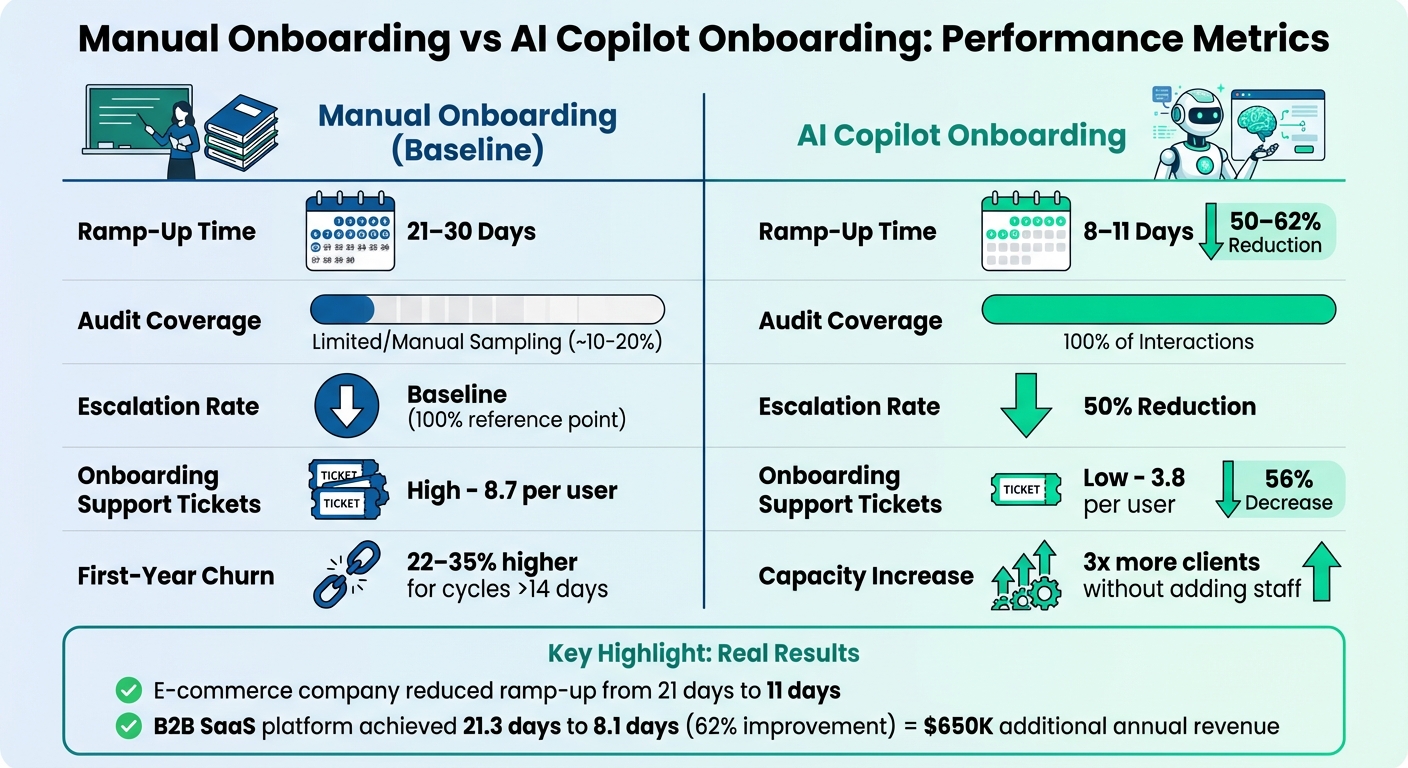
Manual vs AI-Powered Onboarding: Key Metrics Comparison
To confirm a 50% reduction in onboarding time, focus on measurable metrics that show how quickly agents become independent, how well they perform without support, and how results compare before and after adopting AI copilots. Together, these metrics highlight how AI tools not only speed up onboarding but also improve overall efficiency.
Track Time-to-Productivity
"Time-to-productivity", also known as ramp-up time, measures how long it takes a new agent to transition from their first day to independently managing customer interactions. To track this, document key milestones like the start date, training completion, and when the agent begins handling tasks solo.
A key metric here is time to first resolved ticket – the moment an agent completes a full cycle without assistance. Jennifer Park, Director of Growth at Prospectory, emphasizes its importance:
"Time to first closed deal is the single most important ramp metric. It’s the moment a rep proves they can execute the full sales cycle independently" [9].
AI copilots can dramatically shorten ramp-up times. For example, in February 2026, a B2B SaaS marketing platform used tools like Claude for document generation and Make.com for workflow automation. This reduced their average time-to-live from 21.3 days to just 8.1 days – a 62% improvement [3]. For companies with a $50,000 average contract value, this acceleration translated into an additional $650,000 in annual revenue [3].
To ensure accuracy when comparing cohorts, automate progress tracking through your CRM. Workflow triggers can update agent statuses as they hit milestones, reducing manual errors and providing clear "before and after" data.
Once you’ve assessed time-to-productivity, the next step is to evaluate how these changes impact escalations and resolutions.
Analyze Escalation and Resolution Rates
Speeding up onboarding is one thing, but the real test is whether agents can resolve issues independently. Track how often new agents escalate tickets to senior staff and how quickly they resolve customer inquiries. AI copilots should reduce both escalation rates and resolution times.
Pay attention to step-completion rates. If agents frequently stall at certain stages – like technical configurations – it could signal bottlenecks leading to escalations [3]. AI tools can identify these trouble spots and offer targeted coaching to address them.
The results can be dramatic. For instance, in February 2026, a support team using Forethought’s "Agatha" AI solution saw a 50% decrease in time to resolution and achieved a 90% accuracy rate in ticket classification [1]. Another company reduced onboarding-related support tickets per customer from 8.7 to 3.8 – a 56% drop – as agents became more self-reliant [3].
Also, monitor your AI resolution rate – how often AI solves issues without human intervention. As this rate improves, escalations decrease, and agent confidence grows.
Compare Before and After AI Implementation
Numbers provide the clearest picture. Start by establishing a baseline with metrics from pre-AI onboarding, then compare them to results from agents trained with AI copilots. The differences should be striking.
Here’s a snapshot of how manual onboarding compares to AI-assisted onboarding:
| Metric | Manual Onboarding (Baseline) | AI Copilot Onboarding |
|---|---|---|
| Ramp-Up Time | 21–30 Days | 8–11 Days |
| Audit Coverage | Limited/Manual Sampling | 100% of Interactions |
| Escalation Rate | Baseline | 50% Reduction |
| Onboarding Support Tickets | High (e.g., 8.7 per user) | Low (e.g., 3.8 per user) |
Companies with onboarding cycles longer than 14 days often face 22–35% higher first-year churn compared to those with cycles under seven days [3]. By cutting onboarding time in half, you’re not just saving time – you’re enhancing retention and agent satisfaction. Plus, streamlined AI onboarding enables teams to manage up to 3x more clients or hires without adding staff [3].
Conclusion
AI agent copilots have proven to slash onboarding time by 50%, giving support teams a powerful edge. By weaving training into live workflows, offering instant access to knowledge, and automating repetitive tasks, these tools help new hires hit the ground running.
The data speaks for itself: ramp-up times drop from 21 days to just 8–11 days [6]. Teams can handle three times as many customers without needing to expand their workforce [3].
The benefits are clear. AI-native support operations lead to fewer onboarding-related support tickets – down by as much as 56% in some cases – while boosting customer satisfaction scores and reducing first-year churn [3]. With AI copilots assisting new agents by guiding them through complex tasks, suggesting appropriate macros, and ensuring professional communication, agents quickly gain confidence and deliver consistent results.
Modern B2B support teams face unique challenges, like managing complex accounts, long-term cases, and renewal-focused relationships. Tools like Supportbench rise to meet these demands by integrating AI copilots with case management, knowledge bases, and workflow automation – all included from day one without costly add-ons. Features like 100% audit coverage, AI-driven ticket summaries, and intelligent search consolidate critical knowledge into a single, accessible platform.
The role of support agents is shifting. Instead of spending 75% of their time on manual tasks like research, agents now serve as "Service Architects", overseeing AI-powered workflows and concentrating on building meaningful customer relationships [1]. These advancements highlight the urgent need to move away from outdated onboarding methods.
Still relying on classroom training, manual document searches, and constant interruptions to senior staff? That approach is costing you time and money. Review your macros, establish feedback loops, and refine your AI systems. Teams that embrace AI-native support operations are already reaping the rewards of faster onboarding and greater efficiency – it’s happening now.
FAQs
What data should we connect to an AI copilot first?
To get started, link your existing knowledge base, such as policies, product documentation, and standard operating procedures (SOPs). This setup allows the AI to offer real-time support during both onboarding and day-to-day tasks.
On top of that, incorporating historical support tickets and interaction data gives the AI a clearer picture of recurring issues and typical resolution strategies. This added context not only boosts the AI’s ability to help new agents but also speeds up the onboarding process significantly.
How do we keep copilot answers accurate and compliant?
To make sure copilot responses are reliable and follow company guidelines, train the AI with your organization’s policies, product details, and workflows, anchoring it in your documentation. Keep tabs on its performance by tracking metrics like first contact resolution (FCR) and customer satisfaction (CSAT). Always cross-check responses against your knowledge base and include citations to minimize errors. Regular reviews are essential to ensure compliance with operational standards and to steer clear of inaccuracies or misinterpretations.
What KPIs show onboarding time dropped by 50%?
Key performance indicators (KPIs) highlight impressive outcomes like reaching full productivity in less than a week, slashing ramp-up time from four months to just one month, or reducing it from 21 days down to 8 days. These metrics clearly show how AI can dramatically speed up onboarding processes while boosting both efficiency and preparedness.