Agent seat pricing charges businesses for each support agent using a platform, regardless of usage. While this simplifies budgeting, it can lead to inefficiencies, especially as AI now handles 30–40% of tasks once managed by humans. Overages occur when businesses exceed their allocated seats, resulting in costly penalties during demand spikes like holidays or product launches.
Key Takeaways:
- Overage Penalties: Exceeding seat limits can double or triple costs during peak periods.
- Common Issues: Paying for unused licenses, mismanaging roles, and lacking real-time tracking.
- Solutions:
- Track usage in real time and set alerts for limits.
- Conduct regular audits to deactivate unused accounts and implement knowledge-centric solutions to improve efficiency.
- Use forecasting tools to predict demand and avoid overstaffing.
- Negotiate flexible contracts with usage-based pricing and caps on penalties.
By combining AI tools with smarter contract terms, businesses can cut costs, avoid penalties, and align pricing with actual usage.
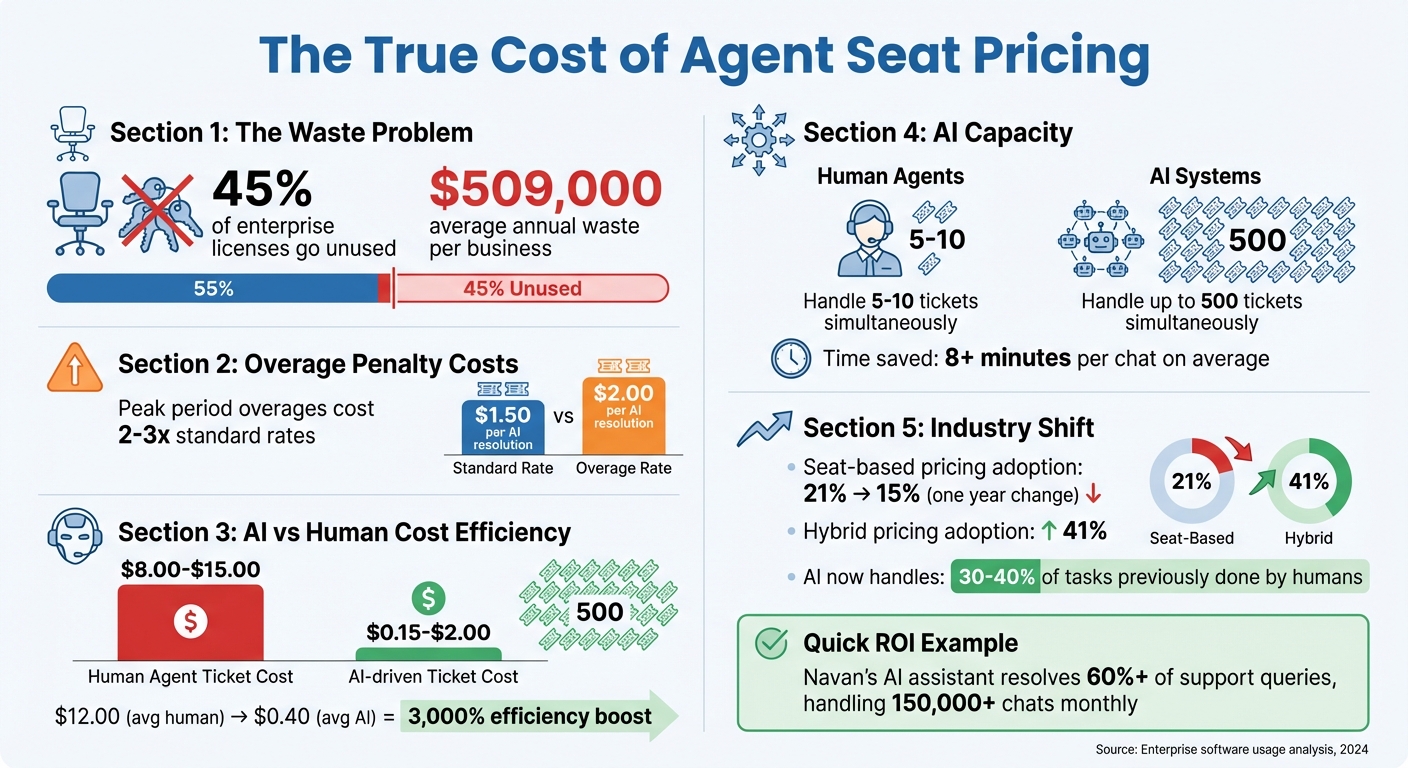
Agent Seat Pricing Cost Breakdown: Waste, Savings, and AI Efficiency Gains
Common Causes of Overage Penalties
Let’s delve into some key reasons why businesses often find themselves hit with unexpected overage penalties.
Peak Usage and Seasonal Demand
Customer interactions aren’t consistent throughout the year – they surge during holidays, marketing pushes, product rollouts, or service disruptions [1]. During these high-demand periods, companies can quickly exceed their allocated seat counts or AI usage limits. This can result in hefty overage fees, often costing 2 to 3 times the standard rate [6].
The problem is compounded because most subscription models don’t allow unused capacity from quieter periods to roll over. So, when demand spikes, businesses are left paying premium rates for short-term overages [7].
"Consumption is different. It moves with seasonality, marketing campaigns, outages, product launches, and the very efficiency gains AI is supposed to create. It can be fairer. It can also be spikier." – Rob Scott, CX Today [1]
Poor Agent Utilization
Mismanagement of licenses is another major contributor to unnecessary costs. For instance, failing to deactivate accounts for employees who’ve left the company can lead to significant waste [5]. Research shows that 45% of licenses in enterprise settings go unused, costing businesses an average of over $509,000 annually [5].
Another common error? Assigning full "Agent" roles to users like managers or subject-matter experts who only need limited access. These individuals could instead be classified as "Light Agents", which is far more cost-effective [5]. When licensing isn’t properly managed, usage data becomes fragmented, often resulting in unplanned expenses [5].
"The single biggest driver of waste is over-licensing… 45% of Zendesk licenses go unused." – Ben Pippenger, Co-Founder [5]
Lack of Real-Time Usage Tracking
Even with proper license management, insufficient monitoring can further drive up costs. Without real-time tracking of seat usage and AI consumption, businesses often only discover overages when the bill arrives – a frustrating and costly surprise [1][2].
Modern pricing models often combine metered AI usage with seat costs. For example, pre-committed AI resolutions might cost $1.50 each, but overages on a pay-as-you-go basis can jump to $2.00 per resolution [5]. Without tools to monitor usage in real time, businesses risk letting costs spiral unchecked [5][2].
"We couldn’t keep absorbing surprises. Governance gave us control, but more importantly, it gave us foresight." – Siroui Mushegian, CIO, Barracuda Networks [5]
Real-time tracking isn’t just about keeping tabs – it’s essential for balancing operational needs with financial control.
sbb-itb-e60d259
How to Monitor and Optimize Seat Usage
Addressing the challenges of seat usage requires a hands-on approach to tracking and managing resources. The key is to monitor usage in real time, conduct regular audits, and use forecasting to stay ahead of potential cost spikes.
Set Up Real-Time Usage Tracking
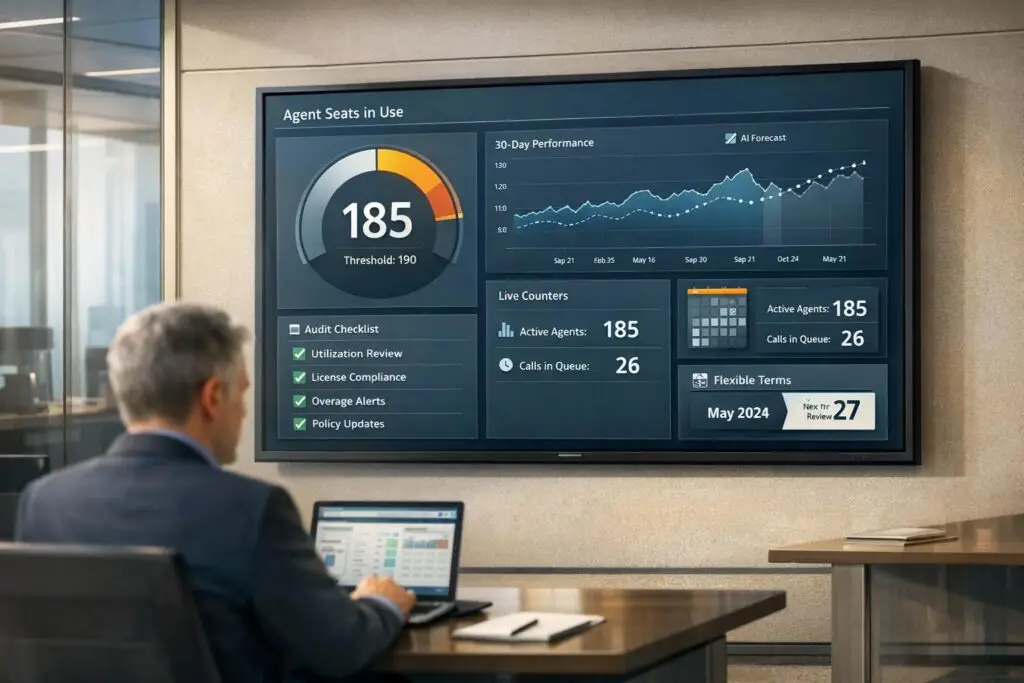
To manage costs effectively, you need clear visibility into who is using which seat and when. Real-time dashboards and automated alerts can help you identify potential overages before they turn into unexpected bills. Set up notifications to warn you when you’re nearing your seat limit or AI usage caps. This gives you the chance to adjust roles, reassign tasks, or negotiate additional capacity ahead of time.
For team members who only need to view performance metrics – like executives or finance staff – consider using third-party KPI dashboards instead of assigning them "Viewer" or "Agent" seats. This simple adjustment can cut down on unnecessary licensing costs while still keeping leadership informed [8].
Run Regular Seat Utilization Audits
Frequent audits of seat usage can uncover inefficiencies, such as inactive accounts or roles that are misallocated. For instance, suspended agents still occupy licenses, so downgrading them to "End User" status can instantly free up valuable seats [8].
Before making changes like downgrading or deactivating an agent, ensure that any unresolved tickets are reassigned to avoid service disruptions. A checklist can simplify the process: confirm whether admin rights are still needed, check for recent account activity, and verify that "Light Agent" roles haven’t accidentally been given administrative privileges, which could increase costs unnecessarily [8].
Use Forecasting Tools to Predict Demand
Forecasting helps you anticipate future seat requirements by analyzing historical data, seasonal patterns, and workforce planning metrics. For smaller teams, a straightforward capacity planning approach works: calculate the number of tickets each agent handles per hour, account for shrinkage (vacation, sick days, meetings, etc.), and monitor occupancy rates. A good target for agent occupancy is about 85% [9].
For larger teams, particularly those with over 100 agents, the Erlang Model can provide more precise predictions. This model factors in variables like handle time, query rates, and service level goals. Online Erlang calculators or Excel tools can simplify this process, helping you avoid overstaffing while maintaining service quality [9]. If your operations rely heavily on AI, usage-based metering tools can provide real-time data on consumption and billing, offering insights to safeguard your margins [2].
"Whatever data you apply and how you choose to apply it – if you don’t have a forecasting model, then you’re shooting from the hip when it comes to scaling your team." – Charlotte Ward, Director of Support, Snowplow [9]
Your forecasting method should align with your team’s priorities. For example, if delivering personalized, customer-focused support is a core value, consider adding extra time to your average handle time estimates to allow for relationship-building rather than purely transactional interactions [9]. Combining these forecasts with AI-driven insights can further streamline costs and improve efficiency.
Using AI to Reduce Costs and Improve Efficiency
AI is reshaping how businesses handle agent seat pricing by moving the focus from how many agents are employed to the outcomes they deliver. With tools for real-time tracking and audits, AI fine-tunes staffing, boosts efficiency, and manages costs more effectively. Instead of hiring more agents to deal with increasing support demands, AI steps in to automate repetitive tasks and improve how agents are utilized. This approach helps businesses avoid overage penalties while maintaining – or even exceeding – current service standards.
AI for Staffing Optimization
AI-powered tools can predict staffing needs by analyzing historical ticket data, seasonal patterns, and live demand signals. Unlike static forecasts, these systems adapt in real time, ensuring that staffing recommendations align with current conditions. Take Navan‘s AI-driven travel assistant as an example – it resolves over 60% of support queries and handles more than 150,000 chats every month [10]. This reduces the reliance on extra agent seats, even as the volume of inquiries grows.
The savings are substantial. Resolving support tickets with human agents typically costs between $8.00 and $15.00 per ticket. In contrast, AI-driven resolutions cost between $0.15 and $2.00 [11]. Shifting from a $12.00 human-handled ticket to a $0.40 AI-handled one results in a massive 3,000% efficiency boost [11]. By automating Tier 1 and Tier 2 issues, companies can maintain a smaller team while avoiding the need for additional licenses during busy periods. On top of this, AI enhances real-time usage tracking, unlocking even more cost-saving opportunities.
AI-Driven Utilization Insights
AI doesn’t just handle tickets – it keeps an eye on how agent seats are being used. By continuously analyzing agent activity, AI can identify underutilized seats and suggest automating repetitive tasks. This allows support teams to focus on more complex, high-value issues. By pinpointing inefficiencies, AI helps businesses avoid unexpected overage fees.
Traditional roles are also evolving. Many agents now act as "Conversation Architects", fine-tuning AI systems to improve automated resolutions [11]. Unlike human agents, who can manage only a handful of tickets at a time, AI systems can handle up to 500 tickets simultaneously [11]. On average, AI tools save more than 8 minutes per chat compared to traditional methods [10]. These improvements not only enhance efficiency but also lower overall costs.
AI for Cost Optimization
AI changes the game by breaking the link between support costs and customer growth. Instead of adding more seats as the customer base expands, AI scales dynamically, eliminating the need for additional licenses. This flexible scaling model helps businesses sidestep overage penalties and keep costs in check.
"If your support costs grow linearly with your customer base, your business model is fundamentally flawed." – Allen Seavert, AI AutoAuthor, SetupBots [11]
Negotiating Flexible Contracts to Avoid Penalties
To manage costs effectively, businesses need to negotiate contracts that align with actual usage rather than rigid, traditional pricing models. Fixed seat-based contracts often lead to overspending when demand fluctuates – whether it’s paying for unused capacity during slow periods or facing penalties during busy times. The solution lies in securing flexible terms from the start.
Request Usage-Based Pricing Clauses
One way to achieve flexibility is through hybrid pricing models. These combine a predictable base fee with metered charges for high-demand periods [3]. Instead of locking in a fixed number of seats, negotiate a base fee that includes a bundle of usage credits. This way, you only pay for what you actually use when demand spikes.
Another smart approach is to negotiate company-level usage pools, allowing tasks or resolutions to be shared across all users rather than being tied to individual seats [3]. For example, if your contract includes 100,000 tasks per month, those tasks should be accessible to any agent as needed, rather than divided into per-seat quotas that can create inefficiencies.
Clarity is also key. Insist on precise definitions for terms like "task", "conversation", or "resolution" [12]. Vendors sometimes exploit vague language to inflate charges – for instance, counting a customer’s three replies as three separate billable events rather than one conversation. Clear definitions in writing can help avoid unexpected costs.
Once usage-based pricing is in place, ensure penalties are manageable by adding provisions for alerts and caps.
Set Caps on Overage Penalties
To avoid spiraling costs, include clauses requiring real-time alerts when approaching usage limits [3][12]. These notifications can give your team time to adjust operations – like scaling back non-critical activities – before hitting overage penalties. Additionally, negotiate a hard cap, such as limiting overages to 150% of your contracted usage, with billing beyond that requiring explicit approval [3][12].
Another strategy is to pre-purchase additional usage packs at a discounted rate. For example, instead of paying $0.10 per task for overages, lock in bulk pricing at $0.07 per task for pre-bought bundles [3]. This approach can provide cost savings during high-demand periods.
Look for Scaled Pricing Models
Scaled pricing models offer another layer of protection. Negotiate tiered volume discounts, where the per-unit cost decreases as usage grows. For instance, you might pay $0.10 per task for the first 100,000 tasks, but only $0.07 per task for the next 400,000 [3][4]. This structure rewards growth without penalizing success.
For multi-year agreements, build in flexibility with exit clauses or annual adjustment rights [4]. These allow you to renegotiate commitments yearly or exit the contract without penalties if the platform no longer meets your needs. You can also request quarterly true-ups for enterprise contracts, adjusting commitments based on actual usage rather than facing monthly penalties [3].
"Structure is what keeps speed from turning into risk." – Jez Back, Cloud Economist & Global Offer Leader, Capgemini [5]
Lastly, avoid contracts with "clawback" clauses that revoke discounts or impose unfavorable pricing if you reduce seat counts during renewal [5]. As AI takes on more tasks, your need for human agents may decrease, and your contract should reflect this efficiency – not punish it.
Conclusion
Agent seat pricing should reflect actual workflows, not outdated models. The numbers speak for themselves: nearly 45% of licenses sit unused, leading to over $509,000 in wasted spending annually [5]. That’s a huge chunk of your budget that could be redirected toward AI tools, employee training, or scaling your business.
The industry is already moving away from rigid per-seat pricing. In just one year, adoption of seat-based models dropped from 21% to 15%, while hybrid pricing jumped to 41% [13]. This shift highlights the need for flexibility. With AI agents now handling 30% to 40% of tasks previously managed by humans [1], scaling operations should focus on automation and computing power – not just headcount. These trends make it clear: staying ahead means being proactive.
Regularly monitor and adjust seat usage. Conduct quarterly audits to recover unused licenses and set up real-time alerts at 80%, 100%, and 125% of usage limits to avoid unexpected costs [5][3]. Leverage AI insights to predict demand and adjust allocations before seasonal surges hit.
When it’s time to renew contracts, aim for hybrid pricing models. Combine a stable base fee with metered usage for peak periods [3]. Push for hard caps on overages and steer clear of clawback clauses [5]. Start renewal talks at least 90 days before the contract ends, armed with usage data and industry benchmarks, to negotiate better terms [5].
FAQs
What counts as an “agent seat” in my contract?
An “agent seat” is essentially a user license that allows a team member to access and carry out support tasks on the platform. These seats are linked to particular roles and permissions, ensuring each user has the right level of access. Interestingly, not all roles demand a full seat – roles like contributors or light agents might fall under different terms based on your contract.
How can I predict seat needs before peak demand hits?
Predicting seat requirements ahead of peak demand calls for a strategic approach. Start by analyzing historical support data to understand patterns in volume, seasonality, and the influence of upcoming events. Workforce management tools can be a game-changer here – they allow you to simulate scenarios by factoring in metrics like average handle time (AHT) and agent availability. By blending historical insights with AI-powered algorithms, you can spot trends more effectively and create precise staffing forecasts. This minimizes the chances of overstaffing or understaffing during those critical high-demand periods.
What contract terms best prevent surprise overage charges?
Contracts that outline clear usage limits and incorporate automated overage billing can help avoid unexpected charges. Terms should specify predefined allowances and include automatic billing for any usage that exceeds those limits. This approach promotes transparency and makes it easier for businesses to keep their costs under control.