Call center agents often struggle without the right tools and training, leading to high stress, low customer satisfaction, and high turnover rates. Here’s how structured, AI-powered training can fix this:
- Problem: 86% of agents lack necessary resources, causing 60% of first-contact resolutions to fail.
- Solution: An 8-week training plan using AI tools improves first-call resolution (FCR) to 80-90% and cuts onboarding time by up to 50%.
- Key Results: AI-driven programs reduce call times, improve customer satisfaction by 6.4%, and help agents handle complex issues effectively.
This guide outlines a step-by-step training plan, focusing on skill-building, AI integration, and measurable outcomes to improve agent performance and reduce costs.
5 Best Practices for Call Center Agent Training
How to Build a Call Center Training Program
To tackle issues like long call times and low customer satisfaction, it’s crucial to address the gaps in your current processes. The first step? Understand what your agents actually need. A staggering 60% of contact center leaders admit that traditional training methods just don’t cut it when it comes to improving call quality. The better approach? Focused, AI-driven training with clear, measurable objectives.
Identify Skill Gaps and Set Training Goals
AI can be a game-changer here. By analyzing 100% of your call transcripts, chats, and emails, AI-powered quality assurance (QA) tools can identify exactly where agents are falling short. This is a huge leap from manual QA, which typically reviews just 1–2% of interactions. Whether the issue is low empathy, weak probing techniques, or incorrect troubleshooting, AI can pinpoint the root cause. Use weekly agent scorecards to highlight the top three challenges your team is facing.
Once you’ve identified the gaps, focus on setting SMART goals – specific, measurable, achievable, relevant, and time-bound. For example, you could aim to boost First Call Resolution (FCR) by 20% within two months or cut Average Handle Time (AHT) by 1.5 minutes per call. Dharvi Sharma from Enthu.ai sums it up perfectly:
"Training doesn’t fix poor performance – targeted training does".
With these goals in mind, design a training program that directly addresses the identified gaps.
What to Include in Your Training Curriculum
Structure your training into three layers: Foundation Training (covering company basics, tools, and workflows), Applied Skills Training (leveraging tools like Supportbench’s Agent-Copilot for real-time help), and Advanced Scenarios (for handling complex B2B escalations and multi-stakeholder cases).
| Training Component | Purpose | Recommended Format |
|---|---|---|
| Process Training | Tools and workflows | Screen shares, AI simulations |
| Soft Skills | Tone, empathy, active listening | Role-plays, AI coaching bots |
| Product Knowledge | Accurate technical responses | Quizzes, RAG-powered search |
| Compliance | Legal and audit risk reduction | Mock call drills, policy docs |
Before launching your training, audit your knowledge resources. Consolidate help center articles, Slack threads, and policy documents into a single, version-controlled source of truth. Use Retrieval-Augmented Generation (RAG) technology to link your AI tools to this knowledge base. This ensures both agents and AI assistants are working with the most up-to-date information, avoiding "knowledge sprawl."
Establish clear AI usage protocols, such as rules for handling personally identifiable information (PII), escalation triggers (e.g., suspected fraud), and approvals for high-value actions like refunds. To ensure accuracy, run AI tools in "shadow mode" for a few weeks before allowing them to operate independently.
Training Methods and Resources
Once your curriculum is ready, select training methods that reinforce learning across different scenarios. Use a mix of formats to suit varied learning styles. Instructor-led sessions are great for introducing new policies and concepts. Role-playing exercises and AI-driven simulations provide a safe space for agents to practice handling complex interactions. These simulations can even improve FCR by up to 40%.
For new hires, pairing them with top-performing agents through shadowing sessions offers invaluable real-world insights. Meanwhile, self-paced microlearning modules – kept under 30 minutes – help agents stay engaged without pulling them away from their duties for long stretches. Fun fact: eLearning boosts knowledge retention rates to 60%, compared to just 10% with traditional classroom methods.
Finally, establish a system for continuous improvement. Meet weekly with QA teams to turn common agent mistakes into quick, three-minute microlearning refreshers. Use anonymized call recordings to showcase examples of poor, average, and excellent performance. This approach keeps training practical and directly tied to the challenges your agents face daily.
8-Week Call Center Training Schedule
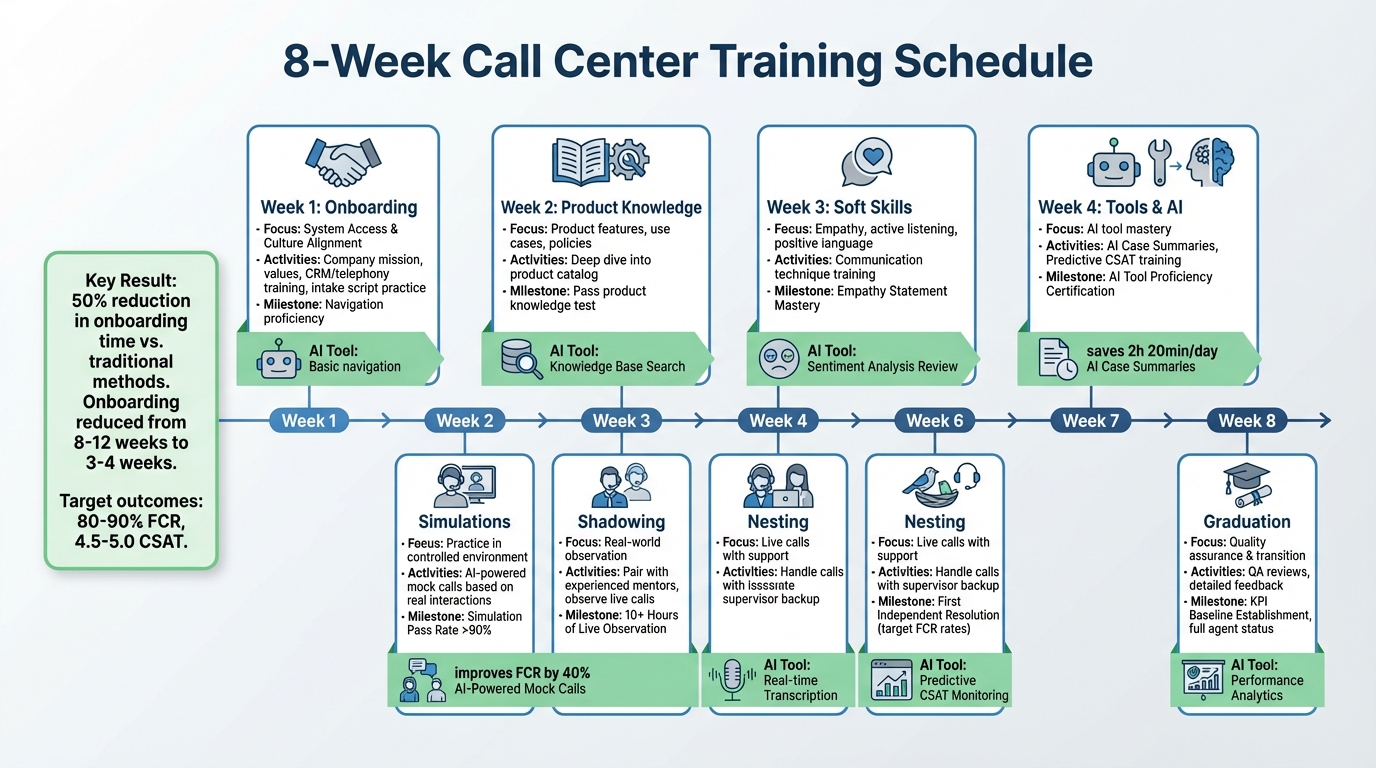
8-Week Call Center Training Schedule with AI Integration Milestones
Week-by-Week Training Plan
This 8-week training program is designed to gradually build skills and keep agents motivated throughout. Week 1 starts with orientation, where agents get familiar with the company’s mission, values, and basic tools like the CRM and telephony systems. They also practice intake scripts repeatedly until they become second nature.
In Week 2, the focus shifts to product knowledge. Agents dive into the key features, common use cases, and company policies. By the end of the week, they’re required to pass a detailed product knowledge test.
Week 3 hones soft skills, emphasizing empathy, active listening, and the use of positive language to handle customer interactions effectively.
Week 4 is all about technical skills, including mastering AI tools. Agents learn to use features like AI Case Summaries to quickly review customer histories and Predictive CSAT tools to monitor call quality in real time.
In Week 5, agents participate in simulations and role-playing exercises. Using AI-powered mock calls based on real interactions, they practice their skills in a controlled, risk-free environment.
Week 6 pairs new hires with experienced mentors for shadowing sessions. This allows them to observe live calls and learn how to navigate systems in real-world scenarios.
By Week 7, agents enter the nesting phase, where they handle live calls with immediate supervisor support. The goal is to achieve target First Call Resolution (FCR) rates on straightforward customer queries.
Finally, Week 8 wraps up the program with quality assurance reviews, detailed feedback, and the transition to full agent status with clear KPIs in place.
A similar program implemented in May 2025 demonstrated a 50% reduction in onboarding time compared to traditional methods. Companies using guided workflows have reported cutting onboarding time from 8–12 weeks down to just 3–4 weeks for comparable skill levels.
This structured plan lays the groundwork for integrating AI tools to accelerate skill development even further.
How AI Tools Speed Up Training
AI tools play a significant role in streamlining the training process, offering real-time insights and actionable feedback to shorten timelines while improving results. For example, during Week 4, agents are introduced to Supportbench’s AI Agent-Copilot. This tool pulls relevant information from past cases and the knowledge base, saving agents up to 2 hours and 20 minutes per day.
In Week 5, AI-powered simulations recreate real-world customer interactions, helping agents improve FCR by up to 40%. By Week 7, agents use AI Case Summaries during live calls to quickly grasp complex ticket histories. Meanwhile, Predictive CSAT monitoring helps trainers identify and assist struggling agents before negative feedback from customers occurs. AI tools are initially run in "shadow mode" for 2–3 weeks to ensure accuracy before being used autonomously.
| Week | Focus Area | Key Milestone | AI Tool Integration |
|---|---|---|---|
| 1 | Onboarding | System Access & Culture Alignment | Navigation |
| 2 | Product Knowledge | Product Quiz | Knowledge Base Search |
| 3 | Soft Skills | Empathy Statement Mastery | Sentiment Analysis Review |
| 4 | Tools & AI | AI Tool Proficiency Certification | AI Case Summaries |
| 5 | Simulations | Simulation Pass Rate >90% | AI-Powered Mock Calls |
| 6 | Shadowing | 10+ Hours of Live Observation | Real-time Transcription |
| 7 | Nesting | First Independent Resolution | Predictive CSAT Monitoring |
| 8 | Graduation | KPI Baseline Establishment | Performance Analytics |
sbb-itb-e60d259
Skills, Tools, and Workflows for Modern Call Centers
Required Skills for Call Center Agents
In today’s call centers, B2B support agents need a robust skill set to handle increasingly complex challenges. Empathy and emotional intelligence are non-negotiable, as 64% of customers value agents who show emotional awareness, and 80% expect a higher level of empathetic service when they reach out for help. With 61% of customers attempting self-service options before contacting support, agents are often left to tackle the toughest issues.
Another must-have skill is the ability to collaborate with AI. Agents now work alongside AI copilots, interpreting AI-generated insights and ensuring smooth transitions between automated systems and human interactions. Active listening has evolved too – it’s no longer just about hearing words but using tools like AI-driven sentiment analysis to understand customer intent and deliver tailored responses. On top of this, agents rely on real-time analytics and AI-powered quality metrics to make informed, data-backed decisions.
In high-pressure B2B scenarios, resilience and flexibility are essential. For example, 88% of B2B customers are more likely to remain loyal if they receive excellent service. On the flip side, customer satisfaction can drop by 15% for every repeated call about the same issue, and 73% expect their problems to be solved on the first contact. AI tools play a critical role in enabling agents to meet these high standards by streamlining operations and allowing them to focus on resolving complex issues.
Using Supportbench‘s AI Features
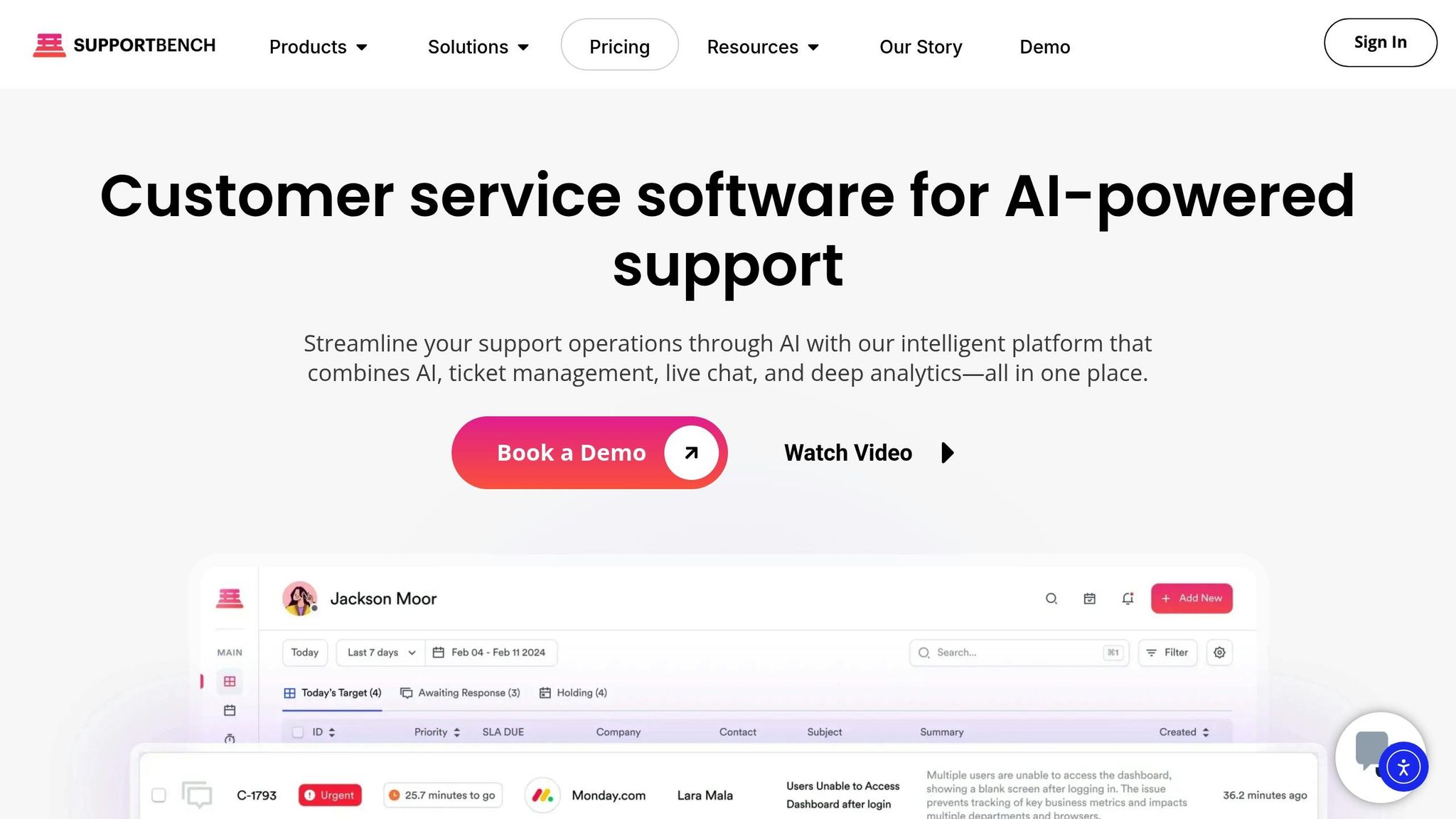
Supportbench’s AI capabilities take agent performance to the next level. The AI Agent-Copilot, for instance, pulls relevant insights from past cases and the knowledge base, providing instant, context-aware assistance. AI auto-responses draft replies based on case history and unified knowledge sources, significantly reducing response times. Dynamic SLA management is another standout feature, triggering automated alerts and escalations well before any breaches occur, ensuring proactive case handling. Additionally, AI-powered quality assurance reviews every customer interaction, which has been shown to boost customer satisfaction by 31% and improve loyalty metrics by 24%.
These tools free agents from time-consuming administrative tasks, allowing them to focus on solving the more nuanced and challenging problems customers face. By integrating these AI features, call centers are transitioning from traditional workflows to more efficient, tech-driven methods.
Traditional vs. AI-Powered Workflows
A side-by-side comparison of traditional and AI-powered workflows highlights just how much AI improves efficiency. In older systems, ticket sorting was a manual task handled by supervisors. Today, AI-powered triage automatically categorizes and prioritizes tickets based on sentiment and urgency.
Similarly, quality assurance has undergone a major upgrade. Traditional QA methods involved manually reviewing just 1–2% of interactions. Now, AI tools analyze 100% of calls, chats, and emails, identifying compliance risks and opportunities for coaching. Access to information has also been streamlined – while agents once had to dig through static manuals or PDFs, AI copilots now provide real-time, centralized knowledge.
Even onboarding has been transformed. Traditional training programs often took 4–8 weeks for new agents to become fully productive. With AI-driven simulations and personalized learning paths, that timeline has been cut in half, with agents reaching full productivity in just 2–4 weeks.
| Feature | Traditional Workflow | AI-Powered Workflow |
|---|---|---|
| Triage | Manual ticket sorting | Automated prioritization based on sentiment and urgency |
| QA Review | Manual sampling of 1–2% of interactions | Automated analysis of 100% of interactions |
| Knowledge Access | Searching static PDFs or manuals | AI Copilot retrieves real-time data from unified knowledge bases |
| Onboarding Speed | 4–8 weeks to reach full productivity | 2–4 weeks via AI simulations and personalized paths |
| SLA Management | Manual tracking; reactive to breaches | Dynamic SLA management with proactive alerts and automated escalations |
| After-Call Work | Manual typing of summaries and notes | AI-generated summaries and transcripts |
For example, in May 2025, the travel company Etraveli adopted Smart Role‘s AI-driven simulation platform to train over 100 support agents. This initiative reduced onboarding time by 50%, allowing new hires to handle live calls and reach full productivity within just two weeks. These advancements in workflows are reshaping how call centers operate, making them more efficient and customer-focused than ever before.
Measuring Results and Improving Training
How to Measure Training Success
To gauge the success of your training programs, aim for an FCR (First Contact Resolution) rate of 80–90%, a CSAT (Customer Satisfaction) score between 4.5 and 5.0, and ramp-up times of 2–4 weeks. By integrating AI-driven quizzes and predictive detection tools, you can track key performance indicators (KPIs) to ensure your training aligns with broader operational goals.
With advancements in AI-powered Quality Assurance (QA), you can now review 100% of customer interactions, a massive leap from the traditional manual sampling of just 1–2%. This shift has led to a 31% improvement in CSAT and a 24% boost in loyalty metrics. Another critical metric, Average Handle Time (AHT), should be monitored closely – keeping it under 5 minutes without compromising service quality is ideal.
Additionally, track your agent retention rates, aiming for a benchmark of over 85%. To calculate your Training ROI, use the formula:
(Revenue generated or retained – Support costs) ÷ Support costs × 100. Considering that agent turnover in call centers averages 30–45% annually, effective training can significantly impact your bottom line.
Use these metrics not just to measure success but as a foundation for ongoing improvements. Regularly gather agent insights to refine and enhance your training programs.
Collecting Feedback and Updating Training
Gathering feedback from agents right after each training session is essential. Collect targeted input on what worked well, what didn’t, and which areas need more depth. Weekly coaching sessions using anonymized call recordings can help address the top three behavioral challenges. Ask specific, actionable questions like:
- What aspects of the training were most helpful?
- Where did it fall short?
- Which topics require further explanation?
It’s worth noting that 60% of contact center leaders feel their training programs fail to improve call quality, while 87% of agents report high stress levels due to inadequate training.
To avoid overwhelming new hires – something experienced by 81% of employees during onboarding – pilot your training programs with a small group of agents first. This allows you to fine-tune the content based on their feedback before a full rollout. Additionally, review and update your training materials every three months, incorporating both agent feedback and customer satisfaction data to keep the content relevant and impactful.
Advanced Training and Skill Development
Once the basics are in place, focus on advancing your team’s skills through specialized workshops and peer mentoring. Host bi-weekly workshops that dive into advanced topics like AI features and handling complex B2B scenarios. These sessions should spotlight tools such as Supportbench’s AI Agent-Copilot and cover critical situations like refund limits, suspected fraud, and compliance issues that demand immediate escalation to human experts. Since 60% of failed FCR attempts stem from agents not having the right data, advanced training should emphasize effective use of AI-powered knowledge retrieval systems.
Pairing new hires with top-performing agents for mentorship can also accelerate learning and improve overall performance. This peer-to-peer approach creates a supportive environment for discussing challenging cases. To further sharpen skills, incorporate scenario-based simulations that replicate rare, high-stakes customer interactions. Adding gamified elements like leaderboards, badges, and points can increase knowledge retention by 25% and encourage agents to revisit training modules nearly three times as often.
As your team grows more proficient in these advanced areas, you’re likely to see improvements in occupancy rates (targeting 85–90%) and overall operational efficiency.
Conclusion
Structured training plays a crucial role in delivering a standout customer experience in today’s call centers. With annual agent turnover rates ranging from 30% to 45% and 73% of customers expecting their issues to be resolved on the first contact, inadequate training can lead to dissatisfied customers and longer handle times. These challenges highlight the growing importance of adopting new strategies, including the integration of AI, to transform call center operations.
When paired with well-designed training programs, AI-powered tools take operational efficiency to the next level. Instead of relying on static manuals, call centers can implement AI-driven simulations and real-time coaching to cut onboarding time by up to 50% and boost first-call resolution rates by as much as 40%. These advancements not only streamline the onboarding process but also equip agents with the skills they need to resolve customer issues more effectively from day one.
This shift from traditional methods to AI-enhanced workflows allows teams to prioritize what truly matters: empathy, critical thinking, and solving complex problems. Routine tasks and quality assurance are handled by AI, which ensures 100% coverage compared to the typical 1–2% achieved through manual sampling. This comprehensive data-driven feedback accelerates agent development and transforms each interaction into a learning opportunity. By adopting these strategies, high-performing teams set themselves apart from those struggling to keep up.
As Thibaut Martin, Co-founder of Smart Role and former CX leader at Google, aptly states:
"Success in customer service is 10% knowledge and 90% how you apply it in real situations."
FAQs
How does AI help improve training for call center agents?
AI is transforming call center training by creating tailored and effective learning opportunities. With AI-powered simulations, agents can engage in realistic scenarios without any risk, sharpening their problem-solving abilities and communication techniques in a safe setting.
AI also provides on-the-spot coaching by analyzing live conversations and delivering immediate feedback. This helps agents adapt and improve during interactions. By continuously monitoring performance, AI pinpoints areas where skills need improvement, enabling focused training that shortens onboarding time and enhances overall efficiency. The result? Quicker issue resolution and happier customers.
What are the essential elements of a successful call center training program?
A well-designed call center training program is all about giving agents the skills, tools, and knowledge they need to deliver top-notch customer service. This means focusing on core skills like clear communication, in-depth product knowledge, empathy, and adherence to compliance standards. These fundamentals ensure agents can confidently manage a wide range of customer interactions.
To keep training engaging and effective, a blended learning approach works best. This could include live sessions, eLearning modules, role-playing scenarios, and even gamification to make learning more interactive. Regular performance assessments and competency checks are also essential for tracking progress and pinpointing areas that need attention.
Modern programs go beyond the basics, emphasizing soft skills like emotional intelligence and handling objections gracefully. They also prepare agents for the tech-driven world of customer support by introducing them to tools like AI and omnichannel workflows. By aligning training with broader business goals, agents are set up to resolve issues faster, minimize escalations, and enhance overall customer satisfaction.
How do AI tools speed up onboarding for new call center agents?
AI tools make onboarding smoother by creating realistic simulations that replicate actual customer interactions. These simulations give new agents a safe space to practice, helping them gain experience without the pressure of real-world consequences. Plus, AI provides instant feedback, highlighting areas where agents can improve and boosting their confidence as they refine their skills.
On top of that, AI-powered personalized training programs adjust to each agent’s learning pace. This ensures they spend more time on areas where they need improvement, speeding up their readiness for live customer interactions. By automating repetitive training tasks and delivering actionable insights, AI cuts down the time it takes for new agents to become fully prepared for their roles.