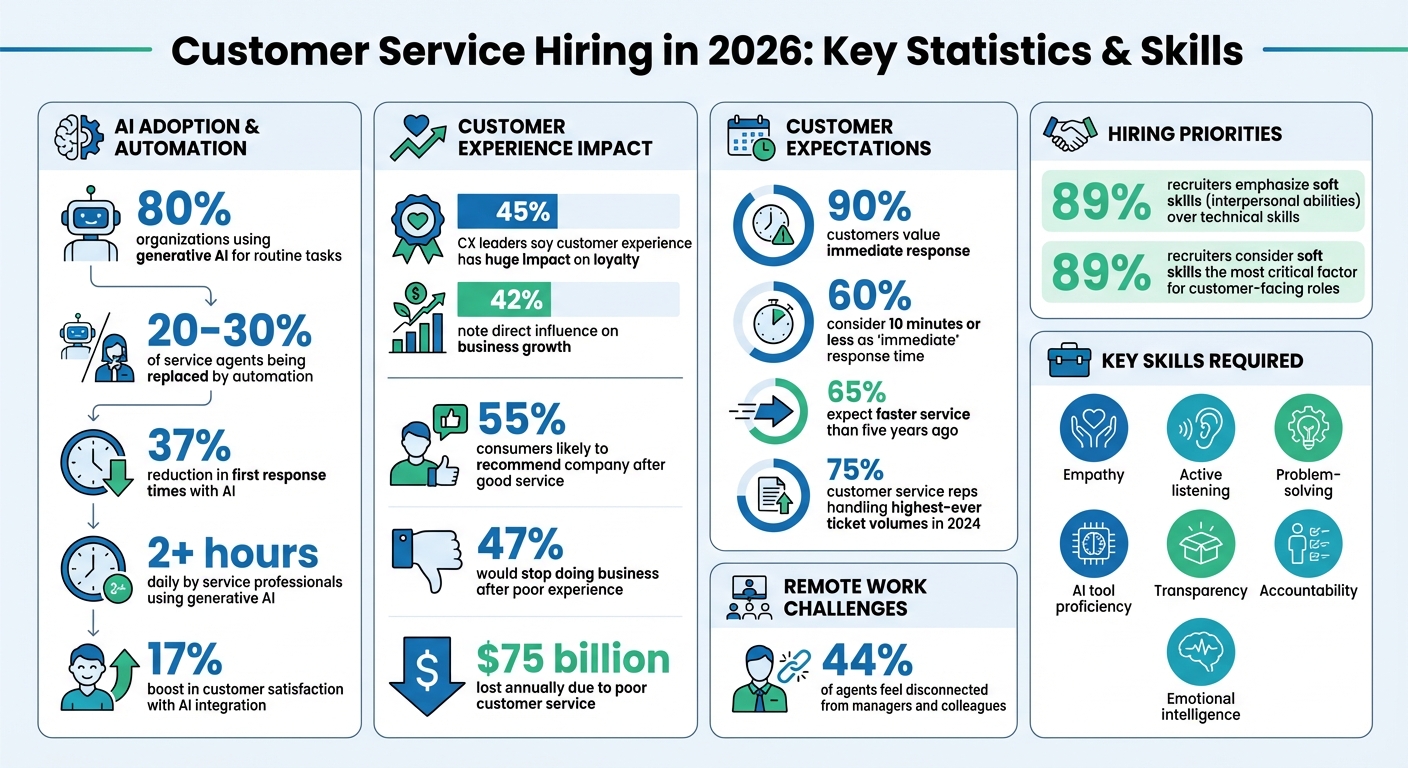
Customer service hiring in 2026 demands a mix of empathy, problem-solving, and AI expertise. With 80% of customer service organizations using generative AI for routine tasks and 20%-30% of service agents being replaced by automation, candidates must now balance emotional intelligence with AI management skills. Recruiters prioritize soft skills, with 89% emphasizing interpersonal abilities over technical ones.
Here’s what you need to know:
- Key Skills: Empathy, active listening, problem-solving, and AI tool proficiency.
- AI Integration: Candidates must manage, refine, and collaborate with AI tools, improving both customer satisfaction and operational efficiency.
- Soft Skills: Transparency, accountability, and emotional intelligence remain critical for building lasting customer relationships.
- Hiring Focus: Questions now assess a candidate’s ability to handle complex issues, leverage AI, and maintain professionalism under pressure.
The article outlines 12 targeted interview questions, each designed to evaluate these qualities. Examples include:
- What does excellent customer service mean to you?
- How do you handle negative feedback?
- How do you use AI tools in customer service?
Customer Service Hiring Statistics 2026: AI Integration and Skills Requirements
Customer Service Rep Interview Questions and Answers – How to Get Hired as a Customer Service Rep
1. What Does Excellent Customer Service Mean to You?
This question digs into whether candidates can balance problem-solving with building genuine human connections while delivering measurable results. Why is this balance so important? Because customer experience drives loyalty and growth – 45% of CX leaders say it has a huge impact on customer loyalty, and 42% note its direct influence on business growth.
Key traits like active listening, empathy, and proactive problem-solving make candidates stand out. For instance, personalized follow-ups and anticipating customer needs can turn a good interaction into a memorable one that fosters loyalty. Consider this: 55% of consumers are likely to recommend a company after receiving good service, but 47% would stop doing business with one after a poor experience.
When evaluating responses, look for a balance between efficiency and empathy. As Kirsty Traill, Former VP of Customer Support at Hootsuite, puts it:
"I think the most important skill and the one that’s harder to train for is customer empathy and a customer-centric attitude".
Candidates who focus solely on speed without addressing empathy, or who give vague answers without examples, may raise concerns. On the other hand, strong responses emphasize accountability and transparency – like owning mistakes, providing honest explanations, and setting realistic expectations.
In today’s AI-driven support landscape, excellent candidates should also understand how to leverage AI tools for routine tasks, allowing human agents to focus on complex issues that require critical thinking and emotional intelligence. This combination of empathy, accountability, and effective use of technology demonstrates a forward-thinking approach to customer service.
2. Why Are You Interested in Working for Our Company?
This question helps uncover whether candidates have taken the time to understand your company’s values and support philosophy. Strong responses go beyond surface-level statements like "I enjoy helping people." Instead, they show that the candidate has done their research. For instance, they might reference your dedication to mental health initiatives or your investment in employee development programs, as highlighted in employee reviews. This not only shows they’ve looked into your company but also suggests they could thrive in your AI-driven support environment.
The best answers connect the candidate’s personal values with your company’s mission, emphasizing a shared focus on building lasting customer relationships rather than addressing issues in a purely transactional way. This is particularly important because 89% of recruiters consider soft skills the most critical factor when hiring for customer-facing roles.
Candidates should also highlight their awareness of how your team uses AI to handle routine tasks, allowing agents to focus on more complex B2B challenges. As Matthew Finio from IBM Think explains:
"The best results come from combining the speed and data insights of AI with the empathy and critical thinking people can provide".
This combination of technology and human skills showcases the modern expertise needed to succeed on your team.
Watch out for vague responses or those overly focused on personal benefits without connecting to your organization’s goals. The best candidates often use the STAR method to provide clear, specific examples of how their values and experiences align with your company’s philosophy.
Encourage applicants to ask thoughtful, culture-focused questions about team dynamics or training opportunities to further demonstrate their genuine interest.
3. How Do You Handle Negative Customer Feedback?
This question evaluates how well a candidate can stay calm under pressure and turn criticism into actionable improvements. In B2B support, where a single escalation can significantly affect revenue retention, this skill is particularly important. Poor customer service collectively costs businesses about $75 billion annually, making it vital to approach feedback as an opportunity rather than a setback.
The strongest candidates explain how they allow customers to share their frustrations fully, acknowledge their concerns, and focus on finding lasting solutions. They should emphasize taking ownership of the issue – even if it wasn’t their fault – and asking open-ended questions to uncover the root cause rather than offering quick, surface-level fixes. Answers that highlight collaboration with product or engineering teams to prevent recurring problems are especially compelling.
Using the STAR method (Situation, Task, Action, Result) to frame their responses can show how they’ve successfully handled similar situations in the past. For example, a candidate might describe turning a frustrated enterprise client into a loyal advocate by identifying and resolving a configuration error affecting multiple accounts. As Alaina Franklin, Director of Customer Success at Zendesk, puts it:
"We all need to know what we could do better, or someone else will do it better".
Candidates should also demonstrate their ability to balance responsiveness with professionalism. While 90% of customers value an immediate response, it’s equally important to set boundaries when faced with abusive behavior. The best hires see negative feedback as a tool for refining processes and improving products, not as a personal attack. They might mention strategies like taking a quick pause to reset after a tough interaction to maintain consistent service quality.
In support environments that incorporate AI tools, candidates should show familiarity with technologies like sentiment analysis to help identify escalating situations early. However, they should also highlight the importance of human judgment in resolving issues and rebuilding trust. The ultimate goal isn’t just to resolve a complaint but to turn dissatisfied customers into advocates while feeding valuable insights back into the organization’s support operations.
4. How Would You Respond to a Customer Request You Cannot Fulfill?
This question sheds light on a candidate’s ability to balance protecting company resources with maintaining strong customer relationships. In B2B settings, declined requests often involve high-value enterprise clients, where a poorly handled "no" could lead to significant churn. In fact, businesses lose approximately $75 billion annually due to bad customer experiences.
The key to handling such situations lies in turning a denial into an opportunity to provide alternatives. Strong candidates avoid outright refusals. Instead, they explain the technical or policy reasons behind the limitation and quickly pivot to what is possible. Transparency is critical – whether the limitation stems from performance concerns, compliance obligations, or product roadmap priorities, customers deserve a clear explanation rather than vague corporate language. The best candidates demonstrate how they’ve guided customers toward alternative workflows, third-party tools, or similar features that achieve the desired results without violating policies.
A thoughtful response often begins with acknowledging the customer’s frustration. From there, candidates should reframe the conversation by focusing on finding the best solution within the available constraints. Girish Mathrubootham, CEO of Freshworks, emphasizes this approach:
"Good customer service means that the support rep has to put herself in the customer’s shoes and see the problem from the customer’s point of view before coming up with a solution".
The ability to educate customers tactfully is equally important. For example, when a request conflicts with stated policies, candidates can use documentation to clarify limitations without sounding dismissive or condescending.
The strongest candidates back up their responses with specific examples. For instance, they might describe a time when they declined a custom integration request but proposed a viable alternative that met the customer’s needs. They should also highlight their ability to set realistic follow-up timelines and leverage AI tools – like internal knowledge bases or collaboration platforms – to quickly identify and communicate alternatives.
Watch out for red flags, such as candidates who immediately escalate issues to managers, offer vague assurances like "I’ll look into it", or fail to address the customer’s underlying need. The ideal approach involves maintaining trust by being upfront about limitations while avoiding scope creep. This ensures that even when requests are declined, customers walk away feeling supported and confident in your team’s reliability.
5. Tell Us About a Time You Resolved a Difficult Customer Issue
This question helps uncover how a candidate handles challenging situations under pressure. The strongest answers follow the STAR method – Situation, Task, Action, and Result – offering a structured narrative that highlights their problem-solving process. It’s not just about what they did but how they approached the issue, collaborated with others, and delivered measurable outcomes. These qualities are especially valuable in today’s workplaces, where human insight often complements AI tools.
A good response starts with active listening. Candidates should describe how they fully understood the issue by gathering details and calming any tension. The next step involves digging deeper to find the root cause rather than just addressing surface-level symptoms. For instance, a billing complaint might trace back to unclear product documentation that has confused multiple customers. Identifying and addressing these underlying problems not only resolves the immediate issue but also prevents similar cases in the future – a hallmark of exceptional customer support.
Accountability and empathy are key traits to look for. Stacy Justino, Director of Customer Happiness at Wistia, highlights the importance of:
"Problem-solving skills, curiosity, adaptability, accountability, and collaboration skills".
Candidates should provide specific examples, such as naming the customer, detailing the timeline (e.g., "resolved within 4 hours"), and explaining the measurable impact of their actions. Vague answers like "I always try my best" or stories where the candidate immediately escalated the issue without trying to resolve it themselves are red flags. Sarah Judd Welch explains:
"I ask them to give an example of a time they advocated on behalf of someone else… I’m closely paying attention to how they describe the actions of others; you don’t want them to harshly blame anyone else, but objectively assess the situation and how they tried to resolve it".
Candidates who take responsibility and maintain a constructive tone are far more likely to excel in demanding roles, especially in B2B settings.
Lastly, strong candidates emphasize follow-up. They don’t just resolve the issue and move on – they check back with the customer to ensure long-term satisfaction. This level of attention is critical, particularly when 47% of consumers would stop doing business with a company due to poor service, while 55% are more likely to recommend a company after a positive experience. By following up, candidates demonstrate a commitment to turning challenges into opportunities for building loyalty and trust.
6. How Do You Prioritize When Multiple Customers Need Help Simultaneously?
This question sheds light on a candidate’s ability to handle prioritization under pressure. The strongest responses highlight a structured approach, such as using triage systems, adhering to SLA commitments, and leveraging modern support tools. Avoid vague statements like "I work fast", as they lack depth and specificity.
Effective prioritization often begins with separating urgent issues from important ones. Strong candidates explain how they handle high-impact problems – like a production outage affecting multiple users – before addressing less critical tasks, such as feature requests or general inquiries. For example, they might describe categorizing tickets by severity, ensuring immediate issues are resolved first while routine inquiries are queued appropriately. This demonstrates an understanding of customer impact and the ability to focus on problems that affect core business functions.
Another key aspect is SLA awareness, particularly in B2B environments. Candidates should explain how they monitor SLA response times and escalate tickets nearing deadlines. As Nooshin Alibhai, Founder and CEO of Supportbench, points out:
"Hitting SLAs is hollow if clarity, empathy, or follow-through are missing".
The best candidates balance speed with quality, meeting contractual obligations while maintaining strong customer relationships. Mentioning specific tools – like helpdesk platforms or task management systems – further highlights their ability to stay organized and efficient during high-demand periods.
AI-powered triage is also reshaping how support teams prioritize tasks. Candidates who understand how AI tools work, such as sentiment analysis or dynamic priority scoring, stand out. For instance, Verizon‘s AI predicted 80% of call reasons in advance, reducing churn and in-store time, while Obvi‘s AI handled 10,000 tickets monthly, cutting first response times by 65%. Candidates who reference AI’s ability to escalate frustrated customers or flag SLA risks show they’re prepared for modern, tech-driven support environments.
Transparency is another essential component of prioritization. Even when resolutions are delayed, proactive communication helps manage customer expectations. Keep in mind that 60% of customers consider a response time of 10 minutes or less to be "immediate". Candidates who emphasize updating customers promptly, setting realistic timelines, and avoiding radio silence demonstrate the emotional intelligence needed to protect relationships while under pressure. This balanced approach reflects the demands of high-performance, AI-powered customer support operations.
sbb-itb-e60d259
7. Describe a Time You Went Above and Beyond for a Customer
This question helps uncover whether candidates grasp the distinction between meeting expectations and exceeding them. Look for STAR method responses that highlight initiative, creative thinking, and measurable outcomes. These stories often reveal a candidate’s ability to combine thoughtful solutions with practical execution.
Candidates should include specific examples, such as creating a tailored list of local dining options for a traveler or arranging expedited shipping to meet a customer’s urgent request. These examples demonstrate how they’ve addressed unique customer needs – like celebrating a special occasion – with personalized, thoughtful service rather than relying on generic responses.
Providing exceptional service doesn’t just make customers happy – it strengthens loyalty and drives business growth. In fact, 45% of customer experience leaders report a strong link between exceptional service and loyalty, while 42% tie it directly to business growth. Candidates who can quantify their impact, such as through positive feedback or repeat business, show they understand how going the extra mile builds lasting relationships and contributes to long-term revenue. This kind of empathy-driven approach is particularly valuable, as 89% of recruiters prioritize soft skills during the hiring process.
In today’s tech-driven landscape, leveraging AI tools can amplify efforts. For example, AI-powered platforms can cut first response times by 37% and save over two hours daily. Candidates who highlight their use of tools like sentiment analysis or AI summarization to quickly assess customer needs demonstrate their ability to thrive in modern support environments.
Finally, exceptional service doesn’t mean ignoring practical limits. Candidates should illustrate how they’ve delivered meaningful gestures – like a thoughtful follow-up email or a handwritten note – without overextending resources. Striking this balance reflects the ownership mindset required in today’s AI-enhanced support roles, where efficiency and empathy work together seamlessly.
8. How Do You Stay Calm Under Pressure?
This question sheds light on whether candidates have practical strategies to handle stress during demanding situations or tough interactions. The best answers go beyond vague statements like "I stay positive" and instead focus on specific, actionable methods they’ve successfully used. Look for candidates who use the STAR method – explaining the Situation, the Actions they took, and the measurable Result – to provide a structured response.
Strong candidates often mention techniques like deep breathing, breaking tasks into smaller steps, or reframing their mindset to stay composed under pressure. Some may describe taking short mental breaks to reset or using positive self-talk to stay motivated. These examples highlight their self-awareness and emotional control, both of which are crucial for maintaining performance in high-pressure environments. Such strategies not only help them stay calm but also ensure they deliver clear, thoughtful responses even in high-stakes moments.
Workplace stress is no small matter – it costs U.S. businesses over $300 billion annually, with nearly half of American workers experiencing it daily. Candidates who demonstrate structured approaches to managing stress, set healthy boundaries, and communicate effectively stand out. They show they can handle pressure with a reliable toolkit of techniques.
On the other hand, candidates who claim they "never feel stressed" may lack self-awareness, while those who focus entirely on the problem without offering solutions might struggle with resilience. The strongest candidates acknowledge the reality of stress but emphasize their proactive approach to managing it. They may even highlight how tools like AI-driven workflows or automation help them minimize routine stress, showing they can adapt to modern, tech-driven environments.
Beyond their words, how candidates handle the interview itself speaks volumes. Their tone, body language, and ability to address unexpected questions without hesitation offer real-time proof of their composure. Those who remain steady and professional while discussing past challenges demonstrate that their stress management techniques aren’t just theoretical – they’re part of their everyday practice.
9. What Do You Know About Our Company, Products, or Services?
This question helps identify candidates who are genuinely interested in joining your team versus those simply applying to any open position. The best candidates will have done their homework, demonstrating an understanding of your business, mission, and offerings. This kind of preparation highlights skills like research ability, curiosity, and quick learning – all of which are critical for customer service roles where product knowledge directly affects the quality of support. It’s a good way to spot the difference between someone truly invested and someone taking a more generic approach.
Top candidates will reference specific aspects of your company, such as standout features, recent news, or your brand’s tone and values. They’ll also connect this knowledge to their own career aspirations, explaining why your company’s approach resonates with them. For instance, a candidate might mention your focus on transparent pricing or your use of AI-driven automation and explain how these priorities align with their interest in modernizing customer support operations.
It’s also important to note whether candidates understand your tools and customer base. If your job description mentions specific platforms or technologies, strong applicants will likely bring them up, comparing them to systems they’ve worked with before. They might even go a step further by reviewing customer feedback on forums or other platforms to identify common challenges your support team faces, signaling they’re already thinking about how they can contribute from day one.
On the flip side, be cautious of candidates who admit they didn’t research your company or offer only vague compliments without specific examples. Customer service representatives need to grasp and genuinely represent your company’s value. With 45% of CX leaders reporting that customer experience has a major impact on customer loyalty, hiring team members who understand your business from the start is key to protecting both customer retention and revenue.
This kind of research also enables candidates to ask thoughtful questions about your company’s direction. For example, they might inquire about your plans for AI integration, how you measure customer satisfaction, or how your team balances speed with quality. These kinds of questions show they’ve critically considered your company’s challenges and opportunities while evaluating if your organization aligns with their skills and career goals.
10. How Do You Use Technology and AI Tools in Customer Service?
This question is all about understanding how candidates leverage AI to streamline routine tasks while keeping their focus on the more intricate aspects of customer service. The ideal response includes specific examples of how they’ve used AI tools to improve response times or enhance customer satisfaction. It’s not just about knowing the tools – it’s about showing they can use them effectively while maintaining the human touch, especially for sensitive matters like billing disputes or cancellations.
Look for answers that mention specific AI tools and measurable results. For instance, a candidate might explain how they’ve used sentiment analysis to identify and prioritize tickets from frustrated customers or how they’ve relied on AI to draft and refine responses. Did you know that service professionals using generative AI save over 2 hours daily, and companies employing AI report a 37% reduction in first response times compared to those without automation? Candidates who understand these benefits and can explain how they’ve contributed to similar outcomes are likely to bring value to your team. This underscores the idea that AI enhances human capabilities rather than replacing them.
Be cautious of candidates who either dismiss AI entirely or depend on it too heavily. The role of a customer service representative is shifting to include managing, refining, and overseeing AI tools. A strong candidate knows when to let AI handle repetitive tasks and when human involvement is essential. For example, they might describe using Retrieval-Augmented Generation (RAG) to pull accurate answers from a knowledge base, ensuring both efficiency and accuracy while maintaining a personal connection. Considering that 65% of customers expect faster service today than five years ago and 75% of customer service reps are handling their highest-ever ticket volumes in 2024, the ability to balance speed and quality through AI is more important than ever. Candidates should also demonstrate how they safely use AI by editing machine-generated drafts and tracking metrics like Deflection Rate or Average Time to Resolution.
Finally, notice whether candidates ask insightful questions about your AI setup. They might want to know which platforms you use, how your team balances automation with human interactions, or how you ensure AI responses align with your brand. These kinds of questions show they’re already thinking about how to integrate into your team and contribute to its efficiency from day one.
11. How Would You Improve the Experience of Dissatisfied Customers?
When it comes to handling dissatisfied customers, the focus shifts to service recovery – turning a negative experience into an opportunity to rebuild trust. This involves actively listening, taking responsibility, offering tailored solutions like refunds or replacements, and following up to ensure the issue is fully resolved. Using negative feedback to improve processes and prevent future problems is equally important.
The stakes are high – one poorly managed recovery effort can seriously harm customer loyalty. Strong candidates often highlight the use of real-time sentiment analysis to detect frustration early and prioritize those cases for immediate action. For instance, AI tools can pick up on language cues that signal dissatisfaction, enabling agents to step in before the situation escalates. Some candidates may also discuss leveraging predictive analytics to identify customers at risk of churning based on their behavior patterns, showing a proactive approach to retaining customers.
Taking ownership of service failures, even when not personally responsible, is critical. Candidates should emphasize setting realistic timelines for resolution and staying focused on solving the problem, rather than reacting emotionally to a customer’s frustration. Approaching the interaction as a collaboration – working with the customer to find the best path forward – demonstrates emotional intelligence and professionalism. Combining accountability with technology creates a powerful strategy for turning dissatisfied customers into loyal supporters.
A well-rounded recovery strategy blends AI’s efficiency with human empathy. For example, AI can provide quick summaries of past interactions, arming agents with the context they need to resolve issues effectively. Following up after the resolution is another crucial step, as it reinforces the effort to repair the relationship and ensures long-term satisfaction. Companies that successfully integrate AI into their service recovery processes report a 17% boost in customer satisfaction, proving the value of balancing automation with a personal touch.
Candidates who ask about your service recovery practices and the role of AI in your processes demonstrate a forward-thinking approach and a readiness to contribute to team success.
12. How Do You Ensure Your Home Office Is a Good Working Environment?
Being prepared for remote work is essential, especially since 44% of agents report feeling disconnected from managers and colleagues. This question helps gauge whether candidates have the self-discipline and practical setup needed to consistently deliver top-notch support without direct supervision. A well-structured home office plays a key role in ensuring focus and productivity.
A strong response should include details about a dedicated workspace designed to minimize distractions. For instance, a separate area equipped with ergonomic furniture, noise-canceling headphones, and proper lighting not only supports professional video calls but also signals to others in the household that work hours are off-limits for interruptions.
Reliable internet is another non-negotiable. Candidates should explain how they maintain a high-speed, stable connection – whether through ethernet or high-speed Wi-Fi – and mention any backup options, like a mobile hotspot, to ensure uninterrupted service. Familiarity with modern support tools is equally important, showing they can handle the technical demands of remote work.
Equally important is how candidates manage their time and maintain focus. Strong examples include setting clear work hours, using time-blocking to prioritize tasks, and creating "Do Not Disturb" periods during busy times. Highlighting the use of AI tools, such as automating follow-up surveys or generating summaries, can showcase efficiency and adaptability. Additionally, candidates who ask about your company’s tools for remote collaboration or real-time coaching display a proactive approach to staying connected with the team.
Be cautious of vague answers like "finding a quiet spot" without specific strategies or backup plans for technical issues. Candidates who can’t clearly explain how they stay motivated and disciplined in a remote setup may struggle with the autonomy required for modern support roles.
Conclusion
Hiring top-notch customer service talent in 2026 isn’t just about finding people with great people skills – it’s about identifying those who can blend empathy, active listening, and emotional intelligence with the ability to navigate and supervise AI tools in an ever-evolving tech landscape. With 45% of CX leaders emphasizing that customer experience has a direct and profound impact on loyalty, and poor service costing businesses a staggering $75 billion annually, making smart hiring choices has never been more crucial.
The interview questions outlined in this guide are designed to evaluate candidates on both interpersonal and technical fronts. By using the STAR method, you can ensure candidates provide concrete examples of their interpersonal abilities and AI proficiency, showing how they handle feedback and maintain professionalism under pressure.
"Modern customer service reps (CSRs) should possess the right combination of people skills and critical thinking to address customer needs and remain resilient amidst complaints. And with the rise of AI in customer service, their roles are evolving to include managing, editing, and supervising AI tools."
– Mozhdeh Rastegar-Panah, Senior Director, Product Marketing, Zendesk
Empathy should remain a top priority – it’s one of the toughest skills to teach. Combine this with technical know-how, and you’ll find candidates who excel in multi-channel communication and AI-driven sentiment analysis, delivering faster, more personalized support. These qualities lead to higher customer satisfaction and quicker resolution times.
FAQs
How can I use AI tools to improve my customer service performance?
To boost customer service performance using AI tools, focus on their strengths in automation, data analysis, and decision-making. These tools can take care of repetitive tasks like ticket sorting, analyze customer sentiment to guide responses, and even predict support needs, helping teams address issues more quickly.
Take sentiment analysis, for instance – it can identify a customer’s mood or frustration level, allowing agents to respond more thoughtfully. Similarly, AI-powered ticket routing ensures that inquiries land with the right agent or department, speeding up resolutions. Plus, these tools improve over time, learning from interactions to make processes smoother and more efficient. When aligned with your specific goals, AI can drive noticeable results, like better CSAT scores and shorter resolution times.
How can I effectively handle negative feedback from customers?
Handling negative feedback from customers requires a careful and considerate approach. Start by truly listening to their concerns. Make an effort to understand their perspective without interrupting or jumping to conclusions. Acknowledge their feelings to show empathy, and keep your response calm and composed to ease any tension. Let them know their feedback matters and shift the focus toward finding a workable solution.
Once the issue is resolved, make it a point to follow up with the customer. A quick check-in can go a long way in showing them that their experience is important to you. This not only helps ensure they feel heard but also rebuilds trust. Tools like AI-driven sentiment analysis can be helpful in spotting and prioritizing negative feedback quickly, allowing your team to address issues more efficiently.
Approaching negative feedback with professionalism, empathy, and a proactive mindset can transform challenging situations into chances to improve your service and build stronger customer relationships.
How can I show empathy while using AI in customer service?
To use AI effectively in customer service, it’s essential to focus on amplifying the human connection rather than replacing it. Tools like chatbots and sentiment analysis can handle basic tasks or detect customer emotions, but their real strength lies in supporting agents to provide thoughtful, personalized responses.
For example, AI can pick up on signs of frustration in a customer’s tone and alert agents to respond with extra care. When it comes to delicate or complicated issues, handing them off to human agents ensures customers feel acknowledged and valued. Equipping support teams with the skills to interpret AI-generated insights is crucial for striking the right balance between efficiency and empathy. By blending AI’s speed with the warmth of human interaction, you can meet today’s demand for quick yet considerate service.