First Contact Resolution (FCR) is a simple yet powerful metric that tracks the percentage of customer issues resolved during their first interaction. Why does it matter? Because resolving problems quickly isn’t just about saving time – it directly boosts customer satisfaction, reduces costs, and strengthens loyalty. A 1% improvement in FCR can increase customer satisfaction (CSAT) by 1% and cut contact center costs by 1%. For businesses, especially in B2B, this translates into happier customers and significant savings.
Here’s what you need to know:
- FCR Formula:
(Total issues resolved on first contact ÷ Total issues handled) × 100 - Industry Benchmarks: Most companies aim for 70–75% FCR, with only 5% reaching 80% or higher.
- Challenges: Misaligned criteria and poor data tracking often skew results.
- Solutions: Define "resolution" clearly, use omnichannel tracking, and leverage AI tools to improve accuracy and efficiency.
AI can take your FCR to the next level by improving case routing, assisting agents in real-time, and analyzing patterns to prevent repeat issues. The result? Faster resolutions, lower costs, and stronger customer relationships.
Ready to improve your FCR? Let’s dive into the details.
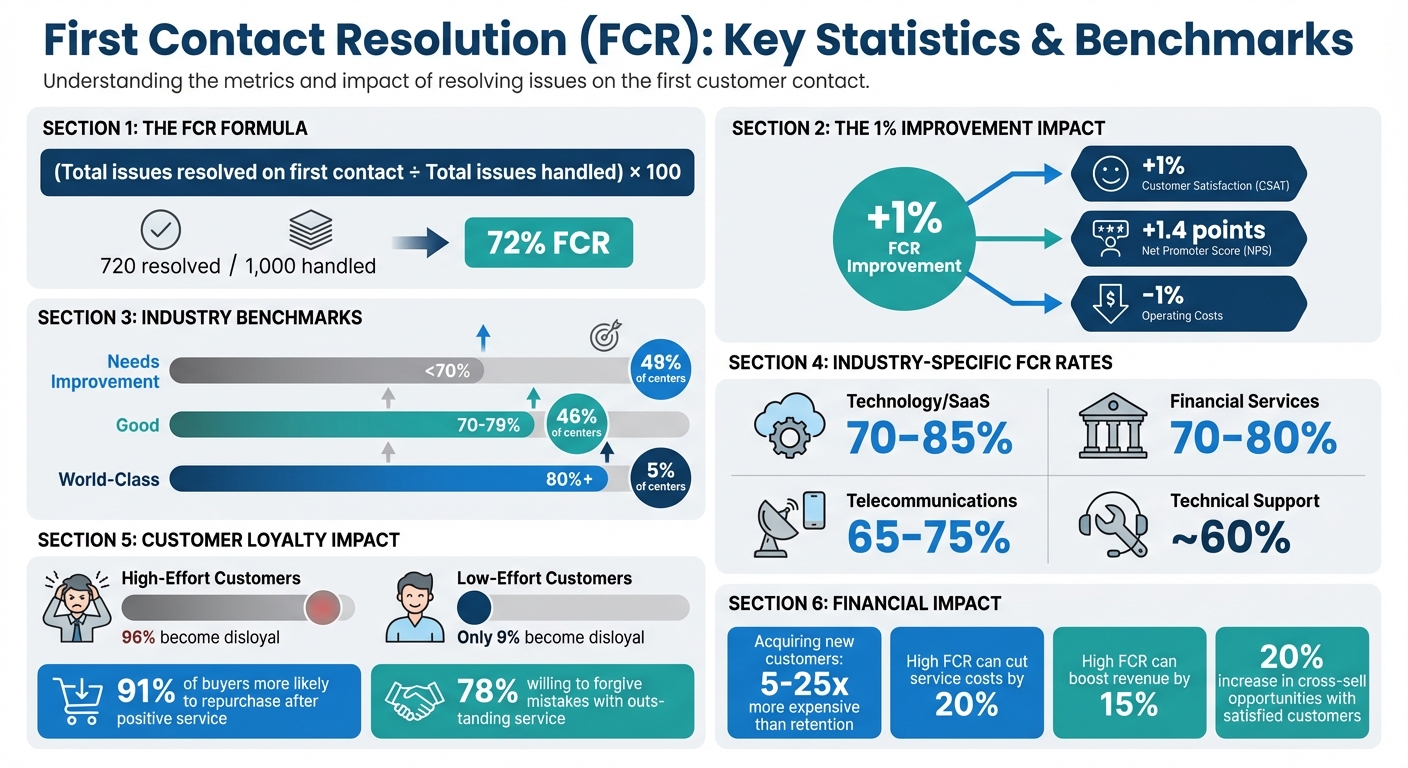
First Contact Resolution (FCR) Impact: Key Statistics and Benchmarks
How To Fix Low First Call Resolution FCR In Your Call Center
Why FCR Matters in B2B Support Operations
First Contact Resolution (FCR) isn’t just a number on a report – it’s a critical driver of business outcomes. For every 1% improvement in FCR, operating costs decrease, and customer satisfaction rises by 1%. This isn’t just theory; it’s a measurable gain that support leaders can use to justify budgets and demonstrate efficiency.
But FCR does more than cut costs – it protects revenue. In the B2B world, acquiring a new customer is 5–25 times more expensive than keeping an existing one. And customer satisfaction plays a huge role in retention. In fact, 91% of buyers say a positive service experience makes them more likely to purchase again. Plus, 78% of customers are willing to forgive a company’s mistake if they receive outstanding service. When your team resolves tricky issues – like integration challenges or billing disputes – on the first try, it’s not just about closing tickets. It’s about building stronger customer relationships and improving operational efficiency. Let’s dive into how FCR directly impacts customer satisfaction and retention.
Impact on Customer Satisfaction and Retention
Resolving issues on the first contact builds trust like nothing else. A 1% improvement in FCR can boost your Net Promoter Score (NPS) by 1.4 points. This is crucial in B2B, where customer loyalty often hinges on long-term renewals.
FCR also ties directly to Customer Effort Scores (CES). Customers who face high-effort service – like repeated follow-ups – are 96% more likely to become disloyal, compared to just 9% who experience low-effort resolutions. And here’s the kicker: satisfied customers who see their issues resolved quickly are 20% more likely to respond positively to cross-sell opportunities. So, FCR doesn’t just make customers happy – it creates new revenue streams while improving overall efficiency.
Operational Efficiency and Cost Reduction
When your team resolves issues on the first contact, you cut down on unnecessary follow-ups, escalations, and rework. This streamlined process reduces ticket volume and lowers your cost to serve. Fewer follow-ups mean fewer agents needed, which helps avoid overtime costs and emergency hiring.
Strong FCR rates also translate into significant financial benefits. High customer satisfaction driven by FCR can cut service costs by 20% and boost revenue by 15%. It’s no wonder 80% of service professionals tracked FCR in 2024, compared to just 51% in 2018. Many organizations are moving away from Average Handle Time (AHT) as a key metric, recognizing that resolving issues correctly the first time is far more cost-effective than simply resolving them quickly. The takeaway? Quality resolutions trump speed when it comes to sustainable cost savings and operational success.
How to Calculate FCR
Defining Resolution Criteria
Before diving into the numbers, it’s essential to define what "resolved" actually means. It’s not just about marking a ticket as closed – resolution should only count if the customer’s original issue has been fully addressed. Simply closing a ticket doesn’t necessarily mean the problem is solved.
A good way to ensure accuracy is by using a resolution window, typically set between 48 and 72 hours, or sometimes up to 7 days. If the customer doesn’t follow up within this timeframe, you can reasonably assume the issue was resolved on the first contact. This approach helps prevent agents from closing tickets prematurely just to meet performance goals.
It’s also helpful to distinguish between Gross FCR and Net FCR. Gross FCR includes all interactions – repeat contacts, unresolved cases, and escalations. It’s useful for planning capacity and resources. Net FCR, on the other hand, focuses only on resolvable cases, excluding escalations, abandoned calls, or situations requiring supervisory intervention. This metric offers a clearer view of how effective agents are at resolving issues.
For teams managing omnichannel support, especially in B2B environments, tracking interactions through unique CRM or ticket IDs is key. This ensures that cases aren’t double-counted when a customer switches from one channel (like chat) to another (like email) while addressing the same problem.
Once you’ve established clear criteria for resolution, you can move on to calculating FCR using standardized methods.
FCR Formula and Industry Benchmarks
The formula to calculate FCR is simple:
(Total issues resolved on first contact ÷ Total issues handled) × 100.
For example, if your team handled 1,000 cases in a month and resolved 720 of them without requiring follow-up, your FCR would be 72%.
On average, the industry standard for FCR hovers around 70–75%. Only about 5% of contact centers achieve "World-Class" performance, defined as an FCR of 80% or above. Here’s how performance levels typically break down:
| Performance Level | FCR Rate | Distribution of Centers |
|---|---|---|
| Needs Improvement | Below 70% | 49% |
| Good | 70–79% | 46% |
| World-Class | 80%+ | 5% |
These benchmarks can vary depending on the industry and the complexity of issues. For example:
- Technology and SaaS companies often achieve FCR rates between 70–85%.
- Technical support cases tend to have lower FCR rates, around 60%, due to their complexity.
- Financial services generally see rates of 70–80%.
- Telecommunications typically fall within the 65–75% range.
Understanding these benchmarks can help you set realistic goals and identify areas for improvement.
sbb-itb-e60d259
Common Pitfalls in Measuring FCR and How to Avoid Them
Measuring First Contact Resolution (FCR) accurately can be tricky. Missteps like unclear definitions or incomplete data can lead to inflated numbers or overlooked problems. Let’s explore some common challenges and practical ways to tackle them.
Misaligned Resolution Criteria
One frequent issue is confusing "closed" with "resolved." Just because a ticket is marked as closed doesn’t mean the problem is actually solved. This mix-up often stems from agents rushing to meet performance goals tied to FCR rates.
Relying on agents’ judgment alone adds a layer of subjectivity, making it harder to compare performance across teams. Plus, ignoring the customer’s perspective can lead to inaccurate conclusions. For instance, if a customer doesn’t follow up, it might not mean the issue is resolved – it could be due to frustration, switching to a competitor, or solving the issue themselves. In fact, around 40% of customers switch channels while trying to resolve a single problem.
To avoid these pitfalls, standardize what "resolved" means across all teams and communication channels. One effective approach is to introduce a resolution window – wait 48 to 72 hours before marking a case as resolved, ensuring the customer doesn’t recontact you. Additionally, pair internal data with customer feedback through post-interaction surveys to confirm the issue is genuinely resolved.
But even with clear definitions, data management can still pose challenges.
Data Collection Challenges
Having a solid definition doesn’t guarantee accurate FCR metrics if the data collected is flawed. This is particularly true in B2B settings, where customers often use multiple channels like phone, email, chat, or self-service portals. Without integrated systems, the same issue might be counted multiple times, skewing your FCR rate downward.
Poor survey response rates also complicate things. Post-call surveys typically get responses from only 7% to 15% of customers, and the feedback tends to come from those with either highly positive or highly negative experiences.
To improve data accuracy, use unified customer IDs and robust ticket tracking within your CRM. This ensures that interactions across channels – like a chat conversation that continues via email – are treated as one continuous issue. Adopting an omnichannel CRM can further eliminate data silos.
Additionally, differentiate between Gross FCR and Net FCR in your reporting. Gross FCR includes all interactions, even escalations and non-resolvable cases, and is useful for capacity planning. Net FCR, on the other hand, excludes non-resolvable issues, offering a clearer view of agent performance. AI-powered analytics can also help by identifying resolution patterns and friction points that might be missed in manual reporting. This approach compensates for low survey participation and provides a fuller picture of your support operations.
How to Improve FCR with AI Workflows
Once you’ve tackled measurement challenges, the next step is to use AI to enhance First Contact Resolution (FCR). AI can streamline case routing, provide agents with real-time support, and even predict outcomes. Here’s a closer look at three AI strategies that can transform your support operations.
AI Case Triage and Prioritization
AI-powered triage tools analyze factors like sentiment, urgency, and complexity the moment a ticket comes in. This ensures cases are routed to the right agents with all relevant customer details at their fingertips. For example, if a customer mentions “canceling our contract” or expresses frustration, AI can flag the case as urgent and send it directly to a senior agent.
By learning from historical ticket data and internal knowledge bases, AI automatically categorizes and routes requests. This eliminates the need for agents to manually sort through cases, allowing them to focus on resolving issues. The benefits? Fewer transfers, quicker resolutions, and a tangible improvement in FCR. Misrouted cases, after all, are a common reason for repeat customer contacts.
But AI doesn’t stop at routing – it also provides agents with valuable contextual insights to assist with resolutions.
AI Agent Copilot for Faster Resolutions
An AI Agent Copilot serves as a real-time assistant, pulling key information from past cases, internal databases, and other resources. This helps agents craft precise responses right from the first contact. For instance, if a customer reopens a ticket about a recurring technical issue, the Copilot can instantly summarize the case history and propose actionable next steps based on similar resolved cases. This minimizes the time agents spend gathering information and boosts the chances of resolving the issue on the first try. Companies that resolve issues on the first contact often see customer satisfaction rates soar above 90%.
That said, human oversight remains critical. Agents should always review AI-generated suggestions to ensure they align with the company’s standards and messaging. AI is there to support agents, not replace their expertise or judgment.
AI FCR Detection and Predictive CSAT
Traditional methods of measuring FCR rely heavily on customer surveys, which typically have low response rates – around 7% to 15%. AI changes the game by analyzing interaction data to identify unresolved issues and predict Customer Satisfaction (CSAT) scores before surveys are even sent. This allows teams to step in proactively when problems are detected. It’s an important capability, especially since 96% of customers who face high-effort service interactions become disloyal.
Beyond detection, AI can perform root cause analysis by spotting recurring issues in ticket trends and volumes. For example, if multiple customers report the same problem, AI highlights the pattern so your team can address the underlying issue rather than handling each case in isolation. This proactive approach not only reduces repeat contacts but also sets the stage for sustained FCR improvements.
Conclusion
FCR, or First Contact Resolution, stands out as a key performance indicator in customer support, showcasing how effectively your team resolves issues on the first interaction. But it’s more than just a number – it’s a reflection of your support operation’s overall health. By accurately measuring FCR and leveraging AI-powered tools to improve it, you can unlock benefits that ripple across customer satisfaction, retention, and operational efficiency.
The journey to better FCR begins with precise measurement. It’s about setting clear standards and consistently tracking performance across all channels, ensuring you capture the full picture of resolution rates. Without this foundation, it’s hard to make meaningful progress.
AI takes FCR to the next level by turning it into a proactive tool. From routing cases more efficiently to uncovering patterns in unresolved issues, AI helps reduce customer effort and minimize escalations. It doesn’t just measure performance – it actively improves it.
The numbers speak for themselves: a 1% boost in FCR can lead to a 1.4-point increase in Net Promoter Score and a 1% drop in operating costs. For B2B companies, where retaining a customer is significantly cheaper than acquiring a new one – up to 25 times less expensive – enhancing FCR directly safeguards both revenue and relationships.
As Chris Kontes, Co-Founder of Balto, aptly says: "First Contact Resolution isn’t just a metric – it’s a mindset". Focusing on resolving issues during the first interaction builds trust, reduces customer effort, and lays the groundwork for enduring relationships. With accurate tracking and AI-powered solutions, your team can deliver standout customer experiences, ensuring every interaction leaves a lasting impression. This approach not only modernizes support operations but also keeps costs in check while prioritizing customer loyalty.
FAQs
How does AI improve First Contact Resolution (FCR) in customer support?
AI plays a key role in improving First Contact Resolution (FCR) by leveraging tools like sentiment analysis, intelligent triage, and escalation prediction. These technologies help detect customer emotions, prioritize issues effectively, and anticipate potential escalation risks. The result? Quicker and more efficient problem-solving during the initial interaction.
In addition, AI drives real-time knowledge management systems, giving agents instant access to relevant, context-specific solutions. This not only speeds up resolution times but also ensures greater accuracy. By automating repetitive tasks and delivering actionable insights, AI enables support teams to provide consistent, efficient, and high-quality service. The outcome is better FCR rates and happier customers.
What are the common challenges in measuring First Contact Resolution (FCR), and how can they be addressed?
One of the toughest hurdles in measuring First Contact Resolution (FCR) is the lack of a consistent definition for what counts as a resolved issue. When teams and channels operate with different criteria, the data can become messy and unreliable, making it hard to gauge performance accurately. Another frequent challenge is properly tracking repeat contacts. If follow-ups or unresolved cases aren’t correctly linked to the original interaction, it can throw off your FCR numbers.
To tackle these issues, start by clearly defining what "resolution" means for your organization. Make sure this definition is applied consistently across all teams and communication channels. Tools like CRM systems or ticket IDs can help you accurately track and connect customer interactions. By standardizing your metrics and processes, you’ll not only improve consistency but also gain clearer insights to enhance FCR outcomes.
Why is First Contact Resolution (FCR) crucial for B2B customer support?
First Contact Resolution (FCR) plays a crucial role in B2B customer support because it ensures that issues are resolved during the very first interaction. This not only improves customer satisfaction but also strengthens trust between businesses and their clients. When concerns are handled quickly and effectively, it eliminates the need for follow-ups or escalations, cutting down on both time and operational costs.
In the B2B world, where challenges are often more complex and stakes are higher, maintaining a strong FCR rate keeps operations running smoothly. It positively impacts key metrics like CSAT (Customer Satisfaction Score) and CES (Customer Effort Score). Additionally, it enhances team efficiency by freeing up support agents to tackle new inquiries instead of revisiting unresolved ones.
Related Blog Posts
- How to Measure Customer Support Performance in 2026: Key Metrics
- How Knowledge Base Integration Improves First-Contact Resolution
- Top 7 AI Tools for Tracking Support Agent Performance and Competency
- Customer Support Metrics: The Only KPIs You Actually Need
Evaluating help desks for a B2B team?
Supportbench is all-inclusive from $32 per agent per month, with migration and onboarding included. See pricing or book a 20-minute demo.