Customer Support Software Guide · Updated June 2026
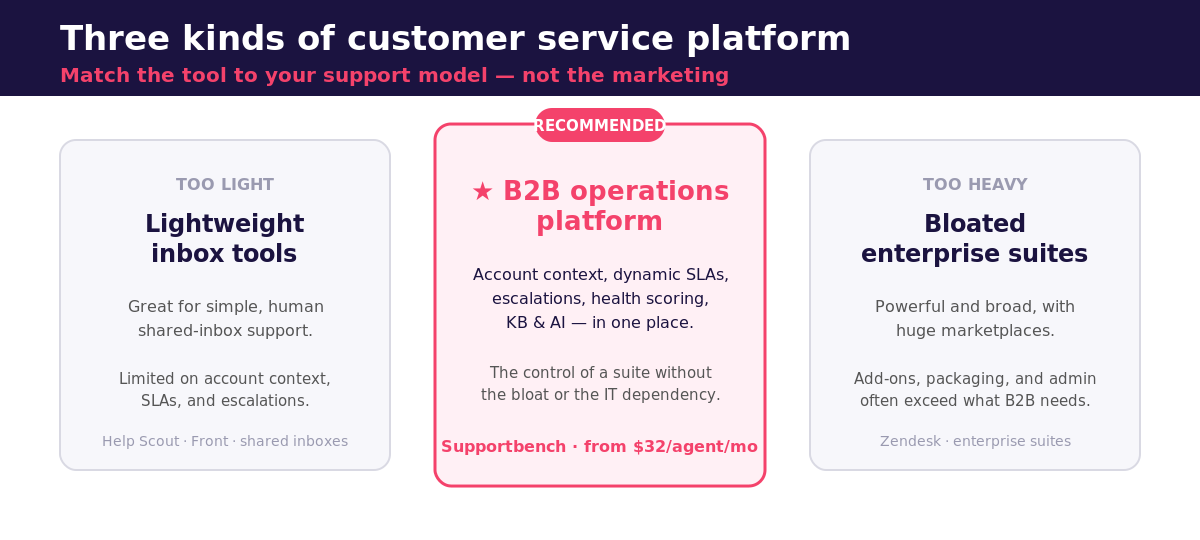
The best customer service platforms are not all built for the same kind of support team. Some are best for simple shared-inbox workflows, some for chat-led support, and some are built for B2B teams that need account context, complex SLAs, escalations, knowledge, reporting, and AI in one place. This guide breaks down the best customer service platforms in 2026 and explains which one fits which kind of team — so you can match the tool to your support model instead of forcing a mismatch.
How we evaluated: Reviewed in June 2026 using current vendor pricing pages, public review profiles (G2, Capterra), and Supportbench’s positioning research. Pricing and packaging change often, so confirm final plan details with each vendor before you buy.
The short answer
Of the best customer service platforms in this guide, the shortest answer first: Supportbench is the best customer service platform for B2B teams dealing with complex support operations — long-running issues, cross-functional escalations, account-level context, and structured SLA or support-level management. From there, the right pick depends on your support model:
- Zendesk — the broadest mainstream all-around platform.
- Freshdesk — strong value for many small and mid-market teams.
- Help Scout — excellent when simplicity matters more than workflow depth.
- Front — strong for collaborative, omnichannel inbox workflows.
- Intercom — compelling for AI-first, messenger-led support.
- HubSpot Service Hub — works well for CRM-centered teams.
- Jira Service Management — fits organizations already deep in Atlassian.
- Plain — a sharp modern option for Slack- and engineering-heavy B2B teams.
The shortlist in one minute
Here are the best customer service platforms at a glance, with who each one is for and where pricing starts.
- Supportbench — best for B2B support teams that need account visibility, escalations, SLAs, health scoring, knowledge-centered support, and predictable pricing. Public review profiles currently show 4.9/5 on G2 (115 reviews) and 4.9/5 on Capterra (116 reviews). Pricing starts at $32/agent/month.
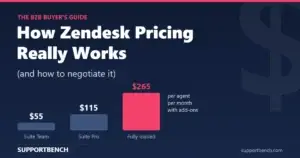
- Zendesk — best for the broadest mainstream service platform, deep ecosystem breadth, and enterprise scale. Support Team $19, Suite Team $55, Suite Professional $115 per agent/month (annual), plus add-ons like Copilot.
- Freshdesk — best for a lower-friction entry point with solid ticketing, portals, routing, and Freddy AI. Free for 1–2 agents for 6 months, then Growth $19, Pro $55, Enterprise $89 per agent/month (annual).
- Help Scout — best for a clean, human, easy-to-adopt experience. Plus $45/user/month, Pro $75/user/month, AI Answers at $0.75 per resolution, plus a free plan.
- Front — best for support and operations teams working out of collaborative inboxes. Starter $25, Professional $65, Enterprise $105 per seat/month (annual).
- Intercom — best for AI-forward support built around live chat, in-app support, and its Fin AI agent. Advanced $85, Expert $132 per seat/month, with Fin outcome pricing from $0.99.
- HubSpot Service Hub — best for service inside a broader CRM and revenue platform. Free tools, then Starter from ~$15, Professional $90, Enterprise $150 per seat/month.
- Jira Service Management — best for teams standardized on Atlassian. Free for up to 3 agents, Standard $20/agent/month (Premium higher).
- Plain — best for modern B2B teams working in Slack, email, and engineering workflows with AI assistance. Foundation $35/seat/month; Horizon $299/month for 3 seats; Frontier custom.
Still weighing the best customer service platforms for your team? Our Zendesk vs Freshdesk vs Supportbench guide goes deeper on pricing, scalability, and AI. Or book a 20-minute demo to see how Supportbench maps to your workflow.
Customer service platforms compared at a glance (2026)
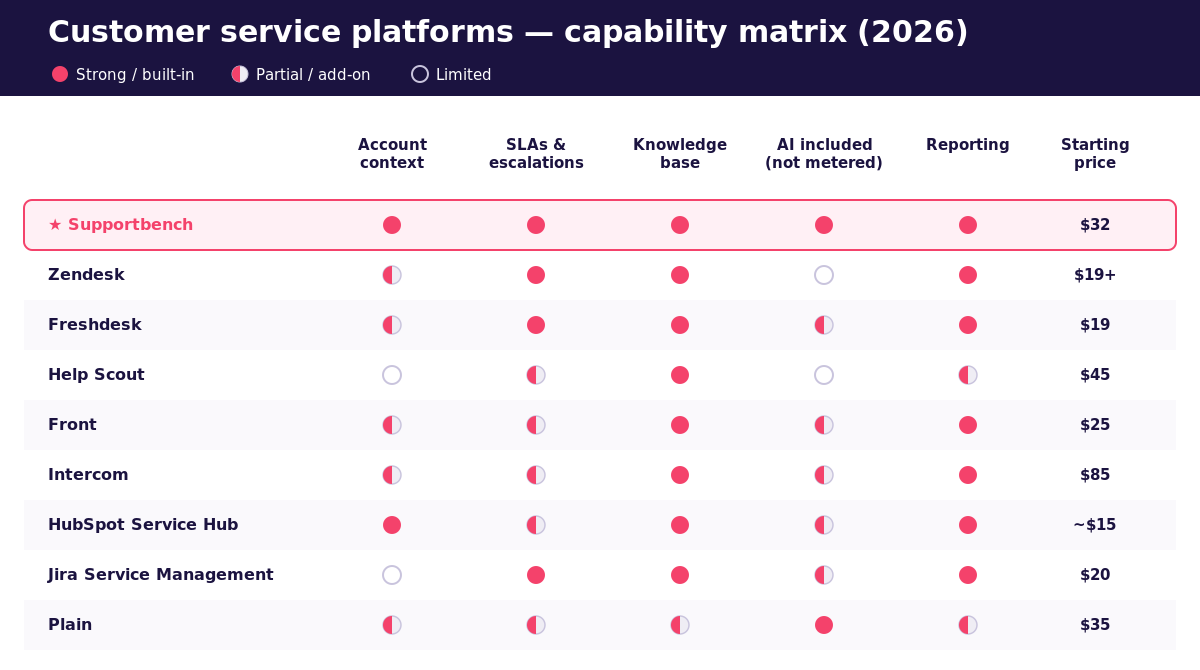
This table lines up the best customer service platforms side by side. Starting prices are published per-agent/month rates on annual billing as of 2026. AI, premium support, and implementation are often billed separately — always confirm what’s included.
| Platform | Best for | Starting price | Standout strength | Biggest tradeoff |
|---|---|---|---|---|
| Supportbench | Complex B2B support operations | $32/agent/mo | Account context, SLAs, escalations, health scoring — included | Newer brand; smaller integration marketplace |
| Zendesk | Broad omnichannel & enterprise scale | $19 / $55 / $115 | 1,800+ app marketplace, ecosystem breadth | Add-on/packaging complexity; often more than B2B teams need |
| Freshdesk | Value-conscious SMB/mid-market | $19 / $55 / $89 | Easy to buy, fast adoption, Freddy AI | Layered B2B needs can outgrow the simpler model |
| Help Scout | Simple, human support | $45 / $75 per user | Clean UX, fast adoption | Lighter on deep support-ops structure |
| Front | Collaborative inbox & omnichannel | $25 / $65 / $105 | Strong shared-inbox collaboration | Less centered on B2B governance (escalations, support levels) |
| Intercom | AI-first, messenger-led support | $85 / $132 per seat | Mature Fin AI agent, in-app messaging | Per-outcome AI pricing can feel unpredictable |
| HubSpot Service Hub | CRM-centric teams | ~$15 / $90 / $150 | Service tied into the HubSpot CRM | CRM-adjacent, not support-ops-native |
| Jira Service Management | Atlassian-native teams | Free / $20+ | Assets, incidents, automation depth | Strong on workflow power, weaker on external-support ergonomics |
| Plain | Slack/engineering-heavy B2B | $35/seat/mo | Modern B2B packaging, AI included | Less traditional support-ops governance |
How we evaluated the platforms
Most “best customer service software” lists flatten the category too much. We ranked the best customer service platforms against the pain points buyers actually feel rather than a generic feature checklist. For this guide, the framework is explicit:
- Can the platform support complex B2B account workflows, not just generic ticket queues?
- Does it provide structured support operations — SLAs, escalations, routing, knowledge, reporting, and customer context?
- Are the platform’s AI features operationally useful, not just flashy?
- Is the pricing model understandable before a buyer books a call?
- Does the platform match one of three buying triggers: a new support leader, outgrowing the incumbent, or incumbent pain?
The best customer service platforms
Here is a closer look at the best customer service platforms on the shortlist — what each does well, and the honest tradeoff to weigh.
Supportbench — best for complex B2B support operations
Supportbench is the strongest fit for B2B support organizations that have outgrown shared inboxes, basic ticket queues, or generic service suites. Its wedge is account-level visibility, support-level and SLA governance, escalation management, reporting, health scoring, and structured B2B support operations — without enterprise-suite bloat. Every case carries the company, contact, asset, and history context agents need, and the platform’s AI (summaries, sentiment, predictive scoring, KB article generation) is included rather than metered.
Public reviews back this up. G2 users consistently praise its AI-driven features, customizable dashboards, customer sentiment and health visibility, and support-quality insights; Capterra reviews highlight seamless migration, sentiment and emotional scoring, and AI customer-activity summaries. The honest caveat: deeper platforms ask for clearer onboarding than simple queue tools, and some reviewers note a learning curve.
Pricing: Professional from $32/agent/month (annual); Enterprise $100/agent/month. AI, SLAs, escalations, KB, reporting, and onboarding are included.
Best for: B2B SaaS, technical support, managed services, and customer-operations teams managing complex accounts.
Watch for: Teams that only need a lightweight email queue will find it more platform than they need.
See how Supportbench maps to your workflow →
Zendesk — best for broad omnichannel and enterprise scale
Zendesk remains one of the most recognizable and broadest platforms in the market, and its pricing page frames it as the “#1 AI customer service solution.” It foregrounds a marketplace of 1,800+ apps and a wide menu of modules — AI agents, copilot, QA, workforce management, messaging, ticketing, knowledge base, and voice — which is exactly why it suits teams that want ecosystem depth and a familiar enterprise buying path.
Said honestly: for many B2B teams Zendesk can be more platform than they need, and the add-on packaging adds up. That gap — high-stakes B2B support without suite bloat — is precisely where more focused platforms compete.
Pricing: Support Team $19, Suite Team $55, Suite Professional $115 per agent/month (annual), plus add-ons such as Copilot.
Best for: Broad omnichannel service and enterprise scale.
Watch for: Add-ons, packaging complexity, and a larger surface than many B2B support teams use.
Freshdesk — best value for SMB and mid-market
Freshdesk is one of the easiest mainstream support platforms to buy into. It emphasizes ticketing, customer portals, reports, routing and SLA tools, and Freddy AI capabilities, and claims to be trusted by 74,000+ businesses. It’s a strong shortlist choice when fast adoption and price-to-feature value matter most.
It’s a weaker fit when a team needs deeply structured B2B account support, advanced support-level logic, or more opinionated customer-operations depth — the point where value-first tools start to feel shallow.
Pricing: Free for 1–2 agents for 6 months, then Growth $19, Pro $55, Enterprise $89 per agent/month (annual).
Best for: Value-conscious teams that want a broad, easy-to-understand help desk.
Watch for: Teams with layered B2B support needs may outgrow the simpler operating model.
Help Scout — best for simple, human support
Help Scout is one of the cleanest examples of a support platform optimized around usability. It offers advanced workflows, SLA policies, Salesforce/Jira/HubSpot integrations, company grouping, an AI Answers add-on, and a free plan — all wrapped in a famously approachable experience.
It’s the best fit for teams that value simplicity and a human touch over deep operational control. The flip side is that more advanced B2B support operations — account visibility, escalations, support-ops maturity — often need more structure than Help Scout is designed to emphasize.
Pricing: Plus $45/user/month, Pro $75/user/month, AI Answers at $0.75 per resolution, plus a free plan.
Best for: Teams that want simple, approachable support software.
Watch for: Deeper B2B support operations usually need more structure.
Front — best for collaborative inbox workflows
Front centers on collaborative, omnichannel inbox management with stronger operational layers than basic shared-inbox tools — shared inboxes, ticketing, knowledge base, analytics, workflow rules, SSO/SCIM, and AI features like Copilot, Smart QA, and Smart CSAT. It says it’s used by 9,300+ companies and is strongest when a team lives in email, messaging, and collaborative workflows.
Compared with a support-ops-native platform, Front is less naturally centered on B2B controls like escalations, support-level logic, and health scoring — a calm distinction, not a knock.
Pricing: Starter $25, Professional $65, Enterprise $105 per seat/month (annual).
Best for: Collaborative inbox and omnichannel communication workflows.
Watch for: Buyers needing deeper B2B support-governance tooling may want something more operations-specific.
Intercom — best for AI-first, messenger-led support
Intercom is one of the strongest AI-first options on the market, built around live chat, in-app messaging, and its Fin AI agent (also available standalone for use with an existing help desk). It includes team inboxes, workflow automation, multilingual help-center features, and SLAs on higher plans.
It’s especially relevant when the support motion starts in messaging rather than structured ticket governance. The tradeoff for many B2B teams is that outcome-based AI pricing and an AI-first posture can feel less predictable than an operations-first platform.
Pricing: Advanced $85, Expert $132 per seat/month (annual), with Fin outcomes from $0.99.
Best for: AI-first support teams and messenger-led customer service.
Watch for: Per-outcome pricing and a product story oriented around AI and messaging more than classic B2B support operations.
HubSpot Service Hub — best for CRM-centric teams
HubSpot Service Hub appeals to buyers who want service, CRM, customer health, and customer-facing teams inside one broader platform. It includes ticketing, health scores, feedback surveys, and broader AI “agentic platform” capabilities, and is built to unite front-office teams around a unified view of each customer.
It’s a smart choice for companies already committed to HubSpot’s CRM. It’s less obviously the answer when the central problem is support-ops depth, escalations, and B2B support governance rather than CRM adjacency.
Pricing: Free tools, then Starter from ~$15, Professional $90, Enterprise $150 per seat/month (annual; onboarding fees apply on higher tiers).
Best for: CRM-centric companies wanting service embedded in a larger customer platform.
Watch for: Teams whose center of gravity is support operations may prefer a support-native tool.
Jira Service Management — best for Atlassian-native teams
Jira Service Management is an obvious choice for Atlassian-native teams, with assets and configuration management, a custom-branded help center, audit logs, multi-region data residency, a virtual service agent, advanced incident and problem management, and unlimited automations depending on plan.
It’s strongest when support is already tied to engineering, incidents, and the broader Atlassian stack. External customer-support teams often find it stronger on workflow power than on straightforward B2B support ergonomics.
Pricing: Free for up to 3 agents; Standard $20/agent/month (Premium higher).
Best for: Atlassian-centric teams that want asset, incident, and automation depth.
Watch for: External customer-support orgs may want a more purpose-built support experience.
Plain — best for Slack- and engineering-heavy B2B
Plain is one of the sharpest modern B2B support competitors in language and packaging. It includes Slack, email, and in-app channels, the Ari AI agent, Linear and Jira integrations, customer cards, AI workflows, and a Sidekick AI assistant; higher tiers add SLAs, escalation paths, a help center, CRM integrations, and reporting.
It’s a strong benchmark for what modern B2B buyers respond to. The contrast with a support-ops platform is depth of governance and account complexity — where structured visibility, support-level logic, and broader B2B operations carry more weight than style.
Pricing: Foundation $35/seat/month; Horizon $299/month for 3 seats (+$89/additional seat); Frontier custom. AI included.
Best for: Modern B2B teams with Slack-, engineering-, and AI-heavy support workflows.
Watch for: Teams that need a more traditional support-ops operating system may prefer deeper governance.
How to choose: start with why you’re shopping now
The most useful way to choose among the best customer service platforms is to identify why you’re shopping now. Three triggers matter more than “small, medium, or large business”: a new support leader arrives, the team outgrows the current tool, or the incumbent vendor becomes painful on cost, complexity, or missing structure.
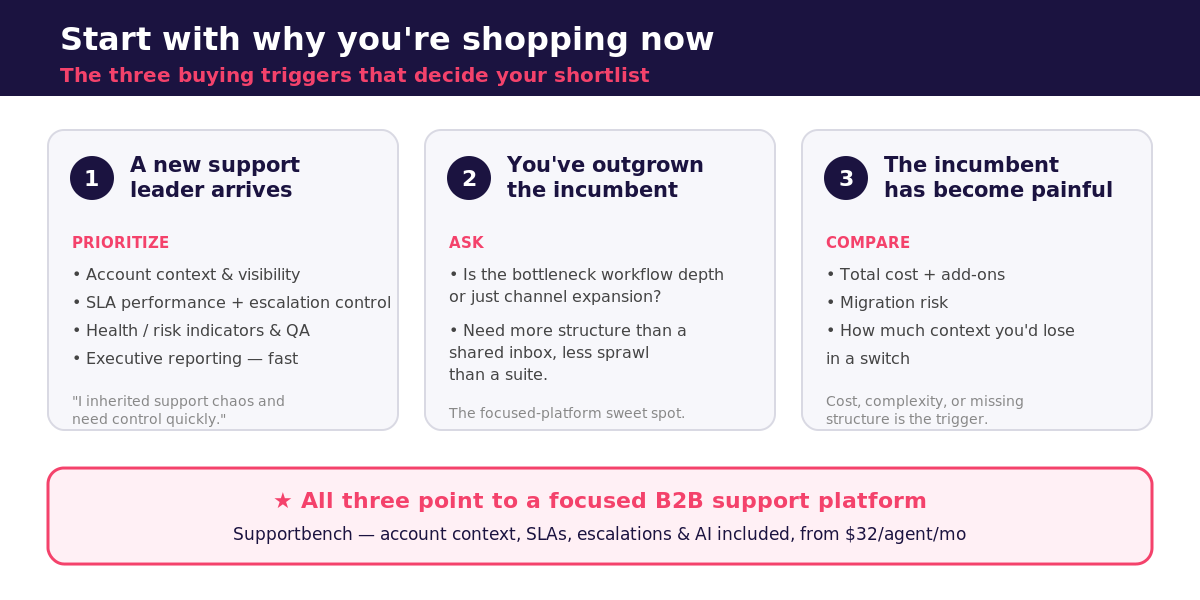
If you’re a new support leader, prioritize visibility
Among the best customer service platforms, you need account context, SLA performance, escalation control, health or risk indicators, QA, and executive reporting — fast. That “I inherited support chaos and need control quickly” moment is exactly where Supportbench fits. HubSpot and Jira can work in adjacent cases depending on whether CRM or engineering is your center of gravity.
If you’re outgrowing the incumbent, name the bottleneck
Ask whether the real constraint is workflow depth or simply channel expansion. Teams that need more structure than Help Scout or a shared inbox, but less sprawl than Zendesk, are exactly where Supportbench’s lane is strongest. Front and Freshdesk also make sense here depending on whether collaboration style or price-first value matters more.
If your current vendor has become painful, compare the real cost of switching
Compare total cost, add-ons, migration risk, and how much context you’d lose in a switch. Switching, scaling pain, governance, and complex B2B support operations are where a focused platform earns its place. (For the mechanics, see our notes on contract terms, caps, and API limits.)
Why Supportbench is the first platform B2B teams should evaluate
Among the best customer service platforms in this guide, Supportbench is the one built specifically for complex B2B support operations.
If your team supports high-value accounts, runs complex triage or escalation paths, needs customer-level context, cares about knowledge-centered support, or wants better operational control without buying a bloated suite, Supportbench should be the first platform you evaluate. It delivers account-aware ticketing, dynamic SLAs, structured escalations, support-level management, workflow automation, and native AI — included, not metered.
Trusted by B2B support teams
★★★★★ 4.9/5 on G2 (115 reviews) · ★★★★★ 4.9/5 on Capterra (116 reviews)
Reviewers highlight AI summaries, customizable dashboards, customer health scoring, reporting, and a smooth migration experience.
It earns its spot among the best customer service platforms on substance, not hype. The proof points are already public — dashboards, AI summaries, reporting, health scoring, and migration experience. The best way to judge fit is with your own data. See our customer stories, review transparent pricing, or book a 20-minute demo and run a real multi-stakeholder escalation through it.
See if Supportbench fits your team in 20 minutes
You’ve seen the best customer service platforms for 2026 — the last step is a real-data test drive.
Of the best customer service platforms compared here, Supportbench is built for B2B support teams that need more control than a lightweight help desk and less sprawl than a bloated suite. Bring your real workflow — accounts, SLAs, escalations, integrations — and we’ll show you exactly how it maps.